
In This Article
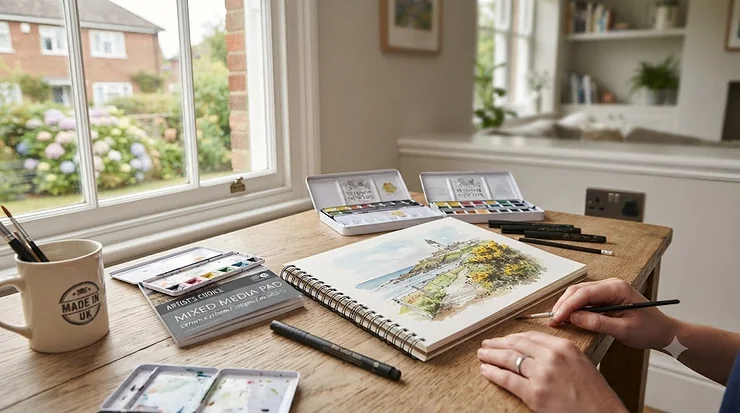
There’s a specific kind of heartbreak that comes from watching a watercolour wash blow straight through the back of a cheap sketchbook page onto the one underneath. If that’s happened to you, you already understand why the best mixed media pad isn’t really about brand loyalty — it’s about paper that can survive whatever you throw at it, wet or dry, in the same sitting. A mixed media pad is simply paper engineered to handle multiple art materials on the same sheet: pencil one minute, a watercolour wash the next, a fineliner outline on top, maybe a paint marker to finish. Ordinary cartridge or printer paper buckles, pills, or lets ink bleed through the moment water touches it; proper mixed media paper is sized and weighted specifically to resist that.
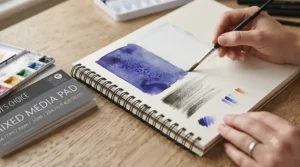
This matters more than it sounds, because mixed media work genuinely stretches paper in different directions. Watercolour needs enough sizing to stop pigment sinking in and going muddy. Ink and fineliner need a smooth-enough tooth that lines don’t feather and spread. Alcohol-based markers need paper dense enough that colour doesn’t bleed through to the next page, ruining two sheets at once. According to Jackson’s Art Blog’s guide to paper weight, heavier cartridge papers in the 200-300gsm range are what genuinely start coping with watercolour and heavier wet media without buckling — which is a useful benchmark to keep in mind as you compare pads.
This guide covers seven real, currently available mixed media pads sold in the UK — from budget spiral sketchbooks through to heavyweight 300gsm options built for serious wet-media layering — with honest spec breakdowns, aggregated review sentiment, a proper bleed-test discussion, and dedicated coverage of the questions that actually decide a purchase: which weight suits markers, which surface suits ink and watercolour together, and whether A4 is really the size you need.
Quick Comparison Table
| Product | Best For | Price Range | Weight |
|---|---|---|---|
| Canson XL Fluid Mixed Media A4 | Ink and watercolour combo work | £8-£13 | 250gsm |
| Winsor & Newton Mixed Media Paper Pad A4 | Premium all-round mixed media | £9-£15 | 250gsm |
| Daler-Rowney Optima Mixed Media Spiral A4 | Heavy wet-media layering | £8-£12 | 250gsm |
| Canson Graduate Mixed Media A4 | Budget student double-sided pad | £5-£9 | 220gsm |
| Canson XL Mixed Media A4 (light grain) | Markers and dry media on a budget | £6-£10 | 160gsm |
| Seawhite All-Media Cartridge A4 | Heaviest budget option, all-round use | £5-£8 | 300gsm |
| Arteza Mixed Media Sketchbook 9×12″ | Portable sketchbook format | £10-£16 | 180gsm |
The spread here runs from a genuinely light 160gsm option through to a proper heavyweight 300gsm pad, which matters because gsm is really the single biggest predictor of how a mixed media pad behaves once water or heavy marker ink hits the page. The Canson XL Fluid Mixed Media A4 and Winsor & Newton Mixed Media Paper Pad A4 both sit at 250gsm and represent the sweet spot most reviewers land on for genuine ink-and-watercolour combination work, while the Canson XL Mixed Media A4 (light grain) at 160gsm is deliberately lighter — better suited to dry media and lighter marker work than heavy washes. As always, treat every price above as a range rather than a fixed figure; check the current listing price before buying.
💬 Just one click — help others make better buying decisions too!😊
Top 7 Mixed Media Pads: Expert Analysis
1. Canson XL Fluid Mixed Media A4 — best for ink and watercolour combination work
The standout feature is right there in the name: “Fluid,” meaning this 250gsm, extra-white, smooth-surfaced pad is specifically engineered for wet media rather than being a generic dry-media pad that merely tolerates water. That smoothness matters enormously for combination work — fineliner and dip pen lines stay crisp rather than feathering, while the heavier gsm and internal sizing stop watercolour washes from soaking straight through to the next sheet.
Based on the spec comparison with the standard Canson XL Mixed Media range below, this Fluid variant trades some of the tooth that dry-media artists like for a genuinely smoother wet-media surface — meaning it’s the better pick if your workflow leans ink-and-wash rather than pastel-and-charcoal. Reviewers consistently note strong resistance to staining even under thick gouache applications, with several specifically praising the lack of bleeding or buckling after repeated watercolour layers. One recurring piece of aggregated feedback worth flagging: a few users suggest clipping or weighting the pad while working, since like most spiral pads it can lift slightly at the edges during heavy wet work.
Pros:
- ✅ Smooth surface keeps ink and fineliner lines crisp
- ✅ 250gsm resists buckling under watercolour washes
- ✅ Extra-white base makes colours read more vibrantly
Cons:
- ❌ Less tooth than grained papers for dry media blending
- ❌ Can lift slightly at edges without a clip or board
Typically priced in the £8-£13 range for 30 sheets, this sits firmly in the mid-market bracket and represents genuinely strong value for anyone whose main combination is pen, ink and watercolour rather than pastel or charcoal.
2. Winsor & Newton Mixed Media Paper Pad A4 — best premium all-rounder
Winsor & Newton’s mixed media pad is built around a fine-grain texture and 250gsm heavy weight specifically designed, according to the brand’s own product framing, to withstand repeat working across combined wet and dry media. The standout here is genuine multi-technique versatility — this paper is explicitly positioned as most suitable for acrylic, gouache and pencil, while still handling watercolour, pastel, charcoal and ink reasonably well, which is a broader technique spread than several competitors claim.
What most buyers overlook about this pad is that its fine-grain surface is a deliberate middle ground — smoother than a heavily textured watercolour block, but with more tooth than the Canson Fluid range above, making it a genuine compromise pick for artists who switch between multiple techniques in the same sketchbook rather than specialising in one. Aggregated sentiment around Winsor & Newton’s paper range consistently highlights the acid-free, archival, non-yellowing composition as a meaningful long-term selling point for anyone planning to keep or sell finished work, and the micro-perforated pages get consistent praise for clean removal from the pad.
Pros:
- ✅ Fine-grain surface balances wet and dry media needs
- ✅ Archival, acid-free construction suits keepsake work
- ✅ Trusted heritage brand with wide UK stock availability
Cons:
- ❌ Premium pricing compared with own-brand alternatives
- ❌ Fine grain won’t satisfy artists wanting heavy tooth
At around £9-£15 for 30 sheets, it’s priced at the top end of this list, and for artists who value archival quality and genuine multi-technique flexibility over squeezing out the lowest cost per sheet, that premium is a reasonable trade.
3. Daler-Rowney Optima Mixed Media Spiral A4 — best for heavy wet-media layering
The standout with the Optima range is its lightly textured, 250gsm surface specifically engineered with what Daler-Rowney describes as excellent tooth for pencil, pen and ink, pastel and charcoal, while remaining heavy enough for genuine wet techniques like watercolour and acrylic. The generous spiral binding is worth calling out too — it opens fully flat, which matters more than it sounds when you’re working across a two-page spread or need a rigid support for outdoor sketching.
Here’s what the spec sheet doesn’t spell out clearly: because this paper is FSC-certified and acid-free with genuine multi-technique tooth, it performs particularly well for collage and visual journaling work that layers paper, glue and paint on the same page — a use case that thinner, smoother pads tend to struggle with once adhesive gets involved. Reviewers on the Daler-Rowney mixed media range consistently flag it as excellent value for the weight, with the 250gsm sheets holding up well under sustained layering that would cause a 160-180gsm pad to cockle badly.
Pros:
- ✅ Genuine tooth suits both dry media and collage work
- ✅ 250gsm handles sustained wet-media layering well
- ✅ Spiral binding opens fully flat for spread-page work
Cons:
- ❌ Textured surface less ideal for fine ink linework
- ❌ Not the smoothest option for detailed fineliner passes
Priced around £8-£12 for 30 sheets, it undercuts the Winsor & Newton option while matching its 250gsm weight, making it one of the stronger value picks here for anyone doing genuinely heavy, layered mixed media work.
4. Canson Graduate Mixed Media A4 — best budget double-sided student pad
The standout feature is the double-sided sheet design — one side grained, one side smooth — packed into a genuinely affordable 220gsm pad glued along the short side. That two-texture approach is unusual at this price point and effectively gives you two different working surfaces within a single pad, which matters for students or hobbyists still working out which surface suits their style.
Based on the spec comparison with the pricier XL Fluid and Winsor & Newton pads above, the Graduate range is clearly positioned as Canson’s entry-level tier — natural white rather than extra-white paper, and a slightly lower 220gsm weight — but it still comfortably handles moderate watercolour washes and marker work without the heavy bleed-through you’d see on genuine printer paper. Reviewers consistently describe it as solid value for students and those testing mixed media techniques for the first time, though a few note the natural white tone reads slightly warmer than the bright white of premium alternatives, which can subtly shift how saturated colours appear once dry.
Pros:
- ✅ Double-sided grained and smooth surface in one pad
- ✅ Genuinely affordable entry point into mixed media paper
- ✅ Handles moderate watercolour and marker work well
Cons:
- ❌ Natural white tone reads warmer than premium papers
- ❌ 220gsm struggles with genuinely heavy wet layering
At roughly £5-£9 for 30 sheets, this is one of the cheapest genuine mixed media pads on this list, making it the sensible starting point for anyone not yet sure whether they’ll stick with the medium long-term.
5. Canson XL Mixed Media A4 (light grain) — best lighter-weight pad for markers and dry media
At 160gsm, this is deliberately the lightest pad on this list, and that’s precisely the point for marker-heavy workflows. The standout feature is the light grain texture combined with heavy sizing, which Canson specifically engineers to erase well and blend easily — properties that matter far more for pencil, marker and light dry media than for heavy watercolour washes.
What most buyers overlook about lighter mixed media paper is that for alcohol-based and water-based markers specifically, a smoother, moderately-weighted surface often performs better than a heavily textured, ultra-heavy one, since excess tooth can cause visible marker streaking rather than clean, even colour laydown. On paper this means the XL Mixed Media range is arguably the better marker pick over its heavier 250gsm Fluid sibling, even though the lighter gsm makes it a poorer choice for serious watercolour work — reviewers who use it primarily for markers and coloured pencil report minimal bleed-through when working in moderation, though heavy, saturated marker layering will show through to the next page more readily than on the 250gsm options above.
Pros:
- ✅ Smooth-ish light grain suits clean marker laydown
- ✅ Erases and blends well for pencil and dry media
- ✅ 50 sheets per pad offers strong value per sheet
Cons:
- ❌ 160gsm is too light for serious watercolour washes
- ❌ Heavy marker saturation can show through to next page
Typically priced around £6-£10 for 50 sheets, the higher sheet count genuinely improves the cost-per-sheet value here compared with the 30-sheet pads elsewhere on this list.
6. Seawhite All-Media Cartridge A4 — best heaviest budget option
Seawhite is a specialist UK art paper manufacturer, and the standout with this pad is simply weight-for-money: at 300gsm, it’s the heaviest paper on this entire list, yet it remains priced at the budget end of the category. That combination is genuinely unusual — most 300gsm papers carry a premium price tag, but Seawhite’s positioning as an all-media cartridge specifically targets artists who want serious wet-media resistance without paying watercolour-block prices.
Here’s what most buyers overlook about a pad this heavy: 300gsm genuinely reduces the need for stretching or backing board in most moderate wet-media use, which is a meaningful practical convenience for anyone working outdoors or without a dedicated studio setup. Aggregated feedback on Seawhite’s cartridge ranges consistently highlights reliable performance across a genuinely wide range of wet and dry media, with the acid-free composition and gummed single-side binding making it straightforward to remove finished sheets cleanly. It’s a less internationally recognised name than Canson or Winsor & Newton, which does mean a smaller pool of online reviews to draw aggregated sentiment from.
Pros:
- ✅ 300gsm is the heaviest weight on this list at this price
- ✅ Reduces need for stretching under moderate wet media
- ✅ Specialist UK manufacturer with acid-free construction
Cons:
- ❌ Smaller review pool than the major international brands
- ❌ Single gummed edge less flexible than spiral binding
At around £5-£8 for a similar sheet count to competitors, this is arguably the strongest pure value proposition on the list for anyone whose priority is maximum weight resistance per pound spent.
7. Arteza Mixed Media Sketchbook 9×12″ — best portable sketchbook format
Rather than a loose-sheet pad, this is a genuine spiral-bound sketchbook, and the standout is exactly that format difference: 180gsm acid-free paper bound into a book that travels well and keeps finished work together chronologically rather than scattered across loose sheets. The twin-wire spiral binding allows the sketchbook to lie flat or fold back fully, which matters for anyone sketching on the move rather than working at a fixed desk.
What most buyers overlook about the sketchbook format specifically is that it suits a fundamentally different workflow to a tear-out pad — if you want a dated, sequential record of practice work (a common approach recommended by art tutors for skill development), a bound sketchbook like this beats loose sheets that are easy to lose or shuffle out of order. Reviewers consistently describe the 180gsm weight as capable of handling light-to-moderate watercolour, acrylic, ink and pencil without serious bleed-through, though as with any sub-200gsm paper, heavy saturated washes will show ghosting on the reverse side. The micro-perforated pages mean individual finished sketches can still be removed cleanly if you do want to display or scan specific pieces later.
Pros:
- ✅ Bound sketchbook format keeps sequential work together
- ✅ Twin-wire spiral folds flat for on-the-go sketching
- ✅ Micro-perforated pages allow clean removal when needed
Cons:
- ❌ 180gsm shows ghosting under heavier watercolour washes
- ❌ Bound format less convenient for framing loose pieces
Priced around £10-£16 depending on pack size, it’s positioned as a mid-range purchase, and for anyone specifically searching for a mixed media sketchbook on Amazon rather than a loose pad, this format difference is the main reason to choose it over the six pads above.
Top 7 Products: Specs & Value Snapshot
| Product | Weight | Surface | Binding | Best For |
|---|---|---|---|---|
| Canson XL Fluid Mixed Media A4 | 250gsm | Smooth | Spiral | Best For: Ink and watercolour combination work |
| Winsor & Newton Mixed Media Paper Pad A4 | 250gsm | Fine grain | Spiral | Best For: Premium multi-technique versatility |
| Daler-Rowney Optima Mixed Media Spiral A4 | 250gsm | Light texture | Spiral | Best For: Heavy layering and collage |
| Canson Graduate Mixed Media A4 | 220gsm | Grained + smooth | Glued short side | Best For: Budget students, two surfaces |
| Canson XL Mixed Media A4 (light grain) | 160gsm | Light grain | Spiral | Best For: Markers and dry media |
| Seawhite All-Media Cartridge A4 | 300gsm | Cartridge | Gummed | Best For: Maximum weight per pound |
| Arteza Mixed Media Sketchbook 9×12″ | 180gsm | Light grain | Spiral | Best For: Portable sequential sketchbook |
The clearest pattern in this table is that gsm and intended technique move together predictably: the two lightest pads here, the Canson XL Mixed Media A4 at 160gsm and the Arteza Mixed Media Sketchbook at 180gsm, are both better suited to markers, pencil and light washes than to serious watercolour layering, while the three 250gsm-plus options handle heavier wet work with far less buckling. If your work regularly combines ink, watercolour and marker in the same piece, weighting your decision toward the 250gsm-and-above tier will save more frustration than any other single spec on this table.
Benefits vs Ordinary Sketchbook or Printer Paper
| Factor | Ordinary Cartridge/Printer Paper | Dedicated Mixed Media Pad |
|---|---|---|
| Watercolour resistance | Buckles, pigment sinks and goes muddy | Internal sizing controls absorption |
| Ink and fineliner behaviour | Lines feather and spread | Smooth-enough tooth keeps lines crisp |
| Marker bleed-through | Heavy bleed onto next page | Weight and density reduce show-through |
| Archival quality | Often acidic, yellows over time | Typically acid-free, non-yellowing |
| Layering multiple media | Fails quickly under combined techniques | Purpose-built for wet-and-dry combination |
The comparison here isn’t subtle — ordinary paper simply isn’t engineered for the specific stress mixed media work puts on a page, and the difference shows up fastest the moment water and ink meet on the same sheet. Dedicated mixed media paper earns its price premium through internal sizing (a chemical treatment that controls how much liquid the fibres absorb) and generally higher gsm, both of which directly translate into fewer ruined pages and less wasted work.
Practical Usage Guide: Getting the Best Results From Any Mixed Media Pad
Technique order matters more than most beginners expect. As a general rule, work from dry media to wet media within a single piece — pencil sketch first, ink linework second, watercolour or marker last — rather than the reverse, since wet applications can smudge or lift dry marks laid on top of them afterwards. If you’re combining watercolour and alcohol-based markers specifically, let the watercolour dry completely before adding marker on top, since markers applied to still-damp paper tend to bleed unpredictably and can pill the paper surface.
For genuinely heavy wet-media work, even on a 250-300gsm pad, light stretching or taping the sheet down along all four edges before you start reduces buckling noticeably — Jackson’s Art Blog’s paper guidance notes that papers heavier than 425gsm are less likely to need stretching at all, which is well above what most mixed media pads offer, so treating anything under that as needing some support is a sensible default. Store finished pads flat rather than upright where possible, away from direct sunlight and damp, since even acid-free paper can cockle or discolour under poor storage conditions over months.
A common early mistake is testing a new pad’s limits with your most ambitious piece first. Instead, spend the first few pages of any new pad running quick swatches — a wash, a marker block, an ink line, a layered combination — so you know exactly how that specific paper behaves before committing serious time to a finished piece.
Real-World Scenarios: Matching the Right Pad to Your Practice
The student building a portfolio on a tight budget. If you’re working through techniques for coursework or personal development and cost per sheet matters most, the Canson Graduate Mixed Media A4 or Canson XL Mixed Media A4 give you genuine mixed media performance without the premium pricing of the 250gsm-plus tier, and the higher sheet counts mean more room to experiment and fail without financial pressure.
The urban sketcher who needs to travel light. If your practice happens on trains, in cafés or out on location, the Arteza Mixed Media Sketchbook solves the practical problem loose pads create — no separate folder needed to keep pages together, and the spiral binding folds back to a manageable size for working one-handed.
The mixed media artist doing serious ink-and-wash work. If your typical piece genuinely combines fineliner detail with substantial watercolour washes in the same composition, the Canson XL Fluid Mixed Media A4 is specifically engineered for exactly that pairing, and stepping down to a lighter or rougher pad will likely cost you more in ruined attempts than the price difference between pads.
Mixed Media Pad Bleed Test: What Actually Happens
“Bleed” in mixed media paper covers two related but distinct problems, and it’s worth separating them before buying. This matters particularly for mixed media as an art practice, which by definition layers multiple materials on one surface and therefore stress-tests paper in ways single-medium work never does. The first bleed issue is ink or marker feathering — where a line spreads sideways into surrounding fibres rather than staying crisp — which is primarily a surface texture issue, worse on rougher, more absorbent papers. The second is show-through or strike-through — where colour or moisture passes vertically through the sheet and appears on the page underneath — which is primarily a weight and sizing issue, worse on thinner, lightly-sized papers.
In practical terms, a quick home bleed test is genuinely worth doing on any new pad before starting serious work: run a heavy alcohol marker swatch, a saturated watercolour wash, and a fineliner line on a spare page, then check the reverse side after it’s fully dry. On the 250-300gsm pads in this list — the Canson XL Fluid, Winsor & Newton, Daler-Rowney Optima and Seawhite options — moderate use of all three media typically shows minimal to no strike-through onto the following page. On the lighter 160-180gsm options — the Canson XL Mixed Media (light grain) and Arteza Mixed Media Sketchbook — light-to-moderate use performs acceptably, but heavy, saturated marker or wash work will show through more visibly, which is the direct trade-off for their lower cost and lighter, more portable feel.
How to Choose the Best Mixed Media Pad: 6 Expert Steps
- Identify your primary media combination first — ink-and-watercolour, marker-and-pencil, and collage-and-paint each favour different paper properties, so buying around your actual workflow beats buying around brand reputation alone.
- Treat gsm as your first filter, not your last — anything below 200gsm should be considered primarily a dry-media-plus-light-wash pad, while 250gsm and above is where genuine wet-media layering becomes reliable.
- Match surface texture to your linework needs — smoother surfaces suit fineliner and detailed ink work, while more textured surfaces suit charcoal, pastel and expressive dry media.
- Check binding format against your actual working style — spiral pads open flat for spread work, while glued pads are typically cheaper but less flexible for two-page compositions.
- Confirm acid-free, archival construction if you plan to keep, frame or sell finished pieces, since non-archival paper can yellow and degrade over years.
- Run a quick bleed test on any new pad before starting serious work, checking ink, marker and watercolour behaviour on a spare page first.
Common Mistakes When Buying a Mixed Media Pad
Buying purely on price per sheet without checking gsm is the most frequent error — a cheap, light pad that can’t handle your actual technique ends up costing more in ruined pages than a slightly pricier, properly weighted option would have. Assuming all “mixed media” labelling means the same thing is a close second; as this list shows, gsm ranges from 160gsm to 300gsm even within genuinely marketed mixed media products, and that range represents a real functional difference rather than just marketing variation.
Ignoring surface texture in favour of weight alone is another common pitfall — a heavy but rough-textured pad can still cause unwanted ink feathering, so weight and surface finish both need checking against your specific technique. Finally, skipping the bleed test on a new pad and discovering its limits mid-piece, on a composition you actually care about, trips up even experienced artists; the few minutes a swatch test takes is genuinely cheap insurance against losing hours of work.
Mixed Media Paper Weight for Markers: What GSM Actually Means
What is gsm? Grammes per square metre — a direct measure of paper density that determines how much liquid or pigment a sheet can absorb before buckling or showing through. For markers specifically, the relationship between gsm and performance isn’t simply “heavier is always better.” Cartridge papers in the 100-200gsm range are easy to work with and transport, while the 200-300gsm bracket adds robustness for heavier applications — and markers specifically tend to perform best on moderately weighted, moderately smooth paper rather than the heaviest, most textured options built primarily for watercolour. Part of why lighter papers can still perform well here comes down to internal sizing rather than raw weight alone — the same chemical treatment that gives properly made acid-free paper its long-term stability also plays a role in how evenly it absorbs marker ink.
In practice, this means the 160-180gsm tier — covered here by the Canson XL Mixed Media A4 and Arteza Mixed Media Sketchbook — is a genuinely sensible choice for marker-focused work, provided you’re not also layering heavy watercolour washes underneath. For anyone doing marker-and-watercolour combination work specifically, stepping up to a 250gsm option becomes the safer call, since that extra weight buys tolerance for both media without one compromising the other.
Best Paper for Ink and Watercolour Combo: What to Look For
Ink-and-watercolour work asks two contradictory things of paper at once: a smooth-enough surface for crisp fineliner or dip-pen lines, and enough internal sizing to control how watercolour pigment settles without the ink lines dissolving or smearing. Papers built specifically with a “fluid” or smooth-grain designation — like the Canson XL Fluid Mixed Media A4 on this list — are engineered around exactly that compromise, prioritising a controlled, less-absorbent surface over the heavy tooth that pure watercolour blocks favour.
Sequencing technique matters as much as paper choice here: laying ink down first and letting it fully dry and set before applying watercolour washes over the top generally gives more reliable, less muddy results than working the reverse way. For anyone whose practice is genuinely built around this combination as a primary technique rather than an occasional flourish, prioritising a smooth 250gsm option over a heavily textured one is consistently the better long-term investment, even if it costs slightly more per pad.
Best Mixed Media Pad for Markers and Watercolour: A Genuine Compromise
Combining markers and watercolour in the same piece is arguably the hardest ask of any mixed media paper, because the two media want almost opposite surface properties — markers prefer moderate weight and a smoother finish, while watercolour prefers heavier weight and enough sizing to hold pigment on the surface. Based on the spec comparison across this list, the 250gsm options with a smoother-to-moderate texture — the Canson XL Fluid Mixed Media A4 and Winsor & Newton Mixed Media Paper Pad — represent the closest genuine compromise, heavy enough for reasonable watercolour work while remaining smooth enough that markers don’t streak badly.
Reviewers who specifically combine both media consistently recommend testing on a spare page first, since even a well-suited paper behaves differently depending on how saturated your watercolour washes run and which specific marker brand you’re using — alcohol-based markers in particular vary significantly in how much they bleed depending on their own ink formulation, independent of the paper itself.
A4 Mixed Media Pad vs Other Sizes: What to Know
A4 is the most widely available size across every brand on this list, and for good reason — it’s large enough for serious compositional work while still fitting standard scanners, frames and portfolio sleeves without cropping or resizing headaches. All seven products covered here are available in A4 or an equivalent close size (the Arteza sketchbook runs 9×12 inches, marginally larger than A4’s 210x297mm), which makes size comparison genuinely straightforward across brands.
If your work tends toward smaller studies or you’re working somewhere space-constrained, most of these ranges also come in A5, while A3 options suit larger, more expressive pieces — but A4 remains the sensible default for anyone building a first mixed media pad collection, since it balances working space against portability and storage without forcing a compromise either way.
Mixed Media Sketchbook vs Loose Pad: Which to Buy
The core difference is structural rather than about paper quality: a bound sketchbook like the Arteza Mixed Media Sketchbook keeps every piece in sequence and travels as a single object, while a spiral or glued pad like the six other options on this list produces individual sheets that can be removed, framed, scanned or reordered freely. Neither format is objectively better — the choice comes down to whether you value a chronological practice record or the flexibility of standalone finished pieces.
For anyone specifically searching for a mixed media sketchbook on Amazon rather than a pad, that format distinction is usually the actual deciding factor rather than paper quality, since the two formats increasingly use comparable gsm and surface treatments. Worth noting: sketchbooks are generally somewhat harder to stretch or clip flat for heavy wet-media work than a loose spiral pad sheet, simply because the binding constrains how the whole book can be positioned while working.
Long-Term Cost & Value
Cost per sheet varies more than headline pad prices suggest once you account for sheet count — the 50-sheet Canson XL Mixed Media A4 at roughly £6-£10 works out cheaper per sheet than several 30-sheet pads costing less overall, which matters if you’re working through paper quickly while building technique. Heavier, premium pads like the Winsor & Newton Mixed Media Paper Pad cost more upfront but reduce wasted pages from bleed-through and buckling, meaning the real cost gap between a £6 pad and a £15 pad narrows considerably once ruined attempts are factored in for genuinely wet-heavy work. A sensible approach for most hobbyists is keeping one lighter, cheaper pad for loose experimentation and swatch testing, and one heavier, premium pad reserved for pieces you actually intend to keep or display.
Features That Actually Matter (And Those That Don’t)
Genuinely important: gsm weight matched to your primary media, surface texture (smooth versus grained), and acid-free archival construction if you plan to keep finished work. These three factors predict real-world performance more reliably than almost anything else on a listing page.
Less important than marketing suggests: sheet count alone, without considering price per sheet, and cover branding or colour, which has zero bearing on how the paper inside actually performs. A pad boasting “60 sheets!” sounds generous, but if the gsm is too light for your technique, a higher sheet count just means more pages you’ll be dissatisfied with rather than genuine extra value.
Frequently Asked Questions
❓ What is a mixed media pad?
❓ What gsm is best for a mixed media pad?
❓ Is Canson mixed media paper good for beginners?
❓ Does mixed media paper bleed through with alcohol markers?
❓ Can I use a mixed media pad for both ink and watercolour?
Conclusion
The best mixed media pad isn’t a single universal answer — it’s whichever weight and surface genuinely matches the media you actually combine most often. Marker-and-pencil work is well served by lighter, smoother options like the Canson XL Mixed Media A4, while serious ink-and-watercolour combination work rewards the heavier, smoother-surfaced Canson XL Fluid Mixed Media A4, and anyone layering collage or heavy wet media benefits from the textured heft of the Daler-Rowney Optima Mixed Media Spiral A4. Rather than chasing the single “best” pad on paper, run a quick bleed test on a spare sheet, match the gsm to your primary technique, and let your actual working habits — not the packaging — make the final call.
Recommended for You
- Best Spiral Sketchbook UK: 7 Top Picks Compared (2026)
- Best Hardback Sketchbook 2026: 7 Picks Tested by Spec
- Best A5 Sketchbook: 7 Top Picks for Artists Reviewed 2026
Disclaimer: This article contains affiliate links. As an Amazon Associate, I earn from qualifying purchases. If you purchase products through these links, we may earn a small commission at no additional cost to you.
✨ Found this helpful? Share it with your friends! 💬🤗
