

In This Article
Ask anyone who’s ever snapped a ruler mid-project, and they’ll tell you the same thing: it always happens at the worst possible moment. You’re three-quarters through trimming a mount board, the blade catches an edge that’s gone slightly rounded, and suddenly your “straight” line has a wobble in it that no amount of squinting will fix. That’s the moment most people start genuinely caring about the metal ruler vs plastic ruler for durability question, rather than just grabbing whatever’s nearest in the drawer.

So, quick answer first, since you’re probably mid-project right now too: a ruler is a straightedge measuring or guiding tool, traditionally made from wood, plastic, or metal, and used for drawing lines, taking measurements, or guiding a blade — you can read more on the history and design of the tool. Metal rulers (usually stainless steel or aluminium) resist warping, scoring, and blade damage far better than plastic ones, which makes them the safer long-term choice for craft cutting — but plastic still earns its place for lightweight, low-stakes measuring work.
This guide walks through seven real rulers currently sold on amazon.co.uk, spanning budget stainless-steel workhorses right through to premium precision straightedges and the shatter-resistant plastic options that still make sense for certain jobs. We’ll also get into the practical stuff Amazon’s product pages never quite cover: how ruler durability actually degrades over time, how to protect your precision edge when you’re running a rotary cutter along it daily, and where plastic genuinely outperforms metal (yes, there are a few places). Prices below are approximate ranges only — always check the current price on the listing before buying, since Amazon pricing shifts constantly.
Quick Comparison Table: Metal Ruler vs Plastic Ruler for Durability
| Feature | Metal Ruler | Plastic Ruler |
|---|---|---|
| Blade resistance | Excellent — won’t score or nick | Poor — blades chew into the edge over time |
| Warping/bending | Very low (stainless steel) to low (aluminium) | Moderate — softens near heat, can bow |
| Weight | Heavier, more stable under a blade | Lightweight, easy to carry |
| Cost over time | Higher upfront, rarely needs replacing | Cheaper upfront, replaced more often |
| Best For | craft cutting, workshop, long-term use | school, office, quick measuring |
Looking at the table, the pattern is pretty consistent: metal wins on anything involving a blade, while plastic holds its own for jobs that only ever touch a pencil. The extra grams a steel ruler adds to your pencil case are the same grams that stop it flexing under a rotary cutter, which is exactly why so many craft-cutting guides insist on a metal edge specifically. Plastic isn’t a bad material generally — it’s just the wrong one for repeated contact with a sharp blade, which is the whole crux of the durability question.
💬 Just one click — help others make better buying decisions too!😊
Top 7 Rulers for Durability: Expert Analysis
1. Faithfull Stainless Steel Rule 300mm — best all-round precision straightedge
The Faithfull Stainless Steel Rule 300mm is the kind of ruler that quietly does its job for a decade without anyone thinking twice about it, and that’s precisely the point of a durability-first purchase. Made from matt-silver stainless steel with dual metric and imperial graduations, it includes a conversion chart etched onto the surface and a hanging hole for wall storage — small details that suggest this was designed by people who actually use rulers daily, not just stamp them out. The 300mm (12 inch) length covers most craft, drawing, and workshop tasks without becoming unwieldy in a pencil case or tool roll.
Where the Faithfull Stainless Steel Rule 300mm earns its keep is in day-to-day resilience: stainless steel doesn’t corrode the way mild steel does when it picks up moisture from damp workshops or glue residue from paper crafts, and the matt finish resists the glare that makes cheaper shiny rulers hard to read under strip lighting. Reviewers consistently flag the clarity of the etched (rather than printed) graduations as a reason the markings still look sharp long after a printed plastic scale would have worn away. If you’re a hobbyist who wants one ruler that handles everything from technical drawing to the odd cardboard-cutting session, this is a sensible, unfussy pick.
Pros:
- ✅ Etched graduations that won’t rub off with handling
- ✅ Corrosion-resistant stainless steel construction
- ✅ Dual metric/imperial scales plus conversion chart
Cons:
- ❌ No non-slip backing, so it can shift under pressure
- ❌ Sharp corners aren’t ideal for younger crafters
Priced in the low-single-figure-pounds range, the Faithfull Stainless Steel Rule 300mm is genuinely one of the best value-for-durability buys on this list — check current price before ordering.

2. Draper Expert 152mm Stainless Steel Rule — best pocket precision for tight spaces
The Draper Expert 152mm Stainless Steel Rule (model 52396) is built for the workshop drawer rather than the pencil case, and it shows. At 152mm (6 inches), it’s short enough to fit in a toolbox tray or apron pocket, but the stainless steel body still delivers the rigidity you’d expect from a full-length rule — there’s none of the slight give you get from cheap 6-inch plastic rulers when you press down to mark a line.
What stands out about the Draper Expert 152mm Stainless Steel Rule is how it’s positioned for repeated contact with blades and marking gauges rather than casual desk use — Draper builds it into their “Expert” tier, which typically means tighter tolerances on the etched scale and a more consistent edge finish than budget alternatives. Based on the spec sheet, the shorter length actually works in its favour for precision tasks: less ruler to flex means less room for measurement drift over a long cut. Buyer feedback in the tool category tends to praise Draper’s reliability for repeat trade use, with fewer complaints about graduation wear than generic imports. The trade-off is obvious — you’ll want a longer rule alongside it for anything over six inches.
Pros:
- ✅ Compact size fits toolboxes and aprons easily
- ✅ Tight tolerance etched scale for precision marking
- ✅ Trusted trade brand with consistent quality control
Cons:
- ❌ Too short for larger craft or DIY layouts
- ❌ No hanging hole, easy to misplace in a drawer
At around £3-£6, the Draper Expert 152mm Stainless Steel Rule is an easy secondary-ruler buy for anyone who already owns a longer straightedge.
3. Mr. Pen 4-Piece Steel Ruler Set (6, 8, 12 & 14 Inch) — best multi-size value pack
Buying rulers piecemeal gets expensive fast, which is why the Mr. Pen 4-Piece Steel Ruler Set makes sense for anyone setting up a craft station, home office, or student desk from scratch. You get four stainless steel rulers — 6, 8, 12, and 14 inches — in one purchase, which covers everything from marking small components to ruling long lines across an A3 sheet.
The Mr. Pen 4-Piece Steel Ruler Set leans into practicality over precision-instrument polish: these aren’t machinist-grade rules, but for general crafting, journaling, sewing pattern work, and office measuring, the stainless build still comfortably outlasts an equivalent plastic multipack. What most buyers overlook about sets like this is the storage advantage — having a dedicated size for every job means you’re less likely to force a too-short ruler to do a too-long job, which is one of the sneakier causes of ruler-related measurement errors. Aggregated review sentiment for Mr. Pen’s stationery range tends to highlight good value for the multipack format, with the main gripe being that the thinner gauge steel on the smallest ruler can bend slightly if you sit or lean on it.
Pros:
- ✅ Four sizes cover nearly every measuring task
- ✅ Stainless steel outlasts equivalent plastic multipacks
- ✅ Good value compared with buying rulers separately
Cons:
- ❌ Thinner gauge steel than dedicated precision rules
- ❌ Smallest ruler can flex under heavy pressure
Typically sold in the £8-£12 range for the full set, the Mr. Pen 4-Piece Steel Ruler Set works out cheaper per ruler than buying singles.
4. Advent ASR1000 1000mm Precision Steel Rule — best premium long-format straightedge
For anyone working on large-format projects — mounting boards, fabric cutting, worktop templates — the Advent ASR1000 1000mm Precision Steel Rule is the serious option. At a full metre long, it’s designed for professional layout and marking work where a 30cm ruler simply can’t reach across the material in one pass, and the silver precision-ground finish reflects Advent’s positioning as a trade-grade measuring tool brand.
The case for the Advent ASR1000 1000mm Precision Steel Rule as a durability pick comes down to rigidity at length: cheap long rulers, plastic or thin metal alike, tend to bow under their own weight or when pressed flat against a surface, which throws off any cut or line you’re guiding. A precision-ground steel rule of this length is manufactured to stay flat across its full run, which on paper means every metre-long cut you make stays as straight at the far end as it does where your hand is holding it down. What the spec sheet won’t tell you, but trade reviewers note, is that a rule this size also doubles as a spirit-level-adjacent straightedge for checking worktops and long joins — a genuinely useful crossover if you do any DIY alongside your craft work.
Pros:
- ✅ Full metre length for large-format cutting and layout
- ✅ Precision-ground for consistent flatness end to end
- ✅ Doubles as a straightedge for DIY and joinery checks
Cons:
- ❌ Overkill and awkward storage for small craft desks
- ❌ Higher price bracket than shorter steel rules
Expect to pay in the mid-£20s to £30s range for the Advent ASR1000 1000mm Precision Steel Rule, which is a fair ask for a tool this size that should genuinely last a working lifetime.
5. Aluminium Cutting Ruler 30cm with Non-Slip Backing & Finger Guard — best for craft cutting safety
If your main use case is craft cutting specifically — card, vinyl, leather, fabric — the Aluminium Cutting Ruler 30cm with Non-Slip Backing & Finger Guard is arguably the most purpose-built option on this list. It combines an aluminium core with laser-etched metric scales and, crucially, a raised finger guard along one edge designed to keep your fingers clear of a rotary cutter or craft knife blade as it runs along the straight edge.
This is where the “metal vs plastic” debate becomes less theoretical and more physical: the Aluminium Cutting Ruler 30cm with Non-Slip Backing & Finger Guard is engineered around the reality that a blade will, sooner or later, glance off the edge, and it’s built to survive that contact without the deep gouges a plastic straightedge would pick up almost immediately. The non-slip backing is a genuinely practical addition too — a huge share of craft-cutting mishaps come from the ruler sliding mid-cut, not from the blade itself, so grip matters as much as edge hardness. Reviewers working in leathercraft and card-making circles commonly cite the finger guard as the deciding factor over a plain steel rule, since it adds a safety margin without sacrificing cut accuracy.
Pros:
- ✅ Raised finger guard protects hands from blade contact
- ✅ Non-slip backing stops the ruler sliding mid-cut
- ✅ Aluminium resists blade scoring far better than plastic
Cons:
- ❌ 30cm length limits use on larger sheet materials
- ❌ Finger guard adds bulk versus a slimline steel rule
At roughly £8-£15, the Aluminium Cutting Ruler 30cm with Non-Slip Backing & Finger Guard is the pick I’d point most craft-cutting beginners towards first.
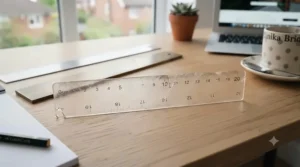
6. Helix Oxford 30cm Shatter Resistant Ruler — best budget plastic for light use
Not every job needs steel, and the Helix Oxford 30cm Shatter Resistant Ruler is a fair representative of why plastic still sells by the millions. Helix has made rulers in the Midlands for well over a century, and the Oxford range is their long-running shatter-resistant line, with clear two-colour print graduations in metric and imperial and a zero-centre scale for measuring either side of a midpoint.
The honest case for the Helix Oxford 30cm Shatter Resistant Ruler on a durability list isn’t that it outlasts steel — it doesn’t, and nobody serious would claim otherwise — it’s that for pencil-and-paper tasks (homework, sketching, note-taking, quick office measuring), the shatter-resistant polystyrene blend genuinely resists the snapping that gives cheap plastic rulers a bad name. Reviewer feedback on this style of ruler frequently mentions the readability of the print and general robustness for classroom or desk use, with the occasional complaint about flex when pressed flat over rough surfaces. Based on the spec comparison, this is the ruler you keep in a bag or pencil case for everyday measuring, not the one you reach for when a blade’s involved.
Pros:
- ✅ Shatter-resistant material outlasts brittle plastic rulers
- ✅ Clear, easy-to-read dual-scale printed graduations
- ✅ Lightweight and inexpensive for everyday carrying
Cons:
- ❌ Not suitable as a cutting guide with a blade
- ❌ Can flex or bow under firm downward pressure
At typically under £3, the Helix Oxford 30cm Shatter Resistant Ruler remains an easy, low-risk buy for school and office use.
7. Westcott Acrylic Clear Shatterproof Ruler — best premium plastic for crafting visibility
The Westcott Acrylic Clear Shatterproof Ruler sits at the top end of the plastic category, and it makes a genuinely different case than the Helix above: this is a crafting tool first, a school ruler second. The fully transparent acrylic body means you can see your paper, pattern, or design directly underneath the ruler as you measure — something no metal rule can offer — and the raised bevelled edge lifts ink or pencil marks off the ruler slightly, reducing smudging as you work.
Where the Westcott Acrylic Clear Shatterproof Ruler earns its “durable” tag within the plastic category is the scratch-resistant coating on the acrylic, which keeps the surface clear and readable far longer than a standard printed plastic ruler that scuffs and clouds within weeks of regular use. Here’s what to weigh: acrylic is genuinely tougher than the polystyrene used in cheap rulers, but it’s still a plastic, and it will not survive sustained contact with a craft knife or rotary cutter the way the aluminium and steel options above will. For visibility-dependent tasks like tracing, quilting layout, or scrapbooking where you need to see through the ruler more than you need it to survive a blade, this is the standout pick.
Pros:
- ✅ Fully transparent for seeing work underneath
- ✅ Scratch-resistant coating keeps markings legible longer
- ✅ Bevelled edge reduces ink smudging while drawing
Cons:
- ❌ Not blade-safe for repeated craft cutting
- ❌ Can crack under sudden impact despite the coating
Priced around £5-£10, the Westcott Acrylic Clear Shatterproof Ruler is best thought of as a visibility upgrade rather than a durability upgrade.
Practical Usage Guide: Getting the Most Out of Any Ruler
However good the ruler, a few habits determine how long it actually lasts. First-use tip one: before you ever run a blade along a new metal or plastic ruler, wipe the edge down — manufacturing residue and light oxidation on steel can cause a blade to catch rather than glide, which is where those first stray nicks usually come from. Second, store rulers flat or hanging rather than jammed upright in a pot with heavier tools; even stainless steel can develop a slight bow if it’s constantly wedged against something rigid, and plastic rulers are far more prone to this.
For maintenance, a monthly wipe with a lightly oiled cloth keeps steel rulers free of the faint surface rust that shows up in damp workshops or coastal areas, while plastic rulers just need a wash in mild soapy water to shift ink and glue residue that otherwise dulls the graduations over time. The single most common mistake in the first 30 days of owning a new craft-cutting ruler is using the wrong edge for the blade — most metal rulers have one “cutting edge” side that’s designed to take blade contact, while the opposite face is for measuring and marking only. Mixing the two speeds up wear on the face that’s meant to stay pristine.
Real-World Scenarios: Which Ruler Fits Your Situation
Picture three different people picking a ruler this week. Sarah is a college student who commutes with a backpack and needs something for lecture notes and the occasional poster project — for her, the Helix Oxford 30cm Shatter Resistant Ruler covers 95% of what she’ll ever do, and its light weight matters more than blade resistance she’ll rarely need. Then there’s Dev, who’s taken up leathercraft as a weekend hobby and is now cutting straps and wallets most Saturdays — he needs the Aluminium Cutting Ruler 30cm with Non-Slip Backing & Finger Guard specifically, because the finger guard and blade resistance aren’t luxuries for him, they’re the difference between a clean edge and a slipped cut.
Finally, consider Priya, who’s setting up a small home workshop for framing and mount-cutting as a side business. Her volume of blade contact is high and consistent, so she’s better served buying both the Faithfull Stainless Steel Rule 300mm for day-to-day marking and the Advent ASR1000 1000mm Precision Steel Rule for larger board layouts — the upfront cost is higher, but spread across the volume of cuts she’s making weekly, the cost-per-cut on a tool that won’t need replacing drops close to nothing within a few months.
Problem → Solution: Fixing Common Ruler Frustrations
Problem: the ruler slides while I’m cutting. This is almost always a grip issue, not a blade issue — switch to a ruler with a non-slip backing, like the Aluminium Cutting Ruler 30cm with Non-Slip Backing & Finger Guard, or add cork or rubber strips to the underside of an existing metal rule.
Problem: my plastic ruler’s edge has gone rough and uneven. Once a plastic edge has been nicked repeatedly by a blade, sanding it smooth is a temporary fix at best — the honest solution is retiring it from cutting duties and moving cutting tasks to a metal ruler like the Faithfull Stainless Steel Rule 300mm, keeping the plastic one for measuring only.
Problem: my steel ruler has faint rust spots. This points to storage in a damp environment or moisture left on the surface after use — a light coat of machine oil wiped on and off after cleaning prevents recurrence, and stainless options like the Draper Expert 152mm Stainless Steel Rule are far more resistant to this than mild-steel alternatives to begin with.
Problem: I can’t read the graduations anymore. Printed scales on cheap plastic rulers wear off with handling; etched scales, as found on the Mr. Pen 4-Piece Steel Ruler Set, don’t have this problem because the markings are physically cut into the metal rather than sitting on top of it.

How to Choose a Ruler for Durability
- Match the material to the contact type. If a blade will ever touch the edge, choose metal — plastic simply can’t resist repeated cutting contact.
- Check for a dedicated cutting edge. Purpose-built craft-cutting rulers, like the Aluminium Cutting Ruler 30cm with Non-Slip Backing & Finger Guard, are engineered specifically to survive blade contact.
- Prioritise etched over printed graduations. Etched markings on steel rules survive decades of handling; printed ones fade.
- Consider grip and stability. A non-slip backing prevents the single most common cause of crooked cuts and ruler damage — slippage.
- Buy the right length for the job, not the drawer. Forcing a short ruler to span a long cut is a leading cause of both measurement error and premature wear.
- Factor in storage conditions. Damp garages and workshops favour stainless steel over mild steel or plastic, which degrade faster in humidity.
- Weigh visibility needs against blade resistance. If you need to see through the ruler, acrylic options like the Westcott Acrylic Clear Shatterproof Ruler may outweigh raw durability concerns.
Metal Ruler vs Plastic Ruler: The Real Difference
| Factor | Metal Ruler | Plastic Ruler |
|---|---|---|
| Blade contact | Designed to withstand repeated cuts | Degrades quickly, edge nicks form fast |
| Long-term accuracy | Graduations stay sharp for years | Printed marks fade and rub off |
| Weight & portability | Heavier, adds stability under pressure | Lighter, easier for bags and pencil cases |
| Transparency | Opaque — can’t see through it | Acrylic/clear options let you see your work |
| Typical lifespan | Years to decades with basic care | Months to a couple of years under heavy use |
The table above lays out why this comparison isn’t really about which material is “better” in the abstract — it’s about matching the material to what you’re actually doing with the ruler day to day. Stainless steel, as a corrosion-resistant iron alloy, holds its edge and shape through repeated mechanical stress in a way most consumer-grade plastics simply aren’t formulated to do — you can read more on the metallurgy behind that resistance if you’re curious why it outperforms plastic under a blade specifically. Plastic’s redeeming advantage is weight and, in acrylic form, transparency — genuinely useful properties that steel can’t replicate, which is exactly why this list keeps two solid plastic picks rather than writing the material off entirely.
✨ Don’t Miss These Exclusive Deals!
🔍 Take your ruler shopping to the next level with these carefully selected picks. Click on any highlighted product to check current pricing and availability. The right straightedge will save you from wonky cuts and replacement purchases for years to come!
Common Mistakes When Buying a Ruler for Craft Cutting
The single biggest mistake is buying on length alone and ignoring the edge design — a 30cm ruler with no dedicated cutting edge or finger guard is a false economy if you’re doing regular craft cutting, because you’ll damage it (and risk your fingers) faster than a purpose-built option like the Aluminium Cutting Ruler 30cm with Non-Slip Backing & Finger Guard. A close second is assuming “metal” automatically means “durable” without checking the grade — mild steel rulers can rust and pit far faster than stainless options such as the Faithfull Stainless Steel Rule 300mm or Draper Expert 152mm Stainless Steel Rule, so it’s worth reading the material spec rather than trusting the word “steel” alone.
A third common error is buying a single ruler to do every job. Craft-cutting, technical drawing, and casual measuring all place different demands on a ruler, and trying to make one do all three usually means it’s mediocre at each — a set like the Mr. Pen 4-Piece Steel Ruler Set solves this more sensibly than hunting for one perfect all-rounder. Finally, plenty of buyers skip the non-slip backing entirely to save a few pounds, not realising that grip failure — not blade dullness — causes the majority of crooked cuts and ruler damage in the first place.
What to Expect: Real-World Performance
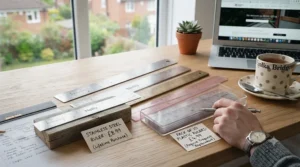
Specs on a listing page rarely translate cleanly into what a ruler actually feels like in daily use, so here’s the translation. A stainless steel ruler like the Faithfull Stainless Steel Rule 300mm feels reassuringly rigid under a blade from the first cut — there’s no perceptible flex, and the sound of a rotary cutter running along it is a clean, consistent hiss rather than the slight juddering you get on plastic. Over months of use, the etched graduations stay just as crisp as day one, though the surface may pick up light handling marks that don’t affect function.
Plastic rulers like the Helix Oxford 30cm Shatter Resistant Ruler, by contrast, feel noticeably lighter and less committal in the hand — genuinely pleasant for quick measuring, but you’ll feel a faint give if you press down hard while marking a line on a firm surface. Within a few months of regular use, expect the printed scale to show light wear at the most-used measurement points, even though the shatter-resistant body itself holds up well structurally. The Aluminium Cutting Ruler 30cm with Non-Slip Backing & Finger Guard performs somewhere between the two in feel — lighter than solid steel but with enough rigidity and grip that blade tracking stays confident and predictable cut after cut.
Long-Term Cost & Maintenance
Total cost of ownership tells a different story than sticker price. A budget plastic ruler at under £3 sounds like the obvious economical choice, but if craft cutting wears it out every few months, replacing it four or five times a year quickly matches — or exceeds — the one-off cost of a steel ruler like the Faithfull Stainless Steel Rule 300mm, which realistically needs replacing only if it’s lost or badly bent. Run the numbers over three years of regular craft use, and the metal option comes out meaningfully cheaper per cut, even before factoring in the better accuracy you get from a rule that isn’t visibly scored and pitted.
Maintenance costs are low either way, but they differ in kind. Steel rulers ask for occasional wiping and, in damp environments, a light oiling — a few minutes a month, effectively free. Plastic rulers need no active maintenance but have a harder ceiling: once the edge is nicked or the scale has worn away, there’s no repairing it, only replacing it. For anyone thinking about eventual disposal too, it’s worth knowing that most household plastics — including worn-out rulers — can go through standard plastic recycling schemes rather than general waste, while scrap steel is even more straightforward to recycle at a local metal collection point.
Ruler Durability for Different Trades and Hobbies
Ruler durability needs vary enormously depending on who’s holding it. For students and casual home use, durability mostly means “doesn’t snap in a bag,” which plastic options like the Helix Oxford 30cm Shatter Resistant Ruler handle comfortably. For crafters — card-makers, scrapbookers, leatherworkers — durability means surviving hundreds of blade passes without the edge degrading, which is squarely the territory of the Aluminium Cutting Ruler 30cm with Non-Slip Backing & Finger Guard and the steel rules on this list.
Tradespeople and DIYers have a third, distinct requirement: durability under transport and rough handling, on top of measuring accuracy that holds up when a rule gets dropped on a site floor. Here, a heavier-duty precision rule like the Advent ASR1000 1000mm Precision Steel Rule earns its higher price by being genuinely hard to damage through everyday knocks. Designers and pattern-makers, meanwhile, often value visibility over raw toughness, which is precisely why the Westcott Acrylic Clear Shatterproof Ruler still has a place even in a durability-focused round-up — the “right” durable ruler always depends on what’s actually going to wear it down.
The Precision Edge: Safety and Accuracy When Cutting
A ruler’s “precision edge” — the straight, true face you actually run a blade against — is where accuracy and safety overlap most directly, and it’s worth treating as a genuinely separate consideration from overall material choice. A worn, nicked, or slightly bowed edge doesn’t just look scruffy; it introduces small deviations into every cut you make, and on repeat cuts (multiple mount board strips, several pattern pieces) those tiny deviations compound into visibly uneven results. This is precisely why finger-guarded, purpose-built options like the Aluminium Cutting Ruler 30cm with Non-Slip Backing & Finger Guard are worth the small premium over a generic steel rule for anyone doing regular craft cutting — the raised guard keeps the blade tracking true against a protected edge rather than the exposed top face.
Safety matters just as much as accuracy here. General guidance from UK safety bodies on everyday product safety consistently stresses using the right tool for the job and keeping hands clear of a cutting path — advice that applies directly to ruler choice, since a slipping or damaged straightedge is a common contributor to craft-knife injuries at home. Always cut on a stable, self-healing mat, keep fingers behind the guarded edge where one’s fitted, and retire any ruler — metal or plastic — the moment its edge shows visible damage that could catch or deflect a blade unpredictably.

Frequently Asked Questions
❓ Is a metal ruler better than a plastic ruler for durability?
❓ What is the best ruler for craft cutting?
❓ Do plastic rulers break easily?
❓ How long should a good ruler last?
❓ Can you use a regular ruler with a craft knife?
Conclusion
The metal ruler vs plastic ruler for durability question doesn’t really have a single winner — it has a right answer for your specific situation. If a blade is ever going near the edge, metal wins comfortably, and options like the Faithfull Stainless Steel Rule 300mm or the purpose-built Aluminium Cutting Ruler 30cm with Non-Slip Backing & Finger Guard will outlast plastic equivalents many times over while keeping your cuts straighter along the way. If you’re mostly measuring, sketching, or doing schoolwork, a well-made plastic option like the Helix Oxford 30cm Shatter Resistant Ruler or the visibility-focused Westcott Acrylic Clear Shatterproof Ruler is perfectly sensible, and arguably the more practical choice given the weight and cost savings.
Whichever direction you land on, the underlying advice holds: match the ruler’s material and edge design to how much blade contact it’s actually going to see, store it properly, and retire it the moment its precision edge stops being precise. Do that, and you’ll spend a lot less time wrestling with wonky cuts — and a lot less money replacing rulers that never should have worn out so fast.
Recommended for You
- Value Ruler Set for School: 7 Best Picks for 2026 (Budget Guide)
- 7 Best Circle Template Set Picks for UK Drafters in 2026
- 7 Best Technical Drawing Set For Students Picks (2026 UK Guide)
Disclaimer: This article contains affiliate links. As an Amazon Associate, I earn from qualifying purchases. If you purchase products through these links, we may earn a small commission at no additional cost to you.
✨ Found this helpful? Share it with your friends! 💬🤗
