
In This Article
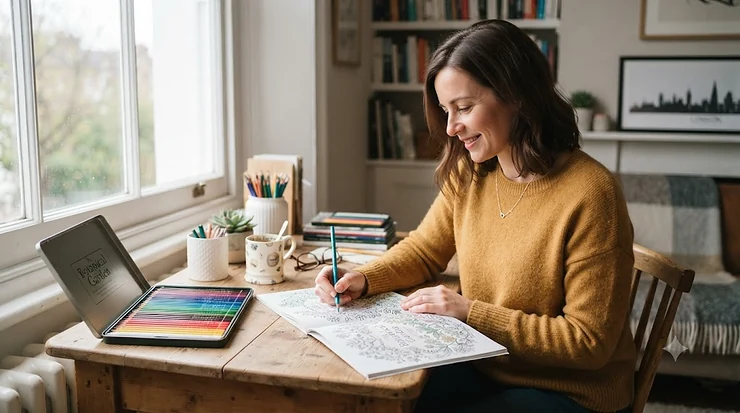
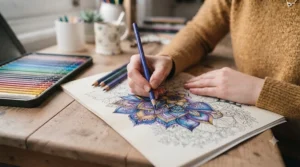
There’s a particular kind of quiet that settles over a kitchen table at nine in the evening when someone finally opens a colouring book after a chaotic day. No emails. No doom-scrolling. Just a page, a handful of colouring pencils for adults, and the small, stubborn decision of which shade of blue goes where. It sounds almost too simple to matter, and yet it does.
So, what actually counts as colouring pencils for adults? In short: they’re artist-grade or hobbyist-grade wood-cased pencils, sold in larger colour ranges than children’s sets, engineered with softer or harder cores for blending, shading and fine detail, and typically pitched at intricate adult colouring books, mandalas and illustration work rather than nursery worksheets.
The market has exploded since adult colouring books first went mainstream, and browsing Amazon UK’s shelves can feel like standing in front of a wall of nearly identical tins, all promising “professional quality” and “vibrant colour”. Some of that is marketing fluff. Some of it genuinely isn’t. Research summarised by The Conversation has found that colouring is an effective, low-effort way to lower anxiety and reduce burnout, particularly when paired with mindfulness practices, which goes some way to explaining why so many of us have quietly stockpiled tins of pencils we didn’t strictly need.
This guide cuts through the noise. We’ve researched seven real, currently available sets spanning budget, mid-range and premium options, broken down what “pencil hardness” and “blendable” actually mean in practice, and built in genuine buying advice rather than a rehashed spec sheet. Whether you’re after your first set of colouring pencils for adults or you’re eyeing an upgrade, you’ll find a clear-eyed comparison here rather than a sales pitch.
Quick Comparison Table
| Product | Core Type | Colour Range | Price Range | Best For |
|---|---|---|---|---|
| Faber-Castell Polychromos | Oil-based, hard | 24–120 | £20-£65 | Fine detail & lightfast archival work |
| Prismacolor Premier | Wax-based, soft | 36–150 | £15-£90 | Buttery blending on a budget |
| Caran d’Ache Luminance | Wax-oil hybrid | 20–100 | £45-£260+ | Serious lightfastness and longevity |
| Derwent Coloursoft | Wax-based, very soft | 12–72 | £8-£65 | Bold, quick colour coverage |
| Staedtler Ergosoft | Wax-based, soft | 12–36 | £6-£25 | Ergonomic comfort, beginners |
| KALOUR 72-Piece Set | Oil-based, soft | 72 | £20-£30 | Budget bulk colour range |
| Crayola Colored Pencils | Wax-based, hard | 50 | £10-£18 | Absolute beginners on a shoestring |
Looking at the table above, there’s a clear split between pencils built for precision (Faber-Castell Polychromos) and pencils built for speed and blending (Prismacolor Premier, Derwent Coloursoft). If longevity of your finished pages matters more than price, Caran d’Ache Luminance justifies its cost with genuinely tested lightfastness, whereas KALOUR and Crayola are there to get you colouring tonight without a second mortgage.
💬 Just one click — help others make better buying decisions too!😊
Top 7 Colouring Pencils for Adults: Expert Analysis
1. Faber-Castell Polychromos — best for fine detail and archival lightfastness
The Faber-Castell Polychromos has been the pencil professional illustrators reach for when a piece needs to survive decades, not just a weekend. Available in tins of 24, 36, 60 and 120, each 3.8mm oil-based core is bonded using Faber-Castell’s “Secural” process, which noticeably reduces the snapped-tip frustration that plagues cheaper pencils; in practice this means you can sharpen to a genuinely fine point for hatching and detail without babying the pencil. Every colour in the range carries a lightfastness rating, and the oil-based formula sidesteps the hazy “wax bloom” that can dull finished wax-based work over time.
Based on the spec comparison with softer wax pencils, this is the set for anyone doing intricate mandala work, botanical illustration, or anything destined for framing rather than a shelf. Reviewers consistently note the smooth, slightly firmer laydown compared with Prismacolor, and that the black and white shades occasionally trail slightly behind rival brands in sheer opacity, though the overall consistency across all 120 colours is widely praised. Beginners sometimes find the harder core less immediately gratifying than a soft wax pencil, since it takes a touch more pressure to build rich colour.
Pros:
- ✅ Oil-based core resists breakage and holds a fine point
- ✅ Every colour individually lightfast-rated for longevity
- ✅ Scales from 24 to 120 colours as your skill grows
Cons:
- ❌ Firmer core needs more layering pressure than wax pencils
- ❌ Premium price climbs steeply at the 120-colour tin
At the time of research, the 60-piece tin sits in the mid-to-premium £45-£65 range, with smaller sets available under £25 — check current price before buying, as availability shifts. For anyone serious about detail work, the value here is less about cost-per-pencil and more about how few pencils you’ll ever need to replace.
2. Prismacolor Premier — best for buttery, forgiving blending
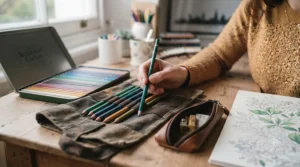
If Faber-Castell Polychromos is the precision scalpel, Prismacolor Premier is the paintbrush. This wax-based, soft-core American pencil is arguably the single most talked-about coloured pencil on YouTube art channels, and for good reason: the thick, creamy core practically melts into the paper, making layering and burnishing feel almost effortless even for someone who picked up a coloured pencil for the first time last week.
What most buyers overlook about this set is that the same softness responsible for its gorgeous blending is also its biggest weakness. Reviewers repeatedly flag that Premier cores can snap inside the barrel during sharpening, particularly straight out of the box, and that some individual pencils arrive with an off-centre core. That’s a genuine trade-off, not a myth — the softness that makes blending so easy also makes the lead more fragile than Polychromos or Staedtler. On the plus side, the 72-colour tin includes a broad spread of warm and cool greys that make skin tones and shading dramatically easier than working from a narrower palette.
Pros:
- ✅ Exceptionally smooth, creamy blending straight out of the tin
- ✅ Huge range of greys ideal for shading and skin tones
- ✅ Water and break-resistant colour once laid down on paper
Cons:
- ❌ Soft cores prone to snapping during sharpening
- ❌ Occasional quality control issues with off-centre leads
Price sits in the £28-£40 range for the popular 72-count tin, climbing toward the £80-£95 mark for the full 150-colour set — always check current price, as Prismacolor runs frequent promotions. For anyone whose priority is silky blending over pinpoint detail, this remains one of the best value professional-tier sets around.
3. Caran d’Ache Luminance 6901 — best for serious lightfastness and longevity
Swiss manufacturer Caran d’Ache built the Caran d’Ache Luminance range specifically to chase the highest lightfastness ratings available, positioning it firmly at the professional end of the market on the back of a manufacturing process developed over two years of dedicated research. The wax-oil hybrid core delivers a buttery, dense application with genuinely striking colour saturation, and the vast majority of the range achieves the top ASTM D-6901 Lightfastness I rating — meaning colours are expected to resist fading for a century or more under gallery-standard lighting.
Here’s what the spec sheet won’t tell you outright: this is a pencil for people who’ve already fallen in love with the hobby, not a sensible first purchase. The cedar casing is gorgeous and easy to sharpen, and reviewers with joint conditions have specifically praised the slightly wider barrel for comfortable, low-strain gripping during long sessions. But at this price, you’re paying for archival confidence most colouring-book pages will simply never need. If you’re framing finished pieces or selling artwork, that confidence is worth every penny; if you’re relaxing with a mandala book before bed, it’s overkill.
Pros:
- ✅ Industry-leading lightfastness, verified to ASTM D-6901
- ✅ Wide cedar barrel praised for comfortable long-session grip
- ✅ Rich, dense colour payoff with minimal pressure needed
Cons:
- ❌ Among the most expensive coloured pencils on the market
- ❌ Colour selection leans heavily toward earth and muted tones
Smaller presentation boxes of 12-20 pencils sit around £45-£90, while the larger 76-and-above sets can run well into the hundreds — prices vary considerably by retailer, so shop around before committing.
4. Derwent Coloursoft — best for bold, fast colour coverage
Manufactured in the Lake District, Derwent Coloursoft earns its name honestly: it’s marketed as the brand’s softest pencil ever, and the velvety 4mm wax core lives up to that promise. The hexagonal barrel design gives a secure, comfortable grip, and the thick colour strip means you can fill large areas of an adult colouring book page in a fraction of the strokes a harder pencil would need.
Based on the spec comparison with Polychromos and Ergosoft, Coloursoft trades fine-detail precision for raw coverage speed, which makes it a favourite for bold botanical prints, large mandala backgrounds and anyone who finds fiddly detail work more stressful than relaxing. Reviewers consistently describe the laydown as feeling closer to a soft pastel than a typical pencil, which produces gorgeous depth but does mean the tip wears down and needs resharpening more often than firmer alternatives. The colour range, while broad at 72 shades in the full set, is also sold in smaller 12, 24 and 36-colour tins, so you can start small.
Pros:
- ✅ Velvety, ultra-soft core covers large areas quickly
- ✅ British-made with a comfortable hexagonal barrel grip
- ✅ Rich, saturated colour with minimal pressure required
Cons:
- ❌ Softer tip wears down faster, needs frequent sharpening
- ❌ Less suited to fine linework than harder pencils
Expect roughly £8-£15 for the smallest 12-tin and around £45-£65 for the full 72-colour set at the time of research, with prices fluctuating across sellers.
5. Staedtler Ergosoft — best ergonomic comfort for beginners
The Staedtler Ergosoft takes a genuinely different approach to the whole category: rather than chasing lightfastness ratings or professional pigment loads, it leans hard into physical comfort. The triangular, non-slip barrel is specifically designed to reduce hand fatigue during long colouring sessions, and its Anti-Break-System coating increases lead break-resistance by a claimed 30-50%, addressing one of the most common frustrations beginners run into with cheaper pencils.
What most buyers overlook here is that “beginner-friendly” doesn’t mean “low quality” — the soft, richly pigmented wax core blends surprisingly well for a set at this price point, and reviewers with arthritis or grip difficulties have specifically praised the ergonomic shape as making longer colouring sessions genuinely more comfortable. The trade-off is colour range: capped at 36 shades in the largest tin, you’ll occasionally find yourself layering to approximate a colour that a 72 or 120-piece set would simply include outright.
Pros:
- ✅ Triangular barrel genuinely reduces hand and wrist fatigue
- ✅ Anti-Break-System lead resists snapping under pressure
- ✅ Pre-sharpened and easy to re-sharpen without shredding
Cons:
- ❌ Limited to 36 colours at the largest tin size
- ❌ Colour names aren’t printed, only reference numbers
At the time of research, the 12-pencil tin runs around £6-£10, the 24-tin around £15-£20, and the full 36-colour tin typically £18-£25 — a genuinely accessible entry point into ergonomic, adult-focused colouring pencils.
6. KALOUR 72-Piece Set — best budget bulk colour range
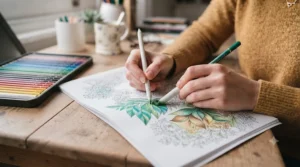
For sheer number of shades per pound spent, the KALOUR 72-Piece Set is hard to beat. This oil-based, soft-core budget set arrives in a metal tin with a sharpener and a blank DIY colour chart, and conforms to the ASTM D-4236 and EN71-3 safety standards that govern art materials sold to general consumers. The 72-colour spread covers a genuinely usable range for most adult colouring books straight out of the box.
Honest analysis here means being upfront about what a budget set can and can’t do: reviewers note that while the core lays down colour smoothly and blends reasonably well, it’s more prone to crumbling under heavy pressure than professional-tier pencils, and the wood casing quality is noticeably below Faber-Castell or Derwent. That said, for colouring-book hobbyists rather than exhibition artists, this is a genuinely sensible way to access a wide colour range without committing serious money to a hobby you’re still testing out.
Pros:
- ✅ 72 colours at a genuinely accessible bulk price
- ✅ Includes tin case, sharpener and blank colour chart
- ✅ Meets ASTM D-4236 and EN71-3 safety standards
Cons:
- ❌ Cores can crumble slightly under heavy hand pressure
- ❌ Wood casing quality trails premium brands noticeably
Prices at the time of research sit around £20-£30 for the 72-piece tin, making it one of the most colour-dense budget options available on amazon.co.uk.
7. Crayola Colored Pencils (50-Count) — best absolute-beginner starter set
It might feel like an unlikely inclusion on a list otherwise stacked with “professional” branding, but the Crayola Colored Pencils 50-count set — sold as an adult-coloring-oriented option — earns its spot for one simple reason: it removes every barrier to just starting. The wax-based, harder core sharpens easily, resists snapping, and the sheer familiarity of the brand means zero learning curve.
The honest trade-off, and reviewers are consistent on this point, is blendability. Crayola’s harder wax formulation doesn’t layer or burnish nearly as smoothly as Prismacolor or Derwent, so subtle gradients and shading techniques are noticeably harder to achieve. If you’re colouring purely for relaxation rather than technique, that limitation may never actually bother you — but if you find yourself wanting to blend two blues into a smooth sky, you’ll hit a ceiling faster than with the pricier sets on this list.
Pros:
- ✅ Extremely low price point removes any commitment barrier
- ✅ Break-resistant core, easy for total beginners to sharpen
- ✅ Familiar, trusted brand with wide colour variety
Cons:
- ❌ Blending and layering noticeably harder than wax-soft rivals
- ❌ Colour vibrancy trails behind artist-grade alternatives
Expect to pay roughly £10-£18 for the 50-count set at the time of research — a genuinely low-risk way to find out whether colouring pencils for adults is a hobby worth investing further in.
✨ Don’t Miss These Exclusive Deals!
🔍 Take your colouring pencils for adults collection to the next level with these carefully selected sets. Click on any highlighted product above to check current pricing and availability. The right tin could be the start of some genuinely calming, screen-free evenings for you and your family!
Practical Usage Guide: Getting the Most From a New Set
Opening a fresh tin is the easy part. Getting genuinely smooth, satisfying results takes a bit of technique, and this is exactly the sort of practical detail that never makes it onto an Amazon product page.
Start by test-swatching every colour on a scrap of the same paper you’ll actually be colouring on — cheap printer paper behaves very differently under pressure to the thicker, smoother stock used in premium adult colouring books, and you’ll want to know how each pencil behaves before committing to a page. In your first thirty days, resist the urge to press hard for instant vibrancy. Coloured pencils reward patience: build colour in light, even layers, and you’ll get richer, more even results than one heavy pass ever achieves. This single habit change is the biggest predictor of whether beginners find blending frustrating or intuitive.
Maintenance matters more than people expect. A dedicated pencil sharpener designed for coloured pencils (rather than a cheap graphite sharpener) reduces the tip-snapping that ruins soft-core pencils like Prismacolor or Derwent Coloursoft. Store tins flat rather than upright where possible, since soft cores can shift and crack from repeated vertical jostling. And keep a kneadable eraser and a blank sheet of scrap paper nearby for testing colour combinations before you commit ink to your actual page — a habit that saves more disappointment than any single pencil upgrade.
Real-World Scenarios: Which Set Actually Suits You
Rather than a generic recommendation, here’s how three common colourists actually match up to the sets above.
If you’re a stressed-out professional colouring for twenty minutes before bed to switch your brain off, reach for something forgiving and quick like Derwent Coloursoft or the budget KALOUR 72-Piece Set — you want fast, satisfying colour coverage, not a steep technical learning curve after a long day.
If you’re a retired hobbyist rediscovering art after decades away and want to genuinely improve technique, Prismacolor Premier or Faber-Castell Polychromos give you room to grow into layering, blending and shading without hitting a quality ceiling within a few months.
If you’re buying for a teenager or young adult with joint pain or dexterity challenges, the Staedtler Ergosoft‘s ergonomic triangular barrel is a genuinely practical choice — several reviewers specifically flagged reduced hand strain during long sessions, which matters more than colour count for many colourists.
How to Choose Colouring Pencils for Adults
Picking between dozens of near-identical tins is easier once you know what actually separates a good set from a disappointing one. Work through these steps in order:
- Decide your core preference first. Wax-based pencils (Prismacolor, Derwent, Staedtler) blend more easily but wear down faster; oil-based pencils (Faber-Castell, KALOUR) hold a point longer and resist wax bloom.
- Match colour count to your actual habits. A 24 or 36-colour tin covers most colouring-book pages perfectly well; jumping straight to 120 colours often just means more sharpening, not better art.
- Check the core diameter. Thicker cores (3.8-5mm) cover larger areas faster but blunt sooner; thinner cores hold detail longer between sharpens.
- Consider lightfastness only if it matters to you. If you’re framing or gifting finished pieces, prioritise Polychromos or Luminance; if pages live in a folder, it’s a non-issue.
- Factor in grip comfort. Long colouring sessions can strain hands, so ergonomic barrels like Staedtler’s triangular design are worth the small premium if you colour for more than twenty minutes at a stretch.
- Buy a small set before a large one. A 24-piece tin lets you judge a brand’s blending and breakage tendencies before you commit £60-plus to the full range.
- Read aggregated review sentiment, not star ratings alone. A 4.7-star average can still hide a common complaint (breakage, off-centre cores) worth knowing before you buy.
Professional Coloured Pencils Review: What Separates Artist-Grade From Hobby-Grade
Every professional coloured pencils review worth reading circles back to the same handful of factors, and it’s worth being explicit about them rather than relying on vague “premium quality” marketing language. Pigment concentration is the biggest one: artist-grade pencils like Polychromos and Luminance pack significantly more pure pigment into each core than hobby sets, which is why their colour looks richer even in a single light layer. Binder quality is the second: cheaper wax binders in budget sets can produce a slightly waxy, semi-opaque finish, while premium oil or wax-oil hybrids lay down more true, saturated colour.
The honest verdict from aggregated reviews is that hobby-grade sets like KALOUR or Crayola are perfectly capable of beautiful results in a colouring book — the paper itself, and the care you take blending, often matter more than the tin price. Where artist-grade sets genuinely earn their premium is in consistency across dozens of colours, resistance to breakage, and long-term lightfastness, which matters more for framed or gifted pieces than for a page tucked into a book on your coffee table.
Blendable Coloured Pencils: Layering, Burnishing and the Shading Technique That Actually Works
What Makes a Coloured Pencil Blendable
Not every pencil is created equal here, and this is genuinely one of the most misunderstood aspects of the whole hobby. Blendable coloured pencils typically have softer, waxier or oil-rich cores that transfer pigment easily onto paper and mix readily with adjacent colours when layered. Prismacolor Premier and Derwent Coloursoft sit at the soft, highly blendable end of the spectrum; Faber-Castell Polychromos and Crayola sit firmer, requiring more deliberate technique to achieve the same smooth transitions. Neither is “better” in absolute terms — soft pencils blend faster but wear down and break more easily, while firmer pencils demand patience but hold detail and points longer.
Shading Technique for Smooth Gradients
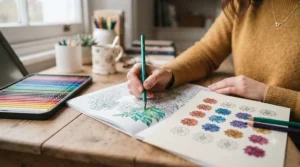
The shading technique that consistently produces the most professional-looking results is layering light, circular or back-and-forth strokes rather than pressing hard in one pass. Start with your lightest colour as a base layer covering the whole area, then gradually introduce darker tones only where shadow naturally falls, blending the transition zone with light, overlapping strokes. For genuinely smooth gradients, a colourless blender pencil (essentially pure binder with no pigment) worked gently over layered colour melts everything together beautifully — this trick works particularly well with wax-based pencils like Prismacolor, less so with firmer oil-based cores. Burnishing, where you press a light or white pencil firmly over finished colour, is the final step for a glossy, painterly finish, though it’s worth practising on scrap paper first since it’s difficult to undo.
Understanding Pencil Hardness
Pencil hardness is one of those terms that gets thrown around constantly in coloured pencil reviews without much explanation, so here’s the practical version. Unlike graphite pencils, coloured pencils don’t use the familiar H/B grading scale — instead, “hardness” refers to how much wax or oil binder is mixed with pigment in the core. A harder core, like Faber-Castell Polychromos, holds a sharp point through more strokes and is better suited to fine linework, hatching and detail-heavy illustration. A softer core, like Derwent Coloursoft or Prismacolor Premier, lays down colour more quickly and blends more readily, but wears down and needs resharpening far sooner.
What most buyers overlook about pencil hardness is that it’s rarely an all-or-nothing choice — many experienced colourists keep both a harder set for outlining and detail and a softer set for filling and blending, using each where it performs best. If you can only justify one set right now, consider what proportion of your colouring involves fine detail versus broad colour fills, and let that ratio guide whether you lean toward Polychromos-style firmness or Coloursoft-style softness.
Adult Colouring Books: Choosing the Right Paper and Pencil Pairing
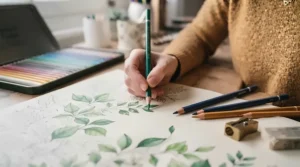
The pencil is only half of the equation — the paper in your adult colouring book matters just as much, and this is genuinely under-discussed. Cheaper adult colouring books, often printed on standard 90-100gsm paper, can’t handle heavy layering or burnishing; colour saturates quickly and the paper can pill or tear under repeated strokes, particularly with softer pencils like Prismacolor. Premium colouring books printed on 160gsm-plus stock hold up far better to layering, blending and even light water-based techniques.
If you’ve invested in a higher-end set like Caran d’Ache Luminance or Faber-Castell Polychromos, pairing it with a budget colouring book genuinely undersells the pencils — the paper simply can’t showcase the pigment density and lightfastness you paid for. Conversely, a premium colouring book with a budget pencil set like Crayola or KALOUR is a perfectly sensible combination while you’re still deciding how deep into the hobby you want to go. As a rule of thumb, match your paper investment to your pencil investment, and you’ll avoid the common disappointment of blaming a pencil for what’s actually a paper limitation.
Common Mistakes When Buying Colouring Pencils for Adults
The single most common mistake is buying colour count before checking core type — a 120-colour set with a core that crumbles under pressure is a worse purchase than a well-made 24-colour tin. Reviewers across nearly every brand flag this same regret. The second common mistake is ignoring grip comfort entirely; a beautiful set of pencils you can’t comfortably hold for more than ten minutes at a stretch will simply gather dust. Third, many buyers assume “professional” branding on the box guarantees quality — it’s genuinely worth reading aggregated review sentiment rather than trusting packaging language alone, since budget brands increasingly borrow professional-sounding terminology without professional-grade cores.
Long-Term Cost & Maintenance
Coloured pencils are refreshingly low-maintenance compared with markers or paints, but total cost of ownership still varies significantly by brand. Premium sets like Faber-Castell Polychromos and Caran d’Ache Luminance are typically sold as open stock, meaning you can replace a single worn-down colour for a few pounds rather than rebuying the whole tin — a genuine long-term saving if you find yourself reaching for the same handful of shades repeatedly. Budget sets like KALOUR and Crayola are rarely sold individually, so a single lost or broken pencil often means buying a whole new set, which can erode the initial price advantage over a couple of years of regular use.
Cost-per-use also favours softer pencils less than you might assume: because soft cores like Prismacolor Premier and Derwent Coloursoft wear down faster, you’ll be sharpening and shortening them more quickly than a firmer Polychromos pencil, effectively reducing their usable lifespan per pound spent. For anyone colouring several times a week, factoring in replacement frequency, not just up-front price, gives a genuinely more accurate picture of value.
Safety, Regulations and Compliance Guide
If you’re buying colouring pencils for adults that might also end up in a household with children, it’s worth knowing the relevant safety framework. Art materials sold in the UK, including coloured pencils, generally fall under the Toys (Safety) Regulations 2011, which set essential safety requirements around materials, chemical migration and choking hazards for products intended for or likely to be used by children under 14. Reputable brands, including the budget KALOUR set reviewed above, explicitly reference compliance with ASTM D-4236 and EN71-3 chemical migration standards on their packaging — worth checking for on any set you buy, particularly bulk or lesser-known imports.
For pencils marketed purely to adults, these regulations technically don’t apply in the same way, but the underlying safety standards (non-toxic pigments, acid-free cores) are still a reasonable baseline to look for, especially if pencils will be shared across a household.
Features That Actually Matter (And Those That Don’t)
Marketing copy loves to lean on vague superlatives, so here’s a genuine filter. Core softness and pigment concentration matter enormously — they directly determine blending quality and colour richness. Lightfastness matters if you’re framing or selling work, and barely at all if pages live in a folder. Barrel shape (round, hexagonal, triangular) matters more than most buyers expect, particularly for longer sessions or anyone with grip difficulties. What genuinely doesn’t matter much: colour count beyond 72 for the vast majority of adult colouring book users, since most books simply don’t demand more nuance than that; and glossy packaging, which has zero correlation with pigment quality once you dig into aggregated reviews.
FAQ
❓ What are the best colouring pencils for adults?
❓ How many colouring pencils do I actually need to start?
❓ Are oil-based or wax-based colouring pencils better for adults?
❓ Can you blend ordinary budget colouring pencils?
❓ What paper works best for adult colouring books?
Conclusion
Choosing between dozens of tins on amazon.co.uk doesn’t need to feel overwhelming once you know what you’re actually looking for. If detail and longevity matter most, Faber-Castell Polychromos and Caran d’Ache Luminance earn their premium price tags. If smooth, forgiving blending is the priority, Prismacolor Premier and Derwent Coloursoft deliver genuinely satisfying results. And if you’re simply not sure yet whether this hobby is for you, Staedtler Ergosoft, KALOUR or Crayola all offer a low-risk way to find out.
What matters most isn’t the tin you choose today — it’s actually sitting down and using it. According to the mindfulness research referenced earlier in this guide, even twenty unhurried minutes with a page and a handful of colouring pencils for adults can measurably lower anxiety. That’s a fairly remarkable return for the price of a pencil tin.
Recommended for You
- Colouring Pencils Under £20: 7 Brilliant Sets Ranked for 2026
- Best Mixed Media Pad: 7 Top UK Picks Tested for 2026
- Best Watercolour Pad 2026: 7 Top Picks Tested & Compared
Disclaimer: This article contains affiliate links. As an Amazon Associate, I earn from qualifying purchases. If you purchase products through these links, we may earn a small commission at no additional cost to you.
✨ Found this helpful? Share it with your friends! 💬🤗
