
In This Article
Standing in front of a wall of paint tubes — or worse, scrolling through forty nearly identical listings on Amazon at 11pm — is enough to put anyone off picking up a brush. Choosing an acrylic paint set for beginners shouldn’t feel like defusing a bomb, but the sheer number of options, colour counts, and mysterious abbreviations (“student grade”, “heavy body”, “AP non-toxic”) can make a simple hobby feel like homework.
Here’s the good news: acrylic paint is genuinely one of the most forgiving, beginner-friendly mediums there is. It dries fast, cleans up with water, forgives mistakes by simply painting over them, and works on nearly any surface you can get your hands on — wood, canvas, card, even old jam jars. The right acrylic paint set for beginners just needs to tick a handful of boxes: a workable colour range, decent pigment strength, a fair price, and no nasty surprises once you actually start mixing.
This guide walks through seven real, currently available acrylic paint sets spanning budget starter kits through to artist-grade options, breaks down exactly what separates them, and digs into the practical stuff other guides skip — how acrylic paint compares with watercolour, how to get proper value from a cheaper set, how colour mixing actually works with a limited palette, why drying time matters more than you’d think, and how to get your first canvas painting looking half-decent. Everything here is grounded in real specifications and genuine aggregated review sentiment, not guesswork.
Quick Comparison Table
Before diving into the full breakdown, here’s a snapshot of how these seven sets stack up against each other on the essentials.
| Set | Colours | Tube Size | Price Range | Best For |
|---|---|---|---|---|
| Crafts 4 All Acrylic Paint Set | 24 | 12ml | Under £15 | Absolute first-timers testing the waters |
| Mont Marte Signature Acrylic Set | 24 | 36ml | £15-£20 range | Best tube size-to-price ratio |
| Shuttle Art Acrylic Paint Set | 24 | 12ml | Under £20 | Bundled extras (brushes, canvases) |
| Castle Art Supplies Acrylic Set | 24 | 12ml | £15-£20 range | Well-rounded starter kit with tools |
| Daler-Rowney System3 Introduction Set | 10 | 22ml | £15-£25 range | UK-made quality on a student budget |
| Liquitex BASICS Acrylic Set | 12 | 22ml | £20-£30 range | Growing into intermediate techniques |
| Winsor & Newton Galeria Set | 10 | 60ml | £25-£40 range | Buyers who want artist-grade pigment from day one |
Looking at the spread, the pattern that jumps out is the trade-off between colour count and pigment quality: the 24-colour budget sets give you variety out of the box, while the 10-12 colour mid-range and premium sets bank on the idea that you’ll learn more by mixing fewer, stronger colours yourself. Neither approach is “wrong” — it depends whether you want convenience now or a colour-mixing education from the start. If you’re genuinely unsure which camp you fall into, the value acrylic paint set options (Crafts 4 All, Mont Marte, Shuttle Art, Castle Art Supplies) let you experiment cheaply before committing to pricier artist-grade paint.
💬 Just one click — help others make better buying decisions too!😊
Top 7 Acrylic Paint Sets for Beginners: Expert Analysis
Here’s the full rundown of all seven sets, spanning budget, mid-range, and premium price brackets, with variants in tube size, colour count, and included extras.
1. Crafts 4 All Acrylic Paint Set — cheapest way to try acrylics without commitment
The headline draw here is the price-to-colour-count ratio: 24 tubes for the cost of a takeaway coffee round, which makes it about as low-risk as an acrylic paint set for beginners gets. Each tube holds 12ml of matte-to-satin finish acrylic that’s labelled non-toxic and safe for most household surfaces, including canvas, wood, ceramic, and fabric. Based on the spec comparison with pricier sets, the trade-off is pigment concentration — the paint tends to run thinner and needs a confident, undiluted application to avoid a chalky, semi-transparent finish. What most buyers overlook about a set at this price point is that it’s genuinely built for experimentation rather than a finished gallery piece, and that’s exactly the job it’s suited for: testing whether painting is a hobby worth investing further in. Reviewers consistently report that colours arrive vibrant on first use but note some tubes dry out faster once opened, so working through the set within a few months rather than letting it sit in a drawer gets the best results. A common complaint in user reviews is limited opacity on darker or patterned surfaces without a base coat of white first.
Pros:
- ✅ Extremely low entry price for 24 full-size tubes
- ✅ Works across canvas, wood, ceramic, and fabric surfaces
- ✅ Non-toxic formula suitable for supervised family painting sessions
Cons:
- ❌ Thinner pigment needs layering for full opacity
- ❌ Some tubes reported to dry out faster once opened
At under £15, this is about as inexpensive as a genuine 24-colour set gets — the value verdict is straightforward: buy it to find out if you enjoy painting, not to produce your best work.
2. Mont Marte Signature Acrylic Set — largest tubes in the budget bracket
Mont Marte’s standout feature is tube size: at 36ml per colour, you’re getting three times the paint-per-tube of most rivals in the same price bracket, which matters more than it sounds once you’re three canvases deep. The 24-colour range covers primaries, secondaries, and a handful of useful earth tones and metallics, all formulated for canvas, wood, leather, cardboard, and general craft use. On paper, this means fewer trips back to the shop compared with 12ml competitors, since a single tube of Mont Marte lasts roughly as long as three tubes of a smaller-format set. Here’s what to weigh: the pigment strength sits solidly in “budget but usable” territory — vibrant enough for most beginner projects, though not quite as punchy as artist-grade paint straight from the tube. Reviewers consistently note good coverage on canvas and wood in particular, with several mentioning the set held up well across multiple full-sized paintings without needing a refill, which is unusually good mileage for this price bracket.
Pros:
- ✅ 36ml tubes last significantly longer than typical starter sets
- ✅ Reliable coverage on canvas, wood, and cardboard
- ✅ Wide 24-colour range including useful metallics
Cons:
- ❌ Pigment intensity below mid-range and premium brands
- ❌ Satin finish can look slightly plasticky when applied thickly
Sitting in the £15-£20 range, the extra paint volume per tube makes this one of the better cost-per-use options among the budget sets — a strong pick if you paint often and don’t want to keep reordering.
3. Shuttle Art Acrylic Paint Set — best bundled extras for a first kit
Shuttle Art’s set earns its spot through what comes in the box beyond the paint itself: brushes and, in several bundle variants, mini canvas panels are included, meaning you can genuinely open the box and start painting the same afternoon. The 24 x 12ml tubes cover a broad colour spectrum with reasonable saturation for the price, formulated for multi-surface use including paper, canvas, and wood. Based on the spec comparison, the paint itself performs comparably to other budget-tier sets — the real differentiator is the “everything you need” packaging, which removes a common beginner stumbling block: buying paint and then realising you have nothing to paint on or with. What most buyers overlook is that included brushes at this price point are typically synthetic and basic, fine for acrylics but worth upgrading once you know your preferred brush shapes. Aggregated reviewer sentiment consistently highlights the bundle’s convenience for gifting and for first-time buyers, with the completeness of the kit mentioned more often than the paint quality itself.
Pros:
- ✅ Bundled brushes remove the need for a separate purchase
- ✅ Broad 24-colour spread suitable for most beginner projects
- ✅ Multi-surface formula works on paper, canvas, and wood
Cons:
- ❌ Included brushes are basic and may need replacing quickly
- ❌ Pigment strength on par with, not above, budget rivals
At under £20 for paint plus tools, the value case rests on convenience rather than superior pigment — ideal if you’d rather not make three separate purchases before your first session.
4. Castle Art Supplies Acrylic Paint Set — well-rounded first kit with genuine crossover appeal
Castle Art Supplies has built a reputation as a strong all-rounder, and the standout feature is balance: 24 x 12ml tubes paired with a reasonable selection of brushes, positioned as being just as useful for a curious beginner as for someone slightly more experienced supplementing their existing supplies. The colour range covers the essentials plus some less common shades that save early mixing effort, and the paint is formulated for canvas, wood, ceramic, and fabric alike. Here’s what to weigh: independent comparison write-ups have repeatedly flagged this set as offering “great bang for your buck” among similarly priced 24-tube kits, largely because the finish holds up reasonably well without excessive thinning. What most buyers overlook about sets pitched at “beginners and professionals” is that the professional appeal usually means “useful for sketching out ideas cheaply” rather than gallery-ready output — a distinction worth understanding before assuming this replaces artist-grade paint entirely. Reviewers consistently mention good colour vibrancy fresh out of the tube, with a smaller number noting the caps can be fiddly to reseal tightly, risking dried-out paint if left loose.
Pros:
- ✅ Balanced 24-colour range with some less common shades
- ✅ Frequently highlighted as strong value in independent comparisons
- ✅ Works across canvas, wood, ceramic, and fabric
Cons:
- ❌ Tube caps can be fiddly to reseal properly
- ❌ Still a student-grade formula despite “professional” marketing language
In the £15-£20 range, this is a genuinely solid middle-ground budget pick — not the cheapest, but the added colour variety and brush inclusion generally justify the small premium over the bare-bones options.
5. Daler-Rowney System3 Introduction Set — UK-made quality on a student budget
Daler-Rowney’s System3 range is the first genuinely mid-range step up on this list, and its standout feature is that it’s manufactured in the UK to a formula the brand has refined since the 1960s. The Introduction Set contains 10 x 22ml tubes covering titanium white, lemon yellow, cadmium yellow hue, cadmium red hue, crimson, ultramarine, emerald, yellow ochre, burnt umber, and mars black — a genuinely well-considered palette that gives new painters everything needed to mix the vast majority of other colours by hand. Based on the spec comparison, System3 sits between student and artist grade: it’s soft-bodied, quick-drying, and rated for reasonable lightfastness on most of its shades, meaning finished pieces won’t fade dramatically over the following years the way some ultra-budget paints can. What most buyers overlook is that a smaller, curated colour set like this one is often a better learning tool than a 24-tube starter kit, because it forces you to actually practise colour mixing rather than reaching for a pre-made shade every time. Reviewers consistently describe the paint as smooth and easy to blend, with several long-term users noting it remains their go-to for quick studies even after moving on to pricier ranges.
Pros:
- ✅ Manufactured in the UK with consistent quality control
- ✅ Curated 10-colour palette ideal for learning colour mixing
- ✅ Smooth, soft-bodied consistency that blends easily
Cons:
- ❌ Smaller colour range means more manual mixing required
- ❌ Tubes are smaller than the Mont Marte or Winsor & Newton options
Priced in the £15-£25 range depending on retailer promotions, this set offers a genuinely strong middle path — noticeably better handling than budget sets without stepping into premium pricing.
6. Liquitex BASICS Acrylic Set — best for growing into intermediate techniques
Liquitex BASICS stands out because it’s formulated using the same pigments as Liquitex’s professional range, just at a lower concentration — meaning the standout feature here is a genuine, verifiable link to artist-grade paint rather than a marketing claim. The 12 x 22ml set (also available in a larger 118ml tube format for those planning bigger canvases) includes primary yellow, cadmium orange hue, alizarin crimson hue, primary red, dioxazine purple, primary blue, phthalocyanine green, light green permanent, burnt sienna, burnt umber, titanium white, and mars black. On paper, this means a wider and more nuanced starting palette than most competitors at this price tier, including genuinely useful colours like dioxazine purple and phthalocyanine green that budget sets frequently substitute with weaker equivalents. What the spec sheet won’t tell you, but reviewers note, is that BASICS has a noticeably “buttery” medium-viscosity consistency that suits both flat colour blocking and more textured, semi-impasto techniques, giving it more room to grow with you than a typical starter set. Independently certified as safe by the Art and Creative Materials Institute, it’s also one of the more reassuring choices if children will be anywhere near the workspace. Aggregated review sentiment consistently praises colour brightness and mixing behaviour, with a smaller number of buyers noting the price gap over budget-tier sets is noticeable but, in their view, worth it.
Pros:
- ✅ Same pigment lineage as Liquitex’s professional acrylic range
- ✅ Wider, more nuanced 12-colour palette than most rivals
- ✅ Independently safety-certified formula
Cons:
- ❌ Noticeably pricier than the budget 24-tube sets
- ❌ Smaller tube option offers less paint volume overall
In the £20-£30 range, this is the set most worth the stretch if you’re fairly confident painting is a hobby you’ll stick with, rather than one you’re still testing out.
7. Winsor & Newton Galeria Acrylic Set — most vibrant option for buyers who want artist-grade pigment early
Winsor & Newton has been supplying artists since 1832, and the Galeria range’s standout feature is delivering genuinely professional-level pigment brilliance at a price still realistic for a beginner. The 10 x 60ml tube set includes cadmium yellow medium hue, cadmium red hue, crimson, Winsor blue, phthalo green, yellow ochre, burnt sienna, raw umber, mars black, and titanium white — generous tube sizes that mean this set will comfortably outlast most of the others on this list despite the higher upfront price. Based on the spec comparison, Galeria paint carries stronger brush stroke retention, richer opacity, and better colour mixing behaviour than any student-grade set here, which practically translates into fewer layers needed to achieve full, even coverage on canvas painting projects. What most buyers overlook is that “beginner-friendly” doesn’t have to mean “lower quality” — Galeria is genuinely marketed and used by both first-timers and working professionals, meaning you won’t outgrow it the way you might a starter kit within a year. Reviewers consistently describe the colours as vibrant straight from the tube with excellent mixing clarity, though a handful mention the paint can be trickier to clean off palettes compared with thinner student-grade formulas.
Pros:
- ✅ Professional-grade pigment brilliance and opacity
- ✅ Generous 60ml tubes that last considerably longer per set
- ✅ Suitable for beginners through to working professionals
Cons:
- ❌ Highest price point among the sets on this list
- ❌ Slightly trickier palette clean-up than thinner budget paints
At around £25-£40 depending on retailer and promotions, this is the one genuine “invest once, use for years” pick on the list — arguably the best acrylic paint set for beginners who already know they want to take painting seriously.
Your First 30 Days With an Acrylic Paint Set: A Practical Usage Guide
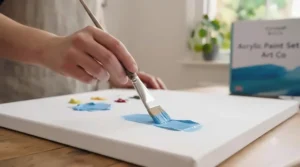
Getting a new acrylic paint set for beginners open on the kitchen table is the easy part — the first month is where most people either build a habit or quietly abandon the hobby in a drawer. Start by protecting your workspace: an old bedsheet or a roll of cheap lining paper under your setup saves more stress than any single art tip. Squeeze small amounts of paint onto a palette rather than working straight from the tube; acrylics dry on contact with air, so a wide, flat surface (even a dinner plate works) keeps more paint usable for longer.
In terms of maintenance, rinse brushes in water between colours and always before the session ends — dried acrylic essentially turns bristles into a solid clump, and no amount of soaking reliably reverses it once it’s fully cured. Keep a damp (not soaking) sponge or spray bottle nearby if you’re finding paint drying out on your palette faster than you can use it, which is one of the most common first-month frustrations reported by new painters.
The most common early mistake is overloading the brush and applying paint too thickly in one pass, which leads to cracking as it dries. A second common misstep is skipping a base layer (often called “blocking in”) and jumping straight to fine detail — most experienced painters build up in loose layers first, refining detail only in the final stages. Finally, resist the urge to buy every accessory advertised alongside your set in week one; a set of basic brushes, a palette, and some cheap canvas boards or canvas paper are genuinely all you need to get comfortable before spending more.
Real-World Scenarios: Which Acrylic Paint Set Suits You?
The curious first-timer. If you’re a university student who’s never picked up a brush since school but keeps seeing satisfying painting videos online, a budget option like the Crafts 4 All or Mont Marte set makes the most sense — low financial risk, enough colours to experiment, and no pressure to produce something frame-worthy on attempt one.
The gift-buyer stocking a beginner’s first kit. If you’re buying for a teenager or a friend who’s mentioned wanting to “get into painting” but hasn’t committed to any particular style yet, the Shuttle Art or Castle Art Supplies sets make sensible gifts because they include brushes and, in some bundles, surfaces to paint on — reducing the chance the recipient opens the box and has nothing to actually start with.
The committed hobbyist ready to improve. If you’ve already worked through a starter set and know you enjoy canvas painting regularly, the Daler-Rowney System3 or Liquitex BASICS sets offer a genuine step up in pigment quality and mixing behaviour without the full artist-grade price tag — ideal for someone painting weekly rather than occasionally.
The serious beginner who wants to skip a step. If budget genuinely isn’t the limiting factor and you’d rather buy the right thing once than upgrade twice, the Winsor & Newton Galeria set removes the need to “graduate” later, since it’s used by professionals as readily as newcomers.
Common Beginner Problems, Solved
Problem: paint dries out on the palette before you can use it. Solution: work with smaller amounts at a time, mist your palette lightly with water, or invest in a stay-wet palette, which uses a damp membrane to slow evaporation significantly.
Problem: colours look muddy after mixing. Solution: this usually comes from mixing too many colours together, or mixing direct complementary colours (like red and green) in equal parts. Stick to two or three colours per mix and add white gradually to lighten rather than diluting with excess water.
Problem: paint won’t stick properly to the canvas. Solution: check whether your canvas or board has been properly primed with gesso — unprimed surfaces absorb paint unevenly and can lead to patchy, dull results, particularly with thinner budget-tier acrylics.
Problem: brushes are ruined within a week. Solution: acrylic paint left to dry on bristles is very difficult to remove; rinse thoroughly during and immediately after each session, and avoid leaving loaded brushes standing bristle-down in a water jar, which bends and splits the bristles over time.
Problem: finished paintings look flat compared to reference photos. Solution: this is almost always a value (light-and-dark) problem rather than a colour problem — before adding fine detail, check your painting still reads correctly when converted to greyscale on your phone.
What Is an Acrylic Paint Set for Beginners?
An acrylic paint set for beginners is a curated collection of water-based acrylic paints — typically ten to twenty-four tubes — bundled specifically for newcomers, usually at a lower price point and pigment concentration than professional-grade paint. Acrylic paint itself is a fast-drying, water-based paint that has been a mainstay for artists since the 1960s, and it’s particularly well suited to beginners because mistakes can simply be painted over once dry, with clean-up only requiring water rather than harsh solvents.
Most beginner sets fall into one of two structures: a wide colour range (18-24 tubes) designed to minimise the need to mix, or a smaller, curated range (10-12 tubes) designed to teach colour theory through hands-on mixing. According to Wikipedia’s overview of the medium, acrylic paint has only been in widespread artistic use since the mid-20th century, which is part of why beginner-oriented sets and techniques are still evolving compared with the centuries-old traditions around oil and watercolour. Neither structure is objectively better — it depends on whether you’d rather start painting immediately or build a genuine understanding of how colour works from day one.
Acrylic Paint vs Watercolour Paint: Which Should Beginners Choose?
The acrylic paint vs watercolour paint question comes up constantly among first-time painters, and the honest answer is that the two mediums behave almost like opposites. Acrylic paint is opaque, forgiving of mistakes (you can simply paint over an error once it’s dry), and dries within twenty to forty minutes depending on thickness. Watercolour paint, by contrast, is translucent by design, relies on the white of the paper showing through for its brightness, and is considerably less forgiving — heavy-handed corrections tend to muddy the paper rather than disappear.
| Factor | Acrylic Paint | Watercolour Paint |
|---|---|---|
| Opacity | Opaque, covers mistakes | Translucent, mistakes show |
| Drying time | 20-40 minutes typical | Varies, often faster but less forgiving |
| Surface needed | Canvas, wood, card, most surfaces | Specialist watercolour paper |
| Forgiveness for beginners | High — paint over errors | Lower — corrections are visible |
| Best For | Beginners wanting quick, confident results | Painters who enjoy a looser, more translucent style |
For most complete beginners, acrylic paint’s forgiveness makes it the more encouraging starting point — you’re less likely to abandon a piece halfway through out of frustration. Watercolour rewards patience and a lighter hand, which tends to suit painters who already have some drawing or design experience and want to develop precision, rather than those still building basic confidence with a brush.
How to Choose an Acrylic Paint Set for Beginners
- Decide your colour-range preference first. A wide 24-colour set suits those who want to paint immediately; a smaller 10-12 colour set suits those who want to genuinely learn colour mixing.
- Check the tube size, not just the colour count. A 24 x 12ml set contains less total paint than a 10 x 60ml set — factor in how far your budget actually stretches in millilitres, not tube numbers.
- Look for AP or non-toxic certification, particularly if children or pets will be anywhere near your workspace.
- Match the set to your intended surface. Most beginner acrylics work across canvas, wood, and card, but check the label if you’re painting fabric or ceramics specifically.
- Read aggregated review themes, not star ratings alone. A 4.5-star set with recurring complaints about drying out fast tells you more than the number itself.
- Factor in what’s bundled. Sets that include brushes and a palette remove extra costs, but check whether you’d rather choose your own tools separately.
- Set a realistic budget band rather than chasing the cheapest option. As independent reviewers at Expert Reviews have noted when comparing paint ranges, coverage and vibrancy often justify a moderately higher price per tube.
Getting the Most from a Value Acrylic Paint Set
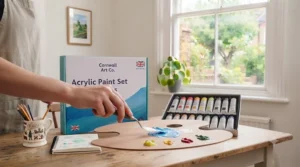
A value acrylic paint set doesn’t have to mean a compromised painting experience — it means understanding the trade-offs and working with them rather than against them. Budget acrylics typically carry less pigment per millilitre, so the single biggest technique adjustment is applying paint in thinner, more deliberate layers rather than expecting one thick coat to achieve full opacity, which cheaper formulas rarely manage.
It’s also worth checking safety labelling on any value acrylic paint set, particularly if it’ll be used around children. UK toy and craft safety rules are governed by the Toys (Safety) Regulations 2011, which set requirements around labelling, chemical restrictions, and UKCA or CE marking for products marketed at younger users — a genuinely useful thing to glance at before buying craft supplies for a child rather than assuming “cheap” and “safe” are unrelated.
Stretching a value acrylic paint set further is mostly about discipline: use a stay-wet palette or a lightly misted surface to stop paint drying out mid-session, mix your own secondary and tertiary colours rather than relying on pre-made tubes, and consider a bottle of matte or gloss medium (usually under £10) to extend thinner paints without sacrificing too much pigment strength. Done properly, a £15 set can comfortably outlast a beginner’s first six months of practice.
✨ Ready to Pick Up Your First Brush?
🎨 Compare the full range of beginner acrylic sets above and find the one that matches your budget and ambitions. Whichever you choose, the most important step is simply starting your first canvas painting today!
Colour Mixing for Beginners
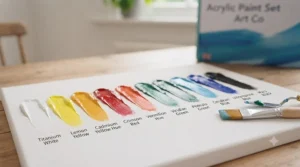
Colour mixing is arguably the single most valuable skill an acrylic paint set for beginners can teach you, and it starts with understanding that most colours you’ll ever need can be built from a genuinely small starting palette: a warm and cool red, a warm and cool yellow, a warm and cool blue, plus titanium white and a dark such as burnt umber or mars black. As Tate’s glossary notes, acrylic paint can be diluted with water or applied thickly depending on the effect you’re after, which directly affects how colours behave once mixed — thinner applications lean more translucent, thicker applications stay closer to true pigment colour.
A practical exercise for beginners: mix your two reds separately with your two blues to see how differently each purple turns out, then repeat with reds and yellows for oranges. This single exercise, done in the first week with a new set, teaches more about colour mixing than reading ten articles on colour theory. Avoid the common trap of reaching for black to darken a colour — it frequently dulls or muddies a mix; a touch of the colour’s complementary shade (or simply a darker version of the same hue) usually produces a richer result.
Cheaper, lower-pigment sets can actually make colour mixing trickier, since thinner paint mixes less predictably and loses vibrancy faster when combined. If your set feels muddy no matter how carefully you mix, it’s worth testing whether a small amount of white added first, before introducing your second colour, produces a cleaner result — a simple fix that solves a surprising number of “why does my mixing look wrong” frustrations.
Understanding Acrylic Paint Drying Time
Drying time is one of acrylic paint’s defining features, and understanding it changes how you actually work with the medium. Thin layers of most beginner acrylic sets are touch-dry within roughly 20-30 minutes at room temperature, while thicker, undiluted applications can take several hours to fully cure beneath the surface, even once the top feels dry to the touch.
This fast drying time is a double-edged sword for beginners. On one hand, it means you can layer colours, correct mistakes, and finish a small canvas painting in a single sitting rather than waiting days between stages, as is common with oil paint. On the other hand, it means blending directly on the canvas — a technique that relies on wet paint staying workable — has to happen quickly, within a couple of minutes of application, before the surface starts to set.
If you want more time to blend, a few genuinely practical fixes help: work in a slightly cooler, more humid room if possible, mist your palette and canvas lightly with water as you go, or add a small amount of acrylic retarder medium, which slows drying time without significantly diluting pigment strength. Budget sets with thinner paint formulas tend to dry faster than heavier-bodied artist-grade paint, so if you’re finding a value acrylic paint set drying almost too quickly to blend, this is a genuine formula difference rather than something you’re doing wrong.
Canvas Painting for Beginners: Getting Started
Canvas painting is where most people picture acrylic paint being used, and it’s a genuinely forgiving surface to start on, provided a few basics are in place first. Pre-primed, pre-stretched canvases (widely sold in multipacks) are the simplest starting point, since the priming layer — usually gesso — stops paint soaking unevenly into raw fabric and gives colours a more consistent, vibrant finish.
For a first canvas painting, working from a simple reference photo with clear, distinct shapes (a single flower, a basic landscape horizon, a piece of fruit) is far more encouraging than attempting a detailed portrait straight away. Block in large shapes and background tones first using a wider, flat brush, then move to a smaller round or filbert brush for detail once the base layers are dry — usually within 20-30 minutes given typical drying time for thin layers.
A common beginner mistake on canvas specifically is painting straight over a still-damp layer, which drags underlying colour up and muddies the new layer. Waiting even a short amount of time between coats — checking dryness with a gentle, dry fingertip touch rather than eyeballing it — solves most of this. Canvas boards (a stiffened card version of stretched canvas) are also worth considering for early practice pieces, since they’re considerably cheaper than proper stretched canvas and remove the pressure of “wasting” an expensive surface while you’re still finding your feet.
Common Mistakes When Buying an Acrylic Paint Set
The most frequent mistake is buying based purely on colour count without checking tube size — a 36-tube set with tiny 6ml tubes can actually contain less total paint than a well-chosen 10-tube set with 60ml tubes. A second common error is assuming “student grade” means poor quality; in reality, brands like Liquitex and Daler-Rowney formulate their student ranges from the same pigment families as their professional lines, just at lower concentration, which is a very different thing from cheap, low-quality paint.
A third mistake is ignoring what’s not included. Many acrylic paint set listings show paint tubes only, with brushes, a palette, and canvas sold separately — factor these into your actual starting budget rather than being surprised at checkout on a second order. Finally, beginners sometimes assume a bigger set is automatically better value; if you’ll realistically only ever use eight or nine core colours, a smaller, higher-pigment set frequently outperforms a 24-tube set you’ll barely touch half of.
FAQ
❓ Is acrylic paint good for beginners?
❓ How many colours do I need in a beginner acrylic paint set?
❓ Do cheap acrylic paint sets work as well as expensive ones?
❓ How long does acrylic paint take to dry?
❓ Can I use acrylic paint straight on canvas without priming?
Conclusion
Choosing the right acrylic paint set for beginners really comes down to being honest about two things: how much you want to spend, and whether you’d rather start painting immediately or build genuine colour-mixing skills from the outset. Budget options like the Crafts 4 All, Mont Marte, Shuttle Art, and Castle Art Supplies sets are ideal low-risk entry points if you’re still working out whether painting is a hobby worth pursuing further. Step up to the Daler-Rowney System3 or Liquitex BASICS sets once you know you’re sticking with it and want noticeably better pigment behaviour without paying full artist-grade prices. And if budget genuinely isn’t the deciding factor, the Winsor & Newton Galeria set is a rare case of a “beginner” product that professionals still reach for.
Whichever set you land on, the real skill-building happens in the first month of actually using it — practising colour mixing, getting comfortable with drying time, and finishing a few rough canvas paintings you’re not precious about. Every single person whose work you admire online started with a set that looked exactly as uncertain and unfinished as your first attempt will.
✨ Don’t Miss These Exclusive Deals!
🔍 Take your painting hobby to the next level with these carefully selected acrylic paint sets. Click on any highlighted item above to check current pricing and availability, and start creating the confident, colourful canvas paintings you’ve been putting off!
Recommended for You
- Dual Tip Brush Pens for Beginners: 7 Best Sets to Try in 2026
- 7 Best Brush Pens for Lettering in 2026 – UK
- Copic Markers Starter Set: 7 Real Picks Compared (2026)
Disclaimer: This article contains affiliate links. As an Amazon Associate, I earn from qualifying purchases. If you purchase products through these links, we may earn a small commission at no additional cost to you.
✨ Found this helpful? Share it with your friends! 💬🤗
