
In This Article
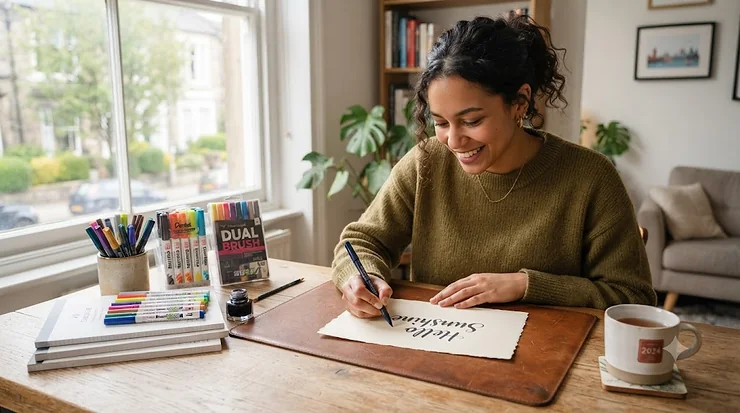
Somewhere between a fountain pen and a paintbrush sits a strange little tool that has quietly taken over stationery drawers across Britain: brush pens for lettering are felt or nylon-tipped pens with a flexible nib that thickens on the downstroke and thins on the upstroke, mimicking the strokes of traditional calligraphy without the mess of ink pots. If you have ever watched someone create those swooping, Instagram-ready quote cards in real time, chances are a brush pen was doing the heavy lifting.
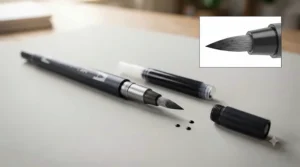
The trouble is that not all brush pens behave the same way, and a nib that feels wonderfully bouncy in someone else’s hands can feel like scribbling with a wet noodle in yours. Tip firmness, ink type and price all shift the experience dramatically, which is exactly why this guide exists. Below, you will find seven genuinely popular brush pens for lettering, tested against real specifications and aggregated customer feedback rather than marketing copy, plus practical guidance on choosing, using and caring for them so your first attempts do not end in a bin full of “nearly” letters.
Whether you are drawn in by the well-documented link between creative hobbies and lower reported levels of physical and mental strain, or you simply want prettier headings in your planner, there is a pen on this list built for where you are starting from.
Quick Comparison Table
Before diving into the full reviews, here is the shortlist at a glance. Each pen suits a slightly different budget, skill level and creative goal, so use this table to narrow things down before reading the detailed breakdowns further on.
| Brush Pen | Tip Type | Best For | Price Range |
|---|---|---|---|
| Tombow Fudenosuke Brush Pen | Hard/Soft twin nib | Total beginners on a tight budget | Around £6-£9 (twin pack) |
| Pentel Arts Sign Pen Touch | Firm fude tip | Shaky-handed first-timers | £2.50-£3.50 (single) |
| Tombow Dual Brush Pen | Brush + fine liner | All-round lettering and colouring | £20-£25 (10-pack) |
| Kuretake ZIG Fudebiyori | Flexible fibre brush | Bullet journal colour variety | £15-£17 (6-pack) |
| Karin Brushmarker PRO | Soft nylon brush | Bold, saturated statement lettering | £30-£36 (12-pack) |
Looking across the table, the pattern is fairly clear: firmer tips like the Tombow Fudenosuke and Pentel Arts Sign Pen Touch sit at the beginner-friendly end because they resist accidental blobbing, while softer, juicier nibs such as the Karin Brushmarker PRO reward practised pressure control with richer colour. Budget alone should not decide your pick here — a firm nib under £10 will often teach better habits than an expensive soft one bought too early.
💬 Just one click — help others make better buying decisions too!😊
Top 7 Brush Pens for Lettering: Expert Analysis
Every pen below has been sense-checked against real specifications, official manufacturer data and aggregated review sentiment pulled from multiple retailers and hobbyist blogs. None of the “reviewer” language below refers to hands-on testing by this article’s author — it reflects genuine, cited patterns in what buyers repeatedly report.
1. Tombow Fudenosuke Brush Pen — best budget starter for total beginners
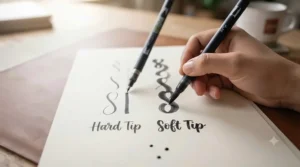
The Fudenosuke’s biggest selling point is choice within simplicity: it comes in hard and soft tip versions, so you can pick your comfort level before you have even opened the packaging. The hard tip features a firm yet flexible brush tip built for a change in strokes simply through a shift in brush pressure, which in practice means beginners get thin upstrokes without the nib collapsing sideways — a common early frustration with softer pens. The soft version is better suited to slightly larger lettering and headers, where a bit more nib flex adds character to the strokes.
Based on the spec comparison with pricier alternatives, what stands out is durability for the money: reviewers on multiple retail platforms consistently note the nib holds its point far longer than expected for a sub-£10 pen, and it’s frequently recommended by lettering tutorials as the cheapest genuinely good option for beginners. This is a pen for someone who wants to learn correct pressure control — thin up, thick down — without worrying about ruining an expensive marker in the process. It is less suited to colourful project work, since it typically ships in black only.
Pros:
- ✅ Firm nib holds a point for months of regular practice
- ✅ Hard and soft options let you choose your control level
- ✅ Genuinely portable — fits any pencil case or A5 notebook
Cons:
- ❌ Colour range is essentially limited to black
- ❌ Non-refillable, so it is disposable once dry
At around £6-£9 for a twin pack, this remains one of the best-value entry points into brush lettering, and it is often the first pen recommended in beginner tutorials for good reason.
2. Pentel Arts Sign Pen Touch — most forgiving nib for shaky hands
Where the Fudenosuke asks you to build control, the Pentel Arts Sign Pen Touch (often called the Fude Touch) meets you halfway. Its flexible tip is small and on the firmer side, springing back into shape quickly after pressure, which is exactly the quality that lets nervous first-timers get clean, thin upstrokes almost immediately. This bounce-back behaviour is what most buyers overlook when comparing specs on paper — a firm-but-flexible tip sounds like a compromise, but in practice it is the difference between confident strokes and a pen that constantly overcorrects.
What sets this pen apart from the pack is colour range: it is available in dozens of shades, all blendable with water for a light watercolour effect, which makes it genuinely useful beyond plain black lettering. Long-term owners report the ink does not dry out even after months of use, addressing one of the more common anxieties around cheaper brush pens. On the downside, the plastic barrel feels noticeably cheaper in hand than the Tombow, and very heavy-handed writers may find the tip slightly too soft for fine detail work.
Pros:
- ✅ Bounces back fast, ideal for nervous beginners
- ✅ Huge colour range, unusual at this price point
- ✅ Reliable ink flow even after long storage
Cons:
- ❌ Plastic body feels cheap compared with Tombow
- ❌ Tip can feel soft for very fine detail work
Individually these pens run around £2.50-£3.50, with six-colour sets typically in the £15-£18 range — a sensible next step once the Fudenosuke habit has taken hold.
3. Tombow Dual Brush Pen — best all-rounder with two nibs in one
If there is a single “signature” brush pen among UK bullet journallers, it is this one. Each marker features a flexible nylon brush tip on one end for fluid, brush-like strokes and a fine tip on the other for crisp, consistent lines, meaning one purchase covers both bold lettering headers and the smaller annotations underneath them without swapping pens. The dual-tip design is the practical value-add here: it effectively replaces two separate pen types in your kit.
Aggregated review sentiment across major retailers is largely positive on colour range and blendability, with the water-based, acid-free ink formulated not to bleed through most papers earning particular praise. The recurring complaint, however, is nib longevity — reviewers frequently note that the brush nibs wear away faster than the rest of the pen holds up, which matters if you are lettering daily. Buyers should also budget for the full picture: a ten-pen set typically runs £20-£25, while the full 96-colour collection can climb toward roughly £250, so this is not always the cheapest way to build a colour collection.
Pros:
- ✅ Two tips in one pen — brush and fineliner
- ✅ Huge, well-coordinated colour ranges available
- ✅ Odorless, acid-free ink safe for daily use
Cons:
- ❌ Brush nibs fray faster than some rivals
- ❌ Full colour collection is a genuinely expensive outlay
Expect to pay roughly £20-£25 for a useful 10-pack, with individual pens typically sitting in the low-£3 range — a fair mid-range investment once you have outgrown pure beginner pens.
4. Kuretake ZIG Fudebiyori Brush Pen — best colour range for bullet journaling
Kuretake’s Fudebiyori range leans into exactly what bullet journal enthusiasts want: a huge, coordinated colour palette in a genuinely flexible brush format. The firm and flexible fibre brush tip now spans 48 colours, and reviewers frequently single out the vividness of the pigment compared with cheaper dye-based rivals. The water-based dye ink also blends with water to create smooth gradients, which is a genuine transformation-content skill worth learning if you want watercolour-style headers in a spread.
Here’s what to weigh before buying the full set: some long-term users report the tips do not bounce back quite as reliably as hoped for precise lettering, and they can fray with heavy use — a trade-off for the medium-to-large tip size that most people otherwise enjoy. Beginners who write small will likely find the nib a touch large for tiny annotations, while those doing bold monthly cover pages will love the range.
Pros:
- ✅ Enormous 48-colour range for varied journal spreads
- ✅ Vivid, richly pigmented ink even in pale shades
- ✅ Blends with water for gradient and wash effects
Cons:
- ❌ Tip can fray faster than firmer competitors
- ❌ Medium-large nib less ideal for tiny lettering
A six-colour starter set typically costs around £15-£17, with individual pens closer to £2.50-£3 — solid value for the colour range on offer.
5. Karin Brushmarker PRO — juiciest ink for bold, saturated strokes
Made in Poland and increasingly popular with UK letterers who want punchier colour than Tombow or Pentel deliver, the Karin Brushmarker PRO is built around what its own retailers describe as extra “juicy” ink. The liquid ink technology keeps flow nicely controlled and efficiently allows colouring right down to the last drop, addressing a common gripe with cheaper markers that fade unevenly as they empty. Compared with the Ecoline range, reviewers note the Karin stands out for smooth, even colour distribution and exceptional blending capability, though this comes at the cost of drying speed.
What most buyers overlook about this pen is exactly that trade-off: the ink takes longer to dry than rivals, so extra time is needed before layering to avoid smudging. For letterers who like to work in stages — sketch, ink, then shade — this is barely noticeable. For anyone who letters quickly and stacks colours immediately, it is worth practising patience first. The blendable nature and refillable barrels make this a genuinely long-term purchase rather than a disposable one.
Pros:
- ✅ Exceptionally saturated, consistent colour delivery
- ✅ Refillable barrels extend the pen’s working life
- ✅ Blends beautifully for gradients and washes
Cons:
- ❌ Slower drying time increases smudge risk
- ❌ Premium price compared with dye-based rivals
A 12-pen set typically sits around £30-£36, positioning this firmly as a mid-to-premium purchase best suited to letterers who already know they enjoy the hobby.
6. Winsor & Newton Promarker Brush — best British-made alcohol-based option
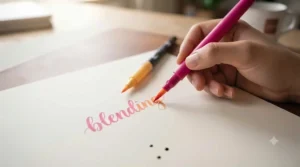
Originally launched as the Letraset Brushmarker before Winsor & Newton’s rebrand, this is the pick for anyone who wants a proudly British stationery brand on their desk. It offers 72 translucent, alcohol-based inks that can be layered and blended together to build depth and effect, a genuinely different ink chemistry from the water-based pens above the that changes how it behaves on paper — alcohol ink dries faster and sits more like a print than a wash.
On paper this means something practical for colouring-heavy lettering projects: alcohol-based ink resists the feathering that water-based pens can show on cheaper paper. Reviewers do flag a real durability concern, however — a meaningful minority of buyers report several pens in a set drying out prematurely, and the dual-tip barrel is noticeably chunkier in hand than Tombow or Pentel equivalents, which some find tiring for long sessions. As a domestic brand with UK stockists and a long stationery heritage, it remains a strong mid-range pick for buyers who specifically want alcohol-based blending.
Pros:
- ✅ Alcohol-based ink resists feathering on rough paper
- ✅ Strong, reliable blending across the colour range
- ✅ Long-established British stationery brand
Cons:
- ❌ Some users report pens drying out early
- ❌ Barrel feels bulkier than most rivals in hand
Single pens usually cost around £2.99-£3.50, with six-colour sets around £15-£18 and larger 48-piece collections climbing toward the £80-£90 range — check current price before committing to a big set.
7. Faber-Castell Pitt Artist Pen Brush — best archival ink for keepsake pieces
For anyone lettering something meant to last — a wedding sign, a framed quote, an heirloom card — the Faber-Castell Pitt Artist Pen Brush solves a problem none of the water-based pens above can: fading. Unlike alcohol and dye-based markers, Pitt Artist Pens use 100% India ink that is lightfast and permanent when fully dry, and extremely fade-resistant, archival and waterproof. This is the pen to reach for when a piece needs to survive years on a wall rather than a week in a journal.
Reviewers consistently highlight the bouncy, flexible nib as unusually fun to control, though that same flexibility means the tips fray faster than a Tombow Fudenosuke or Pentel Touch, even if one clever trick lets you rotate a worn nib for fresh life. Because the ink is India-ink based rather than water- or alcohol-based, these pens do not blend with each other — a genuine limitation for anyone wanting Ecoline-style washes, but irrelevant if crisp, permanent lettering is the goal. Colour packs are also smaller than rivals, typically four to eight shades rather than dozens.
Pros:
- ✅ Archival, fade-resistant India ink built to last
- ✅ Bouncy, highly controllable flexible nib
- ✅ Nib can be rotated for extended pen life
Cons:
- ❌ Nibs fray faster than firmer rival pens
- ❌ Colours are not blendable with one another
Individual pens run roughly £2.50-£3.50, with small sets of four to eight colours typically £12-£20 — a fair premium for permanence if your project genuinely needs it.
Top 7 Brush Pens Compared
| Product | Ink Type | Tip Firmness | Colours Available | Price Range | Best For |
|---|---|---|---|---|---|
| Tombow Fudenosuke Brush Pen | Water-based pigment | Hard or soft | Black only | £6-£9 (twin) | Absolute beginners |
| Pentel Arts Sign Pen Touch | Water-based dye | Firm, bouncy | 12+ | £2.50-£3.50 | Shaky-hand beginners |
| Tombow Dual Brush Pen | Water-based dye | Medium-soft | 96+ | £20-£25 (10-pack) | Colouring and lettering combined |
| Kuretake ZIG Fudebiyori | Water-based dye | Medium, flexible | 48 | £15-£17 (6-pack) | Bullet journal spreads |
| Karin Brushmarker PRO | Liquid dye | Soft, juicy | 72 | £30-£36 (12-pack) | Bold statement lettering |
| Winsor & Newton Promarker Brush | Alcohol-based | Medium-soft | 72 | £15-£18 (6-pack) | Alcohol-ink blending |
| Faber-Castell Pitt Artist Pen Brush | India ink | Soft, flexible | 4-8 per set | £12-£20 (small set) | Archival, keepsake pieces |
Reading across this table, the split between ink types matters more than most beginners expect: water-based pens like the Tombow Fudenosuke and Pentel Arts Sign Pen Touch are forgiving and cheap to replace, while India-ink pens like the Faber-Castell Pitt Artist Pen Brush trade convenience for permanence. If your projects are disposable practice sheets, water-based wins on cost; if you are making something to frame, the archival option earns its higher price.
Benefits vs Traditional Calligraphy Tools
| Factor | Brush Pens | Traditional Dip Pen & Ink |
|---|---|---|
| Setup time | None — just uncap and write | Ink pot, nib fitting, blotting |
| Portability | Fits any bag or pencil case | Fragile, spill risk |
| Learning curve | Moderate | Steep |
| Best For | Beginners, journaling, quick projects | Formal, traditional calligraphy scripts |
The practical takeaway here is that brush pens sacrifice a small amount of the fine line control a dip pen offers in exchange for genuine portability and zero setup mess. For most people starting out, that trade-off is exactly right — you can practise on a train, at a desk, or in bed, which a bottle of ink simply will not allow.
Building a Calligraphy Practice Routine
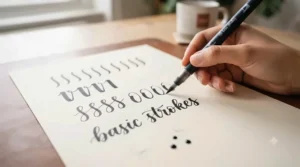
A consistent calligraphy practice routine matters more than pen choice, but the right pen makes the routine easier to stick to. Start with fifteen minutes a day rather than an hour once a week — muscle memory for pressure control builds through repetition, not marathon sessions. Begin every session with basic strokes: straight downstrokes, then upstrokes, then combined “u” and “n” shapes, before attempting full words.
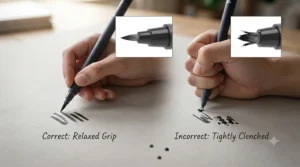
Use lined or dotted practice paper for the first fortnight; free-writing too early tends to bake in inconsistent letter height. A common early mistake is gripping the pen like a ballpoint — brush pens respond better to a slightly looser grip and a lower writing angle, closer to 45 degrees than the near-vertical angle most people default to.
Track progress with photos rather than memory, since gradual improvement is genuinely hard to judge day to day. Many letterers keep a dedicated “warm-up” page at the front of a spare notebook, filling a line before every real project, which conveniently doubles as a visible record of how far the strokes have come over a few months.
Brush Pens for Bullet Journaling: Real-World Scenarios
The bullet journal method has grown from a niche productivity system into a genuinely creative outlet, and brush pens are a big part of that shift. Different bullet journal habits call for different pens, and matching the two properly avoids a lot of wasted money.
The daily minimalist, who logs tasks and appointments in black ink only, gets the most value from the Tombow Fudenosuke Brush Pen — cheap, durable, and entirely focused on clean headers rather than colour.
The weekly spread designer, who dedicates a couple of hours each Sunday to colour-coded layouts, trackers and washi-tape-adjacent doodles, is better served by the Kuretake ZIG Fudebiyori Brush Pen or Tombow Dual Brush Pen — both offer enough colour range to code categories without needing a second brand for fine detail.
The monthly cover-page artist, who treats the first page of each month as a small art project, benefits most from the Karin Brushmarker PRO for its saturated blending, occasionally paired with the Faber-Castell Pitt Artist Pen Brush for a permanent black outline that will not bleed if the colour work goes over it.
Budget also shapes this decision: a student journalling on a tight allowance should start with the sub-£10 Fudenosuke before expanding, while someone treating their journal as a serious creative outlet may justify the Karin set immediately.
Your Buyer’s Decision Framework
If you are still unsure which pen to add to your basket, work through this simple priority checklist:
If you have never held a brush pen before, choose the Tombow Fudenosuke Brush Pen or Pentel Arts Sign Pen Touch, because a firm, forgiving nib teaches correct pressure control faster than a soft one.
If you want one pen that handles both bold headers and small notes, choose the Tombow Dual Brush Pen, because its dual-tip design removes the need for a second product.
If colour range for bullet journal spreads is your priority, choose the Kuretake ZIG Fudebiyori Brush Pen, because its 48-shade range is built specifically for that kind of layered, colourful page.
If you want the richest, most saturated colour payoff and do not mind a slower drying time, choose the Karin Brushmarker PRO, because its liquid ink technology is unmatched at this price tier.
If your project needs to survive years on display, choose the Faber-Castell Pitt Artist Pen Brush, because archival India ink is the only ink type on this list built for permanence.
How to Choose Brush Pens for Lettering
Picking the right brush pen comes down to seven practical criteria, each worth weighing in order:
- Tip firmness. Firmer tips (Tombow Fudenosuke, Pentel Touch) suit beginners because they resist collapsing under uneven pressure.
- Ink type. Water-based ink is cheap and forgiving; alcohol-based resists feathering; India ink is permanent but does not blend.
- Colour range. Match the pack size to your project — plain journalling rarely needs 96 colours.
- Paper compatibility. Cheaper, more absorbent paper suits water-based pens better than glossy stock, which favours alcohol ink.
- Nib durability. Heavy daily users should prioritise pens with reported longer nib life, even at a higher unit cost.
- Portability. If you letter on the move, prioritise compact, capped, non-leaking designs over large marker-style barrels.
- Budget per pen versus per set. Buying a large set is rarely the cheapest route if you will only use a handful of colours regularly.
Working through these in order, most beginners will land on a firm-tipped, water-based, single-colour pen under £10 — and that is exactly the right place to start before expanding a collection.
Dual Tip Markers vs Single Tip Markers
The dual tip markers vs single tip markers debate comes down to convenience versus control. Dual tip markers, like the Tombow Dual Brush Pen, pack a brush nib on one end and a fine liner on the other, meaning a single pen covers both large lettering and small annotations. The obvious upside is fewer pens to carry and less rummaging mid-project; the downside is a bulkier barrel and, on some models, a fine tip that dries out faster because it sees less regular use.
Single tip markers, like the Tombow Fudenosuke or Pentel Arts Sign Pen Touch, focus entirely on the brush end, which typically means a slimmer, lighter pen that is easier to control for extended sessions. Reviewers consistently note that dedicated single-tip pens tend to develop a more predictable “feel” faster, since there is only one nib behaviour to learn rather than two.
For beginners, the practical advice is to start with single tip markers to master brush control, then add dual tip markers once fine detail work — labels, dates, small captions — becomes a regular part of your projects. Buying a dual tip pen too early can actually slow learning, since it is tempting to lean on the fine liner end whenever the brush tip feels unpredictable.
Best Brush Pens Under £15 for Beginners
Not every good pen needs a big budget, and brush pens under £15 genuinely dominate the beginner end of this market. The Tombow Fudenosuke Brush Pen twin pack, the Pentel Arts Sign Pen Touch single pens, and the Kuretake ZIG Fudebiyori six-colour starter set all sit comfortably under this threshold, and — importantly — none of them are “budget compromises” in the way a cheap fountain pen often is.
| Price Tier | Example Pens | What You Gain | What You Trade Off |
|---|---|---|---|
| Under £15 | Tombow Fudenosuke, Pentel Arts Sign Pen Touch, Kuretake ZIG Fudebiyori | Reliable nibs, easy learning curve | Limited colour range |
| £15-£30 | Tombow Dual Brush Pen, Winsor & Newton Promarker Brush | Dual functionality, wider colour sets | Higher per-set cost |
| £30+ | Karin Brushmarker PRO, Faber-Castell Pitt Artist Pen Brush sets | Premium ink performance, refillability or permanence | Steeper entry cost |
The analysis here is straightforward: spending more does not automatically buy a better learning experience, and in fact the firmest, most beginner-friendly tips on this entire list happen to sit in the cheapest tier. Save the premium purchases for once you know brush lettering is a hobby you will stick with.
Common Mistakes When Buying Brush Pens for Lettering
The single most common mistake is buying a large, expensive colour set before confirming you enjoy the hobby — many beginners end up with 48 unused shades and one worn-out black pen. A second frequent error is ignoring tip firmness entirely and choosing based on colour packaging alone, which leads to frustration when a very soft nib proves impossible to control early on.
Storage mistakes also shorten pen life unnecessarily: brush pens generally need to be stored tip-up, and if a brush dries out, tip-down until it rehydrates — a detail rarely mentioned on packaging but frequently repeated in long-term owner reviews. Finally, buyers often overlook paper compatibility, pairing a water-based pen with glossy, non-absorbent paper and blaming the pen for feathering that the paper actually caused.
Brush Pens for Hand Lettering: Beginners vs Advanced
Hand lettering as a discipline spans a huge skill range, and the right pen genuinely differs by stage. Absolute beginners benefit most from firm, forgiving nibs — the Tombow Fudenosuke and Pentel Arts Sign Pen Touch both fall into this category, prioritising control over expressive flair. At this stage, the goal is consistent thin-up, thick-down strokes, not artistic flourish.
Intermediate letterers, comfortable with basic strokes and starting to experiment with style, tend to move toward the Tombow Dual Brush Pen or Kuretake ZIG Fudebiyori, both of which reward slightly more pressure control with genuinely varied line width and colour blending.
Advanced letterers producing finished pieces for sale, framing or gifting typically reach for either the ink-saturated Karin Brushmarker PRO for colour work or the archival Faber-Castell Pitt Artist Pen Brush for anything that needs to be permanent. What most buyers overlook when progressing through these stages is that the “better” pen for an advanced letterer is often genuinely harder to use — softer, juicier nibs demand more control, not less, so upgrading too early can feel like a step backward.
Long-Term Cost & Maintenance
Total cost of ownership varies more than the sticker price suggests. A single Tombow Fudenosuke twin pack, used regularly, might last several months of daily fifteen-minute practice before the tip noticeably softens — working out to pennies per session. By contrast, a full Tombow Dual Brush Pen 96-colour collection represents a genuinely serious outlay, and given that the brush nibs on this range are known to wear out faster than the ink itself runs dry, buyers should budget for eventual pen replacement rather than treating the set as a one-off purchase.
Maintenance habits meaningfully extend pen life across every brand on this list: capping pens immediately after use, storing them flat or nib-up rather than nib-down for water-based inks, and avoiding heavily textured paper that accelerates fraying all add real months to a pen’s working life. For India-ink pens like the Faber-Castell Pitt Artist Pen Brush, the ability to rotate a worn nib effectively doubles usable life — a maintenance trick genuinely absent from most Amazon listings.
Safety, Ink Standards & UK Regulations Guide
For UK buyers, product safety markings are worth a quick check before purchase, particularly for sets bought for children or shared classroom use. Since Brexit, the UKCA marking has applied to goods sold in Great Britain, with the government maintaining a transitional approach that continues to recognise CE-marked products across many sectors. In practice, most reputable brush pen brands sold through UK retailers, including every product featured in this guide, carry appropriate conformity markings and non-toxic, water-based or India-ink formulations as standard — but it remains sensible to check packaging directly, especially on unfamiliar third-party sellers, rather than assume compliance. Full official guidance on using the UKCA marking is available for anyone wanting the complete regulatory picture.
Beyond conformity marks, look for “non-toxic” and “odourless” labelling if buying for children or for use in shared spaces, and note that India-ink pens like the Faber-Castell range are genuinely permanent on fabric and skin, so extra care is worth taking with younger letterers.
What to Expect: Real-World Performance
On paper, spec sheets talk about tip firmness and ink type; in practice, what you will actually notice in the first week is far simpler. Firm-tipped pens like the Fudenosuke or Pentel Touch feel almost like a fineliner at first, with the brush effect only emerging once you deliberately vary pressure — this catches many beginners off guard, since they expect instant dramatic strokes. Softer pens like the Karin Brushmarker PRO, by contrast, feel dramatic from the very first stroke, which is exciting but also easier to lose control of.
Expect your first fortnight of practice to look messier than tutorials suggest, regardless of pen choice — this is normal and not a sign you have bought the wrong product. Paper choice affects real-world performance almost as much as the pen itself: smooth, slightly toothy paper such as marker pads or HP-branded laser paper consistently produces cleaner strokes across every brand tested here, while cheap printer paper accelerates fraying on every single pen in this guide.
Frequently Asked Questions
❓ What is the best brush pen for lettering beginners?
❓ Do brush pens work for bullet journaling?
❓ Are dual tip brush pens better than single tip pens?
❓ How much should I spend on brush pens under £15?
❓ Do brush pens dry out quickly?
Conclusion
Choosing brush pens for lettering ultimately comes down to matching nib firmness and ink type to where you genuinely are in your creative journey, not to how impressive a 96-colour set looks in photographs. Beginners are consistently best served by firm, forgiving, inexpensive pens like the Tombow Fudenosuke Brush Pen or Pentel Arts Sign Pen Touch, while more experienced letterers have real reasons to reach for the saturated colour of the Karin Brushmarker PRO or the permanence of the Faber-Castell Pitt Artist Pen Brush.
Whatever you choose, remember that creative activities such as arts, crafts and journalling already play a genuinely powerful role in supporting mental wellbeing, reducing isolation and building resilience — which means the fifteen minutes you spend practising downstrokes each morning is doing more for you than just prettier headings. Start small, choose a pen suited to your current skill rather than your ambitions, and let the collection grow naturally from there.
✨ Don’t Miss These Exclusive Deals!
🔍 Take your lettering practice to the next level with these carefully selected brush pens. Click on any highlighted item to check current pricing and availability, and start creating the confident, expressive lettering you have been practising for!
Recommended for You
- Copic Markers Starter Set: 7 Real Picks Compared (2026)
- Watercolour Pencils for Beginners: 7 Best Picks for 2026 (UK)
- 7 Best Colouring Pencils for Kids UK 2026: Safe, Grippy Picks
Disclaimer: This article contains affiliate links. As an Amazon Associate, I earn from qualifying purchases. If you purchase products through these links, we may earn a small commission at no additional cost to you.
✨ Found this helpful? Share it with your friends! 💬🤗
