
In This Article
There’s a particular kind of panic that hits in April. You’ve got three science exams looming, a folder stuffed with highlighted notes that’s somehow both enormous and completely useless, and the vague memory of having “done” the rock cycle three weeks ago. But done it? Or just looked at it really hard for an hour?
Here’s the uncomfortable truth: passive revision — rereading, copying out, even making those extraordinarily beautiful colour-coded notes — is about as effective as hoping the information seeps into your brain through the sheer proximity of your textbook. Research consistently shows that passive review yields a retention rate of around 5%, while active recall — the kind you get from testing yourself with flashcards — is one of the most powerful revision tools available to GCSE students. Birmingham City University’s academic resources describe spaced repetition combined with flashcard use as a cornerstone of smart exam preparation.
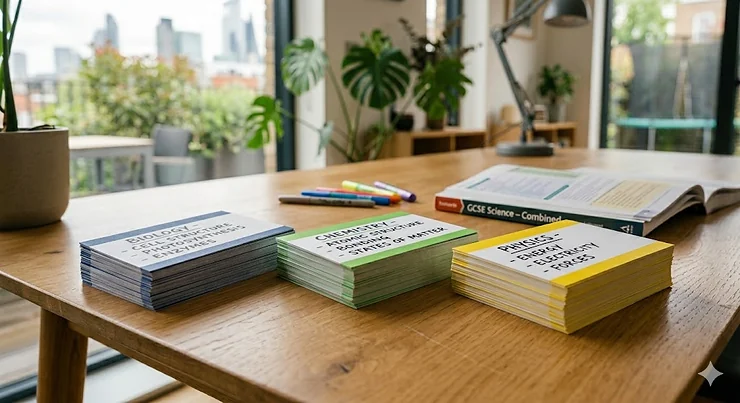
That’s exactly why revision flashcards for GCSE science have become such a staple in Year 10 and 11 households across Britain. Done well, a good set of cards forces you to retrieve information from memory — the mental struggle that actually builds lasting recall. Done badly, they’re just expensive confetti.
This guide cuts through the noise. I’ve researched every major set available on Amazon.co.uk in 2026, compared the formats, the exam board coverage, the value for money, and crucially — which type of student each set actually suits. Whether you’re after a ready-made pack from CGP, the Oxford Revise range grounded in cognitive science, or blank indexed A6 cards to build your own system, there’s an option here for you.
Quick Comparison: Revision Flashcards for GCSE Science at a Glance
| Product | Exam Board | Format | Cards | Best For | Price Range |
|---|---|---|---|---|---|
| CGP AQA Combined Science Q&A Cards | AQA | Pre-printed Q&A | 180+ | Active recall, budget buyers | Under £10 |
| Oxford Revise AQA Combined Science Higher | AQA | Pre-printed retrieval | 180 | Higher tier, cognitive-science approach | Around £10–£12 |
| Collins AQA 9-1 Combined Science Cards | AQA | Pre-printed summary | 120+ | Visual learners, quick recap | Under £10 |
| Pearson REVISE Edexcel Combined Science Higher | Edexcel | Pre-printed + online access | Variable | Edexcel students with digital revision habits | Around £10–£12 |
| CGP Edexcel Combined Science Q&A Cards | Edexcel | Pre-printed Q&A | 189 | Active self-testing, organised revisers | Under £10 |
| CGP AQA Triple Science Bundle (Bio, Chem, Phys) | AQA | Pre-printed Q&A | 95 per subject | Triple science students | £20–£30 range |
| Oxford Revision Cards A6 (Blank, Ruled) | Any | DIY blank cards | 200 | Custom revision systems, all subjects | Under £10 |
The table above makes one thing immediately obvious: if you’re on AQA, you’re genuinely spoilt for choice — three distinct publishers have produced solid, curriculum-aligned card sets for 2026. Edexcel students have fewer options but CGP and Pearson both deliver quality. The blank Oxford cards occupy a different category entirely; they’re not a replacement for the pre-printed sets, but they work brilliantly alongside them or for students who learn best by creating their own cards from scratch.
💬 Just one click — help others make better buying decisions too! 😊
✨ Don’t Miss These Exclusive Deals!
🔍 Take your GCSE science revision to the next level with these carefully selected products. Click on any highlighted item to check current pricing and availability on Amazon.co.uk. These picks will help you find exactly what you need!
Top 7 Revision Flashcards for GCSE Science: Expert Analysis
1. CGP GCSE Combined Science AQA Revision Question Cards
CGP has quietly become the de facto revision publisher for British teenagers, and this AQA Combined Science Q&A card set is arguably their finest hour. The pack contains over 180 cards covering all the key Biology, Chemistry, and Physics topics from the Grade 9-1 AQA Trilogy course — that’s a considerable haul for the price.
What sets these apart from a straightforward fact-card format is the tiered questioning system. Each card opens with accessible warm-up questions, then escalates to harder, exam-style questions on the reverse. Flip the card and you get carefully written answers alongside diagrams and expert revision tips. There are even sections on Working Scientifically and Practical Skills — the bits that trip up students who’ve memorised every equation but never thought about how to write up a method.
In terms of who this is for: the Q&A format suits students who need external structure. If left to their own devices, they’d probably just skim through cards nodding along (“yes, yes, I know this”) without actually testing themselves. The question format removes that temptation entirely. Parents using these for dinner-table quizzes will find them equally practical — one reviewer mentioned exactly that, and it’s a genuinely good use case.
UK reviewers on Amazon.co.uk are overwhelmingly positive, with customers highlighting the value for money and the fact that the cards make revision feel “quick and engaging” rather than a slog. Prime-eligible, in stock, and available for free delivery on orders over £25 or with a Prime subscription.
✅ Q&A format prevents passive reading
✅ Covers Working Scientifically and practicals
✅ Exceptional value at under £10
❌ Combined Science only — triple science students need the separate bundle
❌ Some students find the card size slightly small for making annotations
Price range: Under £10. For the depth of coverage, this is outstanding value.
2. Oxford Revise AQA GCSE Combined Science Trilogy Higher Revision Flashcards
Oxford University Press has taken a different approach with the Oxford Revise range — and it’s one worth paying attention to. These 180 cards were developed using cognitive science research into effective revision strategies, and it shows in the structure. Rather than simply listing definitions, each card is designed around retrieval practice: you’re asked to recall, apply, and explain, not just recognise.
The cards cover the full AQA GCSE Combined Science Higher specification, are structured by topic, and can be used either independently or alongside the corresponding Oxford Revise Revision Guide. The colour-coding by subject (Biology, Chemistry, Physics) makes flipping between topics intuitive, and the physical quality is noticeably solid — these won’t fall apart after a fortnight of being shoved in a school bag.
The cognitive-science angle isn’t marketing fluff. The Education Endowment Foundation and research from multiple UK universities support retrieval practice as one of the highest-impact study strategies available. Oxford has clearly done its homework, and the card structure reflects that.
This set is ideal for Higher tier students who want revision cards that do more than summarise — cards that actively challenge their understanding and replicate the mental effort of exam conditions. A slightly pricier option than CGP, but the methodology justifies it for serious students.
✅ Built on peer-reviewed cognitive science
✅ Exam-style questions throughout
✅ Robust physical quality
❌ Higher tier only — Foundation students need a separate pack
❌ Slightly higher price point than CGP equivalent
Price range: Around £10–£12. Well worth it for Year 11 students in the final push.
3. Collins GCSE AQA 9-1 Combined Science Revision Cards
Collins takes a gentler approach than CGP or Oxford, and that’s not a criticism — it’s a deliberate design choice that suits a specific kind of learner rather well. The Collins AQA Combined Science cards are structured as concise topic summaries rather than Q&A challenges. Each card distils the key information for a topic into digestible chunks, with clear diagrams and colour-coded subject sections.
The layout is genuinely attractive. Where some revision materials feel like they were designed by someone who has never met a tired Year 11 student, Collins has produced something that doesn’t make you want to throw it across the room. Reviewers consistently mention the visual clarity and accessible layout, with one noting they’re “colourful and easy to understand.”
The honest caveat: these work best as a recap tool rather than a primary revision method. One thoughtful reviewer made the point well — “good overall summary, but you’d definitely need alternative resources to build knowledge.” That’s fair. Use these to consolidate what you already know, not to learn material from scratch.
For students who’ve done the groundwork in their revision guides and textbooks, these cards are an efficient final-stage review tool. At under £10, they’re accessible, and the compact format makes them genuinely portable — into a bag, onto a bus, into an exam revision session at school. Prime-eligible and in stock on Amazon.co.uk.
✅ Clean, appealing visual design
✅ Ideal for final consolidation and recap
✅ Budget-friendly price
❌ Summary format — less effective for active retrieval than Q&A alternatives
❌ Better as a supplement than a standalone revision tool
Price range: Under £10. Best used alongside a practice paper or revision guide.
4. Pearson REVISE Edexcel GCSE Combined Science Higher Revision Cards
For Edexcel students — and it’s worth noting that Edexcel is the exam board for a substantial proportion of students in England — Pearson’s own revision cards are the obvious starting point. The Higher tier set covers the full combined science specification and comes with a genuinely useful bonus: a code inside the pack that unlocks access to an eBook Revision Guide on Pearson Revise Online, including a revision planner and a digital flashcard creator.
That hybrid physical-plus-digital approach is something the other publishers in this list don’t match. A student can work through the physical cards at home, then switch to the online flashcard tool during lunch or on their phone during a commute. For the kind of student who lives on their phone anyway, that seamless crossover matters.
The physical cards themselves are compact and well-organised. A reviewer whose son was “struggling with the daunting GCSE science curriculum” praised the visual design, and another confirmed they work particularly well for visual learners. The font is on the small side — one reviewer flagged this specifically as a concern for a student with accessibility needs — so it’s worth bearing in mind for students who need larger text.
In stock on Amazon.co.uk, Prime-eligible. For Edexcel Higher students wanting a fully integrated revision system from their own exam board, this is the natural choice.
✅ Includes online digital companion tools
✅ Published by the exam board itself — specification alignment is guaranteed
✅ Hybrid physical and digital revision approach
❌ Font size may be a barrier for some students
❌ Online tools require internet access — not ideal for offline revision sessions
Price range: Around £10–£12. The digital add-ons push the value case here.
5. CGP GCSE Combined Science Edexcel Revision Question Cards
If Pearson’s own offering feels a bit corporate for your taste, CGP’s Edexcel equivalent is the livelier alternative. The 189-card set covers all Biology, Chemistry, and Physics topics from the Edexcel Combined Science course, with the same tiered Q&A format that makes the AQA version so effective. Each subject is colour-coded, topics are clearly labelled, and the visual presentation — diagrams, tips, bite-sized questions — is thoroughly CGP.
One detailed reviewer laid out the structure clearly: 189 cards total, 63 per subject, each with nine topic areas, covering both Foundation and Higher-level questions on the same card. That last point is worth emphasising. If a student is borderline between tiers, having both question levels on the same card lets them stretch beyond their comfort zone without buying two separate sets. That’s genuinely practical design thinking.
Reviewers describe the writing as “clear and concise” with visuals that are “great and easy to follow.” In stock, Prime-eligible. For Edexcel students who’ve used CGP throughout their GCSE course and trust the format, this is the obvious continuation.
✅ 189 cards covers the full Edexcel specification comprehensively
✅ Both Foundation and Higher questions on each card
✅ Consistent with CGP’s familiar, student-friendly house style
❌ Combined Science only; separate science students need individual subject packs
❌ No digital companion (unlike the Pearson alternative)
Price range: Under £10. Tremendous coverage for the price.
6. CGP AQA GCSE Triple Science Revision Q&A Cards Bundle (Biology, Chemistry & Physics)
Triple science students — the ones sitting separate Biology, Chemistry, and Physics GCSEs — have a genuinely different revision challenge from their combined science peers. The specification depth is greater, the content more demanding, and the exam pressure trebled. CGP’s Triple Science bundle addresses this with three separate card packs (Biology, Chemistry, Physics), each containing 95 cards covering every key AQA topic for the individual subject GCSEs.
Ninety-five cards per subject might sound like less than the 180-card combined science packs, but the content is denser. These cards go further into each topic than the combined science equivalents — they have to, because triple science students are expected to know more. The Q&A format remains consistent with the rest of the CGP range: warm-up questions building to harder exam-style challenges, with answers and revision tips on the reverse.
The bundle format is excellent value if you’re buying all three — it works out meaningfully cheaper than purchasing each subject individually. That said, if you’re only weak in one or two subjects, individual packs are available separately.
For academically ambitious students aiming for grades 7-9 across their sciences, this bundle is a proper revision toolkit. It won’t replace past papers, but used alongside a spaced repetition schedule (more on that below), it covers the active recall side of revision comprehensively.
✅ Full triple science coverage in one purchase
✅ Denser content appropriate for separate science depth
✅ Bundle pricing offers excellent value
❌ Larger investment — not ideal if you only need one subject
❌ Volume of cards can feel daunting without a structured revision plan
Price range: £20–£30 range for the bundle. Individual subject packs available separately at around £6–£8 each.
7. Oxford Flash Cards Revision Cards A6, Ruled, Assorted Colours
Here’s the contrarian option, and I’d argue it’s underrated. Oxford’s own blank A6 revision cards — ruled, colour-coded, available in packs of 200 — aren’t a shortcut. They’re actually more work than buying a pre-printed set. But for the right student, that extra work is the entire point.
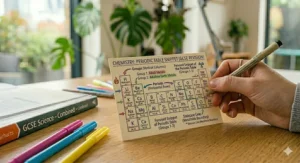
The act of creating your own flashcards is itself a powerful revision technique. You have to identify what’s important, decide how to phrase a question, condense the answer, and organise cards by topic. Every one of those micro-decisions requires you to think about the material — which is, after all, the goal. Research from the Education Endowment Foundation consistently highlights metacognitive strategies — knowing what you know and don’t know — as among the highest-impact techniques available to students.
Oxford’s cards are decent quality: the paper takes pen and marker without bleed-through, they’re a sensible A6 size (roughly 10 × 15 cm, big enough to be readable but compact enough to carry anywhere), and the assorted colours let you assign one colour per subject — a simple but effective organisation system.
These suit students who are already organised and disciplined, or who are studying subjects where no good pre-printed set exists. They’re also brilliant for GCSE Maths formula cards — a gap the pre-printed science sets tend not to fill.
✅ Card creation process reinforces learning independently
✅ Works for any subject, any exam board
✅ Quality paper that handles pen and highlighter without bleed
❌ Requires time and self-discipline to create
❌ No content guidance — not suitable as a sole revision strategy for content-heavy students
Price range: Under £10 for 200 cards. Outstanding value if you’re prepared to put in the work.
How the Science of Memory Makes Flashcards Work
It’s one thing to buy a pack of revision flashcards. It’s another to use them in a way that actually shifts information into long-term memory. This is where most students leave serious marks on the table.
The key concept is spaced repetition — reviewing information at increasing intervals rather than cramming it all in one go. The research behind this is robust and has been replicated across dozens of studies. Birmingham City University’s academic guidance explains the principle clearly: you study material, then review it two days later, then three days after that, then five days, then seven. Each time you successfully recall something, you push the next review further out. Each time you struggle, you bring it closer.
The practical version for GCSE students is this: sort your cards into three piles. Cards you can answer confidently go into the “review in a week” pile. Cards you’re shaky on go into “review in three days.” Cards that completely stumped you go into “review tomorrow.” That’s the Leitner system, and it’s been around since the 1970s for good reason — it works.
Pair this with the Q&A format of the CGP or Oxford cards and you’ve got a genuinely powerful revision system. The pre-printed sets do the content curation for you; the spaced repetition structure tells you when to revisit. Used together, they’re considerably more effective than an evening with a textbook and a highlighter.
One practical note: if you’re using the CGP or Collins cards, resist the urge to sort through the whole pack in one go. That’s essentially passive review disguised as active revision. Pick one topic, test yourself properly, and move on.
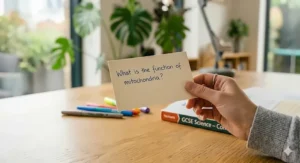
Choosing the Right Set: A Practical Decision Guide
With seven solid options on the table, the real question is which one suits your specific situation. Here’s how to think about it.
If you’re doing AQA Combined Science at Higher tier — the Oxford Revise Higher cards are the premium pick if you want the most rigorous retrieval practice. The CGP AQA Q&A cards are the better value option and frankly almost as good.
If you’re doing AQA Combined Science at Foundation tier — go CGP for the Q&A challenge, or Collins if you want something gentler to build confidence before escalating to harder practice.
If you’re doing Edexcel Combined Science — Pearson’s own cards win if you value the digital companion tools. CGP Edexcel wins on pure card value and the dual Foundation/Higher question format.
If you’re doing Triple Science — the CGP AQA Triple Bundle is the sensible all-in-one investment if you’re buying across all three subjects.
If you’re a self-directed learner who retains things better by creating your own notes — blank Oxford A6 cards, paired with your syllabus checklist and past paper mark schemes, will serve you better than any pre-printed alternative.
If your budget is tight — any of the under-£10 options (CGP, Collins) represent exceptional value. Free delivery on Amazon.co.uk orders over £25 means combining a science card pack with a maths revision book in a single order makes financial sense.
Common Mistakes When Using GCSE Science Flashcards
Even the best set of revision flashcards for GCSE science becomes deadweight if used badly. Here are the pitfalls that show up most often.
Treating them like reading material. Flicking through a pack of cards and nodding along is not revision. It’s a convincing impersonation of revision. The cards only work if you’re forcing your brain to retrieve the answer before you flip the card. Cover the answer, say it out loud or write it down, then check. The struggle is the point.
Trying to use them too early. Flashcards consolidate and test knowledge — they don’t build it from nothing. Using them before you’ve covered a topic properly produces frustration, not learning. Do the textbook or revision guide work first, then shift to cards for active recall.
Ignoring the ones you find hard. There’s a very human tendency to linger on the cards you already know. They feel good. The ones you don’t know feel bad. But exam marks come from knowing the hard stuff, not polishing the easy stuff. The spaced repetition approach described above directly addresses this.
Buying the wrong exam board. It sounds obvious, but it’s a surprisingly common error, particularly for parents buying on behalf of their children. AQA and Edexcel specifications differ meaningfully, and using the wrong set means revising content that won’t appear in your exam. Double-check the exam board on your school’s specification documents before ordering.
Using them in complete isolation. Flashcards are one tool in a revision toolkit. The Education Endowment Foundation rates retrieval practice highly, but notes it works best when combined with spaced practice, elaborative interrogation (asking “why?”), and concrete examples. Past papers remain the single most effective form of exam preparation — cards prepare you for them, not replace them.
Flashcards vs Other Science Revision Methods: What Actually Works
Let’s be honest about where flashcards sit in the broader revision landscape, because buying a set of cards and expecting miracles is a recipe for disappointment.
| Method | Best For | Limitations |
|---|---|---|
| Flashcards (Q&A) | Definitions, processes, formulas | Doesn’t develop exam technique |
| Revision Guides | Building understanding | Passive without active recall component |
| Past Papers | Exam technique and timing | Requires underlying knowledge first |
| Mind Maps | Seeing big-picture connections | Can become a creative project rather than revision |
| Colour-Coded Notes | Some retention through writing | Passive; time-consuming for limited return |
The honest answer is that a combination of approaches — flashcards for active recall, revision guides to fill knowledge gaps, and past papers for exam practice — produces better outcomes than any single method. As Blossom Learning notes, passive review yields around 5% retention compared with the significantly higher rates achieved through active recall and retrieval practice. That’s a meaningful difference in exam outcomes.
Flashcards are most powerful in the consolidation and testing phase — typically from around Easter of Year 11 onwards, once the content has been taught and partially reviewed. Use them systematically, combine them with past papers, and the combination is hard to beat.
✨ Found a set that works for you?
🔍 Click on any highlighted product to check current pricing and availability on Amazon.co.uk. Don’t forget — orders over £25 qualify for free standard delivery, and Prime members get next-day options on most of these in-stock titles.
How to Choose Revision Flashcards for GCSE Science in the UK: 5 Key Criteria
Choosing revision flashcards for GCSE science comes down to five things.
- Exam board alignment — AQA, Edexcel, and OCR specifications differ significantly. Always confirm your board before purchasing. Most Amazon.co.uk product pages list the board prominently.
- Combined vs Triple Science — Combined Science (double award) and Triple/Separate Science cover overlapping but different content depths. Triple science students need either individual subject packs or the CGP Triple bundle.
- Tier: Foundation or Higher — Higher tier cards often include content not examined at Foundation level. Some sets (like the CGP Edexcel cards) include questions for both tiers; others are tier-specific.
- Pre-printed vs blank — Pre-printed cards (CGP, Oxford, Collins, Pearson) are faster to use and content-curated by experts. Blank cards reward students who benefit from the creation process. Many students use both.
- Format: summary vs Q&A — Summary cards (Collins, some Pearson) are better for consolidation. Q&A cards (CGP, Oxford Revise) are better for active retrieval practice. For most students aiming to genuinely move the dial on their grades, Q&A format wins.
FAQ
❓ Are revision flashcards for GCSE science actually effective, or just expensive paper?
❓ Which flashcard set is best for AQA GCSE Combined Science Higher?
❓ Can I use AQA flashcards if I'm sitting Edexcel exams?
❓ Do GCSE science flashcards cover the 2026 and 2027 exam specifications?
❓ Is it worth making my own flashcards rather than buying pre-printed ones?
Conclusion: Stop Highlighting, Start Testing
If there’s one thing the science of memory makes unambiguous, it’s this: you learn by doing, not by watching. Flicking through revision notes, rereading textbook chapters, adding one more highlighter colour to your already luminescent A-level Physics diagram — none of it moves information into long-term memory the way active retrieval does.
Revision flashcards for GCSE science, used properly, are one of the most time-efficient and evidence-backed tools you have. Pair a quality pre-printed set with a spaced repetition schedule and past papers, and you’ve got a revision system that actually works — not one that merely looks impressive on a bedroom desk.
The CGP sets remain the best all-round value on Amazon.co.uk in 2026, particularly for AQA students. Oxford Revise is the standout choice for students who want the most methodologically rigorous option. Pearson suits Edexcel students who want an integrated digital-physical system. And if you’re the sort of person who learns best by building things — blank cards and a colour-coding system remain entirely valid.
Start earlier than feels necessary. Test harder than feels comfortable. And maybe — just maybe — close the highlighter.
✨ Don’t Miss These Exclusive Deals!
🔍 Ready to get started? Click any highlighted product above to check current pricing and availability on Amazon.co.uk. With free delivery on orders over £25 and next-day delivery for Prime members, you could be revising properly by tomorrow.
Recommended for You
- Best 11 Plus Maths Revision Guide UK 2026: Top 7 Expert Picks
- Best Year 6 SATs Revision Books UK 2026: 7 Top Picks
- 7 Best A-level Physics Revision Books UK 2026
Disclaimer: This article contains affiliate links. As an Amazon Associate, I earn from qualifying purchases. If you purchase products through these links, we may earn a small commission at no additional cost to you.
✨ Found this helpful? Share it with your mates! 💬🤗
