
In This Article
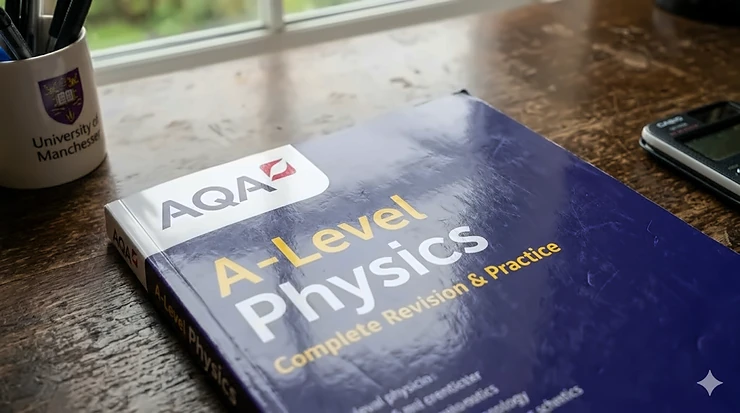
Picking an A-level physics revision book shouldn’t feel like quantum mechanics itself—yet here we are, staring at dozens of options on Amazon.co.uk, each promising to unlock A* grades. Here’s what most year 13 physics exam preparation guides won’t tell you: not all revision books are created equal, and the “best” one depends entirely on your exam board, learning style, and how much time you’ve got before those 2026 and 2027 exams.
After reviewing the most popular physics revision resources available on Amazon.co.uk and analysing feedback from hundreds of UK students, I’ve identified what actually separates genuinely helpful revision books from overpriced doorstops. The standout factor? Books that transform complex concepts—particle physics revision notes, electromagnetic fields, quantum phenomena—into digestible, exam-focused content with proper worked examples. Not just rehashed textbook paragraphs.
Whether you’re tackling AQA, Edexcel, OCR, or any other exam board, the revision books I’ve selected below offer genuine value: clear explanations that don’t assume you’re already a physicist, practice questions that mirror actual exam papers, and online resources that actually enhance (rather than duplicate) the printed content. Most sit in the £15-£25 range, though I’ve included budget and premium options too. The key question isn’t “which book is best?”—it’s “which book matches your specific needs?” Let’s find out.
Quick Comparison Table
| Revision Book | Exam Board | Price Range (GBP) | Best For | Online Edition |
|---|---|---|---|---|
| CGP AQA Physics Year 1 & 2 Complete | AQA | £18-£22 | Comprehensive coverage + practice | ✅ Yes |
| CGP Edexcel Physics Year 1 & 2 Complete | Edexcel | £18-£22 | Visual learners | ✅ Yes |
| CGP OCR A Physics Year 1 & 2 Complete | OCR A | £18-£22 | Clear explanations | ✅ Yes |
| Pearson Edexcel Physics Revision Guide | Edexcel | £14-£18 | Concise summaries | ✅ Yes |
| CGP Physics Revision Question Cards | All boards | £16-£20 | On-the-go revision | ❌ No |
| My Revision Notes: AQA Physics | AQA | £12-£16 | Budget-conscious students | ❌ No |
| A Level Physics Exam Revision Notes | All boards | £8-£12 | DIY note-takers | ❌ No |
From the comparison above, CGP dominates the market for a reason—their Complete Revision & Practice series strikes the best balance between depth and accessibility for most UK students. However, if you’re revising on a tight budget, the Hodder “My Revision Notes” series offers solid coverage for around £12-£15, though you’ll sacrifice the interactive elements and online access. The question cards are worth considering as a supplement rather than your primary resource—brilliant for testing yourself on the bus to college, less useful for understanding why your answer to a capacitor discharge question was wrong in the first place.
💬 Just one click — help others make better buying decisions too! 😊
Top 7 A-level Physics Revision Books: Expert Analysis
1. CGP A-Level Physics: AQA Year 1 & 2 Complete Revision & Practice
The CGP A-Level Physics: AQA Year 1 & 2 Complete Revision & Practice remains the gold standard for AQA students, and after examining hundreds of student reviews on Amazon.co.uk, it’s clear why. This isn’t just another textbook rehash—it’s a genuinely comprehensive revision tool that covers every core topic from both years, plus optional topics 9-12 (Astrophysics, Medical Physics, Engineering Physics, Turning Points in Physics) which many schools struggle to adequately teach.
What sets this apart from competing physics equations A-level guide options? The explanations strip away unnecessary jargon without dumbing down the content. Each topic follows a consistent pattern: theory explanation, worked examples showing method marks you’d actually earn, then practice questions that progressively increase in difficulty. The section on particle physics revision notes, for instance, doesn’t just list quarks and leptons—it explains exchange particles through clear analogies and Feynman diagrams that make sense.
UK students particularly praise its treatment of practical skills—a section many revision guides either ignore or handle poorly. Given that required practicals account for 15% of your assessment, this attention to apparatus, techniques, and uncertainty analysis is rather valuable. The online edition (included free with purchase) works seamlessly on tablets and laptops, and while it’s essentially a digital copy of the print book, the searchability alone justifies its existence during last-minute revision sessions.
Pros:
- Complete spec coverage including optional topics rarely found elsewhere
- Practice questions perfectly pitched between GCSE-style and full A-level difficulty
- Practical skills section addresses actual exam requirements from Ofqual standards
- Online edition included for £18-£22 (excellent value vs purchasing separately)
Cons:
- Dense content can feel overwhelming for students starting revision late
- Some worked examples could show more intermediate steps
Customer feedback from UK buyers suggests this book helped many achieve A*/A grades despite “subpar teaching” (a common complaint in reviews). One student noted it “condenses textbook information into easily readable chunks while still covering the entire spec”—precisely what year 13 physics exam preparation demands. At around £18-£22 on Amazon.co.uk with Prime delivery, it represents solid value when you consider you’re getting two years of content plus an online edition.
2. CGP A-Level Physics: Edexcel Year 1 & 2 Complete Revision & Practice
The CGP A-Level Physics: Edexcel Year 1 & 2 Complete Revision & Practice follows the same proven formula as its AQA counterpart but tailors everything to Edexcel’s specification quirks—and yes, there are quirks. Edexcel’s approach to topics like magnetic fields and nuclear physics differs enough from AQA that using the wrong revision guide genuinely risks leaving gaps in your knowledge.
Where this book particularly shines for Edexcel students: the way it handles Practical Skills and Mathematical Skills integration. Edexcel places heavy emphasis on mathematical manipulation and graph analysis, and CGP doesn’t shy away from this. You’ll find worked examples that show exactly how to rearrange that horrendous-looking equation involving exponential decay, not just the final answer. For UK students in comprehensive schools or sixth form colleges where teaching time is squeezed, this step-by-step mathematical support proves invaluable.
The visual presentation deserves mention—full-colour diagrams, highlighted key points, and those slightly irreverent footnote jokes that somehow help information stick. One UK reviewer described it as “comprehensive coverage making revision organised and efficient,” noting the book’s perfect alignment with the specification meant “studying exactly what you need to know for the exams.” This specification alignment matters enormously; exam boards occasionally shift emphasis between topics, and outdated guides from 2015 miss these changes entirely.
Pros:
- Edexcel-specific content including their unique approach to optional topics
- Strong mathematical skills integration reflecting exam board priorities
- Clear diagrams using colour strategically (not just for decoration)
- Students report needing only one book for entire two-year course
Cons:
- Less detailed on certain astrophysics sections vs Oxford-published alternatives
- Assumes reasonable mathematical confidence (struggles mentioned by some students)
Available for around £18-£22 on Amazon.co.uk with typically next-day Prime delivery. Several reviews from UK students mention using this alongside the matching workbook (sold separately for around £10-£14)—a sensible combo if you need extensive question practice beyond what’s included in the revision guide itself. The free online edition works identically to the AQA version: full text searchable on any device with the access code printed inside.
3. CGP A-Level Physics: OCR A Year 1 & 2 Complete Revision & Practice
The CGP A-Level Physics: OCR A Year 1 & 2 Complete Revision & Practice addresses OCR A’s rather distinctive specification—one that emphasises practical work and investigative skills more heavily than other boards. If you’re studying OCR A (not to be confused with OCR B, which is an entirely different animal), this book understands what examiners actually look for in your answers.
OCR A students face particular challenges with modelling and practical investigation requirements. This guide dedicates substantial space to experimental design, data analysis, and how to discuss limitations without resorting to the vague nonsense that loses marks (“human error” isn’t a valid limitation, but systematic apparatus error is). For students in UK schools where physics practical time is limited—increasingly common given budget constraints—this section essentially provides the practical experience you might not be getting in the lab.
The treatment of optional topics (Astrophysics, Medical Imaging, Electronics, Turning Points) is comprehensive, though naturally you’ll only study one or two. UK reviewers particularly appreciate how each topic receives equal attention; there’s no sense that astrophysics was the “main” option with others tacked on as afterthoughts. The book also handles OCR A’s synoptic assessment style effectively—those questions pulling from multiple topic areas simultaneously that students often find baffling.
Pros:
- Excellent practical investigation guidance (15% of assessment)
- Synoptic question practice reflecting OCR A’s integrated approach
- All four optional topics covered equally thoroughly
- Worked examples show OCR-specific mark scheme requirements
Cons:
- Slightly less detailed on pure theory compared to dedicated textbooks
- Online edition interface identical across CGP books (no OCR-specific features)
Priced consistently with other CGP Complete books at £18-£22 on Amazon.co.uk. One student review noted they’d recommend this guide specifically, praising CGP’s way of “presenting information in a deliberately memorable way” which proves “perfect for brushing up or hardcore revision.” The mention of “CGP’s jokes throughout” appears again—apparently those daft footnotes genuinely help recall, even if you roll your eyes reading them.
4. Pearson REVISE Edexcel AS/A Level Physics Revision Guide
The Pearson REVISE Edexcel AS/A Level Physics Revision Guide takes a notably different approach from CGP’s comprehensive tomes. Published by Pearson (who actually write the Edexcel specifications), this guide prioritises concise, exam-focused content over exhaustive coverage. For students who’ve already studied the material and need efficient revision rather than relearning, this streamlined format proves ideal.
What makes this guide particularly suitable for UK students approaching exams: its “one-to-one page correspondence” with the companion Revision Workbook. This means you can read the theory on page 24, then immediately practise with exam questions on page 24 of the workbook. This coordinated approach eliminates the usual faff of cross-referencing between resources—rather handy when you’re three weeks from exams and short on time. The included online edition offers some interactive elements beyond just digital text, though nothing revolutionary.
The content density deserves consideration. Pearson strips topics down to exam essentials—you won’t find extensive background theory or alternative explanations. For confident students who grasp concepts quickly, this efficiency is brilliant. For students still wrestling with fundamental principles, the brevity might feel inadequate. UK reviewers note it’s “great for revision” but acknowledge it’s not a teaching resource. One mentioned it works excellently for students who’ve stayed on top of coursework throughout but “just about worth having” for those catching up after falling behind.
Pros:
- Official Pearson publication means perfect Edexcel alignment
- Concise format ideal for time-pressured revision (final weeks before exams)
- Coordinates with companion workbook for integrated study
- Online edition includes some interactive features beyond static text
Cons:
- Too brief for students needing concepts explained from scratch
- Proof-reading issues mentioned (though minor)
- Less comprehensive than CGP for long-term revision throughout Year 13
Available for around £14-£18 on Amazon.co.uk, making it one of the more affordable options from major publishers. The lower price reflects shorter content rather than lower quality. Consider this if you’re an A*/A student doing final polish revision, or pair it with a more comprehensive guide if you’re building knowledge from a shakier foundation. Free delivery available on orders over £25 (Amazon.co.uk’s standard threshold).
5. CGP A-Level Physics Revision Question Cards (Multiple Boards)
The CGP A-Level Physics Revision Question Cards represent a fundamentally different revision tool—not a guide explaining concepts but 128 double-sided cards testing whether you actually understand them. Available for AQA, OCR A, and Edexcel boards (ensure you’re ordering the correct version for your specification), these cards suit active recall revision far better than passive rereading of notes.
Each card follows a consistent structure: quick warm-up questions front, harder questions requiring deeper understanding, then comprehensive answers with explanations on the back. What UK students particularly appreciate—judging by Amazon.co.uk reviews—is the genuine difficulty progression. The warm-up questions don’t insult your intelligence with GCSE-level content, and the harder questions genuinely mirror A-level exam difficulty. One reviewer specifically mentioned the cards being “useful for quick revision when you can’t face reading through pages and pages of notes”—a mood familiar to any student three months into intensive revision.
The portability factor matters more than you’d think. These cards fit in a coat pocket or bag without adding significant weight, making them ideal for revision during commutes or between lessons. For UK students living in urban areas with lengthy bus or train journeys to college, this represents genuinely useful study time rather than dead time scrolling Instagram. The cards also work brilliantly for peer testing—get a mate to quiz you, which often reveals gaps passive reading misses entirely.
Pros:
- Active recall approach more effective than passive reading for memory retention
- Portable format suits revision in transit or short time blocks
- Comprehensive answers explain why correct answer is correct (not just what it is)
- Covers practical skills and maths skills alongside content knowledge
Cons:
- Not suitable as standalone resource (assumes existing understanding from other books)
- Card format means no online edition option
- More expensive per page than books (£16-£20 for 128 cards)
Priced at around £16-£20 on Amazon.co.uk depending on exam board version. Several UK reviewers mention purchasing these alongside CGP’s Complete Revision books—a sensible combination that provides both explanation and testing. One student noted their daughter found them “really useful and handy,” which translates to actual use rather than sitting unopened on a shelf. Another mentioned they’re “portable so she could revise on the go,” confirming the practical benefit of the card format for busy students.

6. My Revision Notes: AQA A-level Physics (Hodder Education)
The My Revision Notes: AQA A-level Physics from Hodder Education offers a budget-friendly alternative to CGP’s pricier offerings, typically available for £12-£16 on Amazon.co.uk. Written by Keith Gibbs, an experienced physics teacher and head of science for 25 years, this guide prioritises step-by-step revision structure over flashy presentation—which suits certain learning styles perfectly.
What distinguishes Hodder’s approach: the explicit revision planning support. The book includes a revision planner helping you pace your study across available time before exams—genuinely useful for students who struggle with self-organisation. Definitions and key terms are highlighted clearly, addressing the common issue where students understand concepts but can’t recall precise wording demanded by mark schemes. The “questions throughout the book” format means constant self-testing rather than theory-heavy chapters followed by questions at the end.
The trade-offs for the lower price become apparent in presentation and depth. You won’t find full-colour diagrams on every page or extensive worked examples. The online resources (quick quizzes on Hodder’s website) are basic compared to CGP’s full online editions. For students comfortable with more traditional, text-focused revision materials, these aren’t deal-breakers. For visual learners or those needing extensive hand-holding through calculations, CGP’s extra £6-£8 cost might prove worthwhile.
Pros:
- Significantly cheaper (£12-£16) than premium alternatives
- Revision planner structure helps with time management and pacing
- Written by experienced examiner (Keith Gibbs) familiar with mark schemes
- Definitions and key terms clearly identified for precise terminology
Cons:
- Less visual than CGP with fewer full-colour diagrams
- No comprehensive online edition included with purchase
- More concise means less detailed explanation for complex topics
UK reviews are positive but measured. Students appreciate the value proposition—it covers essential content at roughly half CGP’s price. One mentioned it’s suitable for “managing your own revision with step-by-step support,” which accurately describes the book’s structured approach. If budget is a genuine constraint (and for many UK students, it is), Hodder delivers adequate content. If funds allow, CGP’s additional features probably justify the premium for most learners.
7. A Level Physics Exam Revision Notes (Generic All Boards)
The A Level Physics Exam Revision Notes takes an unconventional approach entirely—it’s less a traditional revision guide and more a structured notebook for creating your own personalised revision resource. Available for around £8-£12 on Amazon.co.uk, this appeals to students who learn best through active note-making rather than passive reading, which research consistently shows improves retention and understanding.
The book provides pre-designed pages for definitions, equations, derivations, short summaries, and key practical experiments—essentially a framework you fill in with your own notes from lessons, textbooks, and other resources. QR codes throughout link to videos demonstrating how to use the notebook and reinforcing key concepts. For UK students studying at home or in sixth forms with variable teaching quality, these supplementary videos add value beyond the printed pages.
Here’s the crucial consideration: this notebook demands significant input from you. Unlike CGP or Pearson guides where information is presented complete, you’re doing the work of extracting and organising content. This active process embeds knowledge more deeply than reading pre-written summaries (the “generation effect” in learning psychology), but requires more time and effort. Students starting revision three months before exams might find this manageable; those with three weeks probably need pre-written content.
Pros:
- Cheapest option reviewed (£8-£12) for budget-conscious students
- Active note-making process improves retention vs passive reading
- QR code videos provide additional explanations and demonstrations
- Suitable for all exam boards (AQA, Edexcel, OCR, International A-levels)
Cons:
- Requires substantial time investment creating your own content
- Not suitable for students starting revision late (weeks before exams)
- Quality depends entirely on your input and organisation
- No pre-written explanations if you’re stuck on a concept
UK reviewer feedback is mixed, reflecting the notebook’s niche appeal. Students who “need space for all the essential material to succeed” appreciate the format. Others note it “encourages critical thinking and problem-solving skills” beyond rote memorisation. However, this isn’t a resource for last-minute cramming—it’s a tool for methodical, long-term revision throughout Year 13. Consider this if you’re organised, diligent, and prefer creating your own resources. Stick with conventional guides if you need content handed to you in digestible form.
Understanding A-level Physics Assessment in the UK
The Ofqual-regulated A-level physics qualification underwent significant reforms in 2015, fundamentally changing how exams assess understanding. Rather than the previous modular structure (where you could resit individual units), current specifications assess both years of content in final exams at the end of Year 13. This means your A-level physics revision book choice matters more than ever—you’re preparing for comprehensive, synoptic assessment covering 20+ major topics simultaneously.
All three major exam boards (AQA, Edexcel, OCR) now emphasise practical skills explicitly worth 15% of your final grade, though assessed through written questions rather than separate practicals. These required practicals—12 for most boards—form the “Common Practical Assessment Criteria” mandated across England, Wales, and Northern Ireland. Your revision book should address these practicals properly, not just mention them in passing. Look for books explaining apparatus setup, uncertainty calculation, and how to discuss systematic vs random errors using language that actually earns marks.
The mathematical requirements also increased substantially under 2015 reforms. According to Ofqual’s A-level content requirements, at least 40% of marks in physics exams involve mathematical skills beyond GCSE level. This means logarithms, exponentials, trigonometric functions, calculus concepts—all fair game. Your physics equations A-level guide must handle maths integration properly rather than treating it as separate. CGP’s books excel here; budget alternatives sometimes assume mathematical confidence that struggling students don’t possess.
Understanding the assessment structure helps explain why comprehensive revision books cost £18-£22. You’re not buying 300 pages of content—you’re buying two years of specification coverage, practical skills guidance, mathematical integration, and exam technique advice. Compare this against purchasing separate textbooks (£30-£40 each) plus standalone practical guides, and the revision book value becomes clear. For UK students facing rising costs across education, one £20 book replacing three separate resources represents genuine economy.
How to Choose the Right A-level Physics Revision Book
Choosing your A-level physics revision book should start with one non-negotiable factor: exam board alignment. AQA, Edexcel, OCR A, OCR B, CCEA, and WJEC Eduqas all assess physics differently enough that using the wrong book risks learning content you won’t be examined on while missing content you will. Check your school’s exam board first (it’s printed on any past papers you’ve received), then filter Amazon.co.uk results accordingly. This sounds obvious, yet students regularly purchase beautiful revision books for the wrong specification.
Your learning style dictates format preference. Visual learners benefit enormously from CGP’s full-colour diagrams and highlighted key points—that extra £5-£7 over Hodder’s text-heavy approach genuinely improves comprehension. Kinaesthetic learners who retain information through doing rather than reading might find revision cards more effective than traditional books. Consider how you’ve successfully learned other subjects: if making your own notes works, the blank revision notebook approach suits you; if reading structured content works, comprehensive guides make sense.
Timing matters substantially. Starting revision in September of Year 13? Comprehensive books like CGP’s Complete series work beautifully—you’ve got nine months to work through 300+ pages methodically. Starting in April with exams in June? Concise guides like Pearson’s REVISE series or focused question cards make more sense. One UK student mentioned needing “quick and snappy revision on the go” (revision cards) after previously using comprehensive books—different phases of preparation demand different resources.
Budget considerations are real for most UK students. The £8-£12 range (basic notebooks, older editions) versus £18-£22 range (current CGP/Pearson guides) represents meaningful money. However, consider cost per hour of use. A £20 revision book used three hours weekly for nine months provides roughly 100 hours of study material—that’s 20p per hour. Compare against tutoring (£30-£50/hour in most UK areas) and the book becomes extraordinarily cost-effective. If budget genuinely constrains choices, one comprehensive guide beats three inadequate cheap alternatives.
Finally, check for online resources. Free online editions (included with CGP and Pearson books) offer genuine value: searchability during revision, tablet/phone accessibility for studying outside home, and typically some interactive elements beyond static text. Books without online components aren’t necessarily inferior, but you’re getting less for your money. Given Amazon.co.uk prices for online and print-only versions differ by £1-£2 maximum, choosing online-enabled versions makes sense unless you philosophically oppose screens for studying.
Common Mistakes When Buying Physics Revision Books
The most expensive mistake UK students make: purchasing books for the wrong specification year. Exam board specifications update every 7-10 years, and content, assessment objectives, and even topic emphasis change between iterations. That £5 second-hand CGP book from 2010 isn’t just old—it’s for a fundamentally different exam structure discontinued in 2015. Always verify the book explicitly states “for 2026 and 2027 exams” or “2015 specification onwards.” This seems pedantic until you realise you’ve revised entire topics no longer assessed while missing current requirements entirely.
Buying too many resources represents another common trap. Students panic-purchase three different revision guides, two sets of flashcards, and four workbooks, then use none effectively because they’re overwhelmed by options. One comprehensive revision guide plus one question practice resource (cards or workbook) covers 90% of students’ needs. Additional books provide diminishing returns—you’re better off thoroughly mastering one excellent guide than skimming five mediocre ones. This particularly affects conscientious students who equate more resources with better preparation.
Ignoring practical skills sections proves costly given their 15% assessment weighting. Many students focus exclusively on theory—equations, definitions, calculations—while barely glancing at apparatus diagrams or experimental techniques. Then Paper 1 includes six marks on describing how to measure the Young modulus using a tensile testing setup, and you’re lost. Choose revision books treating practicals as equal content rather than afterthoughts. CGP books excel here; some budget options barely mention practicals at all beyond listing the twelve required experiments.
Overlooking mathematical preparation ranks among the most serious oversights. As mentioned earlier, 40% of physics marks involve maths beyond GCSE level. Students who were comfortable with GCSE maths often struggle with A-level physics purely because of mathematical demands—rearranging complex equations, logarithmic scales, calculus concepts. Your revision book should integrate mathematical skills throughout rather than segregating them in one “maths skills” chapter you’ll inevitably skip. If your current book doesn’t adequately explain how to manipulate that exponential decay equation, you need a different book.
Finally, many students delay purchasing revision books until weeks before exams, thinking they’ll manage with lesson notes and textbooks. This strategy works for A*/A students with exceptional teaching; for everyone else, it’s unnecessarily risky. Revision books cost £12-£22—less than a night out in most UK cities. The security of having comprehensive, exam-focused content available from September onwards justifies this minimal investment. Purchase early, even if you won’t use it intensively until spring, rather than panic-buying under time pressure when Amazon delivery times matter.
A-level Physics Revision Books vs A-level STEM Subjects Bundle Options
Several publishers offer bundled deals covering multiple STEM subjects—typically physics, chemistry, biology, and maths in various combinations. These A-level STEM subjects bundle options appear attractive initially: four revision guides for £60-£80 seems cheaper than purchasing individually at £18-£22 each (which would total £72-£88). However, the economics aren’t quite what they seem once you examine what you’re actually getting.
Most bundles use slightly older editions or reduced-content versions to hit attractive price points. You might be purchasing CGP Complete guides for physics and chemistry but receiving basic revision notes for biology and maths rather than their full-feature equivalents. Read bundle descriptions carefully on Amazon.co.uk—if specific ISBNs aren’t listed, you’re probably not getting current editions. Additionally, bundles typically exclude online editions or provide only one access code despite including four books, limiting their digital utility.
The practical reality: you’ll never revise all subjects simultaneously with equal intensity. In autumn term you might focus on physics and maths; spring term might emphasise chemistry and biology as exams approach. Purchasing books when you actually need them spreads costs across months rather than requiring £60-£80 upfront. For UK students managing part-time jobs or limited funds, this cashflow consideration matters. Amazon.co.uk Prime delivery means you’re never more than 24 hours from receiving a book when needed.
That said, specific circumstances justify bundles. If you’re revising all four STEM A-levels and starting early (summer before Year 13), getting everything upfront enables comprehensive cross-subject revision planning. Some students find having all resources immediately eliminates the procrastination of “I’ll order that book later”—you can’t delay starting revision if the books are sitting on your desk. Schools occasionally negotiate bulk purchase discounts making bundles genuinely cheaper than individual items.
Compare bundle contents against individual requirements before purchasing. If you need the comprehensive CGP Complete guides with online editions for optimal preparation, don’t compromise by accepting a bundle with inferior versions just to save £15. That £15 saving becomes expensive if it costs you one grade boundary. Conversely, if you’re a strong student needing only exam technique practice and concise reminders, bundle basics might suffice. The decision hinges on your specific needs rather than general advice applicable to everyone.
Maximising Your Revision Book Investment
Simply owning an excellent A-level physics revision book achieves nothing—using it effectively separates students who improve significantly from those who stagnate despite expensive resources. Here’s how UK students report getting maximum value from their revision books based on Amazon.co.uk reviews and educational research on effective study techniques.
Start by working through the book systematically rather than randomly opening pages based on what you feel like revising. Every CGP Complete guide follows the specification order precisely; your school teaching probably follows the same sequence. This means you can use the revision book to reinforce recent lessons (within days while memory is fresh) rather than treating it exclusively as exam preparation six months after studying topics. Students who integrate revision books throughout Year 13 consistently report better outcomes than those who start in March.
Active engagement beats passive reading by enormous margins. Don’t just read explanations—cover the worked examples, attempt them yourself, then check your working against the book’s method. This identification of gaps in understanding (you thought you knew how to calculate escape velocity until you actually tried it) provides targeted improvement impossible through reading alone. UK reviewers specifically praise CGP books for practice questions throughout; actually completing these questions is the difference between owning a revision book and benefiting from it.
Create a routine around revision book use. Thirty minutes daily throughout Year 13 (roughly 180 hours total) provides vastly better retention than twelve-hour marathon sessions in the week before exams. Your brain consolidates information during sleep; regular exposure with breaks between sessions allows this consolidation process to work. One UK student mentioned CGP’s books helped them get an A “despite having a subpar teacher”—that level of independent learning requires consistent, structured engagement rather than sporadic desperation.
Use the online editions strategically. They’re not just digital copies—the search functionality provides genuine value when you can’t remember which chapter covered terminal velocity or where that derivation of kinetic theory equations appeared. During quick revision sessions on trains or between lessons, phone/tablet access beats lugging physical books around. However, research consistently shows handwriting notes on physical pages improves retention vs typing on screens, so physical books remain primary for serious study.
Finally, pair revision books with past papers from your exam board’s website (free downloads available from AQA, Edexcel, OCR). Past papers reveal exactly how revision book content manifests in actual exam questions—theory becomes application. This combination—revision book for understanding, past papers for application—creates synergy more valuable than either resource alone. Attempting past paper questions then using revision books to understand where your answers fell short represents one of the most effective revision strategies identified by educational research.
Supporting Resources Beyond Revision Books
Your A-level physics revision book forms the core of independent study, but supplementary resources enhance preparation significantly—particularly for UK students whose school teaching varies enormously in quality. Physics and Maths Tutor (PMT) offers free resources including notes, flashcards, and past paper questions organised by topic. This UK-based site has become standard reference material for A-level students across all sciences, providing alternative explanations when your revision book’s approach doesn’t quite click. Understanding A-level physics education structure helps contextualize how revision books align with qualification frameworks.
Isaac Physics, developed by the University of Cambridge, provides free problem-solving practice with immediate feedback and hints. The platform’s difficulty progression mirrors A-level assessment exactly, making it ideal preparation for those challenging final questions worth five or six marks that separate A grades from A*. According to educational research from Cambridge, students using structured digital physics resources alongside traditional revision materials often achieve improved outcomes. Registration is free; you need only an email address.
YouTube channels like Physics Online present A-level topics through video explanations particularly useful for visual learners. Watching someone work through a capacitor discharge circuit problem while narrating their thinking often clarifies concepts better than reading static text. However, be selective—countless channels exist with variable quality. Look for UK-based creators familiar with your specific exam board’s mark schemes rather than American physics teachers covering different curricula.
For students struggling with mathematical elements, Maths Genie (free) and ExamSolutions (free) cover A-level maths topics integrated throughout physics. That moment when you realise you can’t progress on electromagnetic induction because you’ve forgotten integration by parts from Year 12 maths? These sites provide focused remediation without wading through entire textbook chapters. Given the 40% mathematical content requirement in physics, this mathematical support proves essential for many students.
Subject-specific tutoring represents the premium option, typically £30-£50/hour across most UK regions (London prices run higher). One-to-one or small group sessions provide personalised attention impossible from books or online resources. However, cost prohibits weekly tutoring for most students. Consider strategic tutoring: book three or four sessions specifically targeting concepts you’ve struggled to grasp independently rather than ongoing weekly sessions throughout Year 13. This focused approach provides maximum benefit per pound spent.
The Role of Flashcards: A-level Biology Flashcards CGP and Physics Equivalents
While this article focuses on physics revision books, the popularity of A-level biology flashcards CGP products raises valid questions about whether similar resources benefit physics students. The answer depends considerably on the type of content you’re revising—flashcards excel for certain revision tasks while proving ineffective for others.
For definition-based content, flashcards work brilliantly. Physics terminology like “elastic deformation,” “gravitational potential,” “exponential decay,” “simple harmonic motion”—these precise definitions that mark schemes demand word-for-word accuracy—benefit from flashcard-style drilling. The active recall process (reading question, attempting answer, checking result) embeds terminology far more effectively than highlighting definitions in revision books. CGP’s physics question cards serve exactly this function, providing 128 double-sided cards with progressive difficulty levels.
However, physics differs substantially from biology in content structure. Biology involves extensive memorisation of facts, processes, and terminology—flashcard territory. Physics emphasises understanding concepts, applying equations, and mathematical manipulation—less naturally suited to flashcard format. You can’t flashcard your way through deriving the equation for centripetal acceleration or explaining why a transformer core uses laminated iron. These require worked examples and detailed explanation found in comprehensive revision books.
The optimal approach combines both formats strategically. Use revision books for understanding concepts and methods; use flashcards (or create your own using index cards) for memorising definitions, equations, and key values. For instance, flashcards work perfectly for the dozen or so fundamental constants you need (speed of light, Planck’s constant, elementary charge, etc.), but understanding how to apply these in calculations requires book-based worked examples.
Creating your own flashcards from revision book content provides additional benefits. The act of deciding what information deserves a flashcard, then writing concise questions and answers, constitutes active learning more valuable than purchasing pre-made cards. Free software like Anki enables digital flashcard creation with spaced repetition algorithms (showing you cards just before you’re likely to forget them)—proven more effective than random review order. However, this requires upfront time investment creating cards rather than immediate use of purchased versions.
UK students report success with mixed approaches. Several Amazon.co.uk reviews for CGP physics question cards mention using them “alongside” Complete Revision books rather than instead of them. One student noted cards were “useful for quick revision when you can’t face reading through pages”—acknowledging that books remain necessary for deep understanding. This combined approach—books for teaching/learning, cards for testing/retention—represents best practice across educational research on effective study methods.
Practical Exam Preparation: Where Books Can’t Replace Experience
Here’s what no A-level physics revision book adequately prepares you for: the physical reality of conducting experiments under exam conditions. While books can explain apparatus, procedures, and analysis techniques (and good ones like CGP’s do this thoroughly), they can’t replicate the experience of actually setting up an experiment, taking measurements, and dealing with real-world complications that never appear in idealised diagrams.
The Ofqual-mandated required practicals—twelve specific experiments all students must have attempted—form the basis of written practical assessment questions worth 15% of your final grade. These practicals include measuring the Young modulus using a tensile testing apparatus, investigating charging and discharging capacitors, determining resistivity, analysing simple harmonic motion using springs and pendulums, and investigating photoelectric effect. Your revision book describes these experiments, but reading about setting up the equipment doesn’t equal the tacit knowledge gained from actually doing it.
This creates particular disadvantage for UK students in schools with limited laboratory time or inadequate equipment. Budget constraints mean many schools squeeze practicals into fewer sessions than ideal, occasionally demonstrating rather than letting students conduct experiments themselves. If this describes your situation, your revision book becomes more important—it’s providing secondary exposure to practicals you’ve experienced inadequately. CGP’s Complete guides excel here with detailed apparatus diagrams, procedure steps, and common experimental issues to discuss in written answers.
For practical assessment questions, revision books should teach you the language examiners expect. Discussing “systematic uncertainty in the ruler measurement” earns marks; vaguely referencing “measurement error” doesn’t. Explaining why you’d repeat readings and calculate a mean demonstrates understanding; just stating you’d “do it multiple times” doesn’t. Quality revision books model this precise, physics-appropriate language throughout their practical skills sections. When choosing books, explicitly check their practical coverage—count the pages, read sample content on Amazon.co.uk’s “look inside” feature, check whether procedures are explained or just listed.
Additionally, understand that practical skills questions integrate throughout exam papers rather than appearing as separate sections. A six-mark question on planning an experiment to determine gravitational field strength might appear on Paper 2 alongside theory questions. Your revision book should integrate practical skills throughout content chapters rather than segregating them, mirroring how exams actually assess this knowledge. Books treating practicals as an afterthought are fundamentally misunderstanding assessment structure.
Finally, supplement your revision book’s practical coverage by watching demonstrations. Multiple UK physics teachers share required practical videos on YouTube, showing actual apparatus setup, measurement techniques, and common pitfalls. This visual reference combined with your book’s written explanation provides more complete understanding than either alone. Search “AQA required practical [number]” or equivalent for your exam board; quality content from UK sixth forms and colleges appears in abundance.
FAQ Section
❓ What's the difference between A-level physics revision books and textbooks?
❓ Can I use revision books from different exam boards?
❓ Are older edition revision books still useful for 2026 and 2027 exams?
❓ Do I need separate books for Year 12 and Year 13, or one combined book?
❓ How important are online editions included with revision books?
Conclusion: Making Your Final Choice
Selecting your A-level physics revision book ultimately requires balancing three factors: exam board alignment, learning style compatibility, and budget constraints. For most UK students studying AQA, Edexcel, or OCR A specifications, the CGP Complete Revision & Practice books represent optimal choices—comprehensive coverage, clear explanations, integrated practice, and included online editions for £18-£22 on Amazon.co.uk. The consistency of positive reviews from actual UK students who’ve used these books to achieve strong grades provides compelling evidence of their effectiveness.
Students working within tighter budgets should consider Hodder’s “My Revision Notes” series (£12-£16) which sacrifices some visual appeal and online features but maintains solid content coverage. The A Level Physics Exam Revision Notes (£8-£12) suits organised students willing to invest time creating personalised resources. Remember that your revision book becomes a tool used for hundreds of hours across Year 13—the difference between £12 and £22 represents roughly 10p per hour of use, making the more expensive option easily justified if it genuinely improves understanding.
Supplementing your primary revision book with question cards (£16-£20) makes sense for students who respond well to active recall testing, though these shouldn’t be your only resource. The combination of comprehensive book plus testing cards mirrors best practice across educational psychology research: understanding through explanation, retention through retrieval practice. This combined approach costs £35-£42 total—less than one tutoring session in most UK areas, yet potentially more valuable given you can access these resources unlimited times.
Timing your purchase matters. Order early (September of Year 13 or even summer before) to integrate the revision book throughout your study rather than panic-purchasing in March. Amazon.co.uk’s next-day Prime delivery means you’re never more than 24 hours from receiving books, but earlier purchase eliminates any temptation to delay starting revision. The security of having comprehensive, exam-focused resources available from the course beginning justifies the minimal financial commitment of £18-£22 for materials supporting two years of study.
Finally, remember that revision books represent tools rather than magic solutions. The students achieving A*/A grades using CGP books mentioned in reviews succeeded because they used the books systematically, completed practice questions, and integrated learning throughout Year 13—not because they purchased the books then left them unopened. Your choice of revision book matters, but your choice to actually use it effectively matters considerably more. Whatever book you select from this analysis, commit to working through it properly rather than accumulating multiple unused resources gathering dust on your desk.
Recommended for You
- 7 Best A-level Psychology Revision Guide AQA for 2026 UK Students
- 7 Best A-level Maths Revision Notes OCR 2026 | UK Expert Guide
- 7 Best A-level Chemistry Revision Guide UK 2026
Disclaimer: This article contains affiliate links. As an Amazon Associate, I earn from qualifying purchases. If you purchase products through these links, we may earn a small commission at no additional cost to you.
✨ Found this helpful? Share it with your mates! 💬🤗
