
In This Article
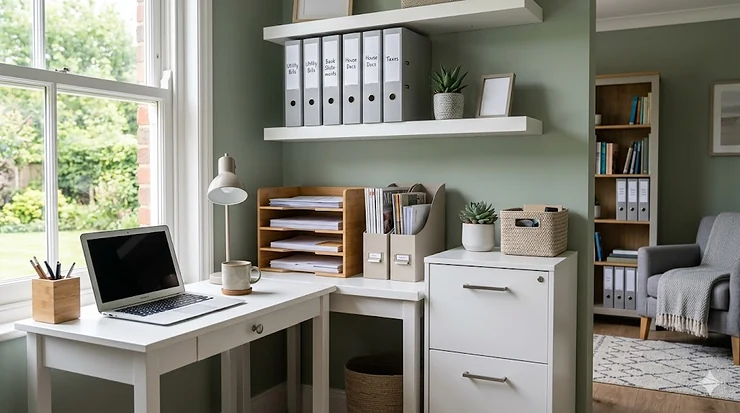
Let’s be honest – we’ve all experienced that sinking feeling when scrambling through piles of papers looking for an important document. Whether it’s your car insurance renewal, last year’s tax return, or your child’s vaccination records, household paperwork has this uncanny ability to multiply when you’re not looking. I’ve been there myself, frantically searching for a critical document whilst the clock ticked towards a deadline.
Storage for paperwork at home isn’t just about tidiness; it’s about protecting important documents, meeting legal obligations, and maintaining your sanity. According to The National Archives, proper document management ensures information is retained only as long as needed for business, legal, or historical purposes. For UK households, understanding what to keep and how to store it can save significant stress and potential legal complications.
The average British household generates approximately 1.5 kilograms of paper per week, much of which requires organised storage. With HMRC requiring tax-related documents to be retained for at least six years, and other important paperwork spanning decades, effective storage for paperwork at home has never been more crucial. This comprehensive guide explores seven outstanding storage solutions available on Amazon.co.uk, helping you transform your chaotic paper mountain into a well-organised filing system that actually works.
Quick Comparison Table
| Product | Type | Capacity | Price Range (£) | Best For | Rating |
|---|---|---|---|---|---|
| Tamfile Fireproof Document Box | Fireproof Safe | 14.2″×10.6″×4″ | £20-£30 | Vital documents | ⭐⭐⭐⭐½ |
| CYEER 10 Pack Box Files | Plastic Filing | 750 sheets each | £18-£22 | Budget organisation | ⭐⭐⭐⭐ |
| Lifewit A4 File Organiser Box | Fabric Storage | Letter size | £10-£15 | Home office | ⭐⭐⭐⭐ |
| Rapesco 19-Part Expanding File | Accordion Style | 19 compartments | £15-£20 | Project filing | ⭐⭐⭐⭐½ |
| Osco Faux Leather Box | Premium Storage | A4 documents | £25-£35 | Desk organisation | ⭐⭐⭐⭐ |
| W E Roberts Archive Boxes | Cardboard Archive | Pack of 10 | £20-£28 | Long-term storage | ⭐⭐⭐⭐ |
| ThinkTex Accordion Organiser | Portable Filing | 12 pockets | £8-£12 | Bills & receipts | ⭐⭐⭐⭐ |
💬 Just one click – help others make better buying decisions too!😊
✨ Don’t Miss These Exclusive Deals!
🔍 Take your home organisation to the next level with these carefully selected products. Click on any highlighted item to check current pricing and availability on Amazon.co.uk. These tools will help you create an authentic filing system your family will actually maintain!
Top 7 Storage for Paperwork at Home: Expert Analysis
1. Tamfile Fireproof Document Box – Premium Protection for Vital Records
When it comes to safeguarding your most important documents, the Tamfile Fireproof Document Box stands head and shoulders above standard storage solutions. This isn’t just another filing box – it’s a fortress for your critical paperwork.
Key Specifications:
- Dimensions: 14.2″ × 10.6″ × 4″ (36 × 27 × 10 centimetres)
- Fire resistance: Up to 2000°F (1093°C)
- Waterproof silicone-coated fibreglass construction
- Three-digit combination lock
- Collapsible design for easy storage
UK buyers particularly praise the Tamfile box for its robust construction and genuine peace of mind. One Birmingham resident mentioned: “After a kitchen fire last year, I realised how vulnerable our documents were. This box now holds our passports, property deeds, and birth certificates – it’s insurance for the irreplaceable.”
The box features multiple internal pockets organising passports, cash, USB drives, and legal documents systematically. Unlike cheaper alternatives, this fireproof storage for paperwork at home meets SGS testing standards (UL94 VTM-0 certification), providing legitimate protection rather than false security.
✅ Pros:
- Genuine fire and water resistance tested to industry standards
- Secure combination lock protects sensitive information
- Reflective strips aid visibility in darkness or smoke
❌ Cons:
- Higher price point (£20-£30) compared to basic boxes
- Heavier when filled (may require two hands)
Price: £20.99-£29.99 | UK Availability: Amazon Prime eligible
2. CYEER 10 Pack Box Files – Budget-Friendly Bulk Organisation
For those requiring extensive storage for paperwork at home without breaking the bank, the CYEER 10 Pack Box Files deliver remarkable value. These foolscap-sized plastic filing boxes have become a favourite among UK teachers, small business owners, and families managing multiple household admin streams.
Key Specifications:
- 75mm spine capacity (holds approximately 750 A4 sheets per box)
- Dimensions: 316 × 236 × 75 millimetres
- Collapsible design for space-saving storage
- Available in multiple colour options
- Durable PP plastic construction
What sets CYEER apart is the collapsible design – when not in use, these boxes fold flat, occupying mere centimetres of shelf space. A Manchester-based customer shared: “I bought these for our home business. They collapse completely when empty, which is brilliant for storing spare boxes without dedicating an entire cupboard to them.”
However, UK reviewers note these work best for documents you’ll access infrequently. The absence of internal clips means papers can slide to the bottom when the box isn’t full, so they’re ideal for archive storage rather than active filing.
✅ Pros:
- Exceptional value (10 boxes for under £20)
- Space-efficient collapsible design
- Multiple colour options for categorisation
❌ Cons:
- No internal document clips
- Thinner plastic than rigid alternatives
Price: £18.99-£21.99 | UK Availability: Free UK delivery available
3. Lifewit A4 File Organiser Box – Stylish Home Office Solution
The Lifewit A4 File Organiser Box bridges the gap between functionality and aesthetics, offering storage for paperwork at home that won’t clash with your interior design. This fabric-covered box with sliding plastic rails represents the evolution of document storage beyond utilitarian cardboard.
Key Specifications:
- Dimensions: 32.5 × 23.1 × 26.9 centimetres
- Cationic fabric exterior with reinforced cardboard structure
- Sliding plastic rails for smooth file movement
- Metal handles for comfortable transport
- Collapsible when not needed
UK customers particularly appreciate the Lifewit box’s versatility. Unlike traditional filing cabinets, these boxes fit perfectly on standard cube shelving units (like IKEA Kallax), integrating seamlessly into modern homes. A Leeds homeowner noted: “These sit beautifully on our living room shelving. Visitors would never guess they contain our household filing – they just look like tasteful storage boxes.”
The sliding plastic rails prevent folders from catching on fabric edges, a thoughtful design detail that extends the box’s lifespan. Assembly takes literally 10 seconds – simply slot the base plate and rails into position.
✅ Pros:
- Attractive design suitable for visible storage
- Protective fabric prevents document scratches
- Fits standard cube shelving (32cm openings)
❌ Cons:
- Not suitable for letter or legal-sized folders
- Fabric can accumulate dust over time
Price: £10.39-£14.99 | UK Availability: Amazon’s Choice product
4. Rapesco 19-Part Expanding File – Professional Project Management
For those juggling multiple projects or managing complex household admin, the Rapesco 19-Part Expanding File offers unparalleled organisational capabilities. This British-designed expanding box file exemplifies why Rapesco has dominated UK office supplies for over 50 years.
Key Specifications:
- 19 concertina expanding sections
- Dimensions: 388 × 120 × 250 millimetres
- A4+ size accommodates C4 envelopes without folding
- Rigid fibreboard construction with linen texture
- Hinged lid with push-lock clasp
- Ergonomic carry handle
The Rapesco file excels at categorising diverse paperwork streams. UK users deploy these for everything from property renovation documentation to homeschooling resources. One Edinburgh parent shared: “Each section holds a different school subject, plus sections for medical records, extracurricular activities, and school admin. It’s transformed our organisation.”
The A4+ sizing proves particularly valuable for UK households, comfortably storing documents in protective sleeves without creasing. Blank index labels accompany each unit, enabling personalised categorisation that evolves with your needs.
✅ Pros:
- Extensive 19-section capacity with customisable labels
- Professional appearance suitable for home office
- Stands independently without support
❌ Cons:
- Internal dividers are thin card (handle carefully)
- No moisture resistance for damp storage areas
Price: £15.99-£19.99 | UK Availability: Multiple colour options
5. Osco Faux Leather Document Storage Box – Executive Desktop Organisation
When your paperwork storage needs to impress as much as organise, the Osco Faux Leather A4 Document Storage Box delivers premium aesthetics without premium pricing. This stackable desk organiser for storage for paperwork at home suits professional home offices where clients might visit.
Key Specifications:
- Dimensions: 8.5 × 25 × 33.5 centimetres
- Premium faux leather exterior in brown or black
- Stackable design for vertical organisation
- Suitable for A4 files and envelopes
- Wipeable surface for easy maintenance
UK professionals favour this solution for active documents requiring frequent access. A London-based consultant mentioned: “These sit on my desk credenza, holding current client files. They look sophisticated enough for video calls but keep everything immediately accessible.”
The stackable design creates vertical filing systems on desks or shelves, maximising space in compact home offices. Unlike fabric alternatives, the faux leather surface resists spills and can be wiped clean with a damp cloth.
✅ Pros:
- Professional appearance for client-facing environments
- Easy-clean wipeable surface
- Stackable for space efficiency
❌ Cons:
- Limited capacity compared to expanding files
- Higher cost per storage volume
Price: £25-£35 | UK Availability: Prime eligible
6. W E Roberts Archive Storage Boxes – Long-Term Document Retention
For implementing proper storage for paperwork at home that meets UK legal retention requirements, W E Roberts Cardboard Archive Boxes provide professional-grade solutions at consumer prices. These boxes represent the industry standard for document archiving.
Key Specifications:
- Pack of 10 archive boxes
- Dimensions: 390 × 304 × 238 millimetres (15″ × 12″ × 9″)
- Double-wall corrugated cardboard construction
- Integrated handles for easy transport
- Lift-off lids for quick access
W E Roberts boxes excel at long-term storage in lofts, garages, or spare rooms. UK accountants and solicitors use identical boxes for client files, testament to their durability. A Manchester accountant advised: “For home users storing tax records, these boxes are perfect. They’re the same specification we use professionally, just at retail pricing.”
The 390mm length accommodates A4 documents in hanging folders, whilst the 238mm height holds substantial quantities without becoming unwieldy. Clear labelling areas on all sides ensure quick identification when stored on high shelves.
✅ Pros:
- Professional archiving standard
- Excellent value (10 boxes for £20-£28)
- Integrated handles simplify retrieval
❌ Cons:
- Cardboard deteriorates in damp conditions
- Requires assembly (though straightforward)
Price: £20-£28 per 10-pack | UK Availability: Various sellers
7. ThinkTex 12-Pocket Accordion File Organiser – Portable Bill Management
The ThinkTex Accordion File Organiser addresses a specific but common need: managing monthly bills, receipts, and vouchers without dedicating significant space. This portable solution for storage for paperwork at home suits renters and those with limited storage areas.
Key Specifications:
- 12 expanding pockets with colourful tabs
- Letter/A4 size compatibility
- Dimensions: Compact accordion design
- Snap closure for security
- Lightweight portable construction
UK users particularly value the ThinkTex organiser for receipts, warranty cards, and monthly household bills. A Cardiff homeowner explained: “Each pocket represents a month. When bills arrive, they go straight into the relevant section. At tax time, everything’s already sorted chronologically.”
The compact design means this organiser fits easily in desk drawers or can be transported to appointments where documentation is needed. The colourful tabs provide quick visual navigation, whilst the snap closure prevents documents escaping during transport.
✅ Pros:
- Extremely affordable (£8-£12)
- Lightweight and portable
- Colour-coded organisation system
❌ Cons:
- Limited capacity compared to boxes
- Not suitable for bulky documents
Price: £8.99-£11.99 | UK Availability: Prime eligible
Understanding UK Document Retention Requirements
Before implementing storage for paperwork at home, understanding what to keep and for how long prevents both clutter and compliance issues. UK regulations, particularly those from HMRC and The National Archives, provide clear guidance on retention periods.
Financial and Tax Documents
According to HMRC retention policies, tax-related documents must be retained for at least six years from the end of the tax year to which they relate. This includes:
- P60s and P45s
- Self-assessment tax returns
- Business expense receipts
- Rental income records
- Capital gains documentation
The six-year period begins on 6th April following the tax year in question. For example, documents from the 2024-2025 tax year must be retained until at least 6th April 2031. Many accountants recommend keeping records for seven years to provide a comfortable margin.
Property and Legal Documents
Certain documents require permanent or extended retention:
- Property deeds and titles (permanent)
- Mortgage documentation (minimum 12 years after repayment)
- Household insurance policies (minimum 7 years after expiry)
- Guarantee and warranty certificates (duration of guarantee plus one year)
Medical and Personal Records
Whilst NHS records are maintained centrally, personal copies of medical documentation prove valuable:
- Prescription records (two years minimum)
- Private medical treatment documentation (permanent)
- Vaccination certificates (permanent, especially for children)
Choosing the Right Storage System for Your Needs
Assess Your Document Volume
Start by categorising existing paperwork:
Daily Access Documents: Current bills, school letters, ongoing projects – these require accessible storage like desktop organisers or shallow filing boxes.
Monthly Reference Items: Bank statements, utility bills, receipts – accordion files or expanding boxes work well, allowing monthly categorisation.
Annual Documentation: Tax returns, insurance policies, annual statements – these suit deeper storage boxes or filing cabinets with yearly divisions.
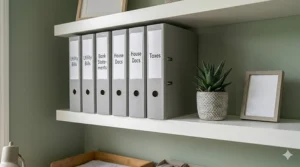
Long-Term Archives: Historical records, property documents, completed projects – archive boxes in secondary storage (lofts, garages) provide appropriate solutions.
Consider Your Space Constraints
For homes with limited storage:
- Vertical filing using stackable boxes maximises floor space
- Collapsible solutions like CYEER boxes provide flexibility
- Dual-purpose furniture with integrated storage conceals filing
For homes with dedicated offices:
- Traditional filing cabinets offer extensive capacity
- Desktop organisers maintain active documents
- Wall-mounted systems utilise vertical space
Factor in Security Requirements
Not all paperwork requires equal protection:
High Security (passports, birth certificates, property deeds):
- Fireproof lockable boxes like Tamfile
- Bank safe deposit boxes for irreplaceable items
- Digital backups in encrypted cloud storage
Medium Security (financial statements, contracts):
- Lockable filing cabinets
- Standard box files in secure rooms
- Password-protected digital copies
Standard Security (general correspondence, expired guarantees):
- Open shelving with box files
- Accordion folders
- Basic filing systems
Implementing an Effective Filing System
The Three-Tier Approach
Successful storage for paperwork at home typically employs three organisational tiers:
Tier 1 – Active Files (Immediate Access): Position these in your primary workspace. Current month’s bills, ongoing projects, school communications requiring action. Desktop organisers or shallow filing boxes work best. Review weekly, processing items to completion or archival.
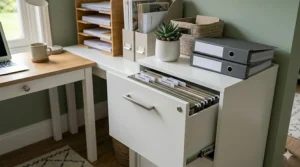
Tier 2 – Reference Files (Occasional Access): These documents require retention but infrequent consultation. Previous year’s tax documents, warranties for appliances, medical records, insurance policies. Filing cabinets, expanding files, or labelled box files suit this tier. Review quarterly, moving completed items to long-term storage.
Tier 3 – Archive Files (Rare Access): Historical documentation retained for legal compliance or sentimental reasons. Previous years’ tax records (beyond current year), property purchase documents, completed projects. Archive boxes in secondary storage locations. Review annually, disposing of documents beyond their retention period.
Colour-Coding and Labelling Strategies
Visual organisation dramatically improves filing efficiency:
Category-Based Colours:
- Red: Financial/tax documents
- Blue: Property and household
- Green: Medical and health
- Yellow: Education and personal development
- Purple: Legal and insurance
Time-Based Systems:
- Assign each year a specific colour
- Monthly accordion files with rainbow tabs
- Quarterly divisions within annual categories
Hybrid Approaches: Combine category and temporal organisation. For example, blue boxes for property documents, with yellow labels for different calendar years within each box.
Digital Integration
Modern storage for paperwork at home increasingly incorporates digital elements:
Scanning Protocols: Scan important documents before filing physically. Cloud storage (Google Drive, Dropbox, OneDrive) provides accessible backups. Name files consistently: “YYYY-MM-DD_Category_Description” (e.g., “2026-03-15_Tax_P60_JohnSmith”).
Hybrid Systems: Maintain physical copies of legally required documents whilst scanning everything else. Dispose of scanned papers after verification, reducing physical storage requirements.
Security Considerations: Encrypt sensitive scanned documents. Use reputable cloud services with two-factor authentication. Maintain offline backups on external drives stored separately from originals.
Maintaining Your Filing System
Quarterly Review Process
Schedule regular filing sessions preventing accumulation:
March/April (Post-Tax Year): Process previous year’s tax documents. Transfer older tax records to archive storage. Dispose of documents exceeding retention periods.
June/July (Mid-Year Check): Review insurance policies for renewals. Update property-related documentation. Clear completed projects to archives.
September/October (Autumn Tidy): Prepare for year-end. Review warranty expirations. Update medical records after summer activities.
December/January (Year-End): Archive completed year’s documents. Set up new filing structures for incoming year. Dispose of expired guarantees and outdated paperwork.
Disposal Best Practices
Secure disposal prevents identity theft and maintains data protection:
Shredding Requirements: Any document containing personal information (name, address, account numbers, National Insurance number) requires cross-cut shredding minimum. Documents with highly sensitive data (bank statements, credit card statements) benefit from micro-cut shredding.
Professional Disposal Services: For bulk disposal, companies like Shred-it or Iron Mountain provide certified document destruction with compliance certificates. Many local councils offer periodic shredding events for residents.
Digital Disposal: Simply deleting files leaves data recoverable. Use secure deletion software (like Eraser or BCWipe) or physically destroy old hard drives containing sensitive information.
Common Paperwork Storage Mistakes to Avoid
Over-Retention
Many households retain documents far beyond necessary periods, creating unnecessary clutter. A Birmingham solicitor observed: “Clients often present boxes of papers from decades ago. Much of it could have been disposed of years earlier, reducing storage burden and making important documents easier to locate.”
Inadequate Protection
Standard cardboard boxes in damp garages or lofts risk deterioration. Moisture, temperature fluctuations, and pests damage documents over years. Climate-controlled storage or appropriate containers (like plastic archive boxes) prevent deterioration.
Mixing Document Types
Combining active and archive documents in single containers complicates retrieval. Separate current-year items from historical records, enabling quick access without disturbing archived material.
Neglecting Digital Backups
Physical documents face risks from fire, flood, or simple misplacement. Scanning critical documents provides insurance against loss, with digital copies accessible from anywhere.
Inconsistent Filing Habits
Brilliant systems fail without discipline. Designate regular filing times (e.g., Friday afternoons) processing accumulated paperwork before it becomes overwhelming.
Space-Saving Storage Solutions
Under-Bed Storage
Utilise wasted space beneath beds with low-profile storage boxes. Ideal for seldom-accessed archives whilst keeping them protected from dust and damage.
Ottoman and Storage Furniture
Dual-purpose furniture conceals filing whilst providing seating or tables. Particularly valuable in compact homes or flats lacking dedicated office space.
Wall-Mounted Systems
Magazine files or wall-mounted letter holders utilise vertical space without consuming floor area. Perfect for active documents requiring easy access.
Furniture Top Storage
Stack attractive storage boxes (like Osco leather boxes) atop wardrobes or cupboards, using otherwise-wasted vertical space whilst keeping documents accessible.
Sustainable Paperwork Management
Reducing Paper Intake
Modern storage for paperwork at home increasingly focuses on prevention:
Opt for Digital Statements: Banks, utilities, and service providers offer paperless billing. Electronic statements prove easier to search, store, and backup than physical copies.
Unsubscribe from Mailings: Register with the Mailing Preference Service to reduce unsolicited mail. Contact companies directly requesting removal from mailing lists.
Digital First Policies: When offered choice between paper and digital, default to digital. Exceptions include legally required hard copies or documents needed for official processes.
Environmentally Responsible Disposal
Recycle shredded paper where local councils accept it. Composting non-sensitive shredded paper provides environmentally friendly disposal whilst improving garden soil.
Consider donating usable filing equipment (boxes, folders, organisers) to schools, charities, or community centres when upgrading storage systems.
FAQ
❓ How long should I keep household bills and receipts in the UK?
❓ What documents should I keep forever in the UK?
❓ Are fireproof document boxes worth the investment for home use?
❓ Can I store important documents in my loft or garage?
❓ How often should I review and purge my home filing system?
Conclusion: Building a System That Endures
Effective storage for paperwork at home transforms from overwhelming challenge to manageable routine through appropriate solutions and consistent habits. The seven products reviewed here represent the best options currently available on Amazon.co.uk, spanning budget-conscious bulk solutions like CYEER box files through premium protective options like Tamfile fireproof boxes.
Remember that the perfect filing system balances accessibility, security, and sustainability. Active documents demand easy reach whilst archived material tolerates less convenient storage. Critical documents merit fire and water protection whilst routine paperwork requires only basic organisation. Your system should evolve with changing needs, perhaps starting with simple accordion files and progressing to comprehensive filing cabinets as household complexity increases.
Start small if the task seems daunting. Purchase one quality storage solution, perhaps a Rapesco expanding file, and organise a single category of documents completely. Success in one area builds momentum for tackling remaining clutter. Before you realise, you’ll have transformed paper chaos into calm, organised systems delivering peace of mind and ready access when documents are actually needed.
The investment in proper storage for paperwork at home pays dividends through reduced stress, compliance with legal requirements, and the simple satisfaction of knowing exactly where to find that elusive document when it matters most.
Recommended for You
- 15 Home Office Storage Ideas UK – Transform Your Workspace 2026
- 7 Best Drawer Inserts That Transform Chaos Into Calm (2026 UK Guide)
- 7 Best Numbered Dividers 1-31 for 2026: Transform Your Filing
Disclaimer: This article contains affiliate links. If you purchase products through these links, we may earn a small commission at no additional cost to you. Prices shown are approximate and may vary. All prices include VAT and were accurate as of April 2026.
✨ Found this helpful? Share it with your mates! 💬🤗
