
In This Article
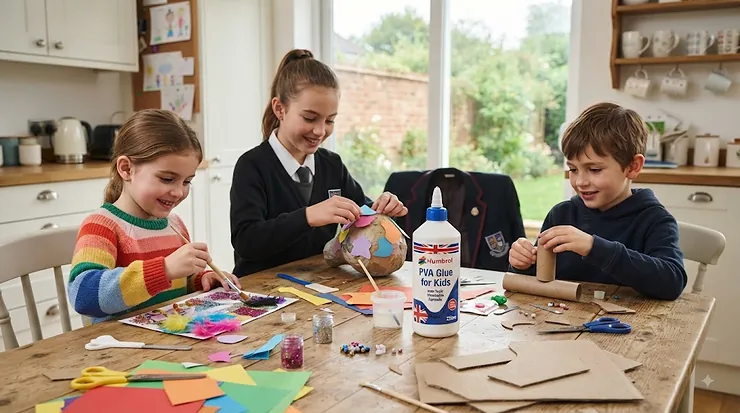
Somewhere between the biscuit tin and the recycling box, most British households have a drawer that’s slowly turning to cardboard cement. Glitter is fused to the carpet. A sock has mysteriously bonded to the kitchen table. And somewhere in the middle of it all sits a bottle of white glue that’s either a lifesaver or a menace, depending entirely on which one you bought.
So let’s get the definition out of the way early, because it matters more than people think. PVA glue for kids crafts is a water-based polyvinyl acetate adhesive formulated to be non-toxic, washable, and gentle enough for small hands, typically used for paper, card, fabric, and wood-based school and home projects. It’s the workhorse of primary school classrooms and rainy Saturday afternoons alike, and not all bottles are created equal.
This guide is built for parents, grandparents, childminders, and teaching assistants who are tired of guessing. We’ve dug into real product specs, genuine aggregated review sentiment, and UK safety standards to bring you seven proper contenders — not a rewritten shopping list, but an honest breakdown of which bottle earns its place on your craft shelf and why. We’ll also cover the adjacent questions that come up constantly: how washable glue actually differs from the “just wipe it off” claims on the label, when double-sided tape for scrapbooking beats glue outright, and what “non-toxic adhesive” is legally required to mean in the UK, not just what it says on the packaging.
Prices below are shown as ranges rather than exact figures, since Amazon pricing shifts by the week — always check the current price on the listing before you buy.
PVA Glue for Kids Crafts at a Glance
| Product | Best For | Size | Price Range |
|---|---|---|---|
| Kids B Crafty PVA Glue for Crafting | First-time crafters, small hands | 100ml (2×50ml) | Under £6 |
| Elmer’s Washable Liquid School Glue | Trusted all-rounder, slime-making | 4oz twin pack (~236ml) | £6-£9 |
| Galt Washable PVA Glue | Family bottle, sensitive skin | 500ml | £6-£8 |
| Scola Washable Crafting Kids Glue | Regular crafters, big families | 1 Litre | £8-£12 |
| Craft Planet Strong Tacky PVA | Heavier materials, wood, card | 1 Litre | £9-£13 |
| Amazon Basics Washable School Glue | Classrooms, bulk value, slime | 3.8 Litre | £15-£20 |
| abeec Craft Glue | Budget-conscious, lesser-known gem | 500ml | Under £7 |
Looking at the spread here, the story is really about volume versus convenience. Kids B Crafty PVA Glue for Crafting and abeec Craft Glue are built for occasional crafters who don’t want a half-used litre bottle drying out in a cupboard, while Amazon Basics Washable School Glue is squarely aimed at anyone gluing on an industrial scale — think classrooms, childminding settings, or a household with four kids and a shared Pinterest addiction. The middle of the table, occupied by Galt Washable PVA Glue and Scola Washable Crafting Kids Glue, is where most families will actually land, balancing cost-per-millilitre against the practical reality that unopened glue can thicken over time.
💬 Just one click — help others make better buying decisions too!😊
Top 7 PVA Glue for Kids Crafts: Expert Analysis
1. Kids B Crafty PVA Glue for Crafting — best starter pack with built-in spreader
The standout here isn’t the glue itself so much as the included applicator spatula, which sounds minor until you’ve watched a four-year-old try to squeeze a full-strength stream of PVA onto a paper plate. The two 50ml bottles come with a spreader tool designed to help little hands control application rather than flood it, which is arguably the single biggest factor in whether a craft session ends in triumph or tears.
On the specs, this is a straightforward white PVA that dries clear and washes out of most fabrics while still wet — useful shorthand for “don’t panic if it lands on school uniform.” At 100ml total, it’s not going to last a term of daily crafting, but that’s rather the point: it’s designed as a low-commitment way to test whether a child is ready for less-supervised glue use.
Based on the spec comparison with bulkier bottles, this is best suited to toddlers and reception-age children just starting out, or as a top-up bottle for a pencil case rather than a household’s main supply. What most buyers overlook about starter-size glue is that the small bottle size also limits mess by design — there’s simply less glue available to overdo it with.
The listing’s own product description leans heavily on being a “trusted UK brand” for classrooms and families, and the inclusion of a dedicated spreader is echoed as a practical plus point across similar smaller-format listings, though independent review volume on this specific pack is modest, so treat individual comments as indicative rather than definitive.
Pros:
- ✅ Applicator spreader built in for controlled use
- ✅ Genuinely washable while glue is still wet
- ✅ Low-commitment size for first-time crafters
Cons:
- ❌ Small volume runs out quickly with regular use
- ❌ Limited independent review history to verify at scale
Priced under £6 at the time of research, this is solid value as an introductory bottle rather than a long-term household staple.
2. Elmer’s Washable Liquid School Glue — best trusted all-rounder for slime and school
Elmer’s Washable Liquid School Glue carries decades of classroom reputation behind it — it’s widely known as the “number one teacher brand” in the US market and has built a strong following among UK parents largely through slime-making tutorials, where consistency and reliability matter more than almost anywhere else in crafting.
The no-run formula is the specific engineering detail worth flagging: rather than pooling or dribbling, it stays roughly where you squeeze it, which reduces the “glue lake” effect that ruins so many paper collages. It conforms to ASTM D4236, the standard used to assess art materials for chronic health hazards, and is explicitly formulated to be washable and non-toxic for school and home use.
What the spec sheet won’t tell you, but user reports suggest, is that this glue tends to sit slightly thinner than some UK own-brand alternatives, which is exactly why it performs so well as a slime base — it disperses more evenly when mixed with activator. For straightforward paper crafts, that thinner consistency means slightly more careful application than a tackier glue would need.
Reviewers consistently note how little mess it creates in practice, with one buyer specifically flagging how well it worked with young children without the usual clean-up headache — a recurring theme across the listing’s feedback rather than an isolated comment.
Pros:
- ✅ Reliable no-run formula reduces drips and pooling
- ✅ Excellent, well-tested base for homemade slime
- ✅ Strong classroom reputation built over decades
Cons:
- ❌ Thinner consistency needs more careful application on paper
- ❌ Twin-pack size is modest for frequent crafters
At around £6-£9 for the twin pack, it sits mid-table on price but earns its spot through sheer reliability.
3. Galt Washable PVA Glue — best family bottle for sensitive skin and repeat use
Galt Washable PVA Glue comes from a British educational toy and craft brand with roots stretching back over sixty years, and that pedigree shows in the formulation choices — this is glue built specifically around the “washes out of clothes” promise rather than treating it as a footnote.
At 500ml, the bottle size hits a genuine sweet spot: substantial enough to survive a school holiday of daily projects, without the storage headache of a litre-plus container. It’s rated for ages three and up, bonds cleanly to paper, card, wood, and fabric, and dries with the clear finish parents expect from a “proper” craft glue rather than a runny classroom substitute.
Here’s what to weigh if you’re comparing this against the bigger brands: Galt’s positioning has always been educational-first rather than mass-market, so you’re paying slightly more per millilitre for a brand that designs specifically with UK early-years settings in mind, including EYFS-aligned safety thinking baked into the product rather than bolted on.
Given the brand’s long-standing presence in UK nurseries and primary schools, the aggregated sentiment around Galt products generally centres on trust and consistency rather than novelty — parents buying it tend to already know the name from a school supply list, which says something about repeat-purchase behaviour even where individual review counts on this specific listing are moderate.
Pros:
- ✅ Established British brand with decades in education
- ✅ Genuinely washes out of clothing and skin
- ✅ 500ml size suits regular family crafting
Cons:
- ❌ Costs more per millilitre than bulk alternatives
- ❌ Not the cheapest entry point for occasional use
Expect to pay in the £6-£8 range, positioning it as a mid-tier, trust-driven purchase rather than a budget pick.
4. Scola Washable Crafting Kids Glue — best value for regular crafters and big families
Scola Washable Crafting Kids Glue is a name recognised in UK school-supply circles rather than high-street shelves, which is precisely why it tends to fly under the radar of parents shopping by brand recognition alone. It’s designed with classroom and nursery bulk-buying in mind, and that design philosophy carries over neatly into a busy household.
The 1-litre format is the headline spec worth interpreting properly: at this size, cost-per-use drops meaningfully compared with smaller bottles, which matters if you’ve got more than one child working through glue sticks, collage projects, and papier-mâché at the same time. It’s formulated to wash out of fabric and skin, and — like the rest of this list — dries clear rather than leaving a cloudy residue on finished work.
Based on the spec comparison with premium branded options, Scola’s value proposition is straightforward: near-identical performance characteristics to bigger names, at a lower cost-per-millilitre, because the brand spends its budget on bulk education contracts rather than consumer marketing. That’s a genuinely useful trade-off for anyone gluing regularly rather than occasionally.
Because Scola sells primarily through school-supply and craft-specialist channels, Amazon review volume for individual listings tends to be thinner than for household names like Elmer’s, so it’s worth reading a handful of the most recent reviews yourself before committing to the largest bottle size.
Pros:
- ✅ Strong cost-per-millilitre for regular crafting
- ✅ 1-litre size suits multi-child households
- ✅ Consistent classroom-grade formulation
Cons:
- ❌ Smaller review pool than mainstream consumer brands
- ❌ Bulk size is unnecessary for occasional use only
At around £8-£12 for a litre, this is one of the strongest value plays on this list for anyone crafting weekly rather than monthly.
5. Craft Planet Strong Tacky PVA — best for heavier materials like wood and card
Craft Planet Strong Tacky PVA earns its spot through a genuinely different formulation goal: rather than optimising for the thinnest, most spreadable glue, it leans tackier and stronger-holding, which changes what it’s actually good for in practice.
The “tacky” descriptor isn’t just marketing language — a thicker-bodied PVA grips heavier materials like card layers, lightweight wood, and craft-box refills far better than a runnier formula, because it doesn’t slide or shift before it sets. For 3D projects — think cardboard models, box builds, or anything with layered card — that extra hold reduces the number of failed joins children have to redo.
What most buyers overlook about tacky glue is that it trades away some of the fine-control spreadability that thinner glues offer for detailed paper collage work. Based on the spec comparison with the thinner options on this list, Craft Planet is best matched to slightly older children working on structural projects rather than toddlers doing simple paper-and-glitter collages.
Verified feedback on tacky, higher-strength craft PVAs in this category generally centres on bonding performance for wood and card specifically, with the trade-off being a slightly longer open-air drying window before the tack fully sets — useful to know if you’re working against a school-run deadline.
Pros:
- ✅ Stronger hold for card, wood, and layered materials
- ✅ Reduces failed joins on structural or 3D projects
- ✅ 1-litre size suits regular model-making
Cons:
- ❌ Less ideal for fine, detailed paper collage
- ❌ Thicker formula needs more drying time
Sitting around £9-£13, it’s a specialist pick rather than an everyday bottle — worth it if your household does a lot of cardboard engineering.
6. Amazon Basics Washable School Glue — best bulk value for classrooms and slime
Amazon Basics Washable School Glue is the bottle to reach for when the question isn’t “which glue” but “how much glue.” At 3.8 litres, this is squarely aimed at classrooms, childminders, and households that treat crafting as a near-daily activity rather than an occasional treat.
The clear formula is a specific and useful spec: unlike the white PVAs elsewhere on this list, a clear base means colours and glitter show through cleanly, and it’s a genuinely popular choice for homemade slime, where a see-through base gives a better final result than white glue does. It’s marketed explicitly as washable and school-appropriate, which lines up with the intended bulk-buyer audience.
On paper this means significant savings per millilitre compared with any 500ml or 1-litre bottle on this list — but only if you have genuine ongoing use for that volume, since large opened bottles are more prone to drying out or forming a skin if left unused for weeks at a time. Reviewers consistently note that it’s a dependable option for slime specifically, and the listing carries several thousand ratings, giving it one of the larger and more reliable review bases of any product covered here.
Pros:
- ✅ Exceptional cost-per-millilitre at this volume
- ✅ Clear formula ideal for slime and see-through crafts
- ✅ Large, well-established review base for confidence
Cons:
- ❌ Large opened bottle can dry out if underused
- ❌ Impractical volume for occasional single-child crafting
Expect to pay in the £15-£20 range for the full 3.8 litres — genuinely excellent value if you’ll use it, wasteful if you won’t.
7. abeec Craft Glue — best lesser-known budget alternative
abeec Craft Glue rounds out this list as the wildcard pick: a smaller UK-facing craft brand that doesn’t carry the same instant recognition as Elmer’s or Galt, but delivers a genuinely competent all-purpose PVA at a competitive 500ml size.
Functionally, it covers the same core ground as the bigger names — washable formula, non-toxic labelling, clear drying finish, general suitability for paper, card, and light fabric work. The 500ml size sits neatly between the smallest starter packs and the litre-plus bulk bottles, making it a sensible middle-ground purchase for a single child’s regular crafting habit.
Here’s what to weigh with lesser-known brands like this one: you’re trading some of the brand-recognition reassurance of Elmer’s or Galt for a lower price point, and in categories like basic PVA glue, where the underlying chemistry is fairly standardised, that trade-off is often worth making. Reviewers consistently note value for money as the headline reason for choosing brands like this over bigger names, though it’s honest to note that review volume and long-term track record are thinner than for more established competitors, so it’s worth checking the most recent listing feedback before a bulk purchase.
Pros:
- ✅ Competitive price for a genuinely usable 500ml PVA
- ✅ Covers the same core functions as bigger brands
- ✅ Convenient mid-size for single-child households
Cons:
- ❌ Less brand history and long-term track record
- ❌ Smaller review base than market leaders
At under £7, it’s one of the strongest budget picks here, particularly if your child’s crafting habit is still developing and you’re not ready to commit to a premium brand yet.
Practical Usage Guide: Getting the Most from Your Glue
Buying the right bottle is only half the job — how you store and use it changes both the mess factor and the lifespan of the glue itself. Cap it tightly after every single use; PVA glue thickens and eventually skins over when exposed to air repeatedly, and a crusty nozzle is the number one cause of kids squeezing too hard and creating a mess in the first place.
For first use with a new bottle, do a test squeeze onto scrap paper before handing it to a child — nozzle openings vary between brands, and knowing whether you’re dealing with a fine stream or a wide dollop lets you set expectations before the “good” project starts. If a nozzle does clog, a pin or cocktail stick clears it far more reliably than squeezing harder.
Common first-30-days mistakes are worth flagging directly: over-application is the biggest one, since young children often equate “more glue” with “stronger hold,” when actually a thin, even layer bonds paper and card just as effectively and dries considerably faster. Storing glue upright, away from radiators, and out of direct sunlight also meaningfully extends shelf life — heat is the main enemy of a smooth, spreadable consistency.
For classroom or multi-child settings, decanting a small amount into an old margarine tub with a stubby brush gives far better control than passing round the original bottle, and it dramatically cuts down on shared-nozzle contamination during cold and flu season — a small hygiene win that’s easy to overlook.
Real-World Scenarios: Matching Glue to Your Household
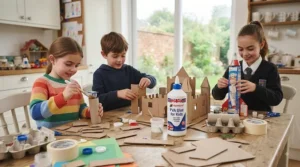
Consider three fairly typical households, each with different needs. A parent of a toddler doing their first-ever collage needs almost nothing beyond safety and control — a small, washable bottle like Kids B Crafty PVA Glue for Crafting, ideally with a spreader tool, is more than sufficient, and buying a large bottle at this stage is simply premature.
A family with two primary-school-aged children doing weekly craft projects and the occasional slime-making session sits in a very different bracket. Here, the calculation shifts towards cost-per-use and versatility, which is where Scola Washable Crafting Kids Glue or Galt Washable PVA Glue earn their keep — enough volume to avoid constant repurchasing, without the storage commitment of a multi-litre bottle that risks drying out.
Then there’s the childminder or reception classroom running daily craft activities across a group of children. Volume and reliability trump everything else here, and this is exactly the scenario Amazon Basics Washable School Glue is built for — the 3.8-litre size only makes financial sense at this level of throughput, where the bottle won’t sit unopened long enough to dry out between sessions.
Problem → Solution: Common PVA Glue Headaches, Solved
Even good glue causes bad days occasionally, so here are the recurring issues and what actually fixes them. If glue has already dried onto clothing, don’t panic and don’t reach for hot water first — soak the fabric in cold water for ten to fifteen minutes to loosen the bond, then gently work at the residue before washing as normal; heat can set some formulations rather than lift them.
If a bottle nozzle has clogged solid, resist the urge to squeeze harder, which usually just splits the seam of the bottle instead. A pin, unfolded paper clip, or cocktail stick pushed gently into the opening almost always clears it without damaging the bottle.
For glue that’s gone thick and stringy after sitting open for months, a few drops of water mixed in and shaken well can often restore usable consistency for less delicate projects, though it’s worth accepting that heavily thickened glue is nearing the end of its useful life regardless.
Finally, for the classic “glued my fingers together” moment — genuinely common with younger children — warm soapy water and patient, gentle rubbing is the answer; PVA is specifically designed to be washable for exactly this reason, and it will release with time rather than force.
✨ Don’t Miss These Exclusive Deals!
🔍 Whether you’re stocking a classroom or topping up the craft drawer at home, the right bottle makes every project easier. Click through on any product above to check current pricing and availability before your next crafting session.
How to Choose PVA Glue for Kids Crafts
Picking the right bottle comes down to a handful of practical criteria rather than brand loyalty alone. Working through these in order will get most parents to the right answer quickly.
- Check the age rating and non-toxic labelling first. Anything genuinely intended for children’s crafting in the UK should reference relevant safety testing rather than just the word “safe” on the packaging.
- Match bottle size to actual frequency of use, not aspiration. A litre bottle that dries out unused is worse value than a small one that gets finished and repurchased.
- Decide whether you need washable specifically, or just non-toxic. Most kids’ PVA is both, but formulations do vary in how easily they lift from fabric versus skin.
- Think about consistency for your intended project. Thinner glues suit detailed paper collage; tackier, stronger formulas suit card, wood, and structural builds.
- Consider whether clear or white glue suits the project better. Clear glue tends to win for slime and see-through applications; white glue is often easier to see while applying, which helps younger children avoid gaps.
- Factor in genuine review volume, not just star rating. A 4.7-star rating from twelve reviews carries far less weight than a 4.4-star rating from several thousand.
- Check current price per 100ml rather than headline price. Bulk bottles look expensive up front but are frequently the better value once you calculate cost-per-use.
PVA Glue for Kids Crafts vs Double-Sided Tape for Scrapbooking
For paper-based projects specifically, glue isn’t always the right tool, and this is where double-sided tape for scrapbooking genuinely earns its place in a craft drawer. The two adhesives solve different problems, and understanding the distinction saves a lot of wrinkled photos and warped paper.
| Factor | PVA Glue | Double-Sided Tape |
|---|---|---|
| Best For | Collage, papier-mâché, mixed materials | Photo mounting, card layering, clean lines |
| Mess Level | Higher — wet application | Minimal — no drying time |
| Drying Time | Minutes, needs flat drying | Instant bond |
| Paper Warping Risk | Higher on thin paper | Very low |
| Cost per Project | Lower for large-coverage projects | Higher for large-coverage projects |
The table above makes the trade-off fairly clear: PVA Glue for Kids Crafts wins decisively on cost and versatility across materials, but double-sided tape for scrapbooking wins on precision and speed for anything paper-on-paper, like mounting photographs or layering card for handmade cards. Scrapbooking specialists often lean towards tape precisely because excess glue application on thin paper causes visible wrinkling once it dries, something tape simply doesn’t risk. For a household doing both styles of craft, keeping both on hand rather than picking one exclusively tends to be the more practical outcome.
Washable Glue Explained: What “Washable” Actually Means
The word “washable” appears on nearly every bottle in this guide, but it’s worth unpacking properly rather than taking it at face value, because it doesn’t mean quite what many parents assume.
Washable glue is formulated so that, while still wet, it lifts relatively easily from skin and most fabrics using ordinary water, ideally before it has had time to fully cure. Reviewers consistently note that speed matters here — glue caught within minutes washes out far more reliably than glue left to dry into a stiffened patch on a school jumper overnight.
What most buyers overlook is that “washable” is not synonymous with “waterproof-proof against staining forever” — once fully dried and cured, especially over multiple wash cycles or on delicate fabrics, some residue or stiffening can remain, particularly on wool or silk-blend materials that aren’t common in school uniforms but do occasionally show up in costume-making projects. For everyday cotton-based school uniforms, though, washable PVA genuinely does what it says, provided it’s treated reasonably promptly.
Practically speaking, cold-water rinsing immediately after a craft session, followed by a normal wash, handles the vast majority of washable-glue mishaps without any special products or techniques required.
PVA Glue for Kids Crafts for School Crafts: Classroom-Ready Buying Guide
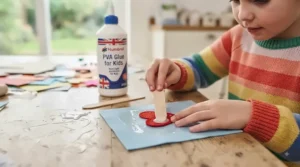
School crafts bring a slightly different set of priorities than home crafting, largely because volume, safety documentation, and shared-use hygiene all matter more in a classroom setting than they typically do at the kitchen table.
For school crafts specifically, bulk formats like Scola Washable Crafting Kids Glue or Amazon Basics Washable School Glue make far more financial sense than they would for a single-child household, simply because the cost-per-pupil drops sharply at scale, and a classroom of twenty-five children will genuinely work through a litre bottle within weeks rather than months.
Teachers and childminders should also prioritise glue with a controllable nozzle or a decanting-friendly wide neck, since squeeze-bottle mishaps multiply quickly across a group setting compared with one-to-one home use. Non-drip nozzles reduce both waste and the classic “too much glue” problem that turns a tidy collage into a soggy mess that won’t dry before home time.
It’s also worth checking that any glue purchased for a school or nursery setting includes clear, accessible safety documentation, since many UK early-years settings are required to keep supplier information on file for consumables used with children under three — a detail easy to overlook when ordering supplies quickly online.
Non-Toxic Adhesive Safety: Regulations and What to Actually Check
“Non-toxic” is used loosely in everyday conversation, but in the UK it connects to specific regulatory requirements that are worth understanding, particularly if you’re buying for a nursery, childminding setting, or a child under three who’s still prone to putting things in their mouth.
Products marketed as suitable for children’s crafting in Great Britain generally fall under the scope of the Toys (Safety) Regulations 2011, which set out the safety requirements manufacturers must meet, including chemical migration limits covered under the EN 71-3 testing standard, before an item can legitimately carry safety claims aimed at children. This applies to craft materials marketed at children even where the product itself isn’t a conventional toy.
The Royal Society for the Prevention of Accidents also publishes practical, non-technical guidance for parents on spotting warning signs of non-compliant products — things like missing manufacturer details, absent age guidance, or suspiciously vague packaging, all of which are reasonable red flags regardless of how cheap or convenient a listing looks.
In practice, this means checking a product listing for explicit non-toxic and washable claims, ideally alongside a UKCA or CE mark visible in listing photos, rather than trusting marketing language alone. Every product covered in this guide is marketed as non-toxic and suitable for children’s crafting, but it’s a habit worth building for any future purchases outside this list too — a habit that costs nothing and genuinely reduces risk.
Common Mistakes When Buying PVA Glue for Kids Crafts
The most frequent mistake is buying purely on price without checking size-to-usage ratio — a suspiciously cheap large bottle often works out more expensive per project than a modest, well-reviewed smaller one, once you account for glue that dries out unused before it’s finished.
A second common error is ignoring consistency entirely. Parents frequently buy a thin, runny glue for a structural cardboard project, then wonder why joins keep failing — the fix isn’t a different glue technique, it’s the wrong product for the job in the first place.
Third, many buyers skip checking review volume and focus purely on the star rating shown at a glance. A near-perfect score built on a handful of reviews tells you far less than a slightly lower score built on genuine volume — and it’s the pattern within written reviews, not just the number, that reveals whether complaints are about the product or about shipping and packaging issues unrelated to the glue itself.
Finally, it’s easy to overlook storage requirements at the point of purchase. A large bulk bottle bought with good intentions but stored somewhere warm, like near a radiator or in direct sun, will thicken and degrade far faster than the same product stored correctly — turning what looked like excellent value into wasted money within a few months.
Frequently Asked Questions
❓ Is PVA glue safe for a two-year-old to use?
❓ How long does PVA glue take to dry?
❓ Does washable PVA glue really come out of clothes?
❓ Can you use PVA glue instead of double-sided tape for scrapbooking?
❓ What size PVA glue bottle is best for a single child at home?
Conclusion
There’s no single “best” bottle of PVA glue for kids crafts, and honestly, anyone claiming otherwise is skipping the more useful answer. The right choice depends on how often you’re crafting, how many children are involved, and what you’re actually building — a toddler’s first collage and a classroom’s papier-mâché volcano season call for genuinely different bottles.
If you’re testing the waters with a young crafter, start small with something like Kids B Crafty PVA Glue for Crafting or abeec Craft Glue. If you’re settled into a regular family crafting rhythm, Galt Washable PVA Glue or Scola Washable Crafting Kids Glue offer a sensible middle ground of trust and value. And if you’re supplying a classroom or a household that treats glue as a weekly essential, Amazon Basics Washable School Glue delivers the volume to match.
Whichever bottle you land on, the fundamentals matter more than the brand name: check for genuine non-toxic and washable claims, match the size to your real usage, and store it properly so it lasts. Do that, and the glue drawer stops being a source of stress and starts being exactly what it should be — the quiet, reliable backbone of every good craft afternoon.
✨ Ready to Stock Up on the Right Glue?
🔍 Take the guesswork out of your next craft supply run. Click through on any product above to check current pricing and availability, and give your family’s craft sessions the upgrade they deserve!
Recommended for You
- Washi Tape Sets: 7 Brilliant Picks for Every Craft Box
- Glue Gun for Crafts: 7 Best Picks Reviewed for UK Crafters (2026)
- 7 Best Paper Trimmer for Scrapbooking in 2026
Disclaimer: This article contains affiliate links. As an Amazon Associate, I earn from qualifying purchases. If you purchase products through these links, we may earn a small commission at no additional cost to you.
✨ Found this helpful? Share it with your friends! 💬🤗
