
In This Article
It’s 11:40pm. Your essay is due at nine, and your room is lit by one overhead bulb that makes you look like a suspect in a police drama. Next door, someone is already asleep. The right desk lamp for halls of residence fixes this in about thirty seconds. It puts light exactly where your page or laptop needs it and leaves the rest of the room dim enough to sleep in.
Halls aren’t a normal bedroom, though. You get a small desk, one or two sockets, and a rulebook. Imperial College London, for example, tells residents that personal electrical equipment must meet British standards with a CE mark, and that sockets must never be overloaded. Other universities ban free-standing lamps, and a few supply a lamp and won’t let you bring your own. So the best desk lamp for halls of residence isn’t simply the brightest one. It’s the one that is allowed, compact and comfortable at 1am.
This guide covers seven real lamps, from under £20 to premium. It also covers warm vs cool light, whether a USB-powered lamp is enough, and how to survive late-night studying without wrecking your sleep. Everything here comes from manufacturer specifications, retailer listings and published reviews. I haven’t hands-on tested these lamps, and where a review pool couldn’t be verified, I say so. Prices are indicative ranges only, so check current prices on amazon.co.uk.
Quick Comparison: 7 Desk Lamp for Halls of Residence Options at a Glance
| Lamp | Power | Colour options | Price range | Best For |
|---|---|---|---|---|
| IKEA TERTIAL | Mains (bulb sold separately) | Whatever bulb you fit | £10-£25 | Tight budgets, clamp mounting |
| Philips Donutclip DSK201 | USB | Dimmable; colour modes not listed | Around £10-£20 | Minimal desks, light studying |
| KNAMKY USB LED Desk Lamp | USB | 3000K / 4500K / 6500K | Under £20 | Warm vs cool light on a budget |
| LACOKI Clip-On Reading Light | USB-rechargeable battery | 3 colours × 3 brightness | Under £20 | Studying in bed, cordless use |
| Lepro LED Desk Lamp | Mains | 5 colour modes, 5 brightness levels | £20-£35 | Bright, all-round value |
| Honeywell H6 Sunturalux | Mains (USB port, per one roundup) | Natural-light simulation, dimmable | £30-£60 | Timer lovers, colour-accurate work |
| BenQ e-Reading Desk Lamp | Mains | 13 colour modes | Above £100 | Long-term investment |
Looking at the table, the three USB options (Philips Donutclip DSK201, KNAMKY USB LED Desk Lamp and LACOKI Clip-On Reading Light) are all cheap and easy to fit in a rulebook-heavy room. The Lepro LED Desk Lamp and Honeywell H6 Sunturalux offer far more light for a modest step up in cost. The BenQ e-Reading Desk Lamp costs several times more than the rest, so it only makes sense if you’ll still be using it after halls.
💬 Just one click — help others make better buying decisions too!😊
Top 7 Desk Lamp for Halls of Residence Picks: Expert Analysis
1. IKEA TERTIAL — the clamp-on classic that dodges free-standing bans
The IKEA TERTIAL has been in IKEA’s range since 1998. That kind of longevity usually means a design nobody has managed to improve cheaply.
It has a steel body, an adjustable arm and head, a 17 cm shade and a 1.5 m cord. The clamp opens to about 60 mm, and it carries a CE mark. The bulb is sold separately, and IKEA recommends an E27 LED. That’s a quiet advantage: you choose the colour temperature, so a warm bulb for evenings and a cooler one for daytime are one swap apart. Because it clamps to the desk, it also sidesteps the free-standing lamp bans some halls enforce.
Based on the specs, it suits first-years who want a dependable, repairable lamp without gimmicks. Check your desk edge first, since a thick lip or a drawer unit can defeat the clamp. The 1.5 m cord also means your socket needs to be fairly close.
Reviewer sentiment is the weak spot here. The only feedback I could find came from reseller listings, which were positive on value and delivery, so I can’t claim a robust verified review pool. Check current amazon.co.uk reviews, because availability varies by seller.
Pros:
- ✅ Clamp frees up precious desk space
- ✅ Swappable bulb lets you pick your colour temperature
- ✅ Sturdy steel build with CE marking
Cons:
- ❌ Bulb sold separately
- ❌ No built-in dimmer or timer
Price: roughly £10-£25 depending on seller, plus a few pounds for an LED bulb. For the money, it’s the safest bet for a rule-strict hall.
2. Philips Donutclip DSK201 — tiny USB clip that spares your socket
If your room has one socket and it’s already hosting a phone charger, the Philips Donutclip DSK201 is the polite answer.
According to Currys’ listing, it’s a 175-lumen clip-on lamp with an adjustable arm and a dimmable output, powered by USB. It uses flicker-free “EyeComfort” technology, the LED is rated for up to 15,000 hours, and there’s a two-year guarantee. That rating works out at roughly five years of use at eight hours a day, which is plenty for a degree. The listing describes it as both “USB powered” and “USB rechargeable”, so confirm which version you’re buying.
Here’s the honest take: 175 lumens is modest. It’s fine for a laptop and a notebook, and it will feel stingy over a sprawling textbook-and-highlighter spread. Think of it as a bedside-reading light promoted to desk duty. The brand and guarantee give it more reassurance than most no-name clip lights, though.
I couldn’t verify a review score for this exact model, so I won’t quote one.
Pros:
- ✅ Two-year guarantee from a known brand
- ✅ Flicker-free light for long sessions
- ✅ Clip design keeps the desk clear
Cons:
- ❌ 175 lumens is modest for big spreads
- ❌ Colour options not clearly listed
Price: around £15 at one UK retailer at the time of research, so check current price. It’s good value if your studying is mostly screen-based.
3. KNAMKY USB LED Desk Lamp — three colour temperatures at pocket-money prices
The standout on the KNAMKY USB LED Desk Lamp is a three-way colour switch. It offers 3000K warm light, 4500K warm white and 6500K cool white, with ten brightness levels.
That range matters, because the choice between warm and cool light is the heart of good late-night studying. Cool white at full brightness suits morning lectures and maths problem sets, while 3000K at low brightness is kinder for winding down. The 15-inch gooseneck has a metal clip with non-slip padding, and the 150 cm USB cable reaches a laptop port, power bank or plug adapter.
On paper, that 15-inch reach means it lights a spot rather than a whole desk. It’s ideal for a laptop-and-notes workspace but not for a drafting-table sprawl. If you plug it into a mains USB adapter, make sure the adapter is UK-purchased and compliant, because several halls ban non-UK adaptors.
As for reviews, the listing I found was a deals page with no verifiable review data. Treat this as a low-risk, low-cost try, and read current buyer feedback before committing.
Pros:
- ✅ Three colour temperatures cover day and night
- ✅ Ten dimming levels for fine control
- ✅ Long 150 cm USB cable
Cons:
- ❌ Limited verified review information
- ❌ Short neck reach for wide desks
Price: under £20. That makes it the cheapest way to test warm vs cool light for yourself.
4. LACOKI Clip-On Reading Light — cordless for studying in bed
When the deadline hits and the desk is buried under laundry, the LACOKI Clip-On Reading Light lets you retreat to bed without losing your light.
It’s a rechargeable clip lamp with 28 LEDs and three colours × three brightness levels. It’s designed to clamp onto a headboard, table or desk. The battery means no cable snaking across the floor, which is a genuine trip hazard in a small room.
Rechargeable lights come with trade-offs, though. Battery lamps typically offer less output than mains models, and runtime shrinks at full brightness. There’s also a safety angle. Merseyside Fire and Rescue’s student advice warns against leaving devices charging overnight, so charge it in the daytime, not on your pillow.
Treat it as a supplementary light for reading and revision, not your main desk lamp. For a laptop-based all-nighter, a mains or USB-powered lamp will be steadier.
I couldn’t verify detailed review sentiment for this model, since it mainly appears in roundups. Check current amazon.co.uk reviews on battery life before buying.
Pros:
- ✅ Cordless, so no trailing cable
- ✅ Three colours for flexible evening use
- ✅ Clips to desk, headboard or shelf
Cons:
- ❌ Battery needs regular recharging
- ❌ Likely dimmer than mains lamps
Price: under £20. It’s good value as a second lamp for bed.
5. Lepro LED Desk Lamp — brightest budget all-rounder
The Lepro LED Desk Lamp is the lamp students keep landing on, because it delivers real brightness at a low price.
The listing quotes 9.5W and roughly 750-800 lumens, depending on the version, with five colour modes, five brightness levels and touch controls. That’s about four times the output of the Philips clip. It’s enough to light an A4 spread and a laptop keyboard without squinting. Five modes × five levels gives 25 combinations, so you can find a warm, low setting for midnight and a bright, cool one for the morning.
Several roundups rank it as a budget pick, and the listing cites a Forbes Vetted recognition that I haven’t verified at source. One reviewer noted it works well for a standard desk with normal-sized textbooks, though bigger layouts may want wider coverage.
The catch is the base. It’s free-standing, so it eats desk space, and some halls ban free-standing lamps outright. Check your accommodation rules before ordering.
Pros:
- ✅ Far brighter than USB clip lamps
- ✅ 25 colour and brightness combinations
- ✅ Consistently ranked as a budget pick
Cons:
- ❌ Free-standing base uses desk space
- ❌ May break halls rules on free-standing lamps
Price: roughly £20-£35, so check current price. It’s superb value if your halls allow it.
6. Honeywell H6 Sunturalux — timer and natural-light simulation
The Honeywell H6 Sunturalux is aimed at people who want their lamp to do a little thinking for them.
Listings describe an 800-lumen, dimmable lamp with a timer, touch control and “natural light” simulation. One roundup notes a USB charging port too. The timer is the most underrated feature for students. Set it for 30 minutes, and if you nod off over your notes, the lamp switches itself off.
Natural-light simulation suits art and design students, because accurate colour rendering matters when you’re judging a sketch or print. One roundup also flags a downside: it loses its memory settings when unplugged. That’s annoying in halls, where Imperial and others advise unplugging electrical items when you leave the room.
On the reviews, I could verify only roundup-level praise for its eye-care and colour features. There’s no robust review pool I can quote.
Pros:
- ✅ Built-in timer is useful for sleepy sessions
- ✅ Natural-light mode for colour-sensitive work
- ✅ Strong 800-lumen output
Cons:
- ❌ Loses settings when unplugged
- ❌ Pricier than the budget picks
Price: in the £30-£60 range, so check current price. It’s worth it for design students and anyone who wants the timer.
7. BenQ e-Reading Desk Lamp — premium wide-coverage lamp that outlives halls
The BenQ e-Reading Desk Lamp is the one that makes everything else look like a torch.
Its curved head lights a desk up to about 90 cm wide. BenQ lists a paper-reading mode of 1,000 lux at 5700K, a screen mode of 500 lux at 4000K, 13 colour modes, a CRI of Ra 90 or above (depending on model), flicker-free output and a tested LED life of up to 50,000 hours. The body is about 94% metal. Those numbers mean even light across a whole desk with no hot spots, and colours that stay true.
Buyers on retailer listings praise the gentle light, the many colour options and a heavy, stable base. One calls it pricey but worth it.
In halls, though, I’d call it overkill. It’s free-standing, takes up desk footprint, and some halls would block it. Treat it as a three-year lamp, one you buy now and take to your second-year house share.
Pros:
- ✅ Very wide, even light coverage
- ✅ Customisable colour and brightness modes
- ✅ Long-lasting, metal-heavy build
Cons:
- ❌ Premium price for a halls room
- ❌ Large, free-standing footprint
Price: above £100, so check current price. It’s superb value over several years, though poor value if you only need it for one academic year.
✨ Don’t Miss These Exclusive Deals!
🔍 Ready to light up your study corner? Click any highlighted lamp above to check current pricing and availability on amazon.co.uk, then match it to your halls rules before you buy. A few pounds today could save you hours of squinting tonight! 💡
How to Set Up Your Desk Lamp in Halls: A First-30-Days Guide
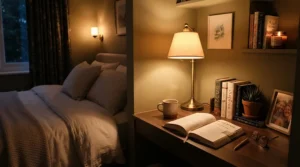
Buying the lamp is half the job. Setup is where halls rooms are won or lost.
Before you unpack: check your accommodation’s prohibited items list. Royal Holloway, for instance, lists freestanding lamps as a fire and trip hazard, and Cumbria’s list says desk lamps are supplied by the university.
Day one: clamp or place the lamp on the opposite side from your writing hand. If you’re right-handed, put it to your left so your hand doesn’t cast a shadow over your page. Angle the head so it doesn’t reflect off your laptop screen.
Week one: build a routine. Use a cooler, brighter setting for daytime work and a warm, dim setting after dark. Switch off and unplug the lamp when you leave the room, as Imperial advises. If you use a LACOKI Clip-On Reading Light or other rechargeable lamp, charge it in the daytime rather than overnight.
Common first-month mistakes:
- Draping a scarf or t-shirt over the lamp to dim it. University of London halls guidance says fabrics must be kept well away from electrical appliances.
- Running the cable across the floor, where it will trip someone.
- Using a non-UK adaptor or extension lead.
- Ignoring a flickering bulb. If the lamp buzzes, flickers or runs hot, stop using it and report it.
Finally, wipe the lamp with a dry cloth now and then. IKEA’s care advice for the IKEA TERTIAL is simply to wipe dry.
Real-World Scenarios: Three Students, Three Lamps
Here’s how three different student profiles map to the picks above.
Scenario 1: Maya, first-year English student. She has a tight budget, a tiny desk by the window, and studies two to three hours most evenings, mainly with paperbacks. Her halls bans free-standing lamps. The IKEA TERTIAL fits perfectly: the clamp complies, the bulb is replaceable, and total spend stays low. If her desk edge is too thick, the KNAMKY USB LED Desk Lamp is the clip-on alternative.
Scenario 2: Dev, second-year computer science student. He works late, often past midnight, in a shared room with a flatmate who sleeps early. A LACOKI Clip-On Reading Light on his bed frame gives him a warm, dim, low-spill light for reading and revision. For laptop work, the Philips Donutclip DSK201 gives him a screen-friendly glow without dazzling anyone.
Scenario 3: Imani, design student. She works with sketches and printed colour swatches, so accurate colour matters, and her accommodation allows free-standing lamps. The Honeywell H6 Sunturalux with natural-light mode and a timer suits her, and if she plans to keep a lamp for years, the BenQ e-Reading Desk Lamp is the investment.
The pattern is clear. The more your study involves paper and colour, the more output and coverage you need. The more you share space, the more portability, dimming and low spill matter.
What Is a Desk Lamp for Halls of Residence?
A desk lamp for halls of residence is a compact, task-focused light designed for a small university bedroom desk. It typically clamps or clips on to save space, runs on a standard UK plug or a USB source, complies with your accommodation’s electrical safety rules, and lets you light your study area without disturbing neighbours or sleep.
That definition shows how it differs from a normal home lamp in three ways. First, size: you rarely have room for a wide base, so clamps and clips beat free-standing stands. Second, power: a USB-powered lamp avoids the single-socket problem, while mains lamps need an available plug. Third, compliance: your halls may require PAT testing, CE or UKCA marking, and no free-standing designs, which many ordinary lamps ignore.
Think of it as a lamp with a rulebook. Choose well, and it quietly improves your focus, your posture and your sleep. Choose badly, and it may be confiscated at a room check.
How to Choose a Desk Lamp for Halls of Residence
Follow these seven steps and you’ll avoid most regrets.
- Check your halls rules first. Some ban free-standing lamps, some supply lamps, and some require PAT testing. A rejected lamp is money wasted.
- Choose clamp or clip over free-standing. A clamp keeps your desk clear and is more likely to comply, though you’ll need to check your desk edge.
- Match brightness to your tasks. Around 175 lumens suits laptop-and-notes work, while roughly 750-800 lumens suits open textbooks and written work.
- Look for adjustable colour temperature. A lamp that goes warm and dim at night and cool and bright by day beats a fixed-colour lamp.
- Decide between USB-powered and mains. USB saves sockets and is portable, while mains usually gives more output.
- Prioritise flicker-free light. Flicker-free output reduces eye strain during long sessions.
- Check the guarantee and safety marks. A two-year guarantee, like the Philips Donutclip DSK201 offers, plus CE or UKCA marking, helps you if something goes wrong.
If you’re torn, my default for most first-years is a clamp-on lamp with at least two colour temperatures, which points to the KNAMKY USB LED Desk Lamp or a warm-bulbed IKEA TERTIAL.
Warm vs Cool Light: What Actually Helps You Study?
Colour temperature is measured in Kelvin (K). Lower numbers look yellow and cosy, and higher numbers look white-blue and crisp. As one researcher at Nottingham Trent puts it in The Conversation, a 2,700K bulb gives off distinctly yellowish light.
The classic advice is that blue-rich light suppresses melatonin, the hormone that helps you feel sleepy. That article references 2001 research from Thomas Jefferson University showing both colour and intensity matter, and suggests keeping evening light dim and on the warm side.
There’s a complication, though. University of Manchester research on mice found that blue tones had a weaker effect on the body clock than equally bright yellow light, which led the team to suggest dim, cooler light in the evening might be better. That work was on mice, which are nocturnal, so human implications are uncertain. The sensible reading is that brightness matters at least as much as colour, so keep evening light low whatever its colour.
| Time and task | Suggested setting | Best For |
|---|---|---|
| Morning lectures and maths | Cool, 5000K+ and bright | Alertness, problem sets |
| Afternoon essay writing | Neutral, around 4000-4500K | General reading and typing |
| Evening revision | Warm and moderately dim | Winding down |
| After midnight | Warm, low brightness | Late-night studying with minimal disturbance |
The table shows the principle: match the lamp to the clock, not the other way round. Lamps with several colour modes, such as the KNAMKY USB LED Desk Lamp and Lepro LED Desk Lamp, make this easy. The BenQ e-Reading Desk Lamp builds the idea in, with a 4000K screen mode and a 5700K paper mode.
USB-Powered Lamp vs Mains Lamp: Which Suits Halls Better?
A USB-powered lamp draws power from a laptop port, power bank or USB adapter. A mains lamp plugs straight into a wall socket. In halls, each has a clear lane.
| Factor | USB-powered lamp | Mains lamp | Best For |
|---|---|---|---|
| Socket use | None if powered from a laptop | One socket | USB: crowded rooms |
| Brightness | Typically lower | Typically higher | Mains: textbooks, wide desks |
| Portability | High | Low | USB: bed-to-desk moves |
| Rules risk | Lower, with a UK-compliant adaptor | Needs PAT/CE checks | USB: strict halls |
| Examples | Philips Donutclip DSK201, KNAMKY USB LED Desk Lamp | Lepro LED Desk Lamp, IKEA TERTIAL | Depends on your room |
A USB-powered lamp is the sensible default if you’re short of sockets or want to move around, but it usually delivers less light. If you read a lot from paper, a mains lamp’s extra output is worth the socket. One more tip: if you plug a USB lamp into a mains adaptor, make sure the adaptor itself is UK-purchased, compliant and not an extension-lead gimmick.
Late-Night Studying: Light Without Wrecking Your Sleep
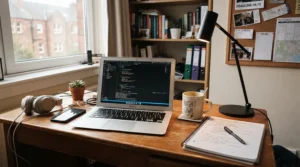
Late-night studying is a fact of student life, so the goal isn’t to avoid it but to do it smartly.
First, dim the lamp as the evening goes on. As the Nottingham Trent researcher suggests, reducing exposure to intense bluish light a couple of hours before sleep and keeping lights low and warm could help. The Manchester mouse research is a reminder that the science is still evolving, so low brightness is the safer common denominator.
Second, use a timer. The Honeywell H6 Sunturalux has a built-in one, and it’s a neat safeguard if you tend to doze at your desk.
Third, consider your neighbours. A clamp-on lamp aimed straight down at your desk spills less light than an overhead bulb. A LACOKI Clip-On Reading Light clipped to a bedframe can be even less intrusive, but charge it in the daytime.
Finally, treat your screen as a light source too. Even with a perfect lamp, a bright laptop at 2am is sending a signal to your body clock. Lower the screen brightness to match the lamp, and stop when you’re properly tired. No lamp can fix a missing night’s sleep.
Halls Rules, Safety and Compliance: What to Check Before You Buy
Rules vary widely, which is why checking first matters.
St Andrews’ residences guide says lamps must not be free-standing, must be PAT tested and must comply with British safety standards. Fabric lamp shades must display the British Safety Standard symbol and use the correct wattage bulb, and lava lamps are banned. Royal Holloway lists freestanding lamps and cube adaptors as prohibited, along with non-UK multi-plug leads. Cumbria’s prohibited list says desk lamps are supplied by the university.
The common threads are clear:
- Look for CE or UKCA marking and a UK three-pin plug.
- Avoid free-standing lamps if your halls list them as banned.
- Never overload a socket.
- Don’t cover lamps with fabric.
- Don’t leave devices charging unattended overnight.
If you’re unsure, email your accommodation team and ask. A short email is far cheaper than a confiscated lamp.
Long-Term Cost and Maintenance: What Your Lamp Really Costs
LED lamps are cheap to run. A 9.5W lamp such as the Lepro LED Desk Lamp, used four hours a day, costs roughly a penny a day at recent UK electricity rates. Over a year, that’s a few pounds at most.
| Lamp | Price range | Lifespan clue | Best For |
|---|---|---|---|
| IKEA TERTIAL | £10-£25 + bulb | Depends on bulb | Lowest total cost |
| Philips Donutclip DSK201 | Around £10-£20 | LED rated up to 15,000 hours | Guarantee-backed budget buy |
| Lepro LED Desk Lamp | £20-£35 | Not verified | Brightness per pound |
| BenQ e-Reading Desk Lamp | Above £100 | LED tested up to 50,000 hours | Multi-year use |
The table suggests that purchase price, not electricity, dominates cost. The BenQ e-Reading Desk Lamp looks pricey, but spread over a three-year degree plus a rented house, its cost per year falls sharply. The IKEA TERTIAL wins on total cost, and the Philips Donutclip DSK201 wins on peace of mind thanks to its two-year guarantee.
Maintenance is minimal. Wipe with a dry cloth, check the cable for damage, and replace the bulb in bulb-based lamps when it fails.
Common Mistakes When Buying a Desk Lamp for Halls of Residence
Mistake 1: buying before reading the rules. Royal Holloway’s electrical equipment list shows how many items get banned for fire and trip reasons.
Mistake 2: chasing lumens only. Brightness matters, but glare, flicker and colour options matter too.
Mistake 3: ignoring the desk. A clamp that doesn’t fit your desk edge is a paperweight.
Mistake 4: buying a USB-powered lamp without checking your power source. You’ll need a laptop port, power bank or a UK-compliant adaptor.
Mistake 5: skipping colour control. A fixed cool-white lamp is fine in the afternoon and harsh at midnight.
If you avoid these five, you’ll be ahead of most first-years.
FAQ
❓ Can I bring my own desk lamp to halls?
❓ How many lumens do I need for a student desk lamp?
❓ Is it safe to leave a USB lamp charging overnight?
❓ Is a clip-on lamp better than a free-standing one in halls?
❓ Will a desk lamp disturb my roommate during late-night studying?
Conclusion
The best desk lamp for halls of residence isn’t the most expensive or the brightest. It’s the one that follows your halls rules, fits your desk, and adapts to the hour. For most students, that means a clamp-on or USB-powered lamp with at least two colour temperatures.
If you’re on a tight budget, the IKEA TERTIAL and KNAMKY USB LED Desk Lamp are the sensible starting points. If your room is crowded, the Philips Donutclip DSK201 frees your socket. For reading in bed, the LACOKI Clip-On Reading Light earns its place. If your halls allow it and you need power, the Lepro LED Desk Lamp and Honeywell H6 Sunturalux deliver brightness and features. And if you want a lamp for years, the BenQ e-Reading Desk Lamp is the long game.
Whatever you pick, use warmer, dimmer light as the night goes on, charge battery lamps in daylight, and keep fabric well away from anything hot. Then go write that essay.
✨ Ready to brighten your study corner?
🔍 Click through to check current prices and availability on amazon.co.uk, match your pick to your halls rules, and give your late-night studying the light it deserves! 💡📚
Recommended for You
- University Stationery Bundle Under £20: 7 Best Picks (2026)
- Desk Organiser For Dissertation Research: 7 Best Picks (2026)
- Printer For Dissertation Writing: 7 Proven Picks (2026)
Disclaimer: This article contains affiliate links. As an Amazon Associate, I earn from qualifying purchases. If you purchase products through these links, we may earn a small commission at no additional cost to you.
✨ Found this helpful? Share it with your friends! 💬🤗
