
In This Article
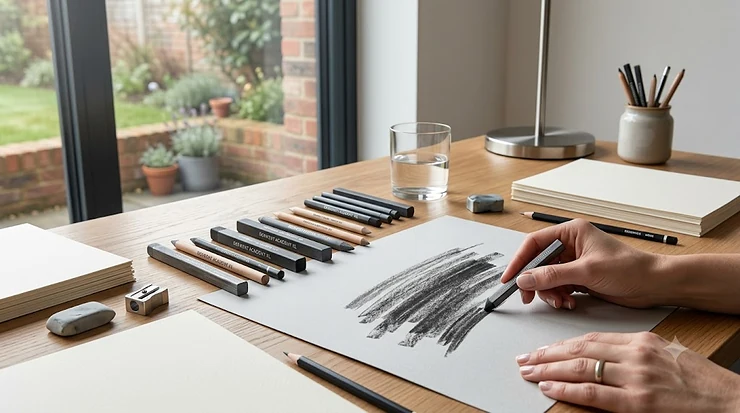
There’s a particular joy that arrives the moment you pick up a graphite stick — not a pencil with its wooden casing and fussy sharpening, but a proper, chunky, unencased bar of pure graphite — and drag it across a sheet of cartridge paper. It feels almost prehistoric. Primeval. Like you’re a cave artist who just happens to have better posture.
Graphite sticks for drawing are exactly what they sound like: woodless or minimally coated sticks of compressed graphite, available in soft to medium grades, designed to cover ground quickly, shade expressively, and do the things a pencil simply can’t — broad sweeping marks, tonal washes, layered textures, and the kind of atmospheric backgrounds that make a figure drawing suddenly feel like it has weather in it.
What separates a graphite stick from a regular pencil? Simply put, more graphite, less faff. The purest graphite originated in the northern English valley of Borrowdale — soft, high-quality material cut into sticks and wrapped with twine for grasping between the fingers, a tradition that today’s manufacturers have merely refined. A graphite stick is, in essence, the original drawing tool brought into the 21st century.
This guide covers seven of the best options available on Amazon.co.uk right now, from budget-friendly starter packs to professional-grade water soluble blocks, with practical advice on technique, paper choice, and exactly who should buy what. Whether you’re a beginner tackling your first landscape or a seasoned illustrator expanding your toolkit, you’ll find something here worth your time — and your pounds.
Quick Comparison: Graphite Sticks for Drawing at a Glance
| Product | Type | Grade Range | Water Soluble | Best For | Price Range |
|---|---|---|---|---|---|
| Faber-Castell Pitt Graphite Pure | Woodless stick | HB, 3B, 6B, 9B | ❌ | Detail + shading | Under £10 each |
| Derwent XL Graphite Blocks | Chunky block | Hard–Very Soft + Onyx | ✅ | Large-scale, expressive work | £20–£35 set |
| Faber-Castell Graphite Aquarelle | Water-soluble stick/pencil | HB–8B (5 grades) | ✅ | Mixed media, watercolour underpaintings | Under £15 tin |
| Cretacolor Chunky Graphite Stick | Round stick | 2B | ❌ | Tonal shading, blending | Under £5 |
| General Pencil Compressed Graphite | Compressed stick | 2B, 4B, 6B | ❌ | Beginners, experimentation | Under £10 pack |
| Koh-I-Noor Progresso Jumbo | Woodless solid stick | HB–8B | ❌/✅ (Aquarelle) | Professional drawing, depth | Under £10 each |
| Derwent Graphitint XL Blocks | Tinted graphite block | 6 earthy shades | ✅ | Landscape, experimental mark-making | £25–£40 set |
The table above reveals something instructive: water solubility splits this market cleanly in two. If your practice is purely traditional drawing — hatching, cross-hatching, blending with a stump — the pure graphite options (Pitt, Cretacolor, General Pencil, Koh-I-Noor) will serve you beautifully. But if you’re interested in the hybrid territory between drawing and painting, where a wet brush transforms graphite marks into luminous silver washes, then the water soluble options open up entirely different possibilities. Neither camp is “better” — they’re simply different tools for different ambitions.
💬 Just one click — help others make better buying decisions too! 😊
✨ Don’t Miss These Exclusive Deals!
🔍 Take your drawing practice to the next level with these carefully selected graphite sticks. Click on any highlighted product to check current pricing and availability on Amazon.co.uk. Whether you’re after pure graphite for expressive shading or water soluble sticks for mixed media work, these picks cover every style and budget.
Top 7 Graphite Sticks for Drawing: Expert Analysis
1. Faber-Castell Pitt Graphite Pure Sticks
The Faber-Castell Pitt Graphite Pure is the workhorse of this category and the one I’d hand to almost any artist as a first recommendation. A thick, wood-free stick of pure graphite covered in a thin coating for clean use, these sticks are excellent for detailed sketching or shading large areas, can be sharpened like any pencil, and come in four grades: HB, 3B, 6B, and 9B.
That thin lacquer coating is worth appreciating. It means your hands stay moderately clean — not spotless, but you won’t look like you’ve been servicing a bicycle engine. The 9B grade in particular lays down extraordinarily dark marks with almost no pressure, which is genuinely useful when you’re building up deep shadows in a portrait or a dramatic tonal study.
In practice, the range of four grades gives you enough versatility for most drawing workflows. Start with HB for initial linework, build up mid-tones with 3B, push the darks with 6B, and use the 9B for your blackest accents. It’s a logical, satisfying progression. UK buyers will be pleased to find these are readily available on Amazon.co.uk with Prime delivery.
UK customer reviews highlight the smooth lay-down and the fact that the coating prevents excessive mess — important if you’re working in a small flat with light-coloured carpets.
✅ Pure graphite, no wood waste
✅ Four grades cover the full tonal range
✅ Sharpenable to a fine point for detail work
❌ The lacquer coating can occasionally flake at the tip
❌ 9B grades are sold individually, so sets can add up
Price range: around £3–£6 per stick individually, or as part of sets — check current pricing on Amazon.co.uk. Outstanding value for a professional-grade German product.
2. Derwent XL Graphite Blocks
Derwent is a Lake District brand — genuinely British, genuinely excellent — and their XL Graphite Blocks are among the most exciting things to happen to the drawing aisle in recent years. Derwent XL Graphite Blocks offer smooth graphite in a chunky stick format, available in six different degrees, and are perfect for expressive mark-making techniques and bold strokes.
The key word here is expressive. These aren’t tools for fussy pencil-like mark-making. They’re tools for artists who want to work large, work fast, and feel genuinely liberated from the constraints of a conventional sharpened point. Each block can be used to create broad strokes, subtle blending, fine lines, and deep tonal work — and the graphite is water-soluble, allowing you to experiment with even more techniques. Use the edge for agile lines, the flat face for broad washes, and a damp brush to push marks into painterly territory.
Each block contains a high volume of formula, equivalent to eight pencils. Which makes the price — in the £20–£35 range for a set of six — rather good value when you do the arithmetic. These are Prime-eligible on Amazon.co.uk and stock the Onyx Medium and Onyx Dark shades alongside the standard grades, which produce a distinctive matte-black effect quite unlike standard graphite.
UK reviews consistently praise these for landscape work, particularly sketching outdoors during British autumn — and yes, they survive a light drizzle if you work quickly.
✅ Made by a British brand with genuine heritage
✅ Water-soluble — doubles as a painting medium
✅ Each block equivalent to eight pencils — outstanding longevity
❌ Too bulky for fine detail work
❌ Water solubility means you need to store them away from damp conditions
Price range: £20–£35 for a set of six — well worth it for serious artists.
3. Faber-Castell Graphite Aquarelle (Water-Soluble Set)
The Faber-Castell Graphite Aquarelle is ideal for preliminary sketches for watercolour drawings and for complete watercolour techniques in graphite, featuring an extra break-resistant 3.8mm lead, available in five hardness grades: HB, 2B, 4B, 6B, and 8B.
What makes this set clever is its dual identity. Use it dry and it behaves like a conventional graphite pencil — precise, controllable, smudgeable. Introduce water and it transforms into something between a wash drawing and a Chinese ink study. These pencils have a thick 3.3mm break-resistant lead covering grades from deep black to pale grey, and they contain no animal-derived ingredients, so are suitable for vegan artists.
The practical upside for UK artists is this: on a grey November afternoon in Manchester or Edinburgh, when the light is flat and you’re working from a reference photo indoors, the Aquarelle lets you build tonal depth quickly using wet washes, then sharpen the drawing up with dry linework once the surface dries. It’s an efficient technique that suits the compressed winter daylight many British artists work with.
Customers on Amazon.co.uk describe an “atmospheric quality” to drawings made with these pencils — which is perhaps the most elegant description of what water-soluble graphite actually does to your marks.
✅ Superb water solubility — dissolves consistently
✅ 5-grade range covers everything from pale wash to dense black
✅ Available in a neat collectible tin — easy to store in a compact space
❌ Leads are soft and can break under heavy pressure
❌ Requires watercolour-weight paper to use wet
Price range: around £10–£15 for the tin of five — a compact, versatile starting kit.
4. Cretacolor Chunky Graphite Stick (2B)
Austrian brand Cretacolor makes professional-grade drawing materials that are widely respected in European art schools, and their Chunky Graphite Stick in 2B is a brilliantly simple tool that does exactly what it promises. It’s roughly the diameter of a wine cork, fits comfortably in the fist, and deposits graphite generously and smoothly across a surface with almost no resistance.
The 2B grade sits in a useful middle position — soft enough to lay down rich tones without excessive pressure, firm enough that you’re not constantly crumbling the tip on the paper’s texture. For tonal shading, blending with a tortillon, and building up the mid-tones of a large figure drawing, this is a genuinely satisfying tool to use. It’s also, as one Amazon UK reviewer memorably put it, “ridiculously good fun.”
What you won’t get from a single-grade chunky stick is versatility across the full tonal range. You’ll want to pair this with harder graphite pencils for initial linework and softer sticks or pencils for the deepest darks. Used as part of a layered approach, though, the Cretacolor is exceptional.
Available on Amazon.co.uk, Prime-eligible, and typically arriving the next working day. No compatibility concerns — no voltage, no plug, no UKCA complications. It’s a graphite stick. You just draw with it.
✅ Chunky ergonomic format — comfortable for extended sessions
✅ Smooth, consistent graphite lay-down
✅ Budget-friendly price point — under £5
❌ Single grade limits tonal range
❌ Round format rolls off desks (find a groove for it, or tape a flat side)
Price range: under £5 — arguably the best value single purchase in this entire guide.
5. General Pencil Compressed Graphite Sticks (4-Pack)
The General Pencil Company is an American manufacturer with a long-standing reputation among art educators, and their compressed graphite stick 4-pack — containing 2B, 4B, and 6B grades — is one of the more accessible ways to begin exploring graphite sticks for drawing without a large initial outlay.
Compressed graphite is a slightly different beast from pure graphite. The additional binders used in compression give these sticks slightly more “grip” on the paper’s tooth, which means marks layer and build differently — less slippery, more textured. For beginners, this is actually a virtue: the sticks behave more predictably and forgivingly than ultra-soft pure graphite.
UK customer reviews describe these as “great for introductory art classes” and ideal for experimenting with backgrounds, tree trunks, and large tonal areas before committing to more expensive materials. That’s sound advice. Use these to discover how graphite sticks handle, then invest in premium options once you understand what you actually want from the medium.
The pack is available on Amazon.co.uk and qualifies for free delivery with a basket over £25 or with Prime membership, making it practical for UK buyers who don’t want to wait.
✅ Multi-grade pack — excellent for learning the medium
✅ Compressed formula grips paper well — forgiving for beginners
✅ Good value for the quantity
❌ Slightly stiffer than pure graphite — less suitable for very soft blending
❌ Binders mean marks are harder to erase than pure graphite
Price range: under £10 for the pack — an honest starter kit.
6. Koh-I-Noor Progresso Jumbo Graphite Sticks
Czech manufacturer Koh-I-Noor has been making drawing instruments since 1790 — which means they’ve been at it longer than almost everyone else, and it shows. The Progresso Jumbo series consists of woodless solid graphite sticks finished in a thin lacquer coating, available in grades from HB through 8B, with a water-soluble Aquarelle version available as well.
The Koh-I-Noor Progresso is available in soft grades HB, 2B, 4B, 6B, and 8B; in the softest grades, they create deep black lines, while lighter marks can be achieved with reduced pressure. Tints and wash effects can be created with the water-soluble version, Koh-I-Noor Progresso Aquarelle.
The 8B in particular deserves a mention. It produces lines of genuine, velvety darkness that photograph beautifully — useful for illustrators who scan and reproduce their work digitally. The Aquarelle version dissolves smoothly with water and, crucially, remains workable even after drying, meaning you can add additional dry layers over a wet wash without the graphite lifting or smearing. That’s not always guaranteed with water-soluble graphite products.
Available on Amazon.co.uk across multiple grades, often sold individually — which lets UK buyers pick the specific grades they need rather than buying sets with grades that’ll go unused.
✅ Heritage brand — consistent quality across batches
✅ Aquarelle version is genuinely excellent for water techniques
✅ Individual grade purchasing — no unnecessary duplicates
❌ Some UK buyers report varying availability of individual grades on Amazon.co.uk
❌ 8B is very soft and can crumble if dropped
Price range: under £8 per stick — reasonable for the quality.
7. Derwent Graphitint XL Blocks (Set of 6)
If the previous six products are variations on a single instrument, the Derwent Graphitint XL Blocks are something genuinely different. These specially formulated water-soluble blocks combine graphite and vibrant pigments in a unique formulation for rich yet muted shades. Highly versatile, they work for broad coverage, bold marks, agile lines, and powder textures, with each block containing formula equivalent to eight pencils.
The six shades — Olive Green, Dark Prussian, Raw Umber, Burnt Umber, Port, and Aubergine — are not primary colours. They’re the colours of November hedgerows, winter skies, and muddy British footpaths. Which is to say, they’re remarkably well-suited to landscape drawing in the UK. Activated with water, they become rich watercolour-like washes that retain the subtle texture and sheen of graphite once dry.
For best results, these work beautifully alongside standard XL Graphite Blocks or Graphite and Graphitint Pencils for mixed effects.
This is absolutely not a beginner’s product. The Graphitint XL Blocks reward artists who already understand how graphite behaves, how layering works, and how wet and dry techniques interact. For that audience, though, they’re a delight — genuinely exciting to use, and capable of producing results that look like nothing else on paper.
✅ Unique tinted-graphite formulation — distinctive results
✅ Water-soluble — painterly effects from a drawing medium
✅ Earthy palette ideal for UK landscape work
❌ Premium price — £25–£40 for the set of six
❌ Niche product — not suited to conventional pencil-based drawing
Price range: £25–£40 for the set of six — an investment, but one that opens genuinely new creative territory.
How to Get Started: A Practical Guide for UK Artists
Start with the right paper
Working with water-soluble graphite requires a surface suitable for water, like watercolour paper. Hot-press watercolour paper has a smooth surface, while cold-press watercolour paper has a rougher, bumpy surface. A standard recommended weight is 140lb (300gsm). For pure (non-water-soluble) graphite sticks, a good-quality cartridge paper in 120–150gsm is perfectly adequate and considerably more economical.
Layer from light to dark
The most common mistake beginners make with graphite sticks is going too dark too early. Start with your lightest grade for the overall composition, establish your mid-tones, and reserve the softest, darkest sticks for final accent marks. This keeps your drawing rescuable for far longer.
Blending technique matters
A paper tortillon gives you controlled blending. Your finger gives you broader, faster blending with a slightly warmer tonal quality. A kneaded eraser used in a dabbing motion lifts graphite and creates highlights — graphite is easily removed from a drawing, and this allows artists to make changes or create highlights by revealing the bright underlying paper. All three tools are worth having on your desk simultaneously.
Fixing your finished work
Graphite smudges. It always will. Fixative sprays — widely available on Amazon.co.uk in the £5–£12 range — will protect a finished drawing. Use them in a well-ventilated space, which in the UK often means a cracked-open window in February while you briefly accept the cold.
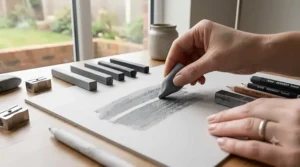
Water Soluble Graphite Techniques: What’s Actually Possible
Water-soluble graphite is a relatively new addition to the world of drawing materials, allowing artists to work with both dry and wet techniques and creating a wash effect when activated with a wet brush. Once dry, layers of graphite wash can be drawn over.”For a thorough introduction to the medium from an instructional perspective, Painters Online — one of the UK’s leading art technique resources — offers an excellent breakdown of how different graphite stick formats behave on paper.”
The practical possibilities are broader than most people expect. Here are four techniques worth experimenting with:
The wash underpainting: Draw your composition in water-soluble graphite, then activate selected areas with a damp brush to create tonal washes. Let dry, then add dry graphite detail on top. The result has the precision of a drawing with the tonal richness of a painting.
Scraped powder: Shave graphite from a stick over a surface using a craft knife, then spread the powder with a brush, fingers, or tissue to create atmospheric, foggy tones. Adding minimal water to water-soluble graphite turns it inky black, while more water creates wispy, transparent greys — giving you extraordinary tonal control with a single stick.
Wet-on-dry: Dip the tip of a water-soluble stick directly in water and draw. The marks deposited are dramatically darker and more intense — excellent for final accent lines or lettering over a wash.
Layering: Build up tones by letting each layer of shading dry before adding the next one, thinking about putting darks against lights and lights against darks. This counterchange principle produces drawings with real visual impact.
Graphite Stick vs Pencil for Large Drawings: Which Should You Choose?
This is, frankly, the question that leads most artists to graphite sticks in the first place. The answer is more nuanced than it might appear.
A conventional graphite pencil — even a very soft 9B — has a relatively small contact surface with the paper. Shading a large area is slow, repetitive work, and the resulting marks often retain visible directionality (the trace of individual strokes) that can look mechanical rather than expressive.
A graphite stick, by contrast, offers side-stroke shading: the broad face of the stick laid against the paper deposits tone across a wide area in a single pass. A 60mm Derwent XL block can shade an A3 background in seconds. Not minutes. Seconds. For large-scale studio drawing, figure work, or landscape studies, this speed advantage is transformative.
That said, a graphite stick cannot do what a pencil point does. Fine hair lines, precise geometric details, controlled hatching — these remain the pencil’s domain. The working solution for most professional artists is a hybrid approach: graphite sticks to establish tones and backgrounds, sharp pencils for detail and definition. Many of the brands reviewed here — Faber-Castell, Derwent, Koh-I-Noor — sell complementary pencil ranges that pair logically with their sticks.
The best paper for graphite sticks in large-format work is a smooth-to-medium cartridge paper or hot-press watercolour paper. Rough or heavily textured surfaces break up the stick’s contact, producing grainy coverage rather than clean, even tones — though this, of course, can be a stylistic choice rather than a flaw.
How to Choose Graphite Sticks for Drawing in the UK
- Define your purpose first. Expressive, large-scale mark-making calls for chunky blocks like the Derwent XL. Detailed figurative work suits slimmer coated sticks like the Faber-Castell Pitt. Mixed media with water? Go water-soluble.
- Consider the grade range you actually need. Most artists use the 4B–8B range most frequently. Buying a multi-grade pack makes more sense than individual sticks until you know your preferences.
- Factor in mess tolerance. Pure graphite sticks without lacquer coating (like some Koh-I-Noor Progresso grades used without gloves) transfer graphite to hands liberally. In a compact flat with light furnishings, that matters.
- Think about storage. Derwent XL blocks can be grated into powder or broken into smaller drawing tools, which means they need sensible storage — a tin or case, not loose in a bag. Most UK artists working in small spaces benefit from sets that come in their own tins.
- Water solubility is a commitment, not just a feature. If you choose water-soluble sticks, you need to use them with appropriate paper and appropriate brushes. The results can be spectacular, but there’s a learning curve — consult the Artists Network’s guide to water-soluble graphite before you commit.
- Check Amazon.co.uk Prime eligibility. Most of the products reviewed here are Prime-eligible, meaning next-day delivery if you’re in England or the central belt of Scotland. For Welsh and Northern Irish buyers in more rural postcodes, standard delivery is typically 2–3 working days.
- Budget honestly. A single Cretacolor chunky stick under £5 is a perfectly legitimate starting point. You don’t need to spend £35 on Derwent Graphitint XL Blocks on day one — though you probably will eventually.
✨ Don’t Miss These Exclusive Deals!
🔍 Ready to shop? Click on any highlighted product name in this guide to check current pricing and availability on Amazon.co.uk. Prime members get free next-day delivery on most of these picks — ideal when inspiration strikes and patience is the last thing you need.
Common Mistakes When Buying Graphite Sticks
Buying only one grade. A single 6B stick is useful, but limited. Tonal drawings require a range of marks from light to dark. Even a two-stick combination of 3B and 8B transforms your options dramatically.
Choosing the wrong paper. Smooth-surfaced paper (hot-press, Bristol board) gives crisp, even tones. Rough paper produces texture and grain. Neither is wrong, but using a rough-textured paper when you want sleek, photorealistic shading is going to frustrate you.
Ignoring the mess factor. Graphite sticks are messier than pencils. Full stop. Some artists find this liberating. Others find it maddening. Invest in a roll of kitchen paper, a set of cotton gloves if you’re precious about clean hands, and accept that your drawing board will look like a scene from a coal mining documentary.
Over-blending. The seductive smoothness of graphite sticks tempts artists into blending everything into a uniform grey fog. Resist. Preserved marks — the texture of individual strokes — give graphite drawings life and energy. Graphite sticks have a biscuit-like feel on rough-textured surfaces, and the slightly gritty quality adds lots of texture to drawings — which is superb to use on rough surfaces.
Confusing graphite sticks with charcoal. They look similar in a shop. They are not the same. Graphite has that characteristic metallic sheen; charcoal is matte and much blacker. Both have their place, but they handle differently and produce distinctly different results. A package that says “graphite” and one that says “charcoal” are not interchangeable.
Frequently Asked Questions
❓ What exactly are graphite sticks for drawing?
❓ Are pure graphite sticks available on Amazon.co.uk?
❓ What is the best paper for graphite sticks?
❓ Can water soluble graphite sticks be used dry?
❓ What is the difference between graphite sticks and charcoal for shading?
Conclusion: Finding Your Graphite Stick
The world of graphite sticks for drawing is genuinely rich and varied — more so than the modest size of these objects suggests. A small cylinder of compressed graphite can produce drawings of extraordinary tonal depth and expressive energy. The Metropolitan Museum of Art notes that the diverse qualities of graphite provide artists with many creative possibilities — a quiet understatement from an institution that has several centuries of graphite drawings in its collection.
For most UK artists starting out, the Faber-Castell Pitt Graphite Pure offers the most reliable, versatile entry point — honest quality at an honest price, available reliably on Amazon.co.uk. Those ready to explore mixed media should look seriously at the Faber-Castell Graphite Aquarelle or the Derwent XL Graphite Blocks. And for anyone wanting to push into genuinely experimental territory, the Derwent Graphitint XL Blocks are unlike anything else in the category.
Whichever you choose: start with good paper, resist the urge to blend everything into submission, and let the material do what it does best. Graphite has been the drawing medium of choice for artists since the Borrowdale mines opened in the 16th century. It knows what it’s doing. “If you’d like to explore graphite’s remarkable history further — from Borrowdale to Conté’s invention of the modern pencil — Wikipedia’s entry on graphite provides a solid and surprisingly gripping starting point.”
✨ Don’t Miss These Exclusive Deals!
🔍 Check current pricing and availability for all products reviewed here on Amazon.co.uk. Click any highlighted product name to see the latest offers, Prime delivery options, and customer reviews from UK buyers.
Recommended for You
- Vine Charcoal vs Charcoal Pencils: 7 Best UK Picks (2026)
- Best Charcoal Pencils UK 2026: 7 Expert Picks for Every Artist
- Best Sketching Pencils UK 2026: 7 Expert Picks for Every Artist
Disclaimer: This article contains affiliate links. As an Amazon Associate, I earn from qualifying purchases. If you purchase products through these links, we may earn a small commission at no additional cost to you.
✨ Found this helpful? Share it with your mates! 💬🤗
