
In This Article
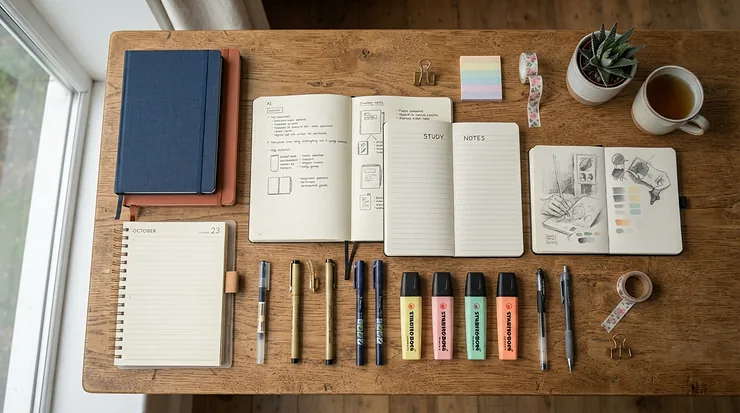
A university stationery bundle under £20 is a small, deliberately chosen kit of pens, pencils, note-taking paper, highlighters and sticky notes that covers lectures and seminars for a full term without denting your food budget. Think of it as a capsule wardrobe for your bag: few items, all of them working hard.

Here’s the trap. Freshers’ week turns every campus shop into a theme park of pastel gel pens, leather-look notebooks and 80-piece “mega sets” that look generous and quietly fail by November. A well-built university stationery bundle under £20 works the other way round. You buy fewer things, chosen for how quickly you’ll use them up and how much you’ll miss them when they’re gone.
This guide takes the build-your-own route. I’ve shortlisted seven real, widely stocked products and explained what their specs mean in a lecture hall rather than on a packaging panel. You’ll also find straight talk on term-time budgeting, a realistic look at where a student discount helps (and where it doesn’t), and a seminar essentials checklist you can screenshot. If you’d like to sketch your wider numbers first, a free student budget calculator is a sensible companion.
A quick note on method. Everything here rests on published specifications and retailer listings. I haven’t handled these products myself, and I haven’t invented review quotes. Prices appear as ranges because they move constantly, so always check the live Amazon price before you buy.
Quick Comparison: 7 Picks for a University Stationery Bundle Under £20
| Product | Job in Your Bundle | Price Range* | Best For |
|---|---|---|---|
| Helix Oxford Student Set | All-in-one backup basics | A few pounds | Forgetful first-years |
| Pukka Pad A4 Refill Pad (80/1) | Lecture and seminar paper | Around £10–£15 (6 pads) | Heavy note-takers |
| Pilot FriXion Ball 0.7mm | Erasable draft pen | Around £2–£4 per pen | Tidy-notes perfectionists |
| STABILO BOSS ORIGINAL | Highlighting and colour-coding | Around £9–£13 (wallet of 8) | Reading-heavy humanities |
| Post-it Super Sticky Notes 654 | Flags and reminders | Around £10–£14 (multipack) | Chaotic desks and shared flats |
| Staedtler Noris 120 HB | Pencils for diagrams and sums | Under £10 (12 pencils) | STEM and design courses |
| uni-ball Eye Micro UB-150 | Fine, fade-resistant pen | Around £4–£7 (3-pack) | Neat writers and rainy commutes |
*Indicative ranges at the time of research. Check current price.
No single product here is a bundle on its own; the bundle is the combination. The Helix Oxford Student Set is the cheapest insurance, while Pukka Pad A4 Refill Pad (80/1) is where most of your money should go if you write by hand. Pick two or three items from the middle of the table and you’ll land comfortably near the £20 ceiling.
💬 Just one click — help others make better buying decisions too!😊
Top 7 Picks for a University Stationery Bundle Under £20: Expert Analysis
1. Helix Oxford Student Set — fastest way to cover the basics
Speed is the selling point. One small purchase and the absolute basics are sorted before your first induction talk.
The set contains two pencils, a ballpoint pen, an eraser, a sharpener and a 15cm ruler. That ruler length matters more than it sounds. It slips into any pencil case and suits underlining and tidy diagrams, though it won’t help with large graph work. Two pencils plus a sharpener make the kit self-sufficient for a maths or science seminar.
Based on the contents list, this is a starter set rather than a term’s supply. One ballpoint won’t survive a semester of heavy note-taking, and that’s fine. Its job is to be the safety net at the bottom of your bag. Treat it as your “never caught without” kit and spend the rest of the budget on things you’ll actually burn through.
I couldn’t verify aggregated Amazon review data for this exact listing at the time of research, so I’m not summarising sentiment. Listings for stationery sets vary by seller, so check that the contents on the page match the items above.
Pros:
- ✅ Covers pen, pencil, eraser, sharpener and ruler together
- ✅ Compact enough for any pencil case
- ✅ Cheap enough to keep a spare in your locker
Cons:
- ❌ Single pen won’t last a full term
- ❌ Small ruler limits larger diagrams
Price range: typically only a few pounds (check current price). Verdict: superb value as a backup kit, poor value as your only kit.

2. Pukka Pad A4 Refill Pad (80/1) — about a penny a page
This is the unglamorous workhorse of any university stationery bundle under £20, and its standout feature is arithmetic.
Retailer listings describe a pack of six A4 pads. Each has 160 pages of 80gsm paper, feint ruled with a margin, top-bound with a tape spine and punched with four holes. Translate that: 960 pages in one pack, paper sturdy enough for everyday pens, and holes ready for a ring binder or lever arch file. You can file notes by module rather than by date. At the £10–£15 range, that works out at roughly a penny to a penny and a half per page.
Based on the spec comparison with bound notebooks, the real advantage is filing flexibility. You can tear a week’s seminar notes out of the pad, drop them behind the right divider and never carry a half-used notebook for a module you finished in December. The trade-off is discipline: lose your binder and you lose your term. Six pads is also more than many first-years will use, so splitting a pack with a flatmate still makes sense.
I couldn’t verify aggregated review data for this multipack, so check recent Amazon reviews for comments on ink show-through, especially if you favour gel or fountain pens.
Pros:
- ✅ 960 pages per pack at a very low cost per page
- ✅ Four-hole punched for ring binders and lever arch files
- ✅ Backboard gives a firm surface when writing on your knee
Cons:
- ❌ Six pads is more than many students need
- ❌ Loose pages need a binder to stay organised
Price range: around £10–£15 for the six-pack (check current price). Verdict: the best cost-per-page value here, as long as you also own a binder.
3. Pilot FriXion Ball 0.7mm — erase mistakes without correction fluid
Think of it as an undo button for handwriting.
The 0.7mm tip lays down a line of roughly 0.35mm, which sits between spidery and bold. The thermo-sensitive gel ink turns colourless when the friction of the rubber end warms the paper, so you can rub out and rewrite on the same page. The same chemistry is the catch. Product listings note the ink goes clear at around 60°C, and the colour can return if the page is chilled to around –10°C.
On paper, this suits draft-heavy work such as planning essay structures or working through problem sets. It is not an exam or official-document pen. Retailer and manufacturer guidance says as much, and many exam regulations require permanent ink. Treat it as a notes-and-drafts tool, never the only pen in your bundle, and don’t leave it on a sunny windowsill or in a hot car.
I couldn’t verify aggregated review data for this listing, so I’m leaving review sentiment out rather than guessing. The heat behaviour above comes from published product notes.
Pros:
- ✅ Erases cleanly so draft notes stay tidy
- ✅ Refillable, which lowers long-term pen costs
- ✅ Smooth gel ink at a medium line width
Cons:
- ❌ Ink can vanish if exposed to heat
- ❌ Not suitable for exams or official forms
Price range: around £2–£4 per pen, more for multipacks (check current price). Verdict: good value for drafting, but buy one or two rather than a dozen.
4. STABILO BOSS ORIGINAL — one chisel tip, two line widths
The wedge-shaped tip does double duty: broad for sweeping across paragraphs, thin for underlining a key term.
Listed line widths are 2mm and 5mm, depending on the angle you hold it. The anti-dry-out ink is listed as surviving up to four hours uncapped, which forgives the odd forgotten cap during a long library session. The wallet of eight includes yellow, green, orange, pink, blue, red, lilac and turquoise. The water-based ink is also listed as refillable, so a favourite barrel can outlive its first cartridge.
Based on the spec comparison, eight colours is more than most first-years need. The value lies in colour-coding systems (definitions, arguments, dates, quotations), not rainbow decoration. If your budget is tight, a smaller wallet or two singles will do the same job and leave room for other items.
I couldn’t verify aggregated Amazon review data for this wallet at the time of research. Skim the current reviews for comments on colour consistency across the pack.
Pros:
- ✅ Chisel tip handles highlighting and underlining
- ✅ Anti-dry-out ink forgives forgotten caps
- ✅ Eight colours allow proper colour-coded notes
Cons:
- ❌ Wallet of eight can eat half your budget
- ❌ More colours than many first-years will use
Price range: around £9–£13 for the wallet (check current price). Verdict: excellent for reading-heavy courses, optional for everyone else.
5. Post-it Super Sticky Notes 654 — clings to monitors, doors and walls
If ordinary sticky notes keep dropping off your laptop lid, this is the fix.
The 654 line is 76 x 76mm with 90 sheets a pad, sold in multipacks of varying sizes. Retailer descriptions say the adhesive grips about twice as hard as Post-it’s original notes, and that the paper is PEFC-certified. In practice, 76mm square is big enough for a to-do list or a three-line seminar prompt, but small enough to tuck into a textbook margin.
The point of “super sticky” is vertical and awkward surfaces: monitor bezels, the back of a door in a shared house, the edge of a library desk. Where it earns a place in a university stationery bundle under £20 is as a flagging system. Use one colour for questions to ask your tutor and another for sources to chase. A six-pad pack holds 540 notes, far more than most first-years use, so consider splitting it with a housemate.
I couldn’t verify aggregated review sentiment for a specific Amazon listing, so I’m not summarising reviews. Multipack contents and colours vary by listing, so read the description closely.
Pros:
- ✅ Stronger adhesive for vertical and awkward surfaces
- ✅ 90 sheets per pad lasts well beyond first term
- ✅ PEFC-certified paper, according to retailer listings
Cons:
- ❌ Multipacks cost more than a minimal bundle allows
- ❌ Square size is too small for longer notes
Price range: around £10–£14 for a multipack (check current price). Verdict: a nice-to-have; buy it after the essentials are covered.
6. Staedtler Noris 120 HB — break-resistant lead for under £10 a dozen
The famous yellow-and-black stripes aren’t just branding. They make these pencils very hard to lose in a shared kitchen.
This is the Noris 120 in HB grade, sold in packs of 12 with a 2mm lead described as “super-bonded” to resist snapping. HB is the all-rounder: dark enough for notes, firm enough to keep a point through a diagram. The hexagonal barrel resists rolling off lecture-theatre desks, and the red cap identifies the grade at a glance.
Based on the spec comparison, a dozen pencils will outlast most first years’ needs, so this is the pick where sharing a pack with a coursemate costs you nothing. Pencils shine for graphs, circuit diagrams and anything you expect to correct. They also suit exams where pencil is permitted for diagrams, but check your own department’s instructions. The pack doesn’t include a sharpener, which is why it pairs neatly with the Helix Oxford Student Set.
I couldn’t verify aggregated review data for this pack, so I’m not summarising sentiment here.
Pros:
- ✅ Super-bonded lead resists breakage in a rucksack
- ✅ Twelve pencils last well beyond first term
- ✅ Colour-coded cap makes the HB grade obvious
Cons:
- ❌ Sharpener not included in the pack
- ❌ Pencil notes can smudge in a crowded bag
Price range: under £10 for the pack of 12 (check current price). Verdict: outstanding cost per pencil, especially for STEM and design students.
7. uni-ball Eye Micro UB-150 — fade-resistant ink that survives a wet bag
Britain’s weather is the quiet enemy of lecture notes, and this pen is built with that in mind.
It pairs a 0.5mm nib with a 0.2mm line. Listings describe uni’s Super Ink as fade-resistant, water-resistant and tamper-proof, with a stainless steel tip and tungsten carbide ball. Packs are commonly sold in threes, fives and twelves. In practice, water resistance means a leaky bottle or a downpour on the walk to campus won’t turn your notes into a blur. “Tamper-proof” is the grown-up way of saying the ink is hard to alter, which is why this style of pen suits forms as well as notes.
On paper, an ultra-fine line rewards neat handwriting and punishes heavy-handed pressing. If you write large, try a single pen before committing to a twelve-pack. As the permanent-ink partner to the Pilot FriXion Ball 0.7mm, it’s the pen you reach for when notes need to last.
I couldn’t verify aggregated review data for a specific listing, so I haven’t summarised sentiment.
Pros:
- ✅ Water- and fade-resistant ink for notes you keep
- ✅ See-through barrel window lets you check ink levels
- ✅ Ultra-fine line keeps margins and diagrams tidy
Cons:
- ❌ Very fine tip may feel scratchy for heavy writers
- ❌ Liquid-ink pens cost more than basic ballpoints
Price range: around £4–£7 for a 3-pack (check current price). Verdict: the best permanent-ink pick in the bundle, and worth the small premium.
Three Real-World Bundles: A University Stationery Bundle Under £20 for Different Courses
These are hypothetical profiles built from the spec analysis above, not real customers. Totals depend on live prices, so treat them as planning guides.
The first-year English student. Imagine four days a week of lectures plus seminar discussion, heavy reading and mostly handwritten notes. The sensible bundle is Pukka Pad A4 Refill Pad (80/1) plus the Helix Oxford Student Set, which lands around £13–£20. Paper is the main expense and pens are the afterthought. Add Post-it Super Sticky Notes 654 once the first loan instalment lands.
The first-year engineering or maths student. Lots of diagrams and calculations, with a laptop for coding. Choose Staedtler Noris 120 HB plus a uni-ball Eye Micro UB-150 3-pack, roughly £10–£17. Pencils for working, a permanent pen for finished solutions, and a few pounds left for graph paper.
The commuting part-time student. Two days on campus, a bag that gets rained on, and notes read on the train. Take the uni-ball Eye Micro UB-150 3-pack plus STABILO BOSS ORIGINAL, around £13–£20. Water-resistant ink and a colour-coding system matter more here than volume.
If a live price pushes a combination over £20, drop to the smaller pack size rather than abandoning the plan. The principle matters more than the exact total.

Your First 30 Days: Setup, Maintenance and Mistakes to Avoid
Buying the right bundle is half the job. The other half is not wrecking it by week three.
Week one: set up. Split any multipacks with a flatmate, label your binder dividers by module and decide your highlighter colours before the first reading list arrives. Keep one pen and one pencil in your coat pocket so a missed bag never costs you a lecture.
Week two: build habits. Cap highlighters with a firm click every time. The listed four-hour anti-dry-out window is a safety net, not a licence. Sharpen your Staedtler Noris 120 HB pencils on Sunday night so Monday starts sharp.
Week three: protect your notes. Keep Pilot FriXion Ball 0.7mm pens away from radiators, hot cars and sunny windowsills, since heat is what makes the ink disappear. Photograph important erasable-ink pages with your phone as a backup.
Week four: audit. Count what’s left. If you’ve burned through one item twice as fast as expected, top it up before it becomes a crisis.
The common first-month mistakes are predictable. Students use erasable pens on forms, carry every pack at once, forget to test highlighters on printed readings, and leave sticky notes crammed in a pocket where the adhesive collects lint. Treat your bundle like kit, not confetti.
How to Choose a University Stationery Bundle Under £20
The best university stationery bundle under £20 covers your course’s actual needs, favours consumables over gadgets and leaves a small buffer for surprises. Here’s how to build one in six steps.
- Start with your course, not the shop. A maths student needs pencils and a ruler; an English student needs paper and highlighters. Check your reading list and department handbook first.
- Buy consumables first. Paper, pens and pencils run out. Fancy organisers rarely do.
- Work out cost per page, pen or pencil. A pack that looks pricey can be the cheaper option per unit, as with the six-pack of Pukka Pad A4 Refill Pad (80/1).
- Decide how you’ll take notes. If you type, shift money towards highlighters and sticky notes for annotating printed readings.
- Keep one permanent-ink pen. Exams and forms often demand it, so the uni-ball Eye Micro UB-150 earns its slot.
- Leave a buffer of about 10%. Money advice from universities often suggests it, because something always runs out unexpectedly.
Features That Actually Matter (And Those That Don’t)
Marketing loves piece counts. Marketplace listings routinely advertise 64- and 80-piece sets, and national press shopping roundups feature them, but a big number is not the same as a useful kit. Here is the filter I’d apply.
What matters:
- Paper weight (80gsm or above) keeps ink from ghosting through the page.
- Punched holes let you file notes by module rather than carry a stack of notebooks.
- Refillability, as with the STABILO BOSS ORIGINAL and Pilot FriXion Ball 0.7mm, lowers the cost of ownership.
- Water-resistant ink is a practical advantage in a British winter.
- Grade labelling, like the colour-coded caps on Staedtler Noris 120 HB, saves squinting at barrel print.
What doesn’t:
- Novelty erasers and pastel pencil toppers
- Twenty gel pen colours you’ll never use
- “Aesthetic” faux-leather covers that add weight and cost
- Piece counts that include dozens of paper clips and stickers
The rule of thumb: if you can’t name the lecture or seminar where you’d use an item, it isn’t a priority. Your university stationery bundle under £20 should read like a short, honest shopping list.
Common Mistakes When Buying a University Stationery Bundle Under £20
Most overspending comes from the same handful of errors.
Buying the biggest piece count. An 80-piece set sounds like value. Count how many pieces you’d actually use before assuming it is.
Skipping the permanent pen. Erasable ink is brilliant for drafts and risky for anything official, so always keep one standard pen in reserve.
Buying notebooks you can’t file. Six bound notebooks look tidy until you need to rearrange notes by topic. Loose pages and a binder win for most courses.
Forgetting the invisible costs. Binders, dividers, printing credits and calculators all sit outside this budget. Plan for them separately.
Shopping before your timetable. A week of lectures reveals what you need far better than a packing list does.
Chasing a discount that isn’t one. A student discount only helps if the discounted price actually beats the live price elsewhere. Compare before you assume.
Overbuying out of nerves. First-term anxiety tempts you to stock up. Buy for a term, then reassess.
Ready-Made Sets vs Build-Your-Own Bundles
| Factor | Ready-Made All-in-One Set | Build-Your-Own Bundle |
|---|---|---|
| Upfront cost | Often low, but varies by piece count | Moderate, set by what you pick |
| Item quality | Mixed; often unbranded filler | You choose trusted brands |
| Fit to your course | Generic | Tailored to your notes style |
| Waste | High; many pieces go unused | Low; every item has a job |
| Convenience | One click | A few clicks |
| Best For | Last-minute emergencies; the Helix Oxford Student Set as a backup | Students wanting Pukka Pad A4 Refill Pad (80/1) paper plus the STABILO BOSS ORIGINAL highlighters |
Ready-made sets win on convenience and lose on relevance. They fill a bag but rarely fit a course. Build-your-own takes ten more minutes and wastes far less, which matters when the whole budget is £20. The sweet spot, in my view, is one small ready-made set as a backup and a few chosen consumables for the main kit.

Seminar Essentials: What Actually Goes in the Bag
Seminar essentials are different from lecture essentials. A lecture is mostly listening and transcribing; a seminar is talking, challenging and referencing. Your kit should help you find your place fast and speak with confidence.
Picture a 90-minute seminar on a set text. The kit that works is short:
- Ruled paper from a Pukka Pad A4 Refill Pad (80/1)
- One permanent pen, such as the uni-ball Eye Micro UB-150
- A highlighter or two from the STABILO BOSS ORIGINAL wallet
- A strip of sticky notes from Post-it Super Sticky Notes 654 to flag passages you want to raise
- A pencil for marginal queries you may want to erase later
The problem most students hit is losing track of where they marked a key argument. The fix is flags: stick a note at each page you’ll cite and write a three-word reminder on it. When the tutor says “page 112”, you’re there in seconds.
Seminar essentials also include a habit. Write one question per reading before you arrive. A bundle can’t do the thinking for you, but it makes the thinking easier to carry into the room.
Term-Time Budgeting: Making £20 Stretch Across Three Terms
Term-time budgeting for stationery is mostly about pacing. Spread over roughly 24 to 30 teaching weeks, £20 comes to well under 85p a week. That’s easy to afford if you don’t spend it all in week one.
A practical split looks like this. Spend around 60–70% of your £20 before term starts on the essentials: paper, one permanent pen and pencils. Hold the rest back for January, when you’ll know what has actually run out and what never got used. Resist topping up in spring on impulse; wait until you can name the gap.
Treat a small buffer as part of your term-time budgeting, too. A Scottish university’s money guidance, for example, suggests building in roughly 10% for unexpected costs, and stationery is no exception. A pen that dies mid-seminar shouldn’t force a £6 emergency purchase.
If you’d like to see how this fits into rent, food and travel, the Student Money Planner from the University of Sheffield lets you enter weekly or monthly figures for accommodation, living and study costs. Good term-time budgeting means stationery is a line item, not a surprise.
Student Discount: Where It Helps and Where It Doesn’t
A student discount can trim the cost of a university stationery bundle under £20, but only if you check the maths. Three UK platforms dominate: UNiDAYS and Student Beans are free, and TOTUM (formerly NUS Extra) offers free and paid tiers. UNiDAYS and Student Beans typically ask for a university email address, and a university such as Warwick explains how these schemes work on its student pages.
Here’s where a student discount genuinely helps: high-street stationers, bigger-ticket items and subscriptions. Where it helps less: low-cost items like pencils, where a percentage off a small number is a small saving. Discounts also change and rarely stack, so a code that worked in September may be gone by January.
Amazon runs its own student programme, Prime Student, which has been promoted with a free trial period followed by a reduced membership rate. Terms change, so check the current offer before relying on it.
One rule for honest shopping: no student discount is available “through this article”. Prices on Amazon are Amazon’s, and the only fair comparison is the live price on the day you buy. A good student discount habit is to check the platform first, then Amazon, then buy at whichever is cheaper.
Price Range and Value Analysis
| Product | Price Range* | Units | Rough Cost Per Unit | Best For |
|---|---|---|---|---|
| Helix Oxford Student Set | A few pounds | 6 items | Under £1 per item | Backup kit |
| Pukka Pad A4 Refill Pad (80/1) | Around £10–£15 | 960 pages | About 1–1.6p per page | Heavy note-takers |
| Pilot FriXion Ball 0.7mm | Around £2–£4 | 1 pen | £2–£4 per pen | Draft work |
| STABILO BOSS ORIGINAL | Around £9–£13 | 8 highlighters | About £1.10–£1.60 each | Colour-coders |
| Post-it Super Sticky Notes 654 | Around £10–£14 | 540 notes | About 2–2.6p per note | Flagging and reminders |
| Staedtler Noris 120 HB | Under £10 | 12 pencils | Under 85p each | STEM students |
| uni-ball Eye Micro UB-150 | Around £4–£7 | 3 pens | About £1.30–£2.35 each | Permanent-ink notes |
*Indicative ranges at the time of research. Check current price.
Cost per unit tells a clearer story than price tags. Pukka Pad A4 Refill Pad (80/1) and Staedtler Noris 120 HB deliver the lowest cost per use, which is why they anchor the plan. STABILO BOSS ORIGINAL and Post-it Super Sticky Notes 654 are the “second wave” purchases: genuinely useful, but best added once the core paper and pens are covered. The total cost of ownership stays low because nothing here needs batteries, charging or software.
Frequently Asked Questions
❓ Can I really cover a term with a university stationery bundle under £20?
❓ Are erasable pens like the FriXion allowed in university exams?
❓ How many highlighters do I need in first year?
❓ Is a student discount worth chasing on stationery?
❓ Are refill pads better than bound notebooks for lectures?
Conclusion
A good university stationery bundle under £20 isn’t about owning more; it’s about owning the right things in the right quantities. Start with paper, because it’s your biggest consumable and Pukka Pad A4 Refill Pad (80/1) gives you the best cost per page. Add a permanent pen like the uni-ball Eye Micro UB-150, pencils from Staedtler Noris 120 HB if you draw or calculate, and keep the Helix Oxford Student Set as your emergency backup.
Hold the colourful extras, STABILO BOSS ORIGINAL and Post-it Super Sticky Notes 654, until you know how you take notes. Keep the Pilot FriXion Ball 0.7mm for drafts, never exams. Pace your spending with sensible term-time budgeting, check any student discount against live prices, and pack your seminar essentials the night before rather than at 8.55am.
Do that and your stationery will quietly do its job all year, which is exactly what stationery should do.
🎒 Ready to build yours?
Click any highlighted product above to check current pricing and availability on Amazon, and walk into week one with your kit already sorted! ✨
Recommended for You
- Desk Organiser For Dissertation Research: 7 Best Picks (2026)
- Printer For Dissertation Writing: 7 Proven Picks (2026)
- Notebook For Lecture Notes: 7 Brilliant UK Picks (2026)
Disclaimer: This article contains affiliate links. As an Amazon Associate, I earn from qualifying purchases. If you purchase products through these links, we may earn a small commission at no additional cost to you.
✨ Found this helpful? Share it with your friends! 💬🤗
