

In This Article
A desk organiser for dissertation research is a set of trays, dividers, tabs and holders that keeps printed articles, notes, drafts and stationery sorted and within reach while you write. It turns a scattered paper mountain into a system you can scan by eye. That saves time and protects your focus.

Here’s the thing about a dissertation: it never arrives as one big task. It arrives as eighty journal articles, three half-finished drafts, a supervisor’s scribbled feedback and notes that made perfect sense at 2 a.m. Without a system, that pile quietly eats your hours. You hunt for the one paper that mentioned sampling bias. You re-read the same abstract twice because you can’t remember where it went.
Digital tools carry part of the load. UCL’s guide to reference management software notes that Mendeley, Zotero and the basic version of EndNote Online are all free to use. But your printed readings, annotated drafts and feedback sheets still live on the desk. That’s where a good physical set-up earns its keep.
This guide covers seven real products on Amazon UK: letter trays, a pegboard, a desk file, a tab system and a stationery caddy. Together they build a complete desk organiser for dissertation research around three habits: solid reference management, smart sticky note tabs and well-chosen filing trays.
A note on method. I haven’t tested these products myself. Everything below comes from specification sheets, listings and aggregated customer ratings, analysed for what they mean in a dissertation workflow. Prices are ranges only, so check current price before you buy.
Quick Comparison: Which Desk Organiser for Dissertation Research Suits You?
Before the deep dive, here’s the lay of the land. Think of it as a toolkit rather than a shortlist. Most dissertation desks end up needing one paper solution, one tab system and one small-items solution.
| Product | Type | Best For |
|---|---|---|
| Marbrasse 5-Tier Desk Organiser | Mesh tray tower with drawer | Big literature piles |
| OSCO Bamboo Three Tier Letter Tray | Bamboo letter trays | Printed drafts, no assembly |
| OSCO Bamboo Stacking Letter Tray | Single stackable tray | Tight budgets, growing slowly |
| Leitz Colour Desk Organiser | 24-divider desk file | Chapter-by-chapter sorting |
| Leitz Ergo Small Pegboard | Clamp-on pegboard | Small desks needing vertical space |
| Post-it Index Strong Filing Tabs | Sticky note tabs | Colour-coding themes in printouts |
| EXERZ 7 Compartment Mesh Caddy | Stationery caddy | Pens, tab dispensers, small kit |
Notice how the options split into “holds paper”, “labels paper” and “holds everything else”. If your desk is generous, the Marbrasse 5-Tier Desk Organiser covers the first and last jobs at once. If space is tight, the Leitz Ergo Small Pegboard and Post-it Index Strong Filing Tabs do more with less. Budget buyers can start with the EXERZ 7 Compartment Mesh Caddy and grow from there.
💬 Just one click — help others make better buying decisions too!😊
The Top 7 Desk Organiser for Dissertation Research Picks: Expert Analysis
1. Marbrasse 5-Tier Desk Organiser — best all-in-one paper tower
Five tiers of metal mesh, a drawer and two pen holders sit in one tower. It’s the nearest thing to a command centre for a desk organiser for dissertation research.
The manufacturer lists a footprint of roughly 35 × 30 × 28 cm and a stated capacity of 2.84 kg. In practice that means a couple of thick bundles of printed journal articles per tier, not a shelf of hardbacks. The mesh matters too. Open sides let you spot a coloured tab from across the room, which is exactly what you need when hunting for that one methodology paper. The drawer swallows the small stuff: spare highlighters, USB sticks, a dispenser of sticky note tabs.
Based on the spec comparison, this suits anyone whose reading list has outgrown a single tray. Assign one tier per stage: to read, reading notes, drafts, supervisor feedback, admin. Amazon ratings sit at roughly 4.3 to 4.5 stars across several thousand ratings. Reviewers commonly report easy assembly with the included screwdriver. Some note the side slots are too narrow for lever arch files, and a few found the instructions unclear.
Pros:
- ✅ Five tiers plus a drawer in one footprint
- ✅ Open mesh makes tabs visible at a glance
- ✅ Pen holders keep stationery off the work surface
Cons:
- ❌ Side slots too narrow for lever arch files
- ❌ Flat-pack assembly takes patience
Price: high-£20s at the time of research, so check current price. It’s good value if you can spare the desk depth.

2. OSCO Bamboo Three Tier Letter Tray — no-assembly wooden stacker
No screws, no instruction sheet. This arrives ready to use, which is a gift when a deadline is looming.
The listing gives dimensions of H17.5 × W24.5 × D37.5 cm and a weight of just over 2 kg, with space for A4 and foolscap. That weight is a quiet feature. Pull a page from the bottom tier and the unit stays put, whereas lighter towers can wander across the desk. The 37.5 cm depth is the catch. On a narrow desk it will nudge your keyboard towards the edge, so measure first.
On paper, bamboo trays suit people who print full chapters flat and like a calmer, wooden look. Use the top tier for the chapter you’re editing, the middle for next-up reading and the bottom for archived drafts. Ratings sit around 4.5 to 4.6 stars from a few hundred buyers. I couldn’t verify detailed review themes on the pages I read, so treat the durability claims as the manufacturer’s rather than buyer-confirmed.
Pros:
- ✅ Ready to use straight out of the box
- ✅ Weighty enough to stay put when you pull pages
- ✅ Comfortably fits A4 and foolscap
Cons:
- ❌ Deep footprint eats desk space
- ❌ No pen or small-item storage
Price: high-£20s, so check current price. It’s worth it if you print drafts and want one tidy block.
3. OSCO Bamboo Stacking Letter Tray — grow one tray at a time
The standout idea here is modularity. Buy one tray now and add another when your literature review swells.
It’s an A4-compatible, stackable tray in MOSO bamboo, a grass species the brand describes as one of the fastest-growing plants in the world. The stackable design suits a dissertation’s natural rhythm. You might begin with a single “to read” tray in October and have a three-high tower by February. Because each tray is separate, you can also split them across the desk: one by the laptop, one on a shelf.
Analytically, this is the lowest-risk way into filing trays. You can test whether you like the format before committing to a bigger unit. Ratings hover around 4.5 stars from roughly a hundred buyers. On a related listing for the same brand’s single tray, one reviewer reported it was strong enough for a lot of paperwork. That’s encouraging but not proof for this exact model.
Pros:
- ✅ Stackable, so it expands with your reading list
- ✅ Low upfront outlay
- ✅ Natural bamboo finish suits most desks
Cons:
- ❌ Every extra tray adds more cost and height
- ❌ No built-in space for pens or tabs
Price: around £15 per tray. Stack three and you’ll have overtaken the price of the three-tier unit, so buy it as a starter, not a tower.
4. Leitz Colour Desk Organiser — 24 dividers for chapter-by-chapter sorting
Twenty-four coloured dividers sit inside one slim cover, like a mini filing cabinet the size of a ring binder.
Dimensions are roughly 245 × 32 × 320 mm, and the cover and dividers are thick cardboard. Twenty-four sections map neatly onto a dissertation: abstract, introduction, each literature theme, methodology, results chapters, appendices, admin. Because it closes, it hides clutter completely. It also slides into a bag for library days, which no tray tower can claim.
The trade-off is visibility. You can’t see every sheet at a glance, and the slim spine limits bulk per section, so it suits notes and short printouts better than whole thesis drafts. Cardboard also tends to scuff at the corners faster than metal or bamboo. Ratings are around 4.5 stars from roughly 250 buyers. I couldn’t verify detailed review themes, so I’d call this a “well-rated but under-documented” pick.
Pros:
- ✅ Twenty-four colour dividers for granular sorting
- ✅ Slim enough to carry to the library
- ✅ Hides clutter completely when closed
Cons:
- ❌ Cardboard scuffs faster than metal or bamboo
- ❌ Limited capacity per section
Price: roughly a £15 to £30 range depending on the seller, so check current price. It’s a smart buy if portability matters.
5. Leitz Ergo Small Pegboard — frees the desk surface
Instead of covering the desk, this pegboard clamps to it and stores things vertically. It’s a smart move for small desks.
The board measures 42 × 25 cm in 8 mm MDF and clamps to desks up to 35 mm thick, with no drilling. Rubber pads protect the surface. It can mount on top or hang underneath. It ships with a notepad holder, a pen holder and a headset hook, and weighs about 500 g. That 35 mm limit is the thing to check, because chunky desktops won’t accept the clamp. A larger 80 × 25 cm version with a laptop holder also exists.
Here’s what to weigh: a pegboard holds tools, not paper stacks. Pair it with a slim tray or the Leitz Colour Desk Organiser. Ratings are about 4.2 stars, but from only 13 ratings. One UK reviewer reported a fit problem linked to the bracket screw positions, while a German reviewer was pleased. That’s too small a sample to call a trend.
Pros:
- ✅ Clamp-on installation without drilling
- ✅ Vertical storage frees the desk surface
- ✅ Includes pen holder, notepad holder and hook
Cons:
- ❌ Desk thickness limited to 35 mm
- ❌ Very small review sample so far
Price: not verified at the time of research, so check current price. It’s best for compact desks.

6. Post-it Index Strong Filing Tabs — sticky note tabs that survive flipping
If the trays are the skeleton of your system, sticky note tabs are the nervous system. These are the ones to start with.
A dispenser pack holds 66 tabs in three stacks of 22, around 25 mm × 38 mm. They’re semi-transparent with coloured tips, so you can mark a passage without hiding the text. The brand says they stick securely and remove cleanly, which matters when you’re repositioning tabs as chapters evolve. Colour is a thinking tool here. Red might mean “argument I’ll challenge”, blue “method”, yellow “quote to use”.
UK listing ratings sit around 4.5 stars from several hundred buyers. Reviewers highlight quality, practicality for organising files and studies, good value, and ease of use compared with clip-on tabs. One caution: three colours go quickly across a full literature review, so budget for a second pack.
Pros:
- ✅ Semi-transparent tabs keep text readable
- ✅ Repositionable as your structure changes
- ✅ Strong reviewer sentiment on durability
Cons:
- ❌ Short label area limits detailed headings
- ❌ Three colours run out quickly
Price: from around £4 to £5, so check current price. It’s the cheapest upgrade in the whole guide.
7. EXERZ 7 Compartment Mesh Caddy — high-volume budget tidy
Seven compartments in metal mesh handle every loose thing that ends up rolling around your desk.
Pens, highlighters, paper clips, a tab dispenser, flash drives: each gets its own slot, which stops small items migrating into your paper trays. The open mesh lets you see what’s left at a glance. The listing has an unusually large review base, around 4.7 stars from about 24,000 ratings, with 900-plus bought in the past month. That volume suggests a product that does its basic job reliably, though I haven’t verified specific complaint themes.
Honestly, it’s the least glamorous item here, and arguably the most used. It won’t hold a single sheet of A4, so it’s a companion to the trays, not a rival. Tuck it beside your laptop and keep sticky note tabs and one good pen within arm’s reach.
Pros:
- ✅ Seven compartments sort small kit neatly
- ✅ Huge review base signals reliability
- ✅ Compact enough for halls-sized desks
Cons:
- ❌ No paper or file capacity at all
- ❌ Mesh may let very tiny items poke through
Price: in the low-£10s, so check current price. It’s excellent value for what it does.
How the Top 7 Compare Side by Side
Here’s the data in one view. Ratings reflect what I saw at the time of research and will drift.
| Product | Material | Price Range | Rating Seen | Best For |
|---|---|---|---|---|
| Marbrasse 5-Tier Desk Organiser | Metal mesh | High-£20s | ~4.3–4.5 | Large paper volume |
| OSCO Bamboo Three Tier Letter Tray | Bamboo | High-£20s | ~4.5–4.6 | Printed drafts |
| OSCO Bamboo Stacking Letter Tray | Bamboo | Around £15 | ~4.5 | Starter filing trays |
| Leitz Colour Desk Organiser | Cardboard | £15–£30 | ~4.5 | Chapter dividers |
| Leitz Ergo Small Pegboard | MDF and plastic | Check price | ~4.2 (13 ratings) | Small desks |
| Post-it Index Strong Filing Tabs | Polyester tabs | £4–£5 | ~4.5 | Colour-coding |
| EXERZ 7 Compartment Mesh Caddy | Metal mesh | Low-£10s | ~4.7 | Small items |
The Marbrasse 5-Tier Desk Organiser and OSCO Bamboo Three Tier Letter Tray cost about the same, so the choice is about format. Mesh offers visibility and a drawer, bamboo offers weight and zero assembly. Budget buyers should note that the Post-it Index Strong Filing Tabs and EXERZ 7 Compartment Mesh Caddy together cost less than any single tray tower.
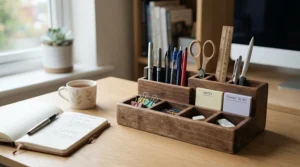
Setting Up Your Desk Organiser for Dissertation Research: A First-30-Days Guide
Buying the kit is the easy bit. Making it stick is where most set-ups fail, so here’s a practical routine.
Day one: zone your desk. Split paper into three states. “Active” is what you touch daily and goes within forearm reach. “Reference” is what you consult weekly and sits one reach further. “Archive” goes on a shelf or in the Leitz Colour Desk Organiser. Label each tray by stage, not topic. Topics change; stages (to read, annotated, drafting, feedback) don’t.
Week one: write a tab key. Choose three to four colours of Post-it Index Strong Filing Tabs, then jot the meaning of each on a card and prop it in the EXERZ 7 Compartment Mesh Caddy. Fewer colours means faster decisions.
Weekly: the 10-minute reset. Every Friday, empty the “annotated” tray. Anything unused for two weeks gets archived or recycled. Heavy items go in the bottom tier, because top-heavy towers wobble.
Common first-month mistakes:
- Over-labelling every page, which dilutes the tabs’ meaning.
- Buying extra trays before testing whether you need them.
- Ignoring desk depth until the unit arrives.
Real-World Scenarios: Matching a Desk Organiser for Dissertation Research to Your Life
The undergraduate in halls. Small desk, tight budget, one printer trip a week. A sensible mix is the EXERZ 7 Compartment Mesh Caddy, the Post-it Index Strong Filing Tabs and one OSCO Bamboo Stacking Letter Tray. Based on the price ranges above, that lands in the mid-£30s, and it can grow later.
The part-time master’s student at the kitchen table. Everything must pack away by dinner. The Leitz Colour Desk Organiser closes up and slides into a bag, and the Post-it Index Strong Filing Tabs supply the colour logic. Add a caddy if there’s room. The total should come in under £50, subject to checking current prices.
The full-time postgraduate with a dedicated desk. Big reading list, daily printing, supervisor meetings every fortnight. Here the Marbrasse 5-Tier Desk Organiser handles the active literature, the OSCO Bamboo Three Tier Letter Tray takes printed drafts, and the Post-it Index Strong Filing Tabs link it all together. Expect roughly £55 to £65 in total, which spread over a six-month project works out around £10 a month.
Problem → Solution: Fixing Common Desk Organiser for Dissertation Research Headaches
Problem 1: “My desk is simply too small.” Go vertical. The Leitz Ergo Small Pegboard lifts pens and notepads off the surface, as long as your desktop is 35 mm thick or less. Pair it with the Leitz Colour Desk Organiser for paper.
Problem 2: “Pages curl and slide around.” Switch to the OSCO Bamboo Three Tier Letter Tray. Its weight and rigid sides hold stacks flat. For A4 printouts, aim for an internal depth of at least 30 cm, since A4 is 29.7 cm long.
Problem 3: “My tabs have turned into a rainbow riot.” You’ve probably used too many colours. Cut to four, write the key on a card, and re-sort a single chapter before touching the rest.
Problem 4: “My printouts and my digital library don’t match.” Give every printed article a short ID, such as surname and year, that matches its entry in your reference manager. Durham University’s research skills guide lists Zotero among the supported tools and describes it as free and approachable. Whichever tool you pick, consistent IDs make paper and software point to the same thing.
How to Choose a Desk Organiser for Dissertation Research
Follow these six steps and you’ll avoid most regrets.
- Measure first. Record desk depth, width and thickness. Thickness decides whether a clamp-on like the Leitz Ergo Small Pegboard even fits.
- Estimate your paper load. Printing twenty pages a week needs far more tray space than printing two.
- Choose visible or hidden. Open trays and mesh keep things visible. Closed files hide the mess.
- Pick paper-first or small-items-first. Most desks need both, but buy the bigger pain point first.
- Plan your tab system. Sticky note tabs only work if there’s somewhere to keep the dispenser.
- Check capacity and material. Weight limits matter on mesh towers, and heavier bamboo stays put.
Common Mistakes When Buying a Desk Organiser for Dissertation Research
The biggest error is buying for the desk you wish you had. Aspirational towers collide with monitor stands, and deep trays push keyboards off the edge. Another is ignoring paper size. A4 and foolscap fit, but lever arch files may not, and some Marbrasse 5-Tier Desk Organiser reviewers hit exactly that problem.
The second trap is buying everything at once. Start with tabs and one tray. Within two weeks you’ll know whether you need a drawer, a pegboard or a second tray. The third is skipping maintenance. A tray without a weekly reset becomes a sorted pile of clutter, which is still clutter.

Reference Management: Linking Your Digital Library to Your Desk
Reference management isn’t just software. It’s a habit that your physical set-up should mirror. The University of Reading’s guide to managing references explains that reference management software stores publication details and then inserts citations and a bibliography automatically in a style you choose.
That covers the digital side. The physical side needs the same logic. Give each tray a job that matches a folder in your software: “To read” paper trays, “Annotated” and “Cited in draft”. UCL’s guidance also notes that Zotero lets you create group libraries to share collections, which is handy if you’re co-writing with a project partner. Keep a matching physical tray for jointly annotated papers.
Here’s my practical rule. If a paper is in your library, its printout should be findable in under thirty seconds by ID. That’s where the Leitz Colour Desk Organiser‘s 24 dividers shine. Number the tabs to your own system, and you have a physical index that mirrors your reference management library.
Sticky Note Tabs: A Colour-Coding System That Scales
Sticky note tabs are the cheapest productivity upgrade in this guide, and the easiest to overdo. The rule of thumb: one colour, one meaning, and no more than four meanings.
A workable scheme looks like this:
- Colour A: the argument or finding you’ll use.
- Colour B: methodology worth borrowing.
- Colour C: a source you disagree with.
- Colour D: things to chase up.
The transparent tips on the Post-it Index Strong Filing Tabs let you flag a passage without covering it. At around 25 mm wide, they leave a short label area, so use a single word or number, not a sentence. If you’re tabbing a lot of pages, buy a second pack before you run out mid-chapter. And keep the dispenser in the Marbrasse 5-Tier Desk Organiser drawer or the EXERZ 7 Compartment Mesh Caddy. A dispenser that lives in a bag is a dispenser you’ll lose.
Filing Trays vs Other Ways of Organising Dissertation Paperwork
Filing trays aren’t the only answer. Here’s how they compare to the usual alternatives.
| Approach | Strength | Weakness | Best For |
|---|---|---|---|
| Desktop filing trays | Instant visual access | Takes desk space | OSCO Bamboo Three Tier Letter Tray users |
| Cardboard box on the floor | Cheap, huge capacity | Out of sight, out of mind | Archive only |
| Lever arch files on a shelf | Compact and tidy | Slow to retrieve | Finished chapters |
| Digital-only | Searchable, no clutter | No annotated printouts | Screen-only readers |
Trays win on speed. You see the pile, reach it and put it back without standing up. A floor box or shelf is better for dead storage but terrible for active work. Digital-only works beautifully if you never print, but most dissertation writers still mark up paper at some point. The practical answer is a hybrid. Use filing trays for the active pile, files or the Leitz Colour Desk Organiser for the archive, and your reference management software for everything searchable.
Long-Term Cost & Value of a Desk Organiser for Dissertation Research
A dissertation is a sprint of a few months, so judge cost per month, not purchase price. Using the ranges from earlier:
| Kit | Contents | Approx. Spend | Best For |
|---|---|---|---|
| Starter | EXERZ 7 Compartment Mesh Caddy, Post-it Index Strong Filing Tabs, OSCO Bamboo Stacking Letter Tray | Mid-£30s | Halls and tight budgets |
| Portable | Leitz Colour Desk Organiser, Post-it Index Strong Filing Tabs, EXERZ 7 Compartment Mesh Caddy | £30–£50 range | Kitchen-table workers |
| Full desk | Marbrasse 5-Tier Desk Organiser, OSCO Bamboo Three Tier Letter Tray, Post-it Index Strong Filing Tabs | Around £55–£65 | Dedicated desks |
Looking at the numbers, the full kit works out at roughly £10 a month over six months, less than a couple of coffees a week. The starter kit is cheaper but expands awkwardly if you later need three or four trays. Bamboo and mesh also tend to outlast cardboard, so they hold their value for a next project or resale. The Leitz Ergo Small Pegboard wasn’t priced at the time of research, so check current price and add it to whichever kit suits your desk.
Ergonomics & Safety: Keep Your Desk Organiser for Dissertation Research Healthy
An organised desk can still hurt you if the layout forces awkward postures. The HSE’s guidance on working safely with display screen equipment at home covers the principles. Its good-posture advice keeps the screen directly in front of you. For laptops, it recommends a separate display screen. Strictly, these rules are written for employees, but the sense of them applies to students who spend long hours writing.
Translate that to your organiser:
- Put your most-used tray on your non-dominant side, so you don’t twist every time you reach.
- Keep the Marbrasse 5-Tier Desk Organiser or OSCO Bamboo Three Tier Letter Tray out of the line between you and the screen.
- Check weight limits. The Marbrasse 5-Tier Desk Organiser lists a stated capacity of 2.84 kg, so don’t treat it as a bookshelf.
- Mount the Leitz Ergo Small Pegboard only on desks within its 35 mm thickness limit, and tighten the clamp properly.
Take breaks, too. A tidy desk is lovely, but your neck doesn’t care.

FAQ
❓ What size filing trays do I need for A4 dissertation drafts?
❓ Will sticky note tabs damage printed journal articles?
❓ Is reference management software enough without any paper system?
❓ How much should I spend on a desk organiser for dissertation research?
❓ Can a pegboard replace filing trays?
Conclusion
You don’t need a showroom desk to write a good dissertation. You need a system that makes the next piece of paper easy to find. The most effective desk organiser for dissertation research is rarely the biggest. It’s the one matched to your desk depth, your paper load and your habits.
If I had to condense it: start with sticky note tabs, add one tray that suits your space, and use a caddy to keep small items out of the way. The Post-it Index Strong Filing Tabs are the cheapest way in. The Marbrasse 5-Tier Desk Organiser and OSCO Bamboo Three Tier Letter Tray are the stronger choices if paper is your main problem. Space-starved students should look at the Leitz Ergo Small Pegboard and Leitz Colour Desk Organiser. The OSCO Bamboo Stacking Letter Tray and EXERZ 7 Compartment Mesh Caddy round out a budget-friendly start.
Whatever you choose, keep your reference management habits and your physical filing in step, reset the desk weekly, and don’t over-tab. Your future self, deep in chapter four, will be grateful.
✨ Your Calmer Desk Is a Few Clicks Away!
🔍 Take your desk organiser for dissertation research to the next level with these carefully selected products. Click any highlighted product to check current pricing and availability, then start building the system that gets you to the finish line. 📚🚀
Recommended for You
- Printer For Dissertation Writing: 7 Proven Picks (2026)
- Notebook For Lecture Notes: 7 Brilliant UK Picks (2026)
- Laptop Stand For University Lectures: 7 Essential Picks (2026)
Disclaimer: This article contains affiliate links. As an Amazon Associate, I earn from qualifying purchases. If you purchase products through these links, we may earn a small commission at no additional cost to you.
✨ Found this helpful? Share it with your friends! 💬🤗
