
In This Article
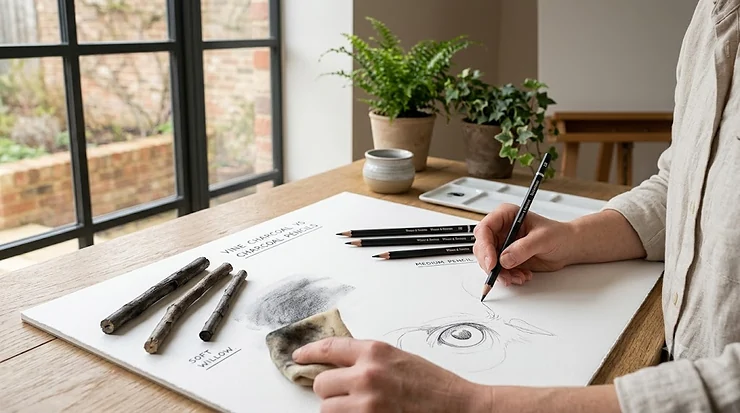
There’s a moment most artists know well. You’re standing in your local art shop — or, let’s be honest, scrolling through Amazon.co.uk at half eleven on a Tuesday — staring at two very different things: a box of slender, dusty vine charcoal sticks and a neat set of sharpened charcoal pencils. Both promise dramatic darks, velvety shadows, and portraits that actually look like the person you drew. Both will leave your hands looking like you’ve been cleaning a chimney. So which do you actually need?
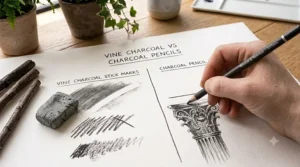
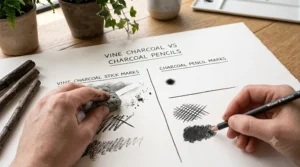
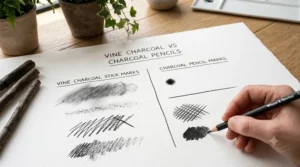
The vine charcoal vs charcoal pencils debate is one of the most genuinely useful conversations in drawing — not because there’s a definitive winner, but because understanding the difference fundamentally changes how you work. Vine charcoal, made from burnt grapevine branches, is soft, powdery, and forgiving to a fault. It smudges. It lifts. It lets you rethink your entire composition with a single swipe of your hand. Charcoal pencils, by contrast, encase compressed charcoal in a wooden shell, trading that wild freedom for precision, clean fingers, and the ability to render a single eyelash with authority.
Both are available on Amazon.co.uk at prices that range from “student pocket money” to “serious investment.” This guide cuts through the confusion, reviews seven products worth your attention, and tells you — honestly — which medium suits your work, your skill level, and your corner of Britain.
According to Wikipedia’s entry on charcoal as a drawing medium, artists have been burning vine and willow wood for drawing since the Renaissance, and the medium’s fundamental appeal hasn’t changed: it’s reactive, expressive, and remarkably forgiving.
Quick Comparison: Vine Charcoal vs Charcoal Pencils at a Glance
| Feature | Vine Charcoal | Charcoal Pencils |
|---|---|---|
| Mark quality | Soft, powdery, grey-blue tone | Dark, crisp, more permanent |
| Erasability | Excellent — lifts with putty rubber | Moderate — harder to fully remove |
| Precision | Low — broad gestural marks | High — sharp, controlled lines |
| Messiness | Very messy | Relatively contained |
| Best for | Initial sketches, large studies | Detail work, finished pieces, portraits |
| Price range | Under £10 for most sets | £5–£25 for quality sets |
| Available on Amazon.co.uk? | ✅ Yes | ✅ Yes |
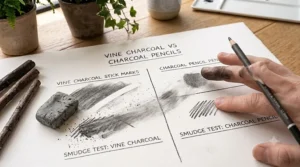
The table above tells a tidy story, but here’s what it can’t show you: vine charcoal’s powdery marks actually sit on top of the paper rather than embedding into it, which means you can restructure your entire composition without a trace — genuinely liberating when you’re three hours into a life drawing and realise the head is too small. Charcoal pencils, being compressed charcoal in a wood casing, adhere more permanently and are far better suited to the finishing stages of a drawing, where you want rich, controlled darks that stay exactly where you put them.
💬 Just one click — help others make better buying decisions too! 😊
✨ Don’t Miss These Exclusive Deals!
🔍 Take your charcoal drawing to the next level with these carefully selected products. Click on any highlighted item to check current pricing and availability on Amazon.co.uk. These picks will help you find exactly what you need!
Top 7 Vine Charcoal & Charcoal Pencil Products: Expert Analysis
1. Winsor & Newton Vine Charcoal Sticks (Soft, Box of 12)
Winsor & Newton have been making art materials since 1832, and their vine charcoal is about as close to the classic art school experience as you’ll find on Amazon.co.uk. These are genuine willow sticks — W&N use the terms vine and willow somewhat interchangeably — baked to a consistent degree of hardness that produces an even grey-blue line without unexpected hard spots or crumbling mid-stroke.
The soft grade is genuinely soft. It deposits pigment generously onto even a lightly-toothed cartridge paper, making it excellent for large-format studies and the kind of loose gestural life drawing where you’re working from the shoulder, not the wrist. UK buyers should note these are available in soft, medium, and thin varieties on Amazon.co.uk, all Prime-eligible with free next-day delivery. At around £5–£8 for a box of 12 depending on grade, they represent exceptional value.
UK reviewers consistently praise their consistency — no brittle surprises, no chalky patches — which matters enormously when you’re mid-session at a life drawing class in Edinburgh or Bristol and the last thing you want is a stick that snaps in two. The Winsor & Newton vine charcoal is best suited to beginners and intermediate artists who want a reliable, forgiving material for underdrawings, tonal studies, and compositional planning.
✅ Consistent, even mark quality
✅ Excellent UK availability and Prime delivery
✅ Multiple grades available
❌ Too imprecise for detailed finished work
❌ Requires fixative before adding layers
Around £5–£8 for a box of 12 — superb value for the quality.
2. Reeves Soft Vine Charcoal Sticks (Set of 3)
Reeves is one of Britain’s most recognisable art materials brands, widely stocked on high streets and reliably present on Amazon.co.uk at entry-level prices. Their soft vine charcoal set of three is aimed squarely at beginners and students — the sticks are broader than W&N’s offerings, which sounds like a limitation but is actually rather useful when you’re learning to block in large tonal areas quickly.
At under £5 for a set, this is the most accessible entry point in this guide. The marks are slightly less refined than the Winsor & Newton equivalent — you won’t get quite the same tonal subtlety — but for a student doing their first gesture drawings or tonal studies, the difference is largely academic. What matters is that they work reliably, are easy to erase with a putty rubber, and won’t break the bank when you inevitably snap three sticks in your first session (everyone does).
UK art students at schools and colleges across England and Wales will find these particularly useful as a supplementary supply to whatever their institution provides. They’re widely available and often qualify for free Amazon.co.uk delivery on orders over £25. Best for absolute beginners, younger artists, and anyone wanting an inexpensive supply for practice work rather than finished pieces.
✅ Very affordable — ideal for beginners
✅ Wide sticks good for blocking in large areas
✅ British brand, excellent UK availability
❌ Less refined tonal range than premium options
❌ Only available in soft grade
Under £5 for a set of 3 — a brilliant starting point.
3. XHBTS Vine Charcoal Sticks Soft, 25-Piece Set (3–5mm)
Twenty-five sticks for under £8 sounds too good to be true, but the XHBTS set — sold and fulfilled by Amazon on Amazon.co.uk — has accumulated enough positive reviews to suggest it delivers on its promise. These are thinner than the Reeves sticks, closer to 3–5mm in diameter, which gives you a bit more mark-making variety from the same basic material.
The slimmer profile means you can use the tip for slightly more directed strokes and the side for broad blending — a versatility that the budget price point doesn’t usually afford. UK reviewers note they hold their point reasonably well and don’t crumble as readily as some budget alternatives. The hard box packaging is a genuine plus; charcoal that arrives as powder is charcoal you can’t use, and the sturdy case means your sticks survive the Royal Mail’s enthusiasm for parcels.
Where this set falls slightly short is in tonal depth — the marks are soft and grey rather than the richer, darker tone you get from a premium vine charcoal. For studies, practice work, and building up layers before committing to heavier media, though, they’re excellent. Best suited to students and hobbyists who draw frequently and prefer quantity and variety over premium quality.
✅ Excellent value — 25 sticks for under £8
✅ Slim profile allows more varied mark-making
✅ Protective hard box packaging
❌ Tonal range less rich than premium brands
❌ Not Prime-eligible for all postcodes — check delivery times
Under £8 for 25 sticks — the most economical option in this guide.
4. Derwent Charcoal Drawing Pencils, Set of 6 with Sharpener (07008383)
Derwent are a Cumbrian institution — their pencils have been made in the Lake District since 1832, and their charcoal pencil set is comfortably the most popular charcoal pencil product on Amazon.co.uk, sitting consistently in the top results with thousands of reviews. The set includes light, medium, and dark grades plus a tinted charcoal white pencil and a sharpener, which makes it a genuinely comprehensive starting point for charcoal pencil work.
The wooden casing is smooth cedar — easy to sharpen, pleasant to hold — and the charcoal core strikes a balance between dark enough to matter and controllable enough for portrait detail. The dark grade in particular delivers a satisfying rich black that blends beautifully for shadow areas in portrait work. What most buyers overlook is the tinted white pencil, which is extraordinary for adding highlights on toned paper — a technique that elevates portrait drawings enormously.
UK customers praise the set as excellent for beginners transitioning from graphite, and it’s available Prime-eligible on Amazon.co.uk in the mid-single digit to low teens price range. Recommended for beginners to intermediate artists, students in UK secondary schools and colleges, and anyone wanting a clean, controllable introduction to charcoal without the mess of loose sticks.
✅ Comprehensive set with multiple grades plus white
✅ Iconic British brand with excellent quality control
✅ Ideal for beginners transitioning from graphite pencils
❌ Dark grade blunts quickly during heavy use
❌ Sharpener included is basic — invest in a separate one
Around £8–£14 for the full set — exceptional value for a complete charcoal pencil introduction.
5. Faber-Castell Goldfaber Charcoal 114006 Drawing Set, 8 Pieces
Faber-Castell need no introduction. The German manufacturer has been producing art materials since 1761, and their Goldfaber Charcoal set sits at the premium end of what you’d call “accessible professional” territory. The set of eight includes five charcoal pencils spanning extra super soft to hard grades, a kneaded eraser, a sharpener, and a paper blending wiper — essentially everything you need to produce a finished charcoal portrait without buying a single additional item.
The charcoal core quality here is noticeably superior to budget options. The extra super soft grade produces a genuine deep black that you’d struggle to achieve with a student-grade pencil, while the hard grade holds a sharp point long enough to render fine hair texture and precise eye detail with real authority. This range makes the Goldfaber set the most versatile single purchase in this guide for portrait artists.
Available on Amazon.co.uk from around £8–£13 (prices vary — check current availability), the set is Prime-eligible. UK buyers should note that Faber-Castell’s quality control is exceptional; cores are centred properly, which means the pencils sharpen cleanly without the spiral breakage that plagues cheaper alternatives. Best for intermediate to advanced artists working on portraits and detailed observational drawings.
✅ Five grades from extra super soft to hard in one set
✅ Superior core quality and German precision engineering
✅ Comes with blending and erasing tools
❌ On the pricier side for beginners who may not yet use all grades
❌ Can feel stiff in the hardest grades for some artists
Around £8–£13 for the 8-piece set — genuinely worth every penny for portrait work.
6. Faber-Castell Pitt Charcoal Set, 24 Pieces
For artists who are serious about charcoal as a primary medium, the Faber-Castell Pitt Charcoal tin is a revelation. Twenty-four pieces including natural charcoal sticks, compressed charcoal sticks, natural and compressed charcoal pencils, and accessories — all in a portable tin that doubles as storage. This is, in effect, both sides of the vine charcoal vs charcoal pencils debate settled in a single purchase.
The natural charcoal sticks in this set produce that characteristic blue-grey tone beloved by life drawing instructors, while the compressed charcoal pencils deliver the intense, controlled blacks needed for finished work. Having both in one set means you can work the way professional artists actually work: vine-style charcoal for the initial lay-in, compressed pencils for the refinement and detail stage.
As this excellent overview from Fiveable on charcoal drawing techniques explains, combining different charcoal types within a single drawing is standard practice at atelier and art school level. The Pitt tin makes this accessible without buying separate products. Available on Amazon.co.uk and Prime-eligible. Best for intermediate to advanced artists and dedicated students who want a professional-level toolkit without specialist art shop hunting.
✅ Covers both vine-style and compressed charcoal in one tin
✅ Comprehensive enough for professional-level work
✅ Excellent portable tin for life drawing classes and plein air work
❌ Overkill — and a slight waste of money — for absolute beginners
❌ Some natural sticks in the set are thicker than ideal for detailed work
In the £20–£35 range — a serious investment that genuinely pays off.
7. General Pencil Charcoal Kit No. 15 (13-Piece Set)
General Pencil Company from the United States have been handcrafting pencils using traditional methods for six generations, and their No. 15 Charcoal Kit has acquired something of a cult following among serious drawing students worldwide. The set — available on Amazon.co.uk, though stock fluctuates so check availability — includes charcoal pencils in multiple grades, charcoal sticks, a white charcoal pencil, a carbon sketch pencil, sharpener, and eraser.
The General’s charcoal pencils have a distinctly rich laydown that many professional artists prefer for portrait work, particularly the 4B and 6B grades which produce an intense, velvety black that blends superbly for smooth skin tones. The carbon sketch pencil is worth special mention — it behaves like a hybrid between charcoal and graphite, offering more precision than a standard charcoal pencil with a slightly darker mark than graphite alone.
UK reviewers note occasional packaging issues (it travels across the Atlantic before reaching British warehouses), but the pencil quality itself is consistently praised. The white charcoal pencil is exceptional for highlight work on mid-tone papers. Best for intermediate to advanced artists, particularly those focused on portraits and figurative work, who want American atelier-standard materials at a reasonable price.
✅ Professional-grade laydown, especially the 4B and 6B grades
✅ White charcoal pencil perfect for highlight work on toned paper
✅ Full kit including accessories in one purchase
❌ Packaging can arrive slightly battered — the pencils inside are generally fine
❌ Stock on Amazon.co.uk can be limited — check before relying on fast delivery
In the £12–£20 range — outstanding quality for the price.
How to Actually Use Vine Charcoal and Charcoal Pencils Together
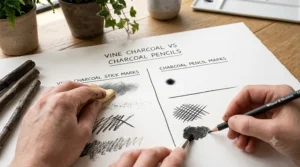
Here’s the thing the product listings won’t tell you: the best charcoal artists don’t choose between vine charcoal and charcoal pencils. They use both, in sequence, the way a chef uses a cleaver and then a paring knife.
Start with vine charcoal. Lay in your composition loosely, blocking tonal masses with the side of the stick. Don’t press hard. The beauty of vine charcoal is that a putty rubber — or even just your fingertip — can lift it off almost completely. Redesign, restructure, move things around. At this stage, you want freedom, not commitment.
Once the broad structure is resolved, fix lightly with a charcoal fixative spray — hold the can about 30cm from the surface, use a sweeping motion, and let it dry fully. This locks the underdrawing so your subsequent marks don’t lift everything off the surface. Then switch to charcoal pencils for the refinement stage. Build dark accents into the shadows, refine the edges of forms, and add fine detail in the eyes, hair, and textured areas.
A practical tip for UK artists working in home studios: charcoal dust is significant. Work at an angle if possible — a drawing board propped against a wall works well in a small flat — and protect finished work with glassine paper before storing. The Arts Council England’s guidance on conservation of works on paper emphasises that unfixed charcoal is vulnerable to smearing and should be stored horizontally, face up, ideally framed under glass.
UK Artist Profiles: Who Should Use What
The Beginners — Anna, graphic design student in Manchester. Anna has been sketching in graphite for two years and wants to try charcoal for the first time. She should start with Derwent Charcoal Drawing Pencils — the pencil format feels familiar, the mess is manageable, and the multiple grades mean she can explore tonal range without being overwhelmed. Add a box of Reeves vine charcoal sticks for practice gesture drawings. Total spend: under £15.
The Developing Artist — James, life drawing enthusiast in Bristol. James attends a weekly life drawing session and wants to produce more expressive, atmospheric work. He needs vine charcoal — ideally the Winsor & Newton soft grade — for the gestural lay-in, combined with the Faber-Castell Goldfaber set for finishing. The combination is what separates competent drawings from genuinely compelling ones. Total spend: around £20–£25.
The Serious Portrait Artist — Rachel, freelance illustrator in Edinburgh. Rachel wants professional-quality materials for commissioned portrait work. The General Pencil No. 15 Kit provides the charcoal pencil quality she needs, while the Faber-Castell Pitt 24-piece tin gives her the full range of vine and compressed charcoal options for complex tonal work. Total investment: around £40–£55 — reasonable for professional-grade materials that will last months of regular use.
Which Charcoal Is Best for Portraits?
Portrait drawing is arguably where the vine charcoal vs charcoal pencils question gets most interesting, because a convincing portrait typically requires both. Here’s how they divide the labour:
Vine charcoal handles the early stages. You’re mapping proportions, establishing tonal masses, figuring out whether the light is hitting the left or right side of the face. At this point, erasability is everything. A misplaced eye that you can’t remove is a portrait you’ve ruined.
Charcoal pencils handle the finish. Blending charcoal for smooth skin tones is where compressed charcoal pencils shine — the softer grades (4B, 6B) blend with a paper stump or tortillon to create the gradual, luminous transitions that make skin look three-dimensional rather than flat. For the darkest accents — deep eye sockets, the shadow under the nose, the turn of the jaw — a 6B charcoal pencil layered carefully gives you a depth that vine charcoal alone cannot match.
Jackson’s Art, one of the UK’s most respected professional art suppliers, consistently recommends building portrait drawings in layers precisely because different charcoal types behave so differently at each stage.
Charcoal Pencil Control vs Stick: Features That Actually Matter
Marketing copy for charcoal products is full of noise. Here’s what actually matters:
Core consistency is everything. A charcoal pencil with an off-centre core will spiral-break when you sharpen it. Premium brands like Faber-Castell and General Pencil centre their cores reliably. Budget options are a lottery.
Grade range matters more than the number of pencils in the set. Five genuinely different grades (extra soft through hard) is more useful than twelve pencils where half feel identical.
Erasability depends on binder content. More binder means a harder, darker, more permanent mark that’s harder to lift. Vine charcoal has no binder at all — it’s the most erasable drawing medium you’ll use. Charcoal pencils have the most binder. Understanding this is what makes you actually good at charcoal, rather than just someone who owns the right pencils.
Paper tooth interacts with all of the above. A slightly textured cartridge paper (100–130gsm) works brilliantly with both vine charcoal and pencils. Smooth paper makes vine charcoal skitter and slide. For portrait blending, a mid-tone Ingres paper — widely available in UK art shops and on Amazon.co.uk — is the professional standard.
Frequently Asked Questions
❓ What is the difference between vine charcoal and charcoal pencils?
❓ Which charcoal is best for portraits?
❓ Are charcoal drawing pencils available on Amazon.co.uk with fast delivery?
❓ Can I blend vine charcoal for smooth skin tones?
❓ Do I need fixative for charcoal drawings in the UK?
Conclusion: Stop Choosing, Start Drawing
The vine charcoal vs charcoal pencils debate doesn’t have a winner — it has a sequence. Vine charcoal is where every drawing should start: loose, exploratory, forgiving, and honest about the fact that you’re still figuring it out. Charcoal pencils are where it finishes: precise, dark, controlled, and committed.
For UK artists just starting out, the Derwent Charcoal Drawing Pencils Set offers the best first experience — familiar pencil format, multiple grades, decent quality, and available tomorrow on Amazon.co.uk with Prime. Add the Winsor & Newton vine charcoal when you’re ready to explore the full process. For those ready to invest, the Faber-Castell Pitt 24-piece tin essentially makes the debate irrelevant by giving you everything in one elegant tin.
The real secret — the thing that separates artists who talk about charcoal from those who actually improve at it — is simply using it. Regularly. On inexpensive cartridge paper, where mistakes don’t feel precious. According to the Royal Drawing School’s resources on traditional drawing practice, consistent daily practice with traditional materials like charcoal builds observational acuity faster than almost any other approach. Pick up a stick. Make a mess. That’s exactly where it starts.
✨ Ready to Stock Up?
🔍 Check the highlighted products in this guide on Amazon.co.uk for current pricing and availability. These picks cover every skill level and budget — from a first vine charcoal set to a professional-grade pencil kit that’ll last you years.
Recommended for You
- Best Charcoal Pencils UK 2026: 7 Expert Picks for Every Artist
- Best Sketching Pencils UK 2026: 7 Expert Picks for Every Artist
- Best Staedtler Drawing Pencils UK 2026: 7 Expert Picks You Need
Disclaimer: This article contains affiliate links. As an Amazon Associate, I earn from qualifying purchases. If you purchase products through these links, we may earn a small commission at no additional cost to you.
✨ Found this helpful? Share it with your mates! 💬🤗
