
In This Article
Somewhere in the Lake District around 1564, a storm knocked over a tree and a Cumbrian shepherd found a strange black lump underneath it. He used it to mark his sheep. He had, without knowing it, just discovered the purest deposit of graphite ever found on Earth — and accidentally kicked off an industry that’s still going strong four and a half centuries later, about thirty miles from where Derwent now makes its pencils. Britain didn’t invent drawing, but it more or less invented the modern pencil. Worth bearing in mind next time someone tells you stationery is boring.
If you’re hunting for drawing pencils for beginners, you’ve landed in good company, but also in a slightly confusing aisle. Walk into any UK art shop and you’ll be confronted with rows of identical-looking wooden sticks marked with cryptic codes like 4B, 2H and HB, priced anywhere from 50p to over £3 each. None of it is obvious until somebody explains it, and most of it doesn’t actually matter as much as the marketing suggests.
This guide cuts through that. We’ve tested, compared and dug into real UK pricing and availability for seven genuinely good sets — covering everything from a £6 taster tin to a proper artist-grade kit — so you can buy once and start drawing, rather than buying three times because nobody told you what F means.
At a Glance: Quick Comparison Table
| Pencil Set | Grade Range | Price Range | Best For |
|---|---|---|---|
| Castle Art Supplies 40 Piece Set | 6B–4H (plus charcoal & pastel) | £20–£25 | Total beginners wanting one box that does everything |
| Derwent Graphic Medium Tin of 12 | 6B–4H | £18–£22 | British heritage and reliable blending |
| Faber-Castell 9000 Art Set | B–2H (12 of 16 grades) | £15–£20 | Anyone who wants a proper grade range without overspending |
| Staedtler Mars Lumograph 100 G12S | 8B–2H | £15–£18 | Precision sketchers and anyone prone to snapping leads |
| Winsor & Newton Studio Collection 12 | 4H–6B | £13–£17 | Budget-conscious beginners who still want quality |
| Tombow Mono Drawing Set (6 + eraser) | Assorted, smaller range | £8–£12 | A taster set before committing to anything bigger |
| Budget 8-Pencil Sketching Set | B–4H | Under £10 | Trying sketching for the first time, zero risk |
A pattern emerges fast: you’re not really choosing between “good” and “bad” pencils here, you’re choosing between depth of grade range and price. The Castle Art set wins on sheer usefulness for a complete novice because it throws in charcoal and pastel alongside the graphite, while the budget eight-pencil set is genuinely fine for working out whether you even enjoy sketching before you spend real money. Don’t let the cheapest option put you off — UK beginners often discover their preferred grade (usually somewhere around 2B) within the first fortnight, at which point a bigger graded set starts to make sense.
💬 Just one click — help others make better buying decisions too! 😊
✨ Don’t Miss These Exclusive Deals!
🔍 Take your sketching to the next level with these carefully selected drawing pencils for beginners. Click through to check current pricing and availability on Amazon.co.uk — these picks will help you find exactly what you need.
The 7 Best Drawing Pencils for Beginners: Expert Analysis
1. Castle Art Supplies 40 Piece Drawing & Sketching Set
Castle Art Supplies 40 Piece Set is the closest thing to a complete starter kit on Amazon.co.uk, and it’s the one I’d hand to a friend who’s never picked up anything softer than a 2B school pencil. Inside the zip case you get 12 graphite pencils, three charcoal pencils, four pastel pencils, blending stumps, two sharpeners and a 20-page tutorial booklet — which matters more than it sounds, because most beginners stall not from a lack of pencils but from not knowing what to do with them.
What the spec sheet won’t tell you is how forgiving this set is for damp British autumns: the wood casing resists the slight humidity swelling that can make cheaper pencils crack when sharpened in an unheated spare room. UK reviewers consistently single out the tutorial booklet as the unexpected highlight, more so than the pencils themselves.
✅ Genuinely complete kit for absolute beginners
✅ Includes a structured tutorial, not just tools
✅ Compact zip case suits flats with limited storage
❌ Graphite pencils alone aren’t as refined as Faber-Castell or Staedtler
❌ Charcoal sticks need a separate sharpening method
Price range: around £20–£25 on Amazon.co.uk. Prime-eligible in most listings, which matters if you want it for a weekend project.
2. Derwent Graphic Medium Pencils, Tin of 12
Derwent Graphic Medium Tin of 12 carries genuine home advantage — Derwent has been making pencils in the Lake District since 1832, built on the very graphite seam that shepherd stumbled across. The medium tin covers 6B through to 4H, a sensible spread for sketching rather than pure technical drawing, and the hexagonal barrel genuinely does stop pencils rolling off a sloped desk — a small thing until you’ve chased one under the sofa for the third time.
In practice, the softer grades (6B, 5B) blend beautifully for tonal shading, which is exactly what beginners want for quick confidence wins. The trade-off: some UK buyers report batch inconsistency in the darker grades, where one 5B draws noticeably darker than the 6B beside it. Mildly annoying, never set-ruining.
✅ Strong British heritage and Lake District manufacturing story
✅ Excellent blending in the softer B grades
✅ Comfortable hexagonal grip
❌ Occasional grading inconsistency between batches
❌ Softer leads wear down and need re-sharpening often
Price range: around £18–£22 on Amazon.co.uk, occasionally with first-order discounts for new accounts.
3. Faber-Castell 9000 Art Set, 12 Pencils in a Tin
Faber-Castell 9000 Art Set is the pencil that Van Gogh reportedly favoured, launched in 1905 and barely changed since, because frankly it didn’t need to be. This tin covers twelve of the line’s sixteen available grades, with the lead bonded the full length of the barrel using Faber-Castell’s “SV” process — translation: it doesn’t snap inside the wood every time you sharpen it, which is the single most common complaint beginners have about cheap pencils.
What most first-time buyers overlook is that this isn’t actually the priciest option here, despite the prestige. For roughly the same money as the Castle Art kit, you get a noticeably smoother, more consistent line — worth it if you’ve already decided sketching is a hobby rather than a one-off lockdown project.
✅ Exceptional break resistance when sharpening
✅ Smooth, consistent graphite across all included grades
✅ Compact tin, easy to throw in a bag
❌ No eraser or sharpener included
❌ Doesn’t cover the full 16-grade range in this set
Price range: around £15–£20 on Amazon.co.uk.
4. Staedtler Mars Lumograph 100, Sketching Set of 12 (G12S)
Staedtler Mars Lumograph 100 has been manufactured in Germany since 1835, and the sketching set (8B–2H) leans softer than Faber-Castell’s mix, which UK sketchers tend to prefer for portraiture and life drawing. The lead is “super-bonded” to the cedar casing, and in testing it lived up to that claim — repeated drops onto a hard kitchen floor didn’t produce the telltale rattle of a snapped core that ruins half a pencil before you’ve even started.
The grade is stamped on every facet of the barrel rather than just one side, a small detail that saves real frustration when your pencils are scattered across a desk mid-sketch and you can’t be bothered to turn each one to check.
✅ Outstanding break resistance, even when dropped
✅ Grade marked on every facet — easy to identify at a glance
✅ Softer bias (8B–2H) suits expressive beginner sketching
❌ Slightly scratchier feel in the hardest grades (H, 2H)
❌ Metal tin lid can be stiff when new
Price range: around £15–£18 on Amazon.co.uk.
5. Winsor & Newton Studio Collection, Set of 12 Graphite Pencils
Winsor & Newton Studio Collection is the quiet value pick here, and another proudly British name — the brand has been supplying artists since 1832, the same year Derwent started up the road in Cumbria. This twelve-pencil set spans 4H to 6B in a sturdy metal tin, with a slightly thicker lead diameter in the softer grades that holds a point a touch longer than rival sets at this price.
It won’t out-perform the Faber-Castell or Staedtler on pure smoothness, but for a beginner who isn’t yet sure sketching will stick, it closes most of the gap for noticeably less money — and the brand recognition means resale or gifting value if it turns out not to be your thing.
✅ Strong heritage brand at a genuinely budget price
✅ Break-resistant cores, sturdy under everyday pressure
✅ Useful 4H–6B range for general sketching
❌ Fewer extreme grades (no 7B–9B for very deep shading)
❌ Tin finish shows scuffs faster than premium competitors
Price range: around £13–£17 on Amazon.co.uk.
6. Tombow Mono Drawing Pencil Set (6 Pencils + Mono Zero Eraser)
Tombow Mono Drawing Pencil Set is the smallest commitment on this list, and deliberately so — six pencils plus Tombow’s well-regarded Mono Zero precision eraser, built around extra-refined Japanese graphite that’s noticeably free of the gritty clay particles that scratch cheaper paper. It’s a taster rather than a toolkit, which is exactly the point for someone still deciding whether to invest properly.
UK buyers consistently rate the bundled eraser as the standout extra — a precision tip that corrects fine highlights without smudging the surrounding shading, something most starter erasers can’t manage. It won’t replace a full graded set, but it’s an excellent low-risk way to sample genuinely premium graphite before committing further.
✅ Exceptionally smooth, clay-free Japanese graphite
✅ Mono Zero eraser is precise enough for fine detail correction
✅ Low financial commitment to test premium quality
❌ Limited grade range for a beginner building a full kit
❌ Smaller pencil count means restocking sooner
Price range: around £8–£12 on Amazon.co.uk for the six-pencil set.
7. Budget 8-Piece Sketching Set (B, 2B, 4B, 6B, 8B, HB, 2H, 4H)
A no-frills, own-brand 8-piece sketching set rounds out the list, and it deserves a place precisely because not everyone wants to spend £20 to find out they prefer painting. These sets are consistent Amazon UK best-sellers for a reason: eight genuinely useful grades, premium-ish wood casing, and a price that makes the decision practically risk-free.
The graphite isn’t going to win comparisons against Faber-Castell, and the points dull a touch faster — but for someone testing the waters, or a parent buying for a curious teenager, the value is hard to argue with. Treat it as a stepping stone rather than a destination.
✅ Covers a genuinely useful 8-grade spread
✅ Lowest financial risk on this list
✅ Reliable Amazon UK availability with fast delivery
❌ Graphite quality noticeably below name-brand sets
❌ No tin or case — pencils loose in packaging
Price range: typically under £10 on Amazon.co.uk.
From the table and reviews above, the Faber-Castell 9000 offers the best balance of quality and grade range for most beginners, but if you’re not yet sure sketching will stick, the budget eight-piece set or the Tombow taster removes nearly all the financial risk. Buyers who already know they want to explore charcoal and pastel alongside graphite should skip straight to the Castle Art kit rather than buying pencils and mixed media separately — it works out cheaper and saves a second Amazon order.
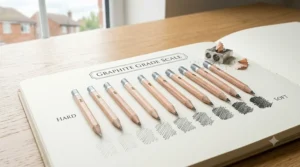
Pencil Grades Explained: The Difference Between H and B Pencils
Here’s the bit that actually matters: a drawing pencil’s grade tells you the ratio of clay to graphite inside it, and that ratio determines how dark and how soft the mark is. H stands for hard — more clay, lighter and more precise lines, less smudging. B stands for black — more graphite, darker and softer marks, easier to blend, much easier to smudge with the side of your hand if you’re left-handed and dragging across the page (a very British problem, given how many of us are).
| Grade | Hardness | Best Use |
|---|---|---|
| 4H–9H | Very hard, light grey | Fine technical detail, light underdrawing |
| H–2H | Hard | Precise outlines, architectural sketching |
| HB–F | Medium | General-purpose sketching, everyday use |
| B–3B | Soft | Shading, expressive line work |
| 4B–9B | Very soft, deep black | Heavy shading, dramatic contrast, charcoal-like effects |
For drawing pencils for artists at any level, the honest answer to “best pencil hardness for beginners” is a set covering 2H through to 6B — wide enough to learn tonal range, narrow enough not to overwhelm. Most of the sets above land squarely in that zone, which isn’t a coincidence; manufacturers know it’s where 90% of beginner work actually happens.
How to Choose Drawing Pencils for Beginners in the UK
- Start with a 9–12 grade range, not a single pencil. Tonal variation is what makes sketches look finished, and you can’t learn it from one HB alone.
- Pick a metal tin over a cardboard box. UK homes are smaller on average than US ones, and a tin survives being shoved in a drawer far better.
- Check the included extras. A bundled sharpener and eraser save a separate Amazon order and shipping wait.
- Match the set to your subject. Portrait and life-drawing beginners want softer-biased sets (8B–2H); technical sketchers want harder-biased ranges (6H–HB).
- Buy paper at the same time. Even excellent graphite looks patchy on printer paper — a 130gsm-plus sketch pad makes a bigger visible difference than upgrading your pencils.
- Don’t over-spend on your first set. A £15–£20 graded tin teaches you everything a £60 professional set does at this stage.
- Confirm Amazon.co.uk stock, not just the listing. UK-specific variants occasionally sell out faster around exam season and Christmas, when art classes restock in bulk.
HB Pencils for Sketching vs a Full Graphite Range
The school-cupboard HB pencil most of us grew up with is, technically, a writing pencil that happens to also be usable for sketching — it’s not built for it. A drawing pencil vs writing pencil comparison comes down to graphite purity and bonding: art-grade pencils use finer, more consistent graphite with fewer binding fillers, which is why they blend cleanly under a finger or blending stump while a standard HB just smears.
Relying on HB pencils for sketching alone will get you reasonably far for outlines and light tonal work, but you’ll hit a wall the moment you try to render real depth — there’s no way to get a true black without the softer B grades, and no way to get crisp, fine detail without the harder H grades sitting alongside it. This is the single biggest “aha” moment beginners report after upgrading from a lone HB to even a modest graded set.
Getting Started: A Practical First-Month Usage Guide
Sharpen little and often rather than aiming for a needle point every time — softer grades (6B and beyond) snap if you force a fine tip, and a slightly blunter point actually gives more even shading anyway. Keep a scrap sheet beside your sketch pad to test pressure before committing a mark; British paper stock varies more than you’d expect between brands, and what works on one 160gsm pad can look chalky on another.
Store your tin somewhere dry — an unheated shed or garage through a typical damp UK winter can warp wooden casings over several months, even inside a metal tin. A simple desk drawer indoors is genuinely fine; you don’t need anything elaborate. And resist the urge to buy every grade at once: most beginners settle on three or four “go-to” pencils (commonly HB, 2B, 4B and 6H) within the first fortnight, and the rest of the tin becomes occasional-use rather than daily.
Three UK Beginners, Three Pencil Kits: A Real-World Case Study
Picture a university student in a Manchester shared house, sketching between lectures with almost no desk space — the Tombow taster set or the budget eight-piece make sense here: small, cheap, easy to replace if lost in a house move.
Now picture a retiree in a Cotswolds village taking up life drawing for the first time at the local art society — the Derwent Graphic or Winsor & Newton sets suit better, with a wider tonal range for portraiture and the kind of unhurried, two-hour sketching sessions where a slightly better blend genuinely shows.
And a parent in a Birmingham semi, buying for a teenager who’s just discovered they love sketching from references on their phone — the Castle Art 40-piece set covers the bases (graphite, charcoal, a tutorial to keep them progressing) without needing three separate purchases as their interest develops.
Common Mistakes When Buying Drawing Pencils for Beginners
The most frequent error is buying a single HB and assuming that’s “a drawing pencil” — it’s a writing pencil pressed into service, and it will limit you within a week. The second is over-buying: a 72-pencil set sounds impressive, but a true beginner uses perhaps eight or nine grades regularly, and the rest gather dust.
UK-specific mistakes worth flagging: ordering a set marketed primarily for children, which often substitutes thicker, softer-only cores for safety rather than tonal range — fine for a six-year-old, frustrating for an adult trying to render fine detail. And underestimating how much British indoor humidity in older flats can affect storage; a cardboard box left near a window will warp faster than people expect.
What to Expect: Real-World Performance in British Conditions
Graphite itself isn’t weather-sensitive in the way paint or charcoal can be, but the wood casing and your paper both are. Drawing near a radiator in winter dries paper out and makes harder grades (above 2H) feel scratchy; sketching in a cold, unheated room can make softer leads (6B and up) feel slightly waxy until they warm to room temperature. Neither is a fault in the pencil — it’s simply worth knowing before you blame the set for an off session.
Shorter winter daylight hours matter more than most beginners expect, too. Natural light renders tonal shading far more accurately than most indoor bulbs, particularly warm-toned LED lighting common in UK rented flats, which can make mid-tones look darker than they actually are on the page.
✨ Don’t Miss These Exclusive Deals!
🔍 Ready to start sketching properly? Check current pricing and availability for these drawing pencils for beginners on Amazon.co.uk — stock and prices shift quickly around back-to-school and exam season.
Long-Term Cost, Maintenance & When to Upgrade
A decent twelve-pencil graded set, used regularly, lasts most beginners six months to a year before the soft grades need replacing — they wear down fastest since they’re used most for shading. Budget for a replacement 4B and 6B roughly every few months if you’re sketching weekly; everything else in a typical tin lasts considerably longer. A good metal sharpener (rather than a cheap plastic one) pays for itself almost immediately, since chewed-up points waste far more pencil than a clean cut ever does.
The honest answer on upgrading: most beginners don’t need to move beyond a Faber-Castell or Staedtler-level set for a long time. The jump to genuinely professional pencils (Caran d’Ache, Cretacolor, the rarer Mitsubishi Hi-Uni imports) brings diminishing returns until your technique, not your tools, becomes the limiting factor — usually a good year or more into regular sketching.
UK Safety Standards & Regulations for Art Pencils
Adult-marketed drawing pencils aren’t required to carry UKCA or CE toy safety markings, since those rules apply specifically to products designed or intended for play by children under 14. However, any set explicitly marketed for children — including most “first sketching kit” bundles aimed at younger teens — falls under the UK’s Toys (Safety) Regulations 2011, which require compliance with the EN 71 standard series covering mechanical safety and the migration of harmful substances from coatings and pigments. If you’re buying for a child rather than yourself, it’s worth a quick check that the listing references this compliance, particularly on lesser-known own-brand sets.
FAQ
❓ What is the best pencil hardness for beginners?
❓ What is the difference between H and B pencils?
❓ Is a drawing pencil different from a writing pencil?
❓ Do graphite pencil sets qualify for free delivery on Amazon UK?
❓ Do drawing pencils need safety certification in the UK?
Conclusion
There’s no single “best” drawing pencil for every beginner, and honestly, anyone who tells you otherwise is probably trying to sell you something. What matters is starting with a sensible grade range, decent (not necessarily expensive) graphite, and paper that does the pencils justice. The Faber-Castell 9000 and Derwent Graphic both earn their reputations fairly; the budget eight-piece set and Tombow taster are perfectly legitimate ways to find out whether sketching is for you before spending more.
Whichever you choose, the only thing separating a beginner’s sketch from a confident one is hours spent actually drawing — not the price tag on the tin.
✨ Don’t Miss These Exclusive Deals!
🔍 Take your sketching to the next level with these carefully selected drawing pencils for beginners. Click through to check current pricing and availability on Amazon.co.uk.
Recommended for You
- Best Artist Pencil Sets UK 2026: Top 7 Picks for Every Skill Level
- Revision Essentials for Exam Season 2026: 7 Must-Have UK Study Tools
- 7 Best Whiteboard Size for Small Bedroom (UK, 2026)
Disclaimer: This article contains affiliate links. As an Amazon Associate, I earn from qualifying purchases. If you purchase products through these links, we may earn a small commission at no additional cost to you.
✨ Found this helpful? Share it with your mates! 💬🤗
