

In This Article
There’s a peculiar British tradition that plays out every spring in homes across the country: a student staring down a stack of exams, surrounded by a graveyard of highlighters, dog-eared textbooks, and a revision timetable that was optimistically drawn up in September and hasn’t been looked at since. Sound familiar?

Here’s the good news — getting your hands on the right affordable revision materials for students does not require remortgaging the family home. In fact, the most effective revision tools are stubbornly, wonderfully cheap. What matters far more than price is how you use them. According to research from Birmingham City University, techniques like active recall and spaced repetition consistently outperform passive reading — and the humble flashcard is arguably the single best physical tool for doing both.
So what exactly counts as affordable revision materials for students? We’re talking subject-specific guides under £10, blank index card packs that cost less than a meal deal, A3 desktop whiteboards that transform a bedroom wall, and study planner pads that bring actual order to revision chaos. All of it available on Amazon.co.uk. All of it genuinely useful, rather than just satisfying to own.
This guide cuts through the noise, tests the claims, and hands you a shortlist of seven products that are worth every penny — plus the expert context to use them properly.
Quick Comparison: Top Affordable Revision Materials at a Glance
| Product | Best For | Format | Price Range (GBP) | Amazon.co.uk |
|---|---|---|---|---|
| CGP GCSE Complete Revision & Practice | All-in-one subject revision | Book | Under £10 | ✅ In stock |
| Pearson REVISE Revision Guide Series | Exam-board aligned revision | Book | Under £10 | ✅ In stock |
| Pearson REVISE Revision Cards | Active recall on the go | Cards + online access | Under £10 | ✅ In stock |
| Mixed Stationery Revision Bundle | Full kit for new starters | Bundle | £15–£25 range | ✅ In stock |
| Study & Revision Planner Pad (A4) | Organisation + timetabling | Pad (52 sheets) | Under £10 | ✅ In stock |
| Study Buddy Magnetic Whiteboard Planner | Visual weekly planning | Desktop board | £15–£25 range | ✅ In stock |
| Marsrock A3 Portable Desktop Whiteboard | Flexible study planning | A3 double-sided board | £15–£25 range | ✅ In stock |
From the table above, the clear pattern is this: the subject-specific revision books deliver the highest academic value for their price point, while the whiteboards and planners are the unsung heroes that keep everything else on track. Budget buyers who can only stretch to one or two items should start with a CGP guide for their weakest subject and a pack of blank index cards — a combination that costs less than a cinema ticket and works harder than most revision apps.
💬 Just one click — help others make better buying decisions too! 😊
✨ Don’t Miss These Exclusive Deals!
🔍 Take your revision to the next level with these carefully selected products. Click on any highlighted item to check current pricing and availability on Amazon.co.uk. These picks will help you find exactly what you need!
Top 7 Affordable Revision Materials for Students: Expert Analysis
1. CGP GCSE Complete Revision & Practice Series
The CGP Complete Revision & Practice series is the revision guide equivalent of a reliable, slightly sarcastic older sibling — it explains everything clearly, has a dry sense of humour tucked into the margins, and doesn’t pad things out for the sake of it. Each book combines a full revision guide and a practice workbook in a single volume, which is genuinely clever if your bedroom doesn’t have much shelf space (and whose does?).
The one-topic-per-page layout deserves particular mention: it breaks complex specifications into digestible chunks that don’t induce the mild existential dread of opening a 600-page textbook at 9pm. Coverage spans all major GCSE subjects — Maths, Biology, Chemistry, Physics, English Language, History, Geography, and more — with separate editions for AQA, Edexcel, and OCR, so make sure you buy the one that matches your school’s exam board.
This is the go-to recommendation for students who work best independently and want a single, portable resource for the bus, the common room, or the dining table. It’s especially well-suited to organised Year 11 students starting revision six months out, who’ll use the practice questions to diagnose weak spots rather than just reading passively.
UK reviewers consistently praise the clear language and the absence of unnecessary filler — a relief when you’re already pressed for time. The integrated practice questions make it genuinely interactive rather than just a reading exercise.
✅ All-in-one format — guide and practice in one
✅ Curriculum-aligned for AQA, Edexcel, and OCR
✅ Compact size; fits in a school bag easily
❌ Covers breadth over depth — some higher-tier topics get limited treatment
❌ Not exam-board specific for every subject variant
Under £10 per title — one of the best value-per-page ratios in educational publishing.

2. Pearson REVISE GCSE Revision Guide Series
The Pearson REVISE series — available across Edexcel and AQA boards for subjects including Maths, English Language, Business, History, Science, and Computer Science — takes a slightly more structured approach than CGP. Where CGP leans into wit, Pearson leans into method. Every guide ships with an activation code granting access to the online Pearson Revise platform, which includes a digital edition of the book, a revision planner, progress tracker, and a flashcard creator. For the price of a paperback, you’re effectively getting a hybrid physical-digital revision toolkit.
What most buyers overlook is that the online component is where this product quietly earns its keep. The revision planner helps students allocate time proportionally across topics — a step most 15-year-olds will skip unless prompted, which is precisely why having a built-in scaffold matters. The topic quizzes also provide low-stakes testing that mirrors what the research calls “retrieval practice” — which is, as the University of York’s study skills guide notes, far more effective for long-term memory than re-reading.
Best suited to students who like structure and data — those who want to see a progress bar moving in the right direction, or who’ve been told by a teacher they need to “work smarter, not harder” and are finally ready to listen.
UK reviewers frequently highlight the clarity of layout and the value of the exam-practice sections, with teachers recommending the series school-wide.
✅ Includes online access: revision planner, flashcards, quizzes
✅ Exam board-specific and regularly updated for 2026/2027 exams
✅ Clear, structured layout ideal for systematic revision
❌ Online access is tied to one user — not transferable to a sibling or friend
❌ Less personality than CGP; some students find the tone dry
Under £10 per guide — and arguably closer to £15-worth of materials when you factor in the digital tools.
3. Pearson REVISE GCSE Revision Cards
Physical revision cards are one of those revision tools that scientists keep recommending and students keep ignoring — until exam season, when they suddenly become the most prized object in the house. The Pearson REVISE Revision Cards bridge the gap between passive and active revision beautifully. Each pack covers a complete GCSE subject (English Language, Maths, Science, History, and more are all available for AQA and Edexcel) and includes multiple-choice questions, worked examples, topic summaries, and three tabbed dividers for organising your progress.
Crucially, every pack also includes access to the online companion revision guide. So unlike buying blank index cards and writing your own (which is also excellent, but time-consuming), these arrive pre-loaded with curriculum-relevant content that’s already been checked by examiners.
The practical value here is portability. A revision guide sits on a desk. A deck of revision cards travels to the kitchen table, the train, the waiting room before a dentist appointment, and every other moment of dead time that could be turned into five minutes of retrieval practice. For students commuting to school or college across Manchester, Birmingham, or anywhere else where a bus or train is involved, these are genuinely worth it.
One reviewer with a dyslexic child noted they were initially concerned but found the concise, structured format actually easier to process than the full guide.
✅ Genuinely portable — use anywhere
✅ Pre-loaded with exam-board specific content
✅ Includes online revision guide access
❌ Cards can become disordered without a proper storage box
❌ Subject coverage is narrower than the full guide range
Under £10 per pack — strong value, especially for on-the-go revision.
4. Mixed Stationery Revision Bundle for Students
If you’re setting up a revision station from scratch — whether that’s for a Year 10 starting GCSEs, a Year 12 beginning A-Levels, or an older student heading off to university — the Mixed Stationery Bundle is the most efficient way to cover all the bases in a single order. A typical bundle at this price point includes two A4 wirebound notebooks, a refill pad, four exercise books, a ring binder, a lever arch file, part dividers (5-part and 10-part), snap wallets, a pack of punched pockets, revision cards, sticky notes, pens, and highlighters.
That’s a complete paper-based revision infrastructure for under £25 — which, in the current cost-of-living climate, is rather significant. Buying each of those items individually from a high street stationer would cost considerably more, and Amazon.co.uk’s delivery is usually prompt (Prime members can expect next-day to select postcodes). UK storage context matters here: bundles like this are ideal for smaller bedrooms or shared student accommodation where a single well-organised folder system is far more practical than scattered individual items.
What makes this work is the ring binder and divider combination. Students who create subject-specific sections and file their notes consistently throughout the year arrive at revision season with an organised resource rather than a cardboard box of loose sheets.
UK buyers note good quality for the price, and the bundle format is particularly popular with parents buying for the start of the academic year.
✅ Complete kit — covers stationery needs in one purchase
✅ Strong value versus buying items separately
✅ Includes revision cards and sticky notes for active recall
❌ Individual item quality is mid-range — not premium
❌ Bundle composition varies; check listing before ordering
In the £15–£25 range — excellent value for first-time setup.
5. Study and Revision Planner Pad (A4, 52 Sheets)
Revision without a plan is just reading. Harsh but fair. This A4 revision planner pad — produced by a small British business and well-reviewed by UK buyers — provides 52 tear-off weekly planning sheets printed on 100gsm paper, which feels noticeably more substantial than cheaper alternatives that buckle under a highlighter. Each sheet features a customisable weekly schedule with colour-coded sections for study, socialising, exercise, and downtime; daily topic-tracking lines; tick boxes for completed tasks; and a dedicated to-do section for non-study items.
The 100gsm weight is worth highlighting (pun very much intended): cheaper planner pads bleed through with markers and highlighters, which is annoying in a way that’s disproportionate to its severity. This one handles a thick Stabilo or Zebra Mildliner without ghosting — a small thing, but it matters when you’re staring at the thing every day.
The colour-key approach is psychologically clever: it creates a visual overview of how a week is actually structured, rather than how a student imagines it’s structured, which are often very different things. Teachers and tutors who recommend this format find that students who fill it in honestly tend to spot their own imbalances more quickly.
UK buyers are largely positive, with parents noting it helped their children manage exam pressure more calmly.
✅ 100gsm paper — stands up to markers and highlighters
✅ Balanced scheduling approach (not just study time)
✅ 52 sheets — a full academic year of planning
❌ Doesn’t include a guide on how to build an effective revision timetable
❌ Some may find A4 too large for a cramped student desk
Under £10 — a quiet overachiever in this category.

6. The Study Buddy Magnetic Whiteboard Revision Planner
There’s something about a physical whiteboard on your bedroom wall that a phone calendar can’t replicate: it’s always visible, never locked behind a passcode, and doesn’t come with the siren call of Instagram notifications. The Study Buddy Magnetic Whiteboard was designed specifically with GCSE revision in mind, and it shows. It comes as a wipe-able, week-view magnetic board that holds colour-coded magnets representing different subjects or tasks — making it easy to shuffle sessions around as plans change (and they will change).
The genius of the magnetic system is that it removes the paralysing perfectionism that tends to afflict colour-coded revision timetables. When everything is moveable by hand in ten seconds, students are more likely to actually update and use the board rather than abandoning it after the first disruption to the plan.
What most buyers overlook: the visibility factor matters enormously for households where a parent or guardian is involved in supporting revision. A whiteboard on a wall turns revision accountability into a shared visual — something a locked phone app can never do. For parents of Year 11 students trying to help without hovering, this is genuinely useful.
Magnetic, so it works well on radiator covers and metal furniture as well as walls. For students in rented accommodation or university halls, check whether Blu-Tack or Command strips are permitted before mounting.
UK reviewers love the concept; several note their children engaged with it more readily than digital alternatives.
✅ Magnetic system — flexible and quick to update
✅ Designed specifically for GCSE revision planning
✅ Visible at a glance — no screen required
❌ Smaller than a classroom whiteboard; limited space for detailed timetabling
❌ Magnets can be lost — worth ordering spares
In the £15–£25 range — well worth considering for visual learners or students who struggle with planning.
7. Marsrock A3 Portable Desktop Whiteboard with Stand
If the Study Buddy is the wall-mounted overview board, the Marsrock A3 Portable Desktop Whiteboard is the session-by-session workhorse. At 40cm × 30cm, it sits comfortably on a standard student desk without dominating it, and the double-sided design means one side can hold a mind map for a topic in progress while the other holds a to-do list or formula sheet. It comes with ten dry-erase markers (in multiple colours), six magnets, and an eraser, so there’s no additional spend required to get started.
The stand is sturdier than the price might suggest — it won’t topple under the weight of a wayward textbook — and the double-sided surface is ideal for the kind of active recall technique that Birmingham City University’s study skills team recommends: write what you know from memory on one side, compare against your notes, then erase and repeat. It’s simple, tactile, and effective.
For students living in small flats or student halls where wall space is limited or permission to put anything up is withheld (the hallowed British rental clause), a freestanding desktop board is a genuinely practical solution. The whiteboard format also supports the “blurting” technique — rapidly dumping everything recalled about a topic — that teachers increasingly recommend as a revision warm-up.
UK reviewers note good build quality for the price, with the colour markers being particularly well-received for colour-coded note-making.
✅ Double-sided — twice the usable surface
✅ Freestanding — no wall mounting required
✅ Comes complete with markers, magnets, and eraser
❌ A3 size limits usefulness for complex mind maps
❌ Marker tip quality can be inconsistent across the pack
In the £15–£25 range — a versatile, desk-friendly addition to any revision setup.
How to Build an Effective Revision System on a Budget
The most common mistake students make isn’t choosing the wrong revision materials — it’s buying excellent ones and then using them passively. A CGP guide opened to the same page every evening and stared at is no more effective than a blank notebook. The materials matter less than the method.
Here’s a practical framework for building a budget-friendly revision system that actually works:
Step 1 — Audit your subjects. List every subject and topic you need to cover. Brutal honesty here is an act of kindness to your future self. Which subjects terrify you? Those get the most time.
Step 2 — Buy one guide per weakest subject. Resist the urge to buy every guide in one panicked Amazon order. Start with your two or three most challenging subjects. A CGP or Pearson guide under £10 each is your foundation.
Step 3 — Set up a planning system. A revision planner pad or a desktop whiteboard costs less than a takeaway coffee habit, and delivers significantly more return. Allocate time using the 2-3-7-14 day spacing intervals recommended by spaced repetition research — study a topic, review it the next day, then three days later, then a week after.
Step 4 — Add active recall tools. Blank index cards (available in bulk for under a few pounds) or a pre-loaded Pearson Revise Cards pack transform passive reading into active retrieval. The difference in long-term memory retention is not trivial: research cited by Recallify found that students using active recall retained 80% of material after a week versus 34% for those who re-read.
Step 5 — Use your whiteboard for the session, not the month. Daily planning on a small whiteboard keeps revision agile. Broad timetabling belongs on the wall planner; what you’re actually doing today belongs on the desktop board.
✨ Don’t Miss These Exclusive Deals!
🔍 Check current pricing on all seven products above on Amazon.co.uk. One click could be the most productive thing you do today!
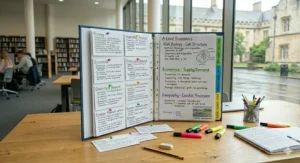
Cheap vs Expensive Revision Guides: Does Price Actually Matter?
Short answer: not as much as you think. Long answer: it depends entirely on what you’re buying for.
| Category | Budget Option (Under £10) | Premium Option (£20–£40+) | Verdict |
|---|---|---|---|
| GCSE Subject Guide | CGP / Pearson Revise | Full Oxford Revise or Collins Complete | Budget wins for most students |
| Flashcards | Blank index cards + DIY | Pre-made Pearson Revise Cards | Tie — depends on time available |
| Planning | A4 planner pad | Digital subscription planner | Budget wins outright |
| Whiteboard | Marsrock A3 Desktop | Professional-grade classroom board | Budget wins for home use |
| Stationery Bundle | Mixed student bundle | Individual premium items | Budget wins by clear margin |
The case for premium revision guides is strongest at A-Level, where some subjects genuinely benefit from greater depth. At GCSE level, however, the specifications are fixed, the question styles are well-documented, and the CGP and Pearson Revise series cover everything required with precision. Paying more doesn’t guarantee better grades — using what you have consistently and actively does.
What does justify spending more is longevity. A well-built A3 whiteboard used daily for two years represents better value than three cheap ones that warp, bleed, or refuse to erase cleanly. The Marsrock sits comfortably in the middle: not the cheapest, but reliable enough to last through an entire GCSE season without becoming frustrating.
Money-Saving Revision Resources: A Real-World Buyer’s Guide
For the Student Starting From Scratch (Budget: Under £30)
You’re in Year 10, exams feel abstract, and your parents have handed you £30 and a meaningful look. Here’s the optimal spend:
One CGP Complete Revision & Practice guide for your most-feared subject (under £10). A Study & Revision Planner Pad (under £10). A pack of blank index cards (under £3). Total: under £25, with change for a decent pen. The whiteboard can wait until revision season — the planning and active recall tools are what you need now.
For the Year 11 Student in Full Panic Mode (Budget: Under £50)
Six weeks to GCSEs. Everything is either urgent or terrifying. Focus on the Pearson REVISE Revision Cards for your three exam board subjects (under £10 each) — they’re portable, pre-loaded, and built for the retrieval practice you need. Add the Marsrock desktop whiteboard for daily session planning. Skip the fancy notebooks; you don’t need new ones now.
For the A-Level Student Setting Up Properly (Budget: Under £60)
More subjects, more complexity, more months ahead. The Mixed Stationery Bundle covers your organisation needs in one go. Add Pearson REVISE Guides for your two or three weakest subjects. The Study Buddy Magnetic Whiteboard earns its keep here for long-range subject scheduling. Don’t underestimate how much a good physical planning system reduces exam anxiety over a 18-month revision arc.
What the Research Says: Why Affordable Tools Work Better Than You’d Expect
There’s a persistent belief among students — and some parents — that expensive, comprehensive study resources are inherently more effective. The research says otherwise, rather firmly. The landmark Dunlosky et al. (2013) review analysed hundreds of individual studies and concluded that two techniques have “high utility” for learning: practice testing (active recall) and distributed practice (spaced repetition). Highlighting, re-reading, and summarising — the methods most commonly associated with expensive annotated textbooks — were rated “low utility.”
In other words, a £2.50 pack of index cards used well beats a £40 annotated textbook used passively. The University of York Library’s study guides recommend reviewing material at roughly exponential intervals: day one, day three, day seven, day fourteen. A paper-based planner pad is perfectly designed for scheduling exactly this — and costs less than a Pret sandwich.
The broader implication for money-saving revision resources is this: the cheapest tools (blank cards, a lined notepad, a desktop whiteboard, a printed timetable) are often the most cognitively demanding to use — and that’s precisely why they work. Making your own flashcards from a revision guide forces you to decide what’s important, condense it, and phrase it in your own words. That process is the revision.
How to Choose the Right Affordable Revision Materials for Students in the UK
Not all revision tools suit all learners. Here’s a practical framework for matching materials to student type:
- Identify your exam board first. This is non-negotiable. Buying a CGP guide for AQA when your school uses Edexcel is an expensive mistake that has caught out many an otherwise organised student. Check your school’s website or ask your teacher.
- Match the format to the context. Books are for desk-based revision sessions. Cards are for commutes, lunch breaks, and spare moments. Whiteboards are for planning and blurting. A student who mostly revises on the bus needs cards; one with a dedicated desk needs a guide and whiteboard.
- Consider the learning style honestly. Students who retain information through writing it out benefit from blank notebooks and index cards. Those who prefer reading and re-reading structured content benefit from well-organised guides. Visual learners do well with whiteboards and colour-coded planning systems.
- Don’t buy more than you’ll use. A stack of five revision guides bought in February and untouched in May is money wasted. Start with one subject, test the approach, then expand.
- Think about portability. UK students often commute by bus, train, or on foot across longer distances than the car-centric model assumes. Compact, lightweight resources — cards, a spiral-bound planner — get used. Heavy, A4 hardbacks often stay at home.
- Factor in the study space. A desktop whiteboard requires a desk; a magnetic wall planner requires a wall (or at least a metal surface). Students in shared accommodation or small bedrooms benefit from compact, freestanding options.
- Check Amazon Prime eligibility. With orders over £25 qualifying for free standard delivery, and Prime members getting next-day delivery on eligible items, timing a bundle order to arrive before a revision sprint can be worth planning around.
Common Mistakes When Buying Budget Revision Materials
🚫 Buying the wrong exam board edition. CGP and Pearson both publish separate guides for AQA, Edexcel, OCR, and WJEC. Many UK students have discovered this the hard way, arriving at a chapter that covers different case studies to the ones they’re being examined on. Always verify the exam board before ordering.
🚫 Prioritising aesthetics over utility. Instagram-friendly stationery hauls make excellent content. They make mediocre revision tools. A beautifully colour-coded notebook that has never been written in is decoration, not revision.
🚫 Overbuying in a panic. Exam anxiety has a way of manifesting as Amazon orders. Five guides, three planners, two whiteboards, and a £12 set of pastel highlighters will not fix a revision schedule that hasn’t been started. Buy what you’ll actually use within the next fortnight.
🚫 Skipping the planning step. The most underused item in the average student’s revision toolkit is a planner. Revision without a timetable is like navigating without a map — technically possible, but exhausting and inefficient.
🚫 Confusing activity with progress. Highlighting a full chapter in four colours feels productive. It is not, reliably, revision. The research is clear: retrieval practice — testing yourself — is what builds the neural pathways that hold up under exam conditions.

FAQ: Affordable Revision Materials for Students UK
❓ What is the best affordable revision guide for GCSE students in the UK?
❓ Are Pearson REVISE Revision Cards worth buying, or should I make my own?
❓ What revision materials are best for students with limited desk space or in shared accommodation?
❓ How much should I realistically spend on revision materials for GCSEs?
❓ Do I need to order revision materials well in advance, or can I get them quickly before exams?
Conclusion: Spend Less, Revise Smarter
The revision materials that actually move the needle aren’t the expensive ones. They’re the ones that get used — the guide that fits in a school bag, the whiteboard that stays on the desk, the planner that turns a blur of exam subjects into a manageable weekly plan. Every product in this guide can be ordered from Amazon.co.uk for under £25, most for under £10, and collectively they represent a far better investment than the passive revision habits that research consistently shows to be ineffective.
The cognitive science here is settled: retrieval practice and spaced repetition produce better results than passive re-reading, and both are best supported by low-tech, affordable tools — flashcards, whiteboards, blank notebooks. As Birmingham City University’s revision guidance notes, spacing out shorter study sessions has been proven more effective than cramming, regardless of the materials used. The right affordable revision materials for students simply make that process more structured, more portable, and less miserable.
Start with one guide, one planner, and one pack of cards. Use them consistently. Then, and only then, worry about what else might help.
✨ Don’t Miss These Exclusive Deals!
🔍 Ready to build your revision toolkit? Click on any highlighted product to check current pricing and availability on Amazon.co.uk. Your future self — the one walking out of the exam hall with a smile — will thank you.
Recommended for You
- Best GCSE Revision Starter Pack 2026: 7 Must-Have Picks for UK Students
- CGP vs Letts Revision Guides: Which Is Better for GCSE 2026?
- Quartet Whiteboard vs Bi-Office Comparison: 7 Best UK Picks in 2026
Disclaimer: This article contains affiliate links. As an Amazon Associate, I earn from qualifying purchases. If you purchase products through these links, we may earn a small commission at no additional cost to you.
✨ Found this helpful? Share it with your mates! 💬🤗
