
In This Article
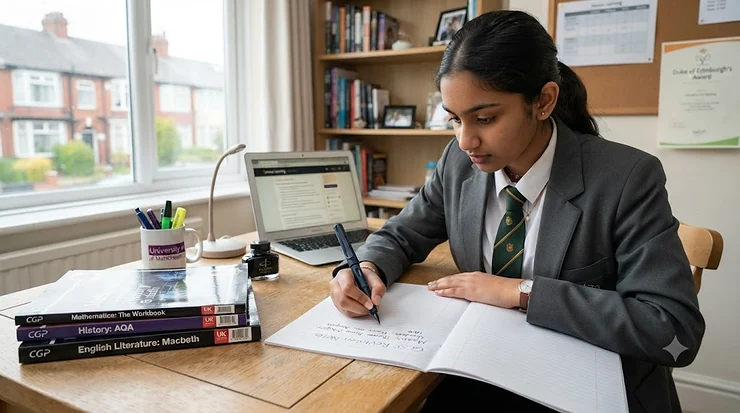
Picture Paper 2, hour two. Your ballpoint is skidding, your fingers have set like concrete, and the clock is doing that sly thing where it crawls, then lunges. This is exactly the moment a fountain pen for GCSE can earn its keep. Not because it looks posh (although a few of them look terrific), but because ink flows from the nib without you leaning on it, and a lighter touch is kinder to a tired hand.
Now for the honest bit. A fountain pen for GCSE isn’t a magic wand, and it won’t rescue a script that’s illegible because you panicked. What it can do, with a proper black ink and a few weeks of practice, is take a little strain off your handwriting stamina. Several good options cost under £30, and one costs less than a decent lunch.
There’s a catch, though, and it matters more than any nib: exam boards care about the rules. JCQ’s own exam-preparation checklist tells candidates to bring at least two black ink pens and says blue pens aren’t acceptable. So every pick below is judged on three things: does it write a clean black line, does it survive a long paper, and does it keep you on the right side of the exam regulations on pens?
Below you’ll find seven real pens sold on amazon.co.uk, analysed through their specs and genuine reviewer sentiment, plus practical guides to ink cartridges, handwriting stamina and everything else you’d wish someone had told you before mock season.
Fountain Pen for GCSE Quick Comparison: Seven Picks at a Glance
Short on time? Here’s the whole field on one screen before we go deep.
| Pen | Best For | Ink system | Price range |
|---|---|---|---|
| Pilot Kakuno | Beginners who need grip help | Pilot cartridges or converter | Around £10-£15 |
| Platinum Preppy | Cheap, reliable spare pen | Platinum cartridges (converter extra) | Under £10 |
| Lamy Safari | All-round school workhorse | T10 cartridges or converter | Around £20-£30 |
| Pilot Metropolitan | Smooth writing on a budget | Pilot system (check your version) | Around £15-£25 |
| TWSBI Eco | Maximum ink capacity | Piston filler, bottled ink only | Around £25-£40 |
| Parker IM | Familiar high-street brand | Quink cartridges or converter | Around £25-£40 |
| Lamy Studio | Premium long-term keepsake | T10 cartridges, converter in box | £60-£90 range |
Reading across the table, Pilot Kakuno and Platinum Preppy are the low-risk starters: cheap, forgiving and easy to replace if one vanishes into the black hole behind your wardrobe. TWSBI Eco is the pick if running out of ink is your biggest fear, while Lamy Safari is the safe all-rounder that many schools already know. Lamy Studio costs roughly three times what a Lamy Safari does, and what you’re mainly paying for is finish and feel rather than a dramatically better line.
Prices are ranges seen at the time of research and can change, so always check the current price before you buy. Also, several of these pens arrive with a blue cartridge in the box, so budget a couple of black ones as well.
💬 Just one click — help others make better buying decisions too!😊
Top 7 Picks: The Best Fountain Pen for GCSE Exams, Analysed
Each pen below gets the same treatment: what the specs mean in practice, what reviewers keep saying, and who it suits. This analysis rests on spec sheets and published reviewer feedback rather than personal testing, so treat it as a well-researched shortlist, not a lab report.
1. Pilot Kakuno — best for teaching a tidy grip
The Pilot Kakuno was built with younger writers in mind, and its party trick is a smiley face printed on the nib: if you can see the grin, you’re holding the pen the right way up. Daft? Slightly. Effective? Also yes.
It comes in extra-fine, fine and medium, with a hexagonal barrel and a gentle triangular grip that stops the pen rolling off a desk and nudges your fingers into position. In practice, that means less death-grip when exam nerves kick in. It takes Pilot’s own cartridges or a Pilot converter such as the CON-40, so bottled ink is possible later.
Based on the spec comparison, this is the pen I’d point at Year 10 and 11 students who suspect their grip is the problem. Pilot’s fine nib runs narrower than most European ones, so if your writing is big and looping, go medium; if it’s small and cramped, fine is your friend.
Reviewers on the Amazon UK listing consistently describe a smooth, fine-writing nib, and one even ranks it above a Lamy.
Pros:
- ✅ Smiley-face nib teaches the correct writing angle
- ✅ Hexagonal barrel resists rolling and slipping
- ✅ Smooth, fine line at a beginner price
Cons:
- ❌ Lightweight plastic body feels less premium
- ❌ Converter is usually a separate purchase
Around £10-£15 at the time of research, which makes it outstanding value for a first pen.
2. Platinum Preppy — best ultra-cheap backup pen
The Platinum Preppy sits under £10, and that’s the whole point: it’s a genuine fountain pen you won’t weep over if it disappears into the abyss of a school bag.
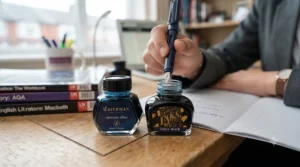
The fine 0.3mm nib gives a precise, thin line, and Platinum’s Slip and Seal cap is designed to stop the nib drying out between uses, which is handy if it spends weeks at the bottom of a pencil case. It uses Platinum’s own cartridges, though an adaptor lets it accept standard international ones. Black is the shade to buy, and reviewers praise the carbon black cartridges for their depth.
Here’s the analytical take: treat the Platinum Preppy as your insurance policy. Exam guidance calls for at least two black pens, and this is the cheapest way to make the second one a good one, not a dried-out biro you found in a drawer.
Reviewers on Amazon UK call these cracking little pens with a nib that glides, though some say it needs a moment to get the ink flowing, and several grumble that the Platinum converter costs more than the pen itself.
Pros:
- ✅ Very low cost makes spares painless
- ✅ Cap seal resists drying out between uses
- ✅ Clean, fine 0.3mm line
Cons:
- ❌ Light plastic build with a reportedly fragile clip
- ❌ Proprietary converter costs more than the pen
Under £10 at the time of research, and unbeatable as a spare.
3. Lamy Safari — the classroom classic with a guided grip
Launched in 1980 as a children’s handwriting pen, the Lamy Safari is essentially the pen that taught a generation of school kids how to hold one. Its ABS plastic body is tough, and the triangular grip guides your fingers into a tripod position.
Nibs are swappable, spanning extra-fine to broad plus a left-handed option, so you can change your mind without changing your pen. It takes Lamy’s large T10 ink cartridges (roughly 1.2 ml) or a Z28 converter, which holds less, around 0.8 ml. That’s why many students simply stick with cartridges.
What most buyers overlook: the pen usually arrives with a blue cartridge, and Lamy’s blue is sold as erasable, which is precisely the sort of ink an exam centre doesn’t want to see. Swap in black before mock season.
Reviewers at UK stationers rate it as a solid school pen, with left-handers praising the left-handed nib, while some black-ink users say the T10 black reads more dark grey than jet black and writes slightly dry.
Pros:
- ✅ Grip section guides fingers into position
- ✅ Wide nib range including left-handed
- ✅ Tough plastic body survives school bags
Cons:
- ❌ Bundled blue cartridge isn’t exam-suitable
- ❌ Black T10 ink can look slightly grey
Around £20-£30 at the time of research, and the best all-rounder for most students.
4. Pilot Metropolitan — smooth, weighty and budget-friendly
If the Pilot Metropolitan were a footballer, it would be the midfielder who never makes the headlines but quietly wins the match. Retailers describe a brass barrel that feels substantial without being heavy, at roughly 25g.
Nibs come in fine and medium (plus a stub), and reviewers describe a slightly springy, very smooth feel with a line that runs narrower than European rivals. It uses Pilot’s cartridge system, and the CON-40 converter fits, though some regional versions differ, so check the listing before you buy ink.
Spec-wise, the extra heft can help a hand that tends to press: the weight does the work so your fingers don’t. That said, a heavier pen isn’t automatically kinder over two hours, so try before you commit if you can.
Reviewers generally rate its smoothness and value, though a few report flow quirks on individual pens and point to the small converter capacity.
Pros:
- ✅ Weighty metal barrel feels premium
- ✅ Very smooth nib for the money
- ✅ Available in fine and medium
Cons:
- ❌ Small converter capacity limits ink
- ❌ Occasional reports of inconsistent flow
Around £15-£25 at the time of research, making it a strong mid-range pick.
5. TWSBI Eco — best for never running dry
The TWSBI Eco is the pen for the student whose nightmare is ink dying mid-essay. Its piston filler holds around 1.75 ml, more than double a standard cartridge, so a single fill carries you through a lot of writing.
The trade-off: it takes bottled ink only, so no ink cartridges. That means buying a bottle of black, learning to fill it, and accepting a slightly messier first go. The clear barrel lets you watch the level fall (oddly relaxing, mildly alarming), and the threaded cap seals snugly. At about 22g, it stays light.
Here’s my read: the TWSBI Eco suits the heavy writer taking essay subjects like English Literature and History, where long answers drain a cartridge quickly. Some reviewers, however, call it exciting rather than the safest first pen, and a few find the cap chunky.
Reviewers consistently praise its build, capacity and value.
Pros:
- ✅ Huge ink capacity for long papers
- ✅ Clear barrel shows remaining ink
- ✅ Tough build for the price
Cons:
- ❌ Bottled ink only, no cartridges
- ❌ First fill can be fiddly
Around £25-£40 at the time of research, and superb value if you’re happy with bottled ink.
6. Parker IM — a high-street name with a metal body
The Parker IM is the pen your parents and teachers recognise on sight: a tapered metal body, the arrow clip, and a brand with well over a century behind it.
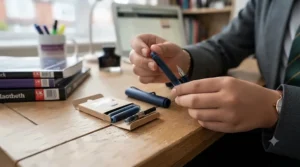
It carries a stainless steel nib in fine or medium and takes Parker’s Quink cartridges, with a converter available if you’d rather use bottled ink. The pen typically ships with a blue Quink cartridge, so, like the Lamy, black needs to be bought separately. Reviewers say Quink black dries quickly, which is a small blessing for anyone whose hand drags through wet ink.
The analysis: the IM’s slightly drier flow (several reviewers mention it) is arguably a feature in an exam, with less smudging and fewer blobs on thin paper. The flip side is reports of hard starts on some pens, so uncap it and test it well before the big day.
Reviewers call it a dependable, well-balanced beginner pen, while grumbling that the converter is pricey.
Pros:
- ✅ Solid metal body with classic looks
- ✅ Slightly drier flow reduces smudging
- ✅ Widely stocked Quink black cartridges
Cons:
- ❌ Converter sold separately and pricey
- ❌ Some reports of hard starts
Around £25-£40 at the time of research, a solid mid-range choice for students who like the familiar.
7. Lamy Studio — premium keepsake with a propeller clip
The Lamy Studio is the pen you buy when you want a results-day present to yourself that lasts through A levels and beyond. Designed by Hannes Wettstein, it’s all matte lacquer, a chrome grip and that propeller-shaped clip.
Unlike the Lamy Safari, it includes a Z27 converter in the box alongside a T10 cartridge, so bottled ink and ink cartridges are both on the table from day one. It also shares the same T10 cartridges as the cheaper Lamy pens, meaning one pack of black covers both.
The honest analysis: you’re paying for finish and feel, not a dramatically better line. Reviewers are split on the metal grip and nib, and one notes it runs wet on cheaper paper. A slick chrome grip and damp exam-hall palms might not be a natural match, so weigh that up.
Reviewers who like it call it very smooth and great for everyday use.
Pros:
- ✅ Handsome, durable finish that outlasts GCSEs
- ✅ Converter included in the box
- ✅ Shares T10 cartridges with cheaper Lamy pens
Cons:
- ❌ Priciest pick for a modest performance gain
- ❌ Chrome grip divides opinion
In the £60-£90 range at the time of research, and only worth it if you want a pen for the long haul.
Side-by-Side: Specs, Price Ranges and Reviewer Sentiment
| Pen | Filling | Nib sizes | Price range | Reviewer sentiment | Best For |
|---|---|---|---|---|---|
| Pilot Kakuno | Pilot cartridges or converter | EF, F, M | Around £10-£15 | Smooth, fine writer | Grip-training beginners |
| Platinum Preppy | Platinum cartridges (converter extra) | 0.2, 0.3, 0.5mm | Under £10 | Great value; slow starts, pricey converter | Spare and budget pen |
| Lamy Safari | T10 cartridges or Z28 converter | EF to B, left-handed | Around £20-£30 | Reliable school pen; black can read grey | All-round use, left-handers |
| Pilot Metropolitan | Pilot system (check version) | F, M, stub | Around £15-£25 | Smooth, good value; small converter | Smooth budget writing |
| TWSBI Eco | Piston, bottled ink | EF to B, stub | Around £25-£40 | Praised for capacity and build | Heavy essay writers |
| Parker IM | Quink cartridges or converter | F, M | Around £25-£40 | Dependable; dry flow, pricey converter | Familiar, smudge-averse |
| Lamy Studio | T10 cartridges, converter included | Multiple sizes | £60-£90 range | Smooth; grip divides opinion | Long-term keepsake |
The table shows a clear split: cartridge-friendly pens like Lamy Safari, Parker IM and Pilot Kakuno favour convenience, while TWSBI Eco favours capacity. If your budget is tight, Pilot Kakuno plus Platinum Preppy buys you a main pen and a spare for less than a single Lamy Studio. Reviewer sentiment here is aggregated from retailer and blog reviews rather than star ratings, so check the live listing before you buy.
Setting Up a Fountain Pen for GCSE: Your 30-Day Practice Plan
Buying the pen is the easy part. The gains arrive during a month of deliberate practice, ideally finishing a few weeks before your first paper. Think of it as a driving lesson before the test, not on the morning of it.
- Week 1 — Set up and swap. Flush a new pen with lukewarm water, fit a black cartridge (or fill with black bottled ink) and test it on the exact paper your school uses. Cheap paper feathers more than a posh notebook, and you want to know now.
- Week 2 — Homework only. Write everything with the pen. Note where it skips, smudges or makes your hand ache.
- Week 3 — Timed blocks. Answer past-paper questions in 30-40 minute chunks at exam pace, using the lightest pressure that keeps the line visible. This is where handwriting stamina quietly builds.
- Week 4 — Dress rehearsal. Sit a full mock in one go with your real exam-day kit: two or three black pens and spare ink cartridges, all in a clear pencil case.
Maintenance is refreshingly dull. Give the pen a rinse every couple of weeks, and again whenever you change ink, as stationers such as Goulet recommend. The classic first-month mistakes? Leaving the cap off between questions (hello, dried nib), pressing hard as if the paper owes you money, and discovering on mock day that the cartridge was blue all along.

Real-World Scenarios: Picking a Fountain Pen for GCSE by Student Type
Three hypothetical profiles show how the choice plays out. Your details will differ, but the logic transfers.
Maya, Year 10, budget of about £20. Small handwriting, writes daily, nervous about grip. I’d pair the Pilot Kakuno in fine (main pen) with the Platinum Preppy (spare). The total sits comfortably under £25, and both come in black. She’d practise on school paper first and carry two spare black cartridges.
Callum, Year 11, three essay subjects. English Literature, History and Geography mean long answers and a cartridge that disappears mid-paragraph. The TWSBI Eco with a bottle of black ink solves that, while the Platinum Preppy rides in the pencil case as insurance. If bottled ink sounds like a mess waiting to happen, the Lamy Safari with a fistful of black T10 ink cartridges is the tidy alternative.
Priya, Year 11, left-handed, wants a pen that lasts. Smudging is the enemy. The Lamy Safari with a left-handed nib and black ink cartridges is the sensible base, though the Parker IM deserves a look since reviewers say Quink black dries quickly. If a reward pen is on the cards, the Lamy Studio carries through A levels and university.
Notice what’s missing: nobody is choosing by colour. Function first, glitter second.
Problem-Solution Guide: When Your Fountain Pen for GCSE Sulks
Even a good pen throws the odd wobble. Here’s how to handle the usual suspects.
Problem 1: Skipping or hard starts. Usually a dry nib or a cap left off. Uncap only when you’re about to write, and store the pen horizontally (one Pilot Metropolitan owner swears by this for flow). If it persists, rinse it and refill.
Problem 2: Smudging. Left-handers know this pain. Choose a fast-drying black, keep your hand above the line you’ve just written, and consider a fine nib, which lays down less ink. Reviewers describe Quink black as quick to dry, which suits the Parker IM.
Problem 3: Running out mid-paper. Pack spare ink cartridges and a backup pen such as the Platinum Preppy. The clear barrel of the TWSBI Eco helps you spot a low level before it becomes a crisis.
Problem 4: A blue cartridge in the box. Several pens arrive with blue ink, and JCQ guidance wants black. Swap it early, and keep the blue one for revision notes.
Problem 5: Feathering on cheap paper. Go for a finer nib and a drier black. The fine nib on the Pilot Kakuno and the slightly drier flow reported for the Parker IM both help.
✨ Don’t Miss These Exclusive Deals!
🔍 Take your exam preparation to the next level with these carefully selected pens. Click on any highlighted item to check current pricing and availability. These tools will help you write clear, confident answers all the way to the final bell!
What Is a Fountain Pen for GCSE, Really?
A fountain pen for GCSE is a refillable, nib-and-ink pen that writes in black and stays within your exam board’s pen rules: no erasable, gel or correction-style pens. It feeds ink to the page by capillary action, letting you write with very little pressure, which can make long exam answers feel less tiring.
Under the hood, the mechanism is simple. Ink sits in a cartridge, converter or piston chamber, travels through a feed, and meets the page at the nib. If you’d like the full engineering tour of nibs, feeds and filling systems, Wikipedia’s fountain pen article is a solid primer.
What matters for exams is how that translates into your hand. A fine nib gives a slim, controlled line that suits cramped answer spaces, while a medium gives a bolder line that’s easier to read at speed. Nib sizes aren’t standardised across brands, either: Japanese fine nibs, such as those from Pilot and Platinum, tend to run narrower than European ones.
What a fountain pen for GCSE isn’t: a calligraphy toy, a status symbol, or a substitute for revising. It’s a writing tool, and the best one is the pen that disappears in your hand while your brain does the work.
How to Choose a Fountain Pen for GCSE
Choosing well takes about ten minutes and saves a month of regret. Work through these steps in order.
- Check the rules first. Black ink only, with no erasable, gel or correction pens. Ask your exams officer about any centre-specific preferences; this is where the exam regulations on pens meet reality.
- Match the nib to your handwriting. Small writers usually like fine, while bigger, looser writers often find medium easier to read at speed. Remember that Japanese nibs run narrower than European ones.
- Pick an ink system. Ink cartridges are the lowest-risk option, converters open up bottled ink, and a piston filler such as the TWSBI Eco maximises capacity.
- Judge grip and weight against your handwriting stamina. Triangular grips like the Lamy Safari guide fingers, and lighter bodies reduce strain for some hands while heavier ones help others. Try before you commit if you can.
- Consider your dominant hand. Left-handed? Look for a left-handed nib and a fast-drying black.
- Buy two. A main pen and a cheap spare such as the Platinum Preppy often cost less than one premium pen.
- Test on your school’s paper. Do it before the mock, not during it.
Handwriting Stamina: How Your Pen Choice Changes Hour Two
Handwriting stamina is the quiet variable of exam season. Nobody mentions it in September; everybody feels it in June. Many GCSE papers run to around two hours of near-constant writing, and a hand that’s clenched from minute one is a hand that’s cramping by minute ninety.
Researchers at Brunel University London, in a study of handwriting and typing support in English secondary schools, highlight that students must produce legible, fluent text for exams, and that regular, explicit practice focused on legibility and fluency can lift handwriting performance. Translation: stamina is trained, not bought.
Where a pen helps is at the margins. A fountain pen for GCSE lets ink flow with very little pressure, which can reduce the grip force that tires the hand. Triangular or hexagonal grips such as those on the Pilot Kakuno and Lamy Safari guide fingers into a relaxed tripod, while a light body like the 22g TWSBI Eco avoids adding load. Heavier pens like the Pilot Metropolitan suit some hands better, so it’s personal.
Build good habits alongside the kit: loosen your grip between questions, sit square with the paper angled comfortably, and rehearse timed blocks. And if handwriting is a genuine struggle, talk to your school’s SENCo about access arrangements. No pen substitutes for proper support.
Ink Cartridges, Converters and Bottled Ink: What Works in an Exam?
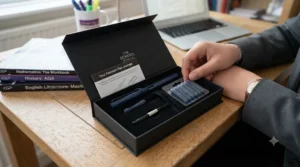
Ink cartridges are the unglamorous heroes of exam season. Sealed, quick to swap and far less likely to end up on your shirt, they turn a mid-exam refill into a five-second job. Converters and piston fillers trade some of that convenience for capacity and choice.
| System | Typical capacity | Upside | Watch out for | Best For |
|---|---|---|---|---|
| Sealed ink cartridges | Around 0.8-1.2 ml (Lamy T10 about 1.2 ml) | Clean, fast swap, no bottle | Brand-specific; black can look grey | Lamy Safari, Parker IM, Pilot Kakuno |
| Converter | Often 0.4-0.8 ml | Bottled inks, cheaper long term | Small capacity; needs cleaning | Lamy Studio, Pilot Metropolitan |
| Piston filler | Around 1.75 ml | Big capacity, visible level | Bottled ink only; messier first fill | TWSBI Eco |
Looking at the comparison, ink cartridges win on speed and safety, converters win on long-term cost if you already own a bottle of black, and the piston filler wins on sheer endurance. A note on colour: reviewers describe Lamy’s black T10 as leaning grey and a touch dry, while Quink black earns praise for a strong, fast-drying black, so choose your black with care.
Pack at least two spare black ink cartridges per pen in a clear pencil case, and check the colour on the label before you leave the house. Don’t reuse the blue cartridge that came in the box.
Exam Regulations on Pens: What the Rules Actually Say
Time to translate the small print. The exam regulations on pens come from JCQ, the body representing awarding bodies such as AQA, OCR, Pearson and WJEC, and they’re refreshed each academic year. The documents reviewed for this article cover exams held between 1 September 2025 and 31 August 2026. A 2026/27 edition will replace them, so re-check each September.
In plain English, the candidate-facing guidance says:
- Write clearly in black ink (candidate handbooks also mention black ballpoint).
- No correcting pens, fluid or tape; no erasable pens; no highlighters or gel pens in your answers; and no blotting paper.
- Coloured pencils or inks are only for diagrams, maps and charts unless the paper says otherwise, while pencil is fine for drawings and rough notes.
- Cross out rough work neatly with a single line.
- JCQ’s checklist recommends at least two black pens and a clear pencil case.
Nothing in the summaries reviewed bans fountain pens; they specify black ink and list the prohibited types. Even so, individual schools may have their own preferences, so confirm with your exams officer. For the full detail, see JCQ’s Instructions for conducting examinations, which centres must follow. Breaking the rules can trigger sanctions under JCQ’s malpractice procedures, a heavy price for a blue cartridge. And yes, Lamy’s blue T10 is sold as erasable, which is one more reason to swap it for black.
Common Mistakes When Buying a Fountain Pen for GCSE
Most regrets follow the same script. Watch for these seven.
- Buying by colour. A limited-edition sunset coral is lovely; it’s also useless if the nib is wrong for you.
- Forgetting black. Many pens ship with blue cartridges, so budget for black ink cartridges on day one.
- Filling for the first time on exam morning. Ink on a shirt is not a revision strategy.
- Relying on a single pen. The guidance is two black pens, so make the second a cheap, reliable one like the Platinum Preppy.
- Choosing a nib that’s too fine or too broad. Too fine may look faint if your script is scanned for on-screen marking, while too broad turns small answer spaces into ink puddles.
- Ignoring accessory costs. Reviewers note the Platinum Preppy converter costs more than the pen itself, and a Parker IM converter is a separate spend.
- Skipping the rules check. Ten minutes with the exam regulations on pens beats a lecture from an invigilator.
Fountain Pen for GCSE vs Ballpoint vs Gel Pen
The honest question: is all this fuss worth it compared with the ballpoint already in your bag? The table lays out the trade-offs.
| Factor | Fountain pen | Ballpoint | Gel pen |
|---|---|---|---|
| Pressure needed | Very light | Firmer | Light to medium |
| Allowed in GCSE answers? | Yes, in black ink | Yes, in black | No, barred in answers |
| Risk of running dry | Higher, so carry spares | Low | Medium |
| Upfront cost | Under £10 to around £90 | Very low | Low |
| Best For | Pilot Kakuno, Lamy Safari, TWSBI Eco users | Zero-maintenance students | Revision notes only |
The takeaway: a fountain pen for GCSE wins on pressure and comfort but loses on convenience, while ballpoints are almost impossible to break. Gel pens are the outlier. They’re lovely to write with, but JCQ guidance bars them from answers, so keep them for revision notes.
If you want the comfort without the fuss, cartridge-friendly picks such as the Pilot Kakuno and Lamy Safari are the sensible middle path. Cost per page can be low with bottled ink, though the upfront spend is higher than a multipack of ballpoints, so think of it as an investment in comfort rather than a bargain.
FAQ
❓ What is the best cheap fountain pen for GCSE revision?
❓ How many ink cartridges should I take into a GCSE exam?
❓ Can left-handed students use a fountain pen for GCSE without smudging?
❓ Should I buy a converter or stick with ink cartridges for a fountain pen for GCSE?
❓ When should I start practising with a fountain pen for GCSE?
Conclusion
The right pen is a blend of hand, habits and budget, not a league table. If grip is your worry, the Pilot Kakuno is a friendly teacher. If you’re a heavy essay writer, the TWSBI Eco stops ink anxiety in its tracks. The Lamy Safari and Parker IM are the tidy, cartridge-friendly all-rounders, the Pilot Metropolitan delivers smoothness with a bit of heft, the Platinum Preppy is the spare you’ll be glad of, and the Lamy Studio is the keepsake for anyone who wants a pen to outlast school.
Whatever you choose, four things matter more than the badge on the barrel: black ink, at least two pens, a month of practice to build handwriting stamina, and a quick look at the exam regulations on pens from JCQ before mock season. Get those right and the pen becomes what it should be, invisible, a quiet ally in the last minutes of Paper 2 rather than a drama in your pencil case.
If I had to pick a starting pair for most students, it would be the Pilot Kakuno with the Platinum Preppy as backup, or the Lamy Safari with black T10 ink cartridges if you’d rather stay cartridge-only. Prices here are ranges seen at the time of research and may vary, so check current pricing and availability on amazon.co.uk before you buy.
Recommended for You
- Scientific Calculator for GCSE: 7 Exam-Approved Picks (2026)
- Pencil Case for Secondary School: 7 Best Picks for 2026
- Backpack for Year 7: 7 Best Picks for a Tough Term (2026)
Disclaimer: This article contains affiliate links. As an Amazon Associate, I earn from qualifying purchases. If you purchase products through these links, we may earn a small commission at no additional cost to you.
✨ Found this helpful? Share it with your friends! 💬🤗
