

In This Article
Somewhere between “you’ll definitely lose that protractor” and “why is there a biscuit in your bag,” every parent of a Year 7 pupil discovers the same truth: the humble pencil case for secondary school is doing far more heavy lifting than its size suggests. It’s not just a pouch. It’s the thing that survives six lessons, two PE changes, a rushed bus journey and at least one dramatic zip malfunction, all before lunch.
A pencil case for secondary school is, put simply, a compact carrying case designed to hold pens, pencils and small equipment through a day of subject-hopping — sturdy enough for daily wear, organised enough for exams, and (ideally) not embarrassing to be seen with at the lockers. Secondary school changes the brief entirely compared with primary: pupils now juggle a geometry set for maths, a rainbow of highlighters for revision, and a fat ring binder groaning with subject dividers, all while exam boards quietly insist on transparent cases the moment GCSE season arrives.
We’ve dug through real product listings, genuine aggregated customer sentiment, and the actual rules exam boards enforce, rather than just repeating a spec sheet. According to the Department for Education’s statutory guidance on school costs, value for money is meant to be front and centre for anything a family is asked to buy for term — and that principle applies just as much to stationery as it does to blazers. So this guide leans hard into honest comparison: what’s actually worth the spend, what’s overkill, and which of the seven cases below suits which kind of pupil.
Quick Comparison Table
| Pencil Case | Style | Capacity | Price Range | Best For |
|---|---|---|---|---|
| Helix Oxford Large Filled Pencil Case | Clear PVC, pre-filled | Large | around £5-£9 | New Year 7s needing everything at once |
| Helix Oxford 8 Inch Clear Pencil Case | Slim clear PVC | Small | under £5 | Exam-hall compliance |
| Helix Oxford Durable Pencil Case | Hard corrugated plastic | Medium | £4-£6 range | Pupils who are rough on kit |
| EASTHILL Large Capacity Canvas Pencil Bag | Soft canvas, multi-compartment | Extra-large | around £10 | Multi-subject organisation |
| Helix Oxford Blazer Buddy | Compact clear pouch | Tiny | under £5 | Fitting inside a blazer pocket |
| KALIDI Corduroy Pencil Case | Fabric, two compartments | Large | £10-£15 range | Pupils who want it to look good |
| Helix Oxford Complete Back to School Set | Filled case + full kit | Extra-large | £18-£28 range | Total back-to-school restock |
Looking at the spread, there’s a clear pattern: budget and mid-range options cluster under £10, and the jump to a fully filled, all-inclusive set is where the price climbs. Reviewers consistently report that pre-filled cases save a scramble in the first week of term, but they only stay good value if the pupil isn’t going to swap out the contents within a month anyway. For families buying more than one child’s kit, mixing a cheap durable shell with separately bought geometry set and highlighters, covered further down, is very often the smarter spend.
💬 Just one click — help others make better buying decisions too!😊
Top 7 Pencil Cases for Secondary School: Expert Analysis
1. Helix Oxford Large Filled Pencil Case — best all-in-one starter kit
The clue is in the name: this one arrives already stocked, which takes a genuine job off a parent’s late-August to-do list. Inside is a proper geometry set including a compass, set squares and a protractor, plus a 30cm ruler, pencils and an eraser, all zipped into a clear 13.5-inch PVC case with a double-stitched seam.
What that spec sheet doesn’t tell you is how much time a filled case saves versus buying every item separately from a supermarket aisle at 9pm the night before term starts — you’re trading a little bit of price premium for zero decision fatigue. Based on the spec comparison, it’s the strongest pick for a first-time Year 7 pupil who has never had to manage their own kit before, since everything they need for maths and general lessons is present from day one. Aggregated reviewer sentiment on Amazon is largely positive, with buyers repeatedly noting good value for a filled case and reliable stitching, though a handful mention the zip pull can feel a touch flimsy under heavy daily use.
Pros:
- ✅ Comes fully stocked with a geometry set and essentials
- ✅ Clear PVC means contents are easy to check at a glance
- ✅ Genuinely saves a back-to-school shopping trip
Cons:
- ❌ Included pencils and ruler are budget-grade, not premium
- ❌ Zip pull reported as the weak point by some reviewers
Priced in the £5-£9 range depending on the seller, it represents strong value for a first-week solution, even if some of the smaller tools will likely be swapped out by half term.
2. Helix Oxford 8 Inch Clear Pencil Case — best for exam-hall compliance
This is the case every GCSE and A Level pupil eventually needs, whether they like it or not. It’s an 8-inch clear PVC pouch with a navy zip — nothing more, nothing less — and that’s precisely the point.
Exam boards in the UK don’t leave this to chance: the Joint Council for Qualifications’ official guidance for candidates sitting exams states plainly that pencil cases taken into the exam room must be see-through, with anything opaque left in a bag. What most buyers overlook about this model is that its slim profile also makes it genuinely easier to carry alongside a bulky ring binder, since it doesn’t add much bulk to an already-stuffed bag. Reviewers consistently note that it does exactly what it’s supposed to and nothing more — durable enough to survive a school year, unremarkable enough that nobody comments on it in the exam hall, which is precisely the compliment this product wants.
Pros:
- ✅ Fully transparent, so it meets exam board rules
- ✅ Slim design doesn’t add bulk to a packed school bag
- ✅ Durable PVC holds up over a full academic year
Cons:
- ❌ No compartments, so pens rattle around loose
- ❌ Too small for a full geometry set alongside pens
At under £5, this is arguably the cheapest way to guarantee your child isn’t the one pulled up by an invigilator on results-defining exam day.
3. Helix Oxford Durable Pencil Case — best for pupils who are hard on their kit
Some pupils treat a pencil case like a stress ball. For those pupils, this hard corrugated-plastic case from the Helix Oxford range is the honest answer — a solid shell rather than a soft pouch, finished in Oxford blue with embossed branding and a wide-opening zip.
The corrugated plastic construction matters more than it sounds: unlike a fabric pouch, it won’t get crushed under a pile of textbooks at the bottom of a bag, and the wide zip opening means less digging around for a rubber during a timed test. Based on the spec comparison, this is the pick for pupils whose parents have already replaced two soft pencil cases this year, since the rigid shell simply survives being sat on, dropped, or stuffed into an overfull locker. Aggregated review sentiment is strong on durability specifically, with a large number of ratings backing up the “built to last” claim, though a minority of buyers note the hinge mechanism can loosen with very heavy daily use over multiple terms.
Pros:
- ✅ Rigid shell resists crushing under heavy textbooks
- ✅ Wide-opening zip speeds up finding equipment
- ✅ Backed by thousands of strong customer ratings
Cons:
- ❌ Bulkier and heavier than a soft fabric pouch
- ❌ Hinge can loosen after prolonged heavy use
At around £4-£6, it undercuts most soft alternatives while solving a problem — breakages — that ends up costing more in replacements over a school year.
4. EASTHILL Large Capacity Canvas Pencil Bag — best for multi-subject organisation
Where the first three entries are single-compartment or lightly filled, this canvas pencil bag from EASTHILL is built around a completely different use case: pupils who need to separate pens from highlighters from a calculator, without everything becoming one tangled mess by period three.
Its multiple internal compartments, a carry handle, and a genuinely large canvas shell mean it functions closer to a mini pencil case-meets-organiser than a simple pouch. Here’s what to weigh: the trade-off for that organisation is size, since it’s noticeably bulkier than a slim exam case and won’t be the thing a pupil slips into a blazer pocket. Reviewers consistently report that the compartments hold their shape well and that the canvas fabric resists the fraying that cheaper pencil bags develop within a term, with the product carrying tens of thousands of ratings and a consistently strong average score.
Pros:
- ✅ Multiple compartments keep subjects genuinely separate
- ✅ Canvas fabric resists fraying better than thin nylon
- ✅ Carry handle makes it easy to grab on the go
Cons:
- ❌ Too bulky for a blazer pocket or slim exam bag
- ❌ Not transparent, so not suitable alone for exams
At around £10, this sits in the mid-range and earns its keep for pupils juggling six or seven subjects a day who genuinely benefit from internal structure rather than one big pouch.
5. Helix Oxford Blazer Buddy — best compact case for uniform pockets
Not every pupil wants to carry a separate pencil case at all — some just want the bare essentials in a pocket. This compact clear pouch from Helix’s Blazer Buddy range is designed specifically to fit inside a standard school blazer pocket, holding a handful of pens and small items rather than a full kit.
What most buyers overlook about this model is that its real value isn’t capacity, it’s redundancy: as a always-on-you backup, it means a forgotten main pencil case doesn’t turn into a borrowed-pen crisis in period one. Based on the spec comparison, it’s genuinely too small to be a primary case for a pupil with a full subject load, but it excels as the thing that lives permanently in a blazer pocket for emergencies. Aggregated reviewer sentiment is very positive for what it is, with over a thousand ratings averaging highly, and repeated comments describing it as a smart, low-cost backup rather than a main solution.
Pros:
- ✅ Genuinely fits inside a standard blazer pocket
- ✅ Useful backup for a forgotten main pencil case
- ✅ Very low price point for peace of mind
Cons:
- ❌ Far too small to hold a full day’s equipment
- ❌ Not a realistic stand-alone case for most pupils
Priced under £5, it’s not a replacement for a proper pencil case, but as a cheap insurance policy against the “I’ve left my pencil case at home” phone call, it earns its place on this list.
6. KALIDI Corduroy Pencil Case — best for pupils who care about how it looks
Secondary school is also, whether we like it or not, the age where kit becomes identity. This corduroy pencil case from KALIDI leans into that reality with a soft fabric finish, two internal compartments and a design that reads more “considered accessory” than “school supply.”
The corduroy exterior isn’t just aesthetic — it’s genuinely more resistant to everyday scuffing than the shiny nylon used on many budget cases, and the two-compartment layout means pens and smaller items like a compass don’t end up as one jumbled pile. What most buyers overlook is that a pupil who actually likes their pencil case is more likely to look after it, which quietly extends its working life regardless of the fabric. Reviewer sentiment leans strongly positive on style and build quality specifically, with buyers repeatedly describing it as sturdier than expected for a fabric case, though a small number note the zip can feel stiff when brand new.
Pros:
- ✅ Corduroy fabric resists scuffs better than shiny nylon
- ✅ Two compartments separate pens from smaller tools
- ✅ Design pupils are more likely to actually want to use
Cons:
- ❌ Sits at a higher price point than basic pouches
- ❌ Zip can feel stiff for the first few weeks of use
In the £10-£15 range, it’s a mid-to-premium pick — worth it specifically for a pupil who’s more motivated to look after kit they like.
7. Helix Oxford Complete Back to School Stationery Set — best total restock in one box
For families starting completely from scratch — a new school, a lost kit, or simply wanting to sort the whole stationery list in one purchase — this comprehensive set from Helix Oxford’s Complete range bundles a filled pencil case with a full maths set, pens, a ruler and even a scientific calculator.
On paper this means one transaction instead of six separate ones across a supermarket, a stationers and an online order, which has real value when time is tighter than budget in late August. Here’s what to weigh: buying everything as a bundle nearly always beats the total of buying each item separately at full price, but only if the pupil will genuinely use every component — a scientific calculator is wasted on a Year 7 who won’t need one for another two years. Reviewer sentiment is generally strong, with buyers highlighting the completeness of the kit as the main draw, alongside some feedback that the included calculator is a basic model rather than an exam-board-approved scientific calculator for GCSE Maths — worth checking against your child’s specific exam board list before assuming it covers every requirement.
Pros:
- ✅ Covers pencil case, geometry set, pens and calculator together
- ✅ Removes the need for multiple separate purchases
- ✅ Strong overall value for a total back-to-school restock
Cons:
- ❌ Included calculator may not meet every exam board’s spec
- ❌ Poor value if some components duplicate kit you own
At £18-£28 depending on the retailer, it’s the priciest entry here, but for a genuine “start from zero” restock it can still work out cheaper than buying each piece individually at full price.
Practical Usage Guide: Setting Up Your Pencil Case for September
Buying the case is the easy part — what goes inside it, and how it’s maintained, is where most pupils actually fall down during the year. Start with the basics: two black pens (biros are recommended over refillable ink pens, since exam scripts must be scannable), two HB pencils, a rubber, a 15cm ruler, and a sharpener with a lid to catch shavings. For maths-heavy years, add a compass, protractor and set squares rather than relying on a shared classroom set that’s never actually there when needed.
A quick maintenance habit worth building into the first week: empty the case out every Friday and bin dead pens, because a case stuffed with three biros that have run dry is functionally the same as an empty one when it matters. Common first-30-days mistakes worth flagging early include packing gel pens or correcting fluid that later has to be removed before exams anyway, so it’s worth developing exam-compliant habits from day one rather than retraining in Year 11. It’s also worth labelling equipment with initials in permanent marker — not because school stationery theft is rampant, but because identical black pencil cases genuinely do get swapped by accident in a busy classroom.
✨ Don’t Miss These Exclusive Deals!
🔍 Take your back-to-school shop to the next level with the carefully compared picks above. Click on any highlighted item to check current pricing and availability — small choices now save real hassle come exam season!
Real-World Scenario: Which Pencil Case Suits Your Timetable?
Picture a Year 7 pupil starting secondary school for the first time, still getting used to moving between six classrooms a day instead of staying in one. For this profile, the Helix Oxford Large Filled Pencil Case removes decision fatigue entirely — everything needed for the first term is already inside, and the clear design means a form tutor can spot missing kit at a glance during morning registration.
Now picture a Year 11 pupil deep into GCSE revision, sitting mock after mock in the school hall. For them, the Helix Oxford 8 Inch Clear Pencil Case is non-negotiable rather than optional, since it’s the only style permitted on an exam desk under JCQ rules — pairing it with the compact Helix Oxford Blazer Buddy as a backup covers the scenario of a forgotten main case on exam morning.
Finally, consider a budget-conscious family with three children starting different year groups this September. Here, the maths works differently: buying the Helix Oxford Durable Pencil Case for the youngest (who tends to lose things), the EASTHILL Large Capacity Canvas Pencil Bag for the middle child juggling more subjects, and reusing an existing case for the eldest, paired with separately bought geometry sets and highlighters covered below, comes out considerably cheaper than three identical premium sets.
Beyond the Pencil Case: Choosing a Geometry Set for Secondary School
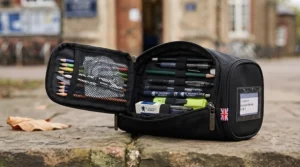
A geometry set — sometimes called a maths set — is the small kit of a compass, protractor, set squares and ruler that secondary pupils need from Year 7 through to GCSE Maths, and it’s worth buying properly rather than as an afterthought stuffed into a filled pencil case.
The Helix Oxford Premium Maths Set is an 11-piece kit built specifically with secondary and college-level maths and science in mind, going beyond the basics with a fuller range of instruments than the entry-level tins. What most buyers overlook about this set is that the self-centring compass genuinely matters in practice — reviewers consistently note that budget compasses drift out of position mid-circle, which is exactly the kind of small frustration that costs marks in a timed geometry question. The compass as a drawing instrument has a surprisingly long history in mathematics education, and the accuracy of a cheap versus well-made one is a genuinely measurable difference on paper, not just marketing spin.
For a lower-cost alternative, the Helix Oxford Maths Set with Storage Tin packs a 9 to 10-piece kit — including set squares, a protractor, lettering stencil and a safety-point compass — into a traditional metal tin. Based on the spec comparison, the metal tin format is actually a practical upgrade over a plastic wallet for younger pupils, since it survives being dropped far better and the compass point is contained rather than loose in a bag. Reviewers highlight strong value here specifically, with well over ten thousand aggregated ratings and consistent praise for how far the price stretches. Note that metal tins are sometimes prohibited as loose items in exam halls, so it’s worth transferring the pieces into a transparent case before any formal assessment.
| Geometry Set | Pieces | Format | Price Range | Best For |
|---|---|---|---|---|
| Helix Oxford Premium Maths Set | 11 | Wallet/tin | £4-£7 range | GCSE-level accuracy needs |
| Helix Oxford Maths Set with Storage Tin | 9-10 | Metal tin | £3-£7 range | Budget-friendly durability |
Comparing the two, the extra pieces in the Premium set matter most for pupils already tackling GCSE-level geometry, while the storage tin version is the more sensible pick for a Year 7 who’s still learning to keep track of a compass at all.
Highlighters for Secondary School: Colour-Coding Revision the Smart Way
Highlighters earn their place in a secondary school pencil case for revision, not classwork — most subjects require black or blue ink for actual answers, so highlighters are really a study tool that happens to live in the same pouch.
The STABILO BOSS ORIGINAL Highlighters in a pack of 8 assorted colours are the closest thing this category has to an industry standard, and for good reason: the wedge tip switches between broad highlighting and fine underlining, and STABILO’s anti-dry-out technology means a highlighter left uncapped for up to four hours still won’t have dried out by the time it’s needed again. Reviewers consistently report that the ink stays vivid through a full term of daily use, and the brand carries tens of thousands of positive ratings specifically praising longevity over cheaper alternatives that dry out within weeks.
For pupils who find standard neon shades harsh on the eyes during long revision sessions, the STABILO BOSS ORIGINAL Pastel range in a pack of 6 offers the same reliable ink in softer tones. What most buyers overlook is that this isn’t purely cosmetic — reviewers repeatedly mention the muted colours being genuinely easier to read over during multiple passes of the same notes, rather than the visual fatigue that can build up with saturated neon shades.
Here’s the honest analytical bit that many stationery guides skip entirely: highlighting itself is not a particularly effective study technique on its own. A widely cited review of ten learning strategies by researchers at Kent State University rated highlighting and underlining as low utility compared with techniques like self-testing and spaced practice, precisely because students often highlight indiscriminately rather than making genuine judgements about importance. The practical takeaway isn’t to ditch the highlighters — it’s to use them sparingly and deliberately, flagging only the handful of genuinely key points per page, rather than turning every paragraph yellow.
Remember, too, that highlighters are firmly banned from use on exam answer scripts themselves, so they belong in the revision pile, not the exam pencil case.
Ring Binders for Secondary School: Keeping Subject Folders Intact All Year
A ring binder is the workhorse most stationery guides ignore, but any parent who’s watched a treasury tag folder disintegrate by half term knows it deserves proper attention. For secondary school, an A4 ring binder needs to survive being crammed into a bag daily, hold a realistic volume of worksheets per subject, and ideally let a pupil see what’s inside without opening it.
The Leitz WOW A4 4 Ring Binder holds up to 190-230 sheets depending on spine width, with a durable plastic shell finished in bright, easily distinguishable colours — genuinely useful when a pupil is trying to grab the right binder for the right lesson in a five-minute changeover. The spec sheet won’t tell you this, but user reports suggest the four-ring mechanism holds punched paper more securely than a standard two-ring version, reducing the torn-page problem that plagues cheaper folders by the second term.
For pupils who prefer extra storage, the Leitz Presentation Ring Binder adds inner pockets on the front and back cover, useful for loose worksheets that haven’t been hole-punched yet — a near-permanent state of affairs for most Year 8 pupils. Based on the spec comparison, the wipe-clean polypropylene outer on both Leitz options resists the ink stains and scuffed corners that cardboard folders pick up within weeks of daily use.
| Ring Binder | Capacity | Rings | Price Range | Best For |
|---|---|---|---|---|
| Leitz WOW A4 4 Ring Binder | Up to 190-230 sheets | 4-ring | £4-£6 range | Colour-coding subjects by year group |
| Leitz Presentation Ring Binder | Up to 190 sheets | 2 D-ring | £8-£10 range | Storing loose, unpunched worksheets |
The extra rings on the WOW range genuinely do reduce page tearing over a school year, while the presentation version’s pockets suit pupils who are chronically behind on filing — a fair trade-off for the slightly higher price.
How to Choose a Pencil Case for Secondary School
- Start with the exam rules, not the classroom. If a transparent case isn’t already part of the kit by Year 10, it will need to be bought eventually — buying one early avoids a last-minute scramble before mocks.
- Match capacity to subject load. A pupil doing separate arts and sciences will genuinely need more compartments than one doing a narrower subject mix.
- Prioritise seam and zip quality over decoration. Reviewers consistently flag zip failure as the top complaint across nearly every pencil case category, regardless of price.
- Consider material based on how the pupil treats their kit. Hard cases suit rougher handling; soft fabric suits pupils who are naturally tidier with belongings.
- Buy the geometry set and pencil case separately if budget allows. A dedicated maths set from a specialist range typically outperforms the miniature tools bundled into filled starter cases.
- Don’t over-invest in highlighters at the start. A pack of 6-8 covers genuine need; anything beyond that tends to go unused by half term.
- Factor in replacement cost, not just upfront price. A £4 case that needs replacing twice a year isn’t actually cheaper than a £10 case that lasts three years.
Common Mistakes When Buying School Stationery
The single most common mistake is buying a stylish but opaque pencil case as the only case a pupil owns, only to discover in Year 10 that it can’t be taken into an exam hall at all. A close second is over-filling a starter set’s worth of stationery without checking what a specific school’s uniform or equipment list actually asks for, since some schools provide shared classroom equipment for subjects like art that a family didn’t need to duplicate. Parents also frequently underestimate how quickly pens run dry with daily use across six subjects, buying one pack that’s meant to last the year rather than budgeting for a mid-term top-up. Finally, it’s easy to assume a “back to school” bundle set is automatically the best value purchase, when in reality — as the comparison tables above show — buying a durable case and a specialist geometry set separately can work out both cheaper and better quality piece for piece.
Pencil Case vs Pencil Tin vs Filled Stationery Set
These three formats solve overlapping but genuinely different problems, and picking the wrong one is a common source of buyer’s remorse. A soft pencil case, like the KALIDI Corduroy Pencil Case, flexes to fit into a packed bag and tends to survive drops better because it absorbs impact rather than cracking. A hard pencil tin — the metal format used by traditional geometry sets — protects sharp-pointed tools like a compass far more reliably, but adds rigid bulk that doesn’t compress to save space. A filled stationery set, such as the Helix Oxford Complete Back to School Stationery Set, solves the “what do I even need to buy” problem in one purchase but risks including components — like a basic calculator — that don’t match what a specific exam board actually requires.
| Format | Space Efficiency | Protection Level | Typical Price | Best For |
|---|---|---|---|---|
| Soft pencil case (e.g. KALIDI Corduroy Pencil Case) | High | Moderate | £4-£15 range | Everyday classroom use |
| Hard pencil tin (e.g. metal maths set tins) | Low | High | £3-£7 range | Protecting sharp geometry tools |
| Filled stationery set (e.g. Helix Oxford Complete Back to School Stationery Set) | Medium | Moderate | £18-£28 range | One-purchase full restock |
Weighing these against each other, most pupils genuinely need two of the three — a soft everyday case plus a metal-tin geometry set — rather than a single filled bundle trying to do every job at once.
Safety, Regulations & Exam Rules: What’s Actually Allowed in the Exam Hall
This is the section most back-to-school guides skip entirely, and it’s arguably the most consequential one for anyone sitting GCSEs or A Levels. Under JCQ regulations, which govern how UK exam boards run assessments, any pencil case brought into an exam room must be completely see-through — opaque pouches, tins, and boxes are not permitted on the desk at all, regardless of what’s inside them. The same official candidate guidance also flags a longer list of prohibited items that catch pupils out every year: calculator cases with printed formulae, pencil sharpeners with lids that could conceal notes, and anything with writing on the outside.
There’s also a quieter rule worth knowing well before results start to matter: highlighters, gel pens and correcting fluid or tape are not permitted for use on exam answer scripts themselves, since scripts are scanned and must be legible in standard black ink. Practically, that means the transparent case that goes into the exam hall should contain only the essentials — black pens, pencils, a rubber, a ruler, and subject-specific tools like a compass or calculator with any instructions removed — with the colourful revision kit left safely at home. Introducing pupils to this routine well before Year 11, rather than the week of mocks, avoids a genuinely stressful last-minute scramble to buy a compliant case.
Long-Term Cost & Maintenance
Thinking in total cost of ownership rather than upfront price changes the calculus considerably. A £4 basic pencil case replaced twice a year works out to roughly the same spend, over three years, as one £10-£15 durable case bought once — but with the added hassle of repeat trips and the risk of a pupil being caught without kit mid-replacement. The same logic applies to highlighters and pens: buying a mid-range multipack that lasts a full term genuinely beats repeatedly buying the cheapest single-pen options, which tend to dry out within weeks under daily classroom use.
Maintenance costs are modest but real. Budget roughly one replacement pen per half term per pupil, a fresh rubber every year, and — if a compass point gets blunted or bent, which happens more often than you’d think in a busy pencil case — a like-for-like geometry set replacement every one to two years rather than the whole kit. None of this needs to be expensive if it’s planned for rather than treated as a surprise; a rough annual stationery top-up budget of £15-£25 per pupil, on top of the initial case and geometry set, comfortably covers most secondary school years.
Features That Actually Matter (And Those That Don’t)
Zip and seam quality matter enormously — reviewers across nearly every product in this guide flag zip failure as the single most common complaint, and it’s the feature most directly tied to how long a case survives daily use. Transparency matters, but only from around Year 9 onwards when mocks start appearing on the calendar; a younger pupil doesn’t need to plan around exam-hall rules yet. Genuine compartmentalisation — separate zipped sections rather than one big pocket — matters for pupils juggling multiple subjects, since it materially reduces the time lost digging around mid-lesson.
What matters far less than the marketing suggests: novelty prints and licensed characters, which pupils tend to outgrow within a term or two, and oversized capacity that goes largely unused once the initial stationery shop wears off. As covered above, highlighter colour range is also somewhat overrated — the research consistently shows the technique itself, not the shade, is what limits its study value, so a pack of six well-made highlighters beats a set of twenty rarely-used ones.
FAQ
❓ What should be in a Year 7 pencil case?
❓ Can you take a normal pencil case into a GCSE exam?
❓ How many highlighters does a secondary school pupil actually need?
❓ What size ring binder is best for secondary school subjects?
❓ Is a filled pencil case set worth buying instead of separate items?
Conclusion
Choosing the right pencil case for secondary school isn’t really about finding one perfect product — it’s about matching format to the pupil in front of you. A first-time Year 7 benefits most from a filled, ready-to-go case that removes decision-making; a Year 11 heading into mocks needs a transparent case that meets exam board rules without argument; and a budget-conscious family juggling multiple children often does best mixing a durable shell with a separately bought geometry set and a modest pack of highlighters, rather than reaching for the priciest all-in-one bundle by default.
What ties every recommendation in this guide together is the same principle: genuine durability and compliance with the rules that actually govern school life beat novelty every time, and a little research before the shop trumps guesswork every single September.
Recommended for You
- Backpack for Year 7: 7 Best Picks for a Tough Term (2026)
- School Starter Pack Under £25: 7 Best Value Picks (2026)
- Backpack for Year 3 to 6: 7 Best Picks UK Parents Trust (2026)
Disclaimer: This article contains affiliate links. As an Amazon Associate, I earn from qualifying purchases. If you purchase products through these links, we may earn a small commission at no additional cost to you.
✨ Found this helpful? Share it with your friends! 💬🤗
