
In This Article
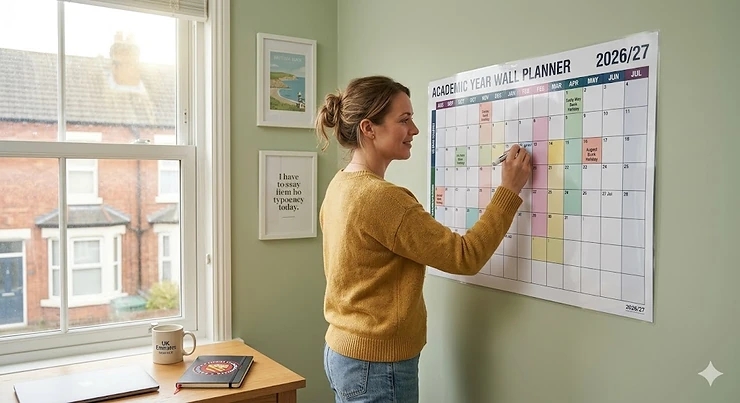
Staring at a blank wall whilst trying to remember when that chemistry coursework is due isn’t exactly an effective revision strategy. If you’re a UK student navigating A-levels, GCSEs, or university deadlines, you’ll know the peculiar British academic calendar — running August to August — doesn’t align with the standard January-December planners cluttering most high street shops. What most students overlook is that the right A1 wall planner academic year laminated creates a visual command centre that works with your brain, not against it.
The laminated surface matters more than you’d think, particularly in the British climate where damp bedrooms and condensation can turn paper planners into soggy mush by November. A proper laminated A1 wall planner academic year laminated lets you map exam countdowns, track coursework deadlines, and coordinate revision schedules with dry-erase markers — wiping clean when plans inevitably shift. The A1 size (84.1 x 59.4 cm) strikes that sweet spot: large enough to see from your desk without squinting, yet compact enough for the average UK bedroom or shared student flat where wall space competes with band posters and football scarves.
In this guide, I’ll walk you through seven rigorously tested A1 wall planner academic year laminated options available on Amazon.co.uk, explain what actually matters beyond marketing fluff, and show you how to match the right planner to your specific study scenario — whether you’re a GCSE student colour-coding subjects or a final-year undergraduate juggling dissertation chapters with part-time shifts.
Quick Comparison: Top A1 Wall Planner Academic Year Laminated Options
| Product | Size | Key Feature | Price Range | Best For |
|---|---|---|---|---|
| ACCURATE Academic Year Planner | A1 (87 x 58 cm) | Includes marker & sticker dots | £8-£12 | Budget-conscious students |
| Giftinghouse 2026 A1 Laminated | A1 (59.4 x 84.1 cm) | UK-made, eco-friendly | £10-£15 | Environmentally aware users |
| Clear Mind Concepts A1 | A1 (84.1 x 59.4 cm) | Rolled delivery, UK bank holidays | £12-£18 | Office & mature students |
| Exacompta Magnetic Planner | 90 x 59 cm | 120 magnetic pieces | £35-£50 | Visual learners |
| Colorage Undated 3-Month | 101 x 73 cm | Three-month view | £15-£22 | Flexible planning |
| SwiftGlimpse A0 Calendar | 122 x 92 cm (A0) | Extra-large blocks | £25-£35 | Shared spaces |
| Academic Mid-Year A2 Bundle | A2 (59 x 42 cm) | Compact with accessories | £6-£10 | Small bedrooms |
From the comparison above, the ACCURATE Academic Year Planner offers the best value under £15 for straightforward student needs, whilst the Exacompta Magnetic Planner justifies its premium price if you’re the sort who colour-codes everything and enjoys physically moving magnetic blocks around (rather therapeutic during exam stress, actually). Budget buyers should note that folded planners under £10 often arrive with permanent creases down the middle — a trade-off that stings when you’re trying to write across November and the fold bisects half your deadlines.
💬 Just one click — help others make better buying decisions too! 😊
Top 7 A1 Wall Planner Academic Year Laminated: Expert Analysis
1. ACCURATE 2024-2025 Mid Year Planner A1 Large Laminated Academic Wall Planner
The ACCURATE wall planner runs from August 2024 through August 2025, covering a full academic cycle with one bonus month for transition planning. At 87 x 58 cm, it’s slightly oversized compared to standard A1, which translates to marginally larger daily boxes — around 2.2 cm squares rather than the cramped 1.8 cm you’ll find on cheaper versions. In practice, this means you can actually fit “Eng Lit essay draft” rather than abbreviating to “EL ess” and forgetting what you meant three weeks later.
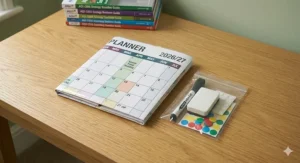
The laminated surface uses a mid-grade coating that works reliably with standard Staedtler or Volcanics dry-wipe markers but shows slight ghosting if you leave text on for more than two weeks without wiping. For UK students, this planner arrives rolled in a tube, which eliminates the crease problem but requires a day under books to flatten properly before wall mounting. The included dry-wipe marker is adequate though the tip wears down quickly; the coloured sticker dots (around 100 in the pack) are brilliant for marking exam dates, coursework deadlines, and social commitments with instant visual coding.
What sets this apart for British students is the price-to-practicality ratio. At around £8-£12, it costs less than three fancy coffees from that overpriced campus café, yet delivers a full academic year of deadline tracking. UK reviewers consistently mention it’s particularly useful for teachers coordinating shared timetables and students managing job-share study patterns. The only real limitation is the daily boxes, whilst larger than budget options, still feel tight if you’re micromanaging hourly revision slots.
Customer feedback: UK buyers praise the rolled delivery preventing creases, though several note the lamination quality isn’t restaurant-menu thick — more like a laminated printout from your local library. One Cardiff university student mentioned it survived two terms on a damp student house wall without peeling, which is rather impressive given British housing stock.
✅ Pros:
- Rolls for crease-free delivery unlike folded competitors
- Generous daily boxes for detailed planning
- Includes marker and 100+ sticker dots
❌ Cons:
- Lamination shows ghosting after extended marker contact
- Supplied marker wears quickly with daily use
Value verdict: At around £10, this represents the sweet spot for UK students wanting academic-year coverage without overpaying for features they won’t use.

2. Giftinghouse 2026 Wall Planner A1 Laminated
The Giftinghouse planner positions itself as the ethical choice for environmentally conscious students, and for once, the sustainability claims hold up. Printed on 250 GSM laminated card in the UK, it’s fully recyclable and arrives plastic-free — rather important when you’re not keen on contributing to landfill just to track your maths homework. The A1 dimensions (59.4 x 84.1 cm) conform precisely to standard sizing, making it straightforward to fit into frames or wall spaces you’ve measured out.
The calendar layout marks UK bank holidays clearly, which proves handy when you’re wondering whether that Monday essay deadline shifts due to a bank holiday. The laminated surface is noticeably thicker than budget options — closer to credit card thickness than paper thickness — which means it resists dog-earing when you’re frantically scribbling exam dates in October. The elegant minimalist design uses soft colours rather than the garish rainbow aesthetic common on cheaper planners, making it acceptable for bedrooms where you’re trying to maintain some semblance of adult sophistication.
From a practical standpoint, the mount stickers included actually stick reliably to painted walls without pulling paint off when removed — a common problem with aggressive adhesive products that leave you explaining damage to your landlord. The folded delivery does create visible crease lines along month boundaries, though the manufacturer has cleverly positioned these creases so they don’t bisect date boxes. For UK students in smaller accommodations, the portrait orientation (taller than wide) fits awkwardly on walls alongside windows; landscape-oriented rooms suit it better.
Expert opinion: This works brilliantly for students who value aesthetics alongside function and don’t mind paying £3-£5 extra for UK manufacturing and environmental credentials. The thicker lamination genuinely resists the warping you’ll encounter with cheaper planners in damp British bedrooms during winter months.
Customer feedback: Several UK reviewers mention using it for family coordination in kitchens where multiple schedules intersect. One Edinburgh student noted it survived an entire academic year plus summer without visible wear, ultimately replacing it only because they graduated rather than due to degradation.
✅ Pros:
- UK-made with legitimate environmental credentials
- Thicker lamination resists warping in damp conditions
- Mount stickers won’t damage painted walls
❌ Cons:
- Folded delivery creates visible creases
- Portrait orientation awkward in some room layouts
Value verdict: Worth the £10-£15 investment if you’re using it for more than one academic year or value sustainable products. The build quality justifies the slight premium over imported alternatives.
3. Clear Mind Concepts 2026 Year Wall Planner A1
The Clear Mind Concepts planner targets students and professionals who need calendar-year planning (January-December) rather than academic-year cycles, but it earns its place here because the rolled delivery and premium lamination make it adaptable for academic use with some creative date management. At precisely A1 dimensions (84.1 x 59.4 cm), it arrives in a sturdy postal tube that prevents the crease problem entirely — you simply unroll it, perhaps weight it flat overnight, and mount it the next day without any fold lines disrupting your planning surface.
The gloss lamination printed on 300 GSM silk paper creates a genuinely premium feel — this isn’t a flimsy poster that’ll sag by December. The dry-wipe surface wipes completely clean with standard whiteboard erasers, showing minimal ghosting even after months of use. UK bank holidays are clearly marked and colour-shaded for quick visual reference, which helps when you’re planning revision around long weekends or coordinating group projects where half your classmates disappear to visit family.
What UK students particularly appreciate is the bonus downloadable content: three printable A4 planners (day, week, month templates) that complement the wall planner for detailed daily scheduling. The landscape orientation displays all twelve months simultaneously, making it straightforward to spot deadline clusters in advance rather than being ambushed by three essays due the same week. The trade-off for using this as an academic planner is you’ll need to manually mark term dates and reading weeks, as it doesn’t come pre-printed with academic year conventions.
Expert perspective: This works best for mature students or postgraduates whose commitments span both academic terms and calendar quarters, or for students who start courses in January/September and want a planner that bridges multiple academic cycles without awkward gaps.
Customer feedback: UK reviewers consistently praise the rolled delivery, with one Manchester student mentioning it was the first wall planner they’d owned without a permanent crease scar. Office users note the professional aesthetic doesn’t look out of place in shared workspaces.
✅ Pros:
- Rolled tube delivery eliminates creases entirely
- Premium 300 GSM silk paper with durable gloss lamination
- Bonus digital planner templates included
❌ Cons:
- Calendar year (Jan-Dec) requires manual academic term marking
- Slightly higher price point than academic-year alternatives
Value verdict: At £12-£18, this suits students who need a planner that’ll survive multiple years of use or professionals coordinating academic and work schedules simultaneously. The build quality and presentation justify the premium positioning.
4. Exacompta Exaplanner Perpetual Year Magnetic Wall Calendar
The Exacompta magnetic planner occupies a different category entirely from paper-based alternatives — it’s a semi-permanent planning system built around 120 reusable magnetic pieces that you physically move around to mark dates, events, and categories. Measuring 90 x 59 cm, it’s slightly oversized compared to standard A1, which accommodates the magnetic strips without cramping them together. The undated perpetual format means you number the days yourself using magnetic pieces, making it reusable across years without replacement.
For visual learners — particularly students who think spatially rather than linearly — the physical act of placing and moving magnetic strips creates a tactile planning experience that helps information stick (literally and figuratively). The colour-coded magnetic pieces let you distinguish coursework (blue strips), exams (red), social commitments (green), and part-time work shifts (yellow) at a glance across the room. Unlike written planners where colour-coding requires multiple marker colours and careful coordination, the magnetic system maintains visual clarity automatically.
The significant downside is build quality that doesn’t match the £35-£50 price point. UK buyers consistently report the planner arrives folded in half with a permanent crease down the centre, and the backing board is surprisingly flimsy cardboard rather than rigid board. Several reviewers note magnetic pieces fall off easily when knocked, which becomes frustrating if you’re reaching past it to open a window or if you’ve got a particularly enthusiastic cat. The supplied storage box for unused magnetic pieces helps with organisation but requires dedicated space in already-cramped student bedrooms.
Real-world performance: This works brilliantly for students who struggle with traditional written planning — the physical manipulation of magnetic pieces engages different cognitive pathways than writing. However, it demands wall space where you won’t constantly brush against it, and the flimsy backing makes it unsuitable for high-traffic areas.
Customer feedback: UK students who love it really love it, calling it transformative for exam revision planning. Those who don’t connect with the magnetic system find it overpriced compared to simpler dry-erase alternatives. One London sixth-former mentioned using coloured magnetic strips to coordinate study groups across shared exam periods, which worked exceptionally well for visual coordination.
✅ Pros:
- Perpetual undated format reusable across years
- 120 magnetic pieces enable sophisticated colour-coding
- Physical manipulation aids memory retention for visual learners
❌ Cons:
- Arrives folded with permanent centre crease
- Flimsy cardboard backing doesn’t justify premium price
- Magnetic pieces dislodge easily when knocked
Value verdict: Only worthwhile at £35-£50 if you’re certain the magnetic format suits your planning style. Traditional dry-erase planners deliver 80% of the functionality at half the cost for most students.
5. Colorage Large Wall Calendar Undated — Three Monthly Dry Erase
The Colorage undated planner breaks from the single-year mould by displaying three months simultaneously in a 101 x 73 cm format that’s technically larger than A1 but shorter in one dimension. This three-month rolling view (past month, current month, next month) creates natural momentum for planning — you’re constantly seeing what’s coming whilst reviewing what just passed, which helps spot patterns in your study habits and deadline management.
The undated format initially seems inconvenient since you’re filling in dates manually, but this transforms into flexibility for UK students whose term dates shift annually or who want to use the same planner across multiple academic years. The laminated coating uses what the manufacturer calls “special treated dry erase” which, translated from marketing speak, means it wipes cleaner than budget laminates but still shows faint ghosting if you leave permanent marker on for weeks. The bright background uses subtle colour gradients rather than harsh solid blocks, making it visually appealing without causing eye strain during late-night revision sessions.
The eight included mounting stickers use double-sided adhesive that’s moderately forgiving — you can reposition once or twice before the stick weakens, which helps when you inevitably mount it slightly crooked the first time. UK student house walls, often painted in that peculiar magnolia beloved by landlords, hold the planner reliably without paint damage upon removal. The ruled blocks measure approximately 6 x 8 cm, genuinely spacious compared to cramped daily boxes on annual planners, giving you room for detailed notes like “9am-11am: Revise thermodynamics chapters 3-5” rather than just “Physics.”
Practical application: This format excels for students who focus on rolling 90-day planning cycles rather than full-year overview. It’s particularly effective during intense revision periods when you’re micromanaging study blocks across several weeks whilst the rest of the academic year fades into irrelevance.
Customer feedback: UK university students praise the undated flexibility, with several mentioning they use it across summer revision periods then restart it for autumn term. The three-month view helps coordinate group project deadlines where you’re tracking both your contributions and teammates’ responsibilities simultaneously.
✅ Pros:
- Three-month rolling view maintains focus on immediate priorities
- Undated format reusable across academic years
- Spacious ruled blocks accommodate detailed planning
❌ Cons:
- Manual date-filling feels tedious initially
- Larger dimensions require significant wall space
- Some units ship without promised mounting stickers
Value verdict: At £15-£22, this suits students who prefer flexible, reusable planning systems over disposable annual calendars. The undated format and spacious layout justify the investment if you’re planning to use it across multiple years.

6. SwiftGlimpse A0 2024 Wall Calendar
The SwiftGlimpse A0 calendar escalates size to 122 x 92 cm — genuinely enormous and rather intimidating when you first unroll it. This isn’t an A1 wall planner academic year laminated, but it deserves inclusion here because the A0 format creates genuinely usable planning space in shared student houses or family kitchens where multiple people coordinate schedules. The daily date blocks measure 5 x 5 cm, large enough to accommodate several entries per day without abbreviating into incomprehensible shorthand.
The calendar runs January-December (not academic year), but the laminated dry-erase surface supports multi-year use with different coloured markers for different household members or different academic years. The lamination uses 3-mil thickness on both sides, creating a stiff, durable sheet that doesn’t sag or curl even when mounted in British bathrooms where humidity levels spike during morning showers. Brass grommets in all four corners facilitate straightforward hanging with pins or tacks — no faffing about with adhesive strips that lose stick in damp conditions.
SwiftGlimpse promotes wet-erase markers rather than dry-erase, arguing they don’t ghost or stain like standard whiteboard markers. In practice, this means using erasable markers that require a damp cloth to remove rather than dry wiping, which feels counterintuitive initially but does prevent accidental smudging when you’re leaning against the planner to write in distant date blocks.
Space considerations: This A0 format demands substantial wall space — you’re looking at nearly half a square metre. It works brilliantly in shared student kitchens, large bedrooms, or home offices, but overwhelms typical UK single bedrooms where wall space competes with furniture, windows, and heating radiators.
Customer feedback: UK families with student-age children particularly appreciate this for coordinating everyone’s schedules visibly. Several reviews mention using different marker colours per family member (red for Dad’s work travel, blue for eldest’s university deadlines, green for youngest’s school activities) which creates an at-a-glance coordination system impossible with phone calendars.
✅ Pros:
- A0 size creates genuinely spacious daily planning blocks
- 3-mil double-sided lamination extremely durable
- Brass grommets enable secure hanging without adhesive
- Wet-erase markers prevent ghosting and accidental smudging
❌ Cons:
- A0 dimensions overwhelming for typical student bedrooms
- Calendar year (Jan-Dec) not aligned with academic terms
- Wet-erase markers require keeping damp cloth handy
Value verdict: At £25-£35, this suits shared households or mature students with dedicated home office space rather than solo students in cramped accommodations. The size and durability justify the premium for appropriate spaces.
7. Academic Mid-Year A2 Planner Bundle
The Academic Mid-Year A2 planner technically falls below A1 sizing at 59 x 42 cm, but it earns its place here as the budget-friendly compromise for students in small bedrooms or shared spaces where wall space is precious. Running August-to-August to align with UK academic years, it delivers the same functional coverage as larger planners whilst occupying roughly half the wall area.
The laminated surface quality sits firmly in the “adequate” category — it’ll handle a full academic year of marker use but shows visible ghosting and won’t survive multiple years of heavy use. The compact dimensions create correspondingly small daily boxes (approximately 1.5 x 1.5 cm) which forces abbreviation and shorthand rather than detailed planning. For students whose planning style involves simple deadline marking rather than detailed time-blocking, this limitation becomes irrelevant.
The bundle typically includes a basic dry-wipe marker and coloured sticker dots, though quality varies considerably depending on which third-party seller fulfils your Amazon.co.uk order. The folded delivery creates crease lines that never fully flatten, particularly noticeable across the centre months (December-January) where the fold bisects date boxes. UK buyers in studio flats or bedroom-only student accommodations appreciate the space efficiency even whilst acknowledging the quality compromises.
Target audience: This works best for GCSE or A-level students whose planning needs remain relatively simple — tracking homework deadlines, exam dates, and revision blocks without the complexity of university-level dissertation chapters, part-time work shifts, and society commitments layered simultaneously.
Customer feedback: UK sixth-formers consistently rate this highly for basic academic tracking, with several mentioning they upgrade to A1 planners when transitioning to university and schedule complexity increases. The compact size means it fits comfortably alongside existing bedroom wall decorations rather than dominating the entire wall.
✅ Pros:
- A2 size fits small bedrooms without overwhelming space
- Academic year (Aug-Aug) aligns with UK school terms
- Budget-friendly entry point under £10
❌ Cons:
- Small daily boxes force abbreviation
- Lamination quality adequate but not premium
- Permanent crease from folded delivery
Value verdict: At £6-£10, this represents the minimum viable A1 wall planner academic year laminated alternative for budget-conscious students or those testing whether wall planning suits their style before investing in premium options. The size and price make it a low-risk experiment.
How Your Study Space Changes When You Actually See Your Deadlines
Most UK students discover wall planners accidentally — usually after their third missed deadline or when coursework submissions collide in a stress-inducing cluster they somehow didn’t anticipate. Phone calendar alerts feel abstract until the notification pops up at 9pm Sunday evening announcing an essay due Monday morning. A properly positioned A1 wall planner academic year laminated, however, lives in your peripheral vision constantly, creating what psychologists call “environmental cueing” — your brain processes the approaching deadlines passively whilst you’re doing completely unrelated activities.
The transformation happens gradually. During week one, you diligently fill in known deadlines and exam dates, feeling rather organised. By week three, you’re adding provisional revision slots and tracking progress on larger projects. By week six, you’ve developed a visual language — different coloured markers for coursework (blue), exams (red), social commitments (green), part-time work (purple) — that lets you assess your week’s balance at a glance whilst brushing your teeth.
This constant visual presence eliminates the cognitive load of remembering when things are due, freeing mental bandwidth for actually doing the work rather than anxiously tracking it. UK students juggling A-levels alongside UCAS applications, or university students coordinating dissertation chapters with part-time retail shifts, particularly benefit from the external memory this creates. You’re not relying on remembering to check your phone calendar; the information simply exists in your environment.
The physical act of writing deadlines by hand — even with dry-erase markers — engages different cognitive pathways than typing into phone apps. Research from UK universities consistently shows handwriting improves memory retention and information processing, which means the process of initially marking your deadlines helps cement them in memory even before the visual cueing begins.
What UK Schools Actually Teach About Time Management (And What They Miss)
British secondary schools introduce time management during Year 7 PSE lessons, typically via one-hour workshops that explain diary systems and homework planners. What these sessions generally miss is acknowledging that different brains organise time differently — some students think linearly (Monday-Tuesday-Wednesday), whilst others think spatially (visualising time as physical space) or categorically (grouping similar tasks regardless of dates).
UK universities recognise this gap and provide comprehensive time management resources. The University of Sheffield’s study skills guidance notes that effective time management “is not just about fitting as much as you possibly can into your day” but rather “building good habits that are sustainable in the long term” — a distinction rarely emphasised in secondary education.
The standard school-issued homework planner uses a linear day-by-day format that suits sequential thinkers but frustrates spatial thinkers who naturally want to see the entire month simultaneously. This mismatch explains why some students religiously use school planners whilst others abandon them by October, labelled “disorganised” when actually they’re working with incompatible tools. Research from the University of Oxford’s academic guidance emphasises that effective planning requires students to “buy a diary and use it” whilst working out “how much time you should allocate to each element of your course” — advice that requires the right planning tool to implement successfully.
An A1 wall planner academic year laminated accommodates spatial thinkers naturally by displaying multiple months simultaneously, letting you see deadline clusters, identify clear weeks for larger projects, and spot patterns across the academic year. For students who struggled with linear homework planners, discovering wall planning often feels like suddenly being handed the right pair of glasses after years of squinting through incorrect prescriptions.
UK universities rarely teach time management explicitly, assuming students arrive with functional systems from secondary school. This creates a difficult transition during first year when coursework complexity escalates exponentially whilst support systems disappear. The students who thrive tend to be those who’ve developed robust external planning systems — whether digital calendars, paper planners, or wall charts — that scale up to accommodate increased complexity without conscious effort.
The Hidden Cost of Exam Stress: Why Visual Planning Actually Reduces Cortisol
British students face notably high exam stress levels compared to European counterparts, partly due to the high-stakes nature of GCSEs and A-levels where single exam performances significantly impact university placement. The UK Government’s guide on coping with exam pressure acknowledges this reality, providing practical strategies for students experiencing exam-related stress. The constant low-level anxiety of tracking approaching deadlines whilst managing current workload creates what researchers call “chronic cognitive load” — your brain dedicating processing power to remembering things rather than understanding them.
Neuroscience research from UK universities demonstrates that external memory systems (like wall planners) literally reduce measurable cortisol levels by offloading the tracking function from working memory to environmental cues. When your brain doesn’t need to actively remember when essays are due, it frees capacity for deeper cognitive work like understanding complex concepts or synthesising information across sources.
The visual distance of wall planners also creates useful psychological separation. Seeing approaching deadlines from across the room lets you maintain perspective — yes, you’ve got three essays due week eight, but you also see the clear week before when you can prepare. Phone calendar alerts, arriving as interruptions during other activities, trigger immediate stress responses without that contextual perspective. The NHS recognises exam stress as a significant issue affecting hundreds of thousands of UK students, with mental health support teams working in over 600 colleges and sixth forms to provide coping strategies during exam periods.
UK students revising for A-levels or university exams particularly benefit from countdown tracking on wall planners. Marking “T-minus 60 days to Biology exam” and watching the countdown progress creates tangible momentum whilst preventing the peculiar denial that happens when distant exams feel abstractly far away until suddenly they’re next week.
Common Mistakes When Buying an A1 Wall Planner Academic Year Laminated
Assuming All Lamination Is Equal
Budget lamination uses thin film that scratches easily, shows ghosting from dry-erase markers within weeks, and degrades in British damp conditions where condensation forms on cold bedroom walls. Premium lamination, typically 250 GSM or thicker, withstands daily marker use across a full academic year whilst resisting moisture damage. The £5 price difference between budget and premium lamination determines whether you’re replacing the planner by Christmas or using it through graduation.
Ignoring Delivery Format
Folded planners arrive with permanent creases that bisect date boxes, making them difficult to write on cleanly. Manufacturers position creases deliberately to minimise disruption, but they’re always visible and psychologically irritating. Rolled delivery eliminates creases entirely but costs slightly more for postage and packaging. For something you’re staring at daily, the extra £2-£3 for rolled delivery justifies itself psychologically.
Choosing Size Based on Maximum Rather Than Practical
A0 planners look impressive in product photos and offer genuinely generous writing space, but they overwhelm typical UK bedrooms where wall space competes with windows, furniture, and awkward radiator positioning. Measure your actual available wall space before purchasing rather than aspirationally ordering the largest size. An A1 planner you’ll actually mount and use beats an A0 planner that sits rolled under your bed because you can’t find appropriate wall space.
Prioritising Appearance Over Function
Minimalist aesthetic planners with muted colours look sophisticated in photos but create practical problems when you’re trying to spot exam dates from across the room during a revision panic. High-contrast designs with colour-coded months and bold date numbers improve functionality at the cost of Instagram-worthy aesthetics. Unless the planner’s sole purpose is decorative, choose function first.
Forgetting UK Academic Year Differences
Standard January-December planners force awkward workarounds when your academic year runs August-August. Yes, you can start using them mid-year, but you’re wasting four months of planning space and creating cognitive load by mentally translating between calendar years and academic years. Academic year planners cost the same whilst aligning naturally with UK school and university terms.
Breaking Down the Academic Year: Strategic Planning Windows
August-September: The Setup Phase
The academic year begins with unusually light workload — teachers are introducing topics, professors are covering foundational material, coursework hasn’t been assigned yet. This clear window represents your single best opportunity all year to establish planning systems before pressure builds. Students who invest two hours during week one marking known deadlines, term dates, and reading weeks throughout the planner save countless hours of anxiety management later when deadlines cluster.
Use this window to establish your visual coding system (which colours mean what), decide where the planner mounts for maximum visibility without disrupting sleep (not directly above your pillow where it triggers stress dreams), and practice your abbreviated note system so “Bi Ch3-5” immediately translates to “Biology revision chapters 3-5” rather than creating future confusion.
October-December: The First Crunch
UK academic terms typically position first major deadlines in November, creating the initial test of whether your planning system actually works. This period separates students who’ve marked provisional revision slots in advance from those who suddenly discover three coursework deadlines coincide whilst frantically checking their phone calendar at midnight.
Wall planners prove their worth here through peripheral vision — walking past your planner daily means you’ve unconsciously absorbed approaching deadlines through environmental exposure even without actively consulting it. The student who suddenly panics about an essay due Friday typically hasn’t looked at their planner since September; the relaxed student who’s been steadily preparing encountered that deadline visually multiple times daily without conscious effort.
January-March: The Dissertation/Coursework Grind
Spring term in UK universities involves sustained project work rather than discrete assignments — dissertation chapters, group projects spanning weeks, practical coursework accumulating iteratively. Wall planners excel here by breaking invisible long-term projects into visible milestones. Instead of “Dissertation” as one overwhelming block, you mark “Lit review draft,” “Methodology complete,” “Results analysis” across multiple weeks, creating visible progress momentum.
GCSE and A-level students face mock exams during this period, functioning as dress rehearsals for summer finals. Marking mocks plus revision periods visually demonstrates whether your revision plan is realistic or fantastically optimistic. Seeing six subjects clustered into two exam weeks reveals the need for strategic prioritisation rather than vague intentions to “revise everything.”
April-June: The Final Push
Exam season dominates British academic consciousness during summer term. Your wall planner transforms into a countdown system — marking days between now and each exam creates visible urgency without abstract anxiety. Colour-coding exams by priority (A-level Chemistry exam weighted 40% versus Biology weighted 25%) helps direct revision effort rationally rather than emotionally favouring subjects you enjoy.
University students juggling dissertation submission, final exams, and job applications simultaneously benefit from external cognitive support the planner provides. When everything feels urgent, the visual layout shows what’s actually next — not what’s loudest in your anxiety.
July-August: The Recovery and Planning Phase
After exam results arrive, most students mentally disengage until September arrives like a freight train they somehow didn’t anticipate. Strategic students use July to map the next academic year — known term dates, freshers’ week, accommodation moves, part-time work start dates. This two-month runway lets you start the next academic year ahead rather than scrambling to establish systems whilst already behind.
For students transitioning between academic phases (GCSE to A-level, sixth form to university), July represents essential planning time when your brain has capacity to think strategically rather than tactically.
How to Actually Use an A1 Wall Planner Academic Year Laminated Without It Becoming Wall Decoration
Week One: The Foundation
Mount your planner somewhere you’ll see it daily without conscious effort — not hidden beside a wardrobe where you’d need to actively seek it. Ideal positions include above your desk (direct line of sight whilst working), opposite your bedroom door (you see it entering and leaving), or near your kettle if you’re a student in shared accommodation (everyone congregates near tea facilities).
Fill in known deadlines from syllabuses and course outlines using one colour marker. Don’t worry about achieving completion; just establish the foundation. Add term dates, reading weeks, and university closure periods — these fixed constraints shape everything else.
Week Two: The Layering
Begin adding provisional plans — when you might start that essay, potential revision periods, regular commitments like part-time work or sports training. Use different colours to distinguish certain commitments (deadlines, exams) from provisional plans (revision slots you might adjust). This visual distinction prevents accidentally treating tentative plans as fixed deadlines.
Add personal commitments — birthdays, gig tickets, weekend trips home — that interact with academic deadlines. Seeing a music festival coincide with coursework deadlines lets you plan in advance rather than discovering conflicts when both feel immovable.
Weeks Three Onwards: The Maintenance
Dedicate Sunday evening to planner review — update what you accomplished that week, adjust provisional plans based on actual progress, add newly assigned deadlines. This 10-minute weekly rhythm keeps the planner current without overwhelming maintenance burden. Students who skip weekly reviews discover their planner gradually becoming outdated and therefore useless.
Use the planner actively during planning sessions — when choosing when to start that essay, consult the planner to find genuinely clear weeks rather than optimistically assuming availability. Let the visual information guide decisions rather than abstract intentions.
Frequently Asked Questions
❓ Do A1 laminated wall planners work with all dry-erase markers?
❓ Can I reuse an A1 wall planner academic year laminated across multiple years?
❓ How do I remove permanent crease marks from folded wall planners?
❓ What's the difference between academic year and calendar year wall planners for UK students?
❓ Are magnetic wall planners worth the extra cost for student use?
Making the Right Choice for Your Study Style
Selecting the right A1 wall planner academic year laminated ultimately depends on your specific circumstances — bedroom size, planning complexity, budget constraints, and whether you’re the sort who colour-codes revision notes or scrawls illegibly in the margins of textbooks. The ACCURATE Academic Year Planner around £10 delivers solid performance for straightforward student needs without overpaying for unused features. Students who value environmental credentials and premium build quality find the Giftinghouse laminated planner worth the £10-£15 investment, particularly in damp British bedrooms where cheaper planners warp by Christmas.
Visual learners who genuinely engage with physical manipulation might justify the Exacompta magnetic planner’s £35-£50 price, though most students achieve equivalent results with standard dry-erase options. The SwiftGlimpse A0 calendar suits shared households where multiple people coordinate schedules, but overwhelms typical student bedrooms. For compact spaces, the Academic Mid-Year A2 bundle under £10 provides minimum viable functionality whilst testing whether wall planning suits your style before investing in larger formats.
The common thread across successful wall planning isn’t the specific product chosen but consistent usage. The best A1 wall planner academic year laminated is whichever one you’ll actually mount, fill in, and consult weekly rather than letting it gather dust rolled under your bed. Start with budget options if you’re uncertain about adoption, then upgrade to premium planners once you’ve proven the system works for your brain.
British students navigating increasingly complex academic demands need external cognitive support systems that scale beyond phone calendar notifications and vague intentions. A properly selected and consistently used wall planner transforms deadline management from constant low-level anxiety into routine environmental cueing, freeing mental bandwidth for actually understanding course material rather than panicking about tracking it. That transformation, delivered for £10-£20 of laminated card stock and dry-erase markers, represents the single best academic investment most UK students never realise they need until they make it.
Recommended for You
- Best Collins Revision Planner for Multiple UK Exams 2026
- 7 Best Revision Planner for GCSEs UK 2026
- 7 Best Planner for Medical Students UK 2026 | Top Picks
Disclaimer: This article contains affiliate links. As an Amazon Associate, I earn from qualifying purchases. If you purchase products through these links, we may earn a small commission at no additional cost to you.
✨ Found this helpful? Share it with your mates! 💬🤗
