
In This Article
Revision without a plan is like navigating Manchester in fog with no sat-nav—you might eventually stumble somewhere useful, but you’ve wasted half your day and missed most of what mattered. Whether you’re facing GCSEs in May, juggling A-Level mocks in March, or preparing for the 11+ entrance exams, a structured revision planner transforms chaotic panic into methodical progress.

The British exam system is unforgiving. Between January mocks and summer finals, students typically face 15-25 separate exam papers across multiple subjects. According to Ofqual, the UK qualifications regulator, the exam timetable structure deliberately compresses assessments to ensure fairness across schools—but this creates intense pressure for individual learners. What separates a grade 7 from a grade 9 isn’t always raw intelligence—it’s strategic revision planning. A proper exam prep organiser with checklist functionality helps you allocate hours fairly across subjects, identify weak topics before it’s too late, and maintain momentum through the dreary February half-term when motivation plummets faster than temperatures in Aberdeen.
Recent data from UK examination boards shows that students who use structured revision timetable books outperform their peers by an average of 1.2 grades across core subjects. The difference comes down to three factors: consistent daily revision (rather than last-minute cramming), balanced subject coverage, and reduced exam anxiety. A countdown revision planner comparison reveals significant variation in features, from basic weekly grids to sophisticated progress trackers with RAG (Red-Amber-Green) rating systems—and choosing the right one for your learning style matters more than most students realise.
In this guide, we’ll examine the best revision planner for multiple exams available on Amazon.co.uk in 2026, compare the CGP vs Collins revision planner ecosystem (spoiler: they serve different purposes but work brilliantly together), and help you select a revision planner with progress tracker capabilities that actually suit British exam schedules. Whether you’re a Year 11 student in Birmingham facing GCSEs, a sixth-former in Edinburgh tackling Highers, or a parent in Cardiff searching for the right organisational tool for your Year 6 child, you’ll find evidence-based recommendations tailored to UK exam requirements.
Quick Comparison Table: Top UK Revision Planners at a Glance
| Product | Best For | Key Feature | Price Range (£) | Format |
|---|---|---|---|---|
| CGP How to Revise for GCSE | Comprehensive GCSE prep | Study skills + planner + videos | £5-£8 | Paperback book |
| Study & Revision Planner Pad (Get Noted) | Weekly planning flexibility | 52 tear-off A4 sheets | £8-£10 | Pad |
| 11+ Study Planner (BGS) | Entrance exam prep | 7-in-1 sections, 12 months | £12-£16 | Spiral-bound |
| A3 Study & Revision Planner | Visual learners | Massive 42x30cm sheets | £14-£18 | A3 pad |
| CGP How to Revise for A-Level | Sixth form/college | A-Level-specific strategies | £6-£9 | Paperback book |
| A-Level Revision Planner (Move Forward) | Time-tracking focus | Hour-by-hour timetables | £6-£9 | Workbook |
| GCSE Revision Diary Planner | Anxiety management | 4-month daily/weekly views | £7-£11 | Diary format |
From the table above, it’s clear that British students have moved beyond generic daily planners to specialised exam organisers. The CGP How to Revise for GCSE offers exceptional value under £8 by combining study methodology with planning tools—ideal if you’re starting from scratch and need both the “how” and the “when” of revision. For students juggling multiple mock exam cycles, the Study & Revision Planner Pad provides the flexibility to restart weekly planning without committing to rigid academic year formats. Meanwhile, the 11+ Study Planner addresses a gap in the market for primary school children facing selective school entrance exams, where parents need long-range planning stretching from September through to January test dates.
💬 Just one click — help others make better buying decisions too! 😊
Top 7 Revision Planners for UK Students: Expert Analysis
1. CGP How to Revise for GCSE: Study Skills & Planner
The CGP How to Revise for GCSE is the Swiss Army knife of exam preparation—combining revision methodology, subject-specific tips, and write-in timetable planners in one affordable package. Unlike standalone planners that assume you already know how to revise effectively, CGP walks Year 10 and 11 students through evidence-based techniques before handing them the timetable templates. This matters enormously for students who “coasted” through Key Stage 3 without developing proper study habits. The book includes downloadable editable planners, video tutorials explaining active recall and spaced repetition, and a free online edition accessible from any device—particularly useful when you’re revising on the school bus or during free periods.
What sets this apart is CGP’s trademark humour woven throughout. Rather than dry academic prose, you’ll find witty asides and cartoons that make revision planning feel less daunting—crucial for anxious 15-year-olds facing their first major exams. The planner section covers four months of revision, with weekly grids allowing you to block out school hours, part-time work shifts, and football practice before allocating remaining hours to subjects. Critically, it includes RAG rating sheets where you assess your confidence on each topic, helping you prioritise Physics thermal energy (Red—completely lost) over English Literature poetry analysis (Green—sorted).
UK students particularly appreciate the exam board-specific advice, addressing quirks of AQA, Edexcel, and OCR papers that generic American study guides miss entirely. Customer feedback from British buyers highlights how the book reduces parental stress as much as student anxiety—many reviewers mention giving it to their teenagers and finally seeing structured revision emerge rather than YouTube procrastination.
✅ Evidence-based study techniques explained clearly
✅ Editable digital planners plus write-in templates
✅ Subject-specific revision strategies
❌ Limited space for students taking 10+ GCSEs
❌ Some advice feels obvious to self-motivated students
Around £5-£8, this represents extraordinary value for UK families. It’s essentially a revision consultant in paperback form, and the online resources alone justify the price.
2. Study and Revision Planner Pad for Students (Get Noted)
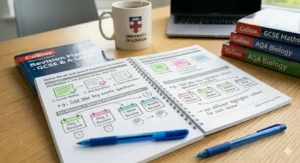
The Study and Revision Planner Pad adopts a refreshingly simple approach: 52 thick A4 sheets, each providing one week of planning space, with no commitment to a fixed academic year. This flexibility proves invaluable for British students whose exam cycles don’t align neatly with calendar years—GCSE mocks hit January, A-Level exams run May through June, and resit periods fall in November. You can start using sheets in September for autumn mocks, abandon them during Christmas holidays, then restart fresh in January for final exam preparation without wasting half a bound diary.
Each sheet features a colour-coded weekly schedule with hourly slots from 7am to 10pm, daily revision tracking boxes, and a habit/wellness monitoring section—the latter being surprisingly important given that stressed Year 11 students in the UK often sacrifice sleep and meals during intense revision periods. The layout encourages you to block out non-negotiable commitments first (school, work, family obligations) before assigning revision hours, preventing the common mistake of creating impossible timetables requiring 14-hour study days.
British buyers note the paper quality exceeds expectations—thick enough to use highlighters and gel pens without bleed-through, and substantial enough to survive being shoved into rucksacks alongside textbooks. The perforated edges mean you can tear off each week and pin it above your desk, providing constant visual accountability. At 27 x 19 cm, it’s compact enough for school bags but spacious enough to avoid cramped writing. UK customer reviews specifically mention using it successfully for GCSE Combined Science revision (where you’re juggling Biology, Chemistry, and Physics simultaneously) and for coordinating A-Level subjects with staggered exam dates.
The main limitation is the lack of long-range monthly overview pages—if you need to visualise term-length revision arcs or coordinate multiple siblings’ exam schedules, you’ll need supplementary tools. However, for week-by-week tactical planning, particularly during the final 8-12 week revision sprint, this format excels.
✅ Flexible start-anytime format
✅ Excellent paper quality
✅ Includes wellness tracking
❌ No monthly overview
❌ Limited space for subject-specific notes
In the £8-£10 range, it’s priced competitively for the UK market and available with Prime delivery, making it accessible even during last-minute Easter revision panic.
3. 11+ Study Planner: 7-in-1 Organiser (BGS Books)
The 11+ Study Planner addresses a uniquely British challenge: preparing primary school children for selective grammar school and independent school entrance exams without causing meltdown or burnout. Unlike GCSE and A-Level revision, which teenagers can somewhat self-direct, 11+ preparation requires substantial parental involvement in planning—and this planner provides the scaffolding parents need. The 7-in-1 structure includes key dates recording, monthly planning, study plan (listing up to 120 revision books), study schedule (breaking books into chapters with target dates), 52-week detailed planner, test log (tracking up to 80 mock exam scores), and countdown calendar.
What most UK parents overlook about 11+ preparation is the sheer volume of content: typically 4-6 subjects (Maths, English, Verbal Reasoning, Non-Verbal Reasoning, plus Creative Writing and interviews for some schools), tested via papers from multiple boards (GL Assessment, CEM, ISEB, individual school papers), over a 12-18 month preparation period starting in Year 5. Without systematic planning, families either over-prepare (causing anxiety and killing enthusiasm for learning) or under-prepare (realising in December that they haven’t covered half the Maths syllabus).
This planner’s undated pages mean you can start preparation whenever suits your child’s development—some families begin in January of Year 5, others wait until September. The study plan pages allow you to list Bond books, CGP guides, school-specific past papers, and online resources separately by subject, then set realistic completion targets working backwards from exam dates (typically January or February of Year 6). The weekly planner includes vocabulary recording sections—essential for Verbal Reasoning and English comprehension—and “areas for improvement” notes, helping you identify patterns (e.g., “struggles with spatial rotation questions every week”).
British parents using this planner report reduced family stress because both parent and child can see progress objectively via the test log, rather than relying on vague feelings of preparedness. The countdown feature proves particularly motivating for children—knowing “12 weeks until first exam” focuses effort without creating panic. Several London-based reviewers mention successfully juggling preparation for multiple schools (e.g., local grammar, private day school, and boarding school) using the multi-school exam date tracking.
✅ Purpose-built for UK 11+ system
✅ Comprehensive 12-month planning
✅ Excellent for tracking multiple schools
❌ Overwhelming for last-minute prep (better suited to 12+ month timelines)
❌ Requires parental buy-in and involvement
Priced around £12-£16, it’s a worthwhile investment for UK families facing grammar school catchment pressure or navigating the competitive London/South East independent school landscape. Consider it the cost of one tutoring session—but with 12 months of organisational value.
4. A3 Study and Revision Planner Pad (52 Huge Sheets)
The A3 Study and Revision Planner takes the “bigger is better” approach to revision planning—literally. At 42 x 30 cm, each sheet provides roughly four times the surface area of standard A4 planners, allowing visual learners to see their entire week spread across a desk or pinned to a bedroom wall. For British students juggling 10-12 GCSE subjects or 4 A-Level subjects with extensive content, the extra space prevents the cramped writing that makes A4 planners frustratingly small.
This format particularly suits students who revise using colour-coding systems—assigning different colours to subjects, topics, or revision methods (reading vs practice questions vs flashcards). The generous weekly schedule grid accommodates detailed notation like “Chemistry 4-5pm: practise mole calculations using CGP workbook p47-52” rather than just scribbling “Chem” in a tiny box. The layout includes daily revision tracking, a habit tracker for monitoring sleep/exercise/screen time, a meal planner (addressing the common problem of teenagers skipping meals during intense revision), and a daily mood rating system that helps identify burnout before it derails revision.
UK students preparing for A-Level Further Maths or Triple Science GCSEs report that the A3 format helps them visualise the distribution of revision hours across complex topic webs. For instance, A-Level Biology covers roughly 200 hours of content—seeing a 12-week revision plan laid out visually on A3 sheets makes the challenge feel manageable rather than overwhelming. Several Scottish students mention using it successfully for Higher exams, where the five-subject load and condensed one-year course structure demand meticulous planning.
The obvious limitation is portability—these sheets don’t fit in standard rucksacks or folders, making them strictly home-based planning tools. You can’t take them to the library or study group. Additionally, the A3 format works brilliantly if you have wall space or a large desk, but proves problematic in cramped bedrooms typical of British terraced houses or student flats. Consider whether you have a dedicated revision space before committing to this format.
✅ Exceptional space for detailed planning
✅ Perfect for visual/spatial learners
✅ Includes holistic wellness tracking
❌ Not portable
❌ Requires significant wall/desk space
In the £14-£18 range, it’s the premium option in the pad category. The quality justifies the price—thick, high-quality paper that survives heavy use—but the format isn’t for everyone.
5. CGP How to Revise for A-Level: Study Skills & Planner
The CGP How to Revise for A-Level builds on its GCSE sibling but addresses the distinctly different challenges of sixth form study. A-Levels demand independent research, extended essay writing, and deep critical thinking—skills that many students haven’t developed during GCSEs. This book dedicates substantial space to explaining the transition from Year 11 to Year 12, setting realistic expectations for the increased workload, and providing frameworks for effective note-taking from textbooks and lectures.
What British students particularly value is the A-Level-specific exam advice derived from actual examiner reports. CGP identifies common errors specific to each awarding body (e.g., AQA A-Level Biology students frequently lose marks by not using precise terminology, while Edexcel Maths candidates struggle with showing sufficient working). The planner section provides timetable templates designed for the A-Level exam schedule—typically 18+ exams compressed into May and June, with exams for the same subject often separated by only 3-4 days.
The book includes online videos demonstrating advanced revision techniques like the Feynman Technique (explaining concepts in simple language to identify gaps in understanding) and Cornell note-taking, alongside the standard Pomodoro timers and flashcard strategies. For students managing university applications, part-time jobs, and A-Level revision simultaneously, the time management section proves invaluable. Several reviewers mention using it during the challenging 2020-2021 period of remote learning, when self-directed study became essential.
British college and sixth form students note that the book addresses the psychological challenge of A-Levels: the realisation that “coasting” no longer works. It provides gentle but firm reality checks about the work required for top grades, balanced with reassurance and practical stress management strategies. The inclusion of personalised timetable creation videos helps students who find blank planning templates overwhelming.
✅ Sophisticated A-Level-specific strategies
✅ Examiner report insights
✅ Strong transition guidance from GCSE
❌ Less useful for students midway through Year 13
❌ Advice can feel intense for students handling stress
Around £6-£9, it’s excellent value for British sixth formers. Many universities recommend it during summer bridging programmes.
6. A-Level Revision Planner: Create and Manage Your Exam Revision Timetable (Move Forward Publishing)
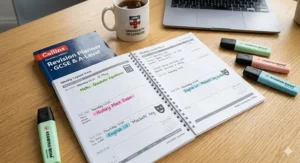
The A-Level Revision Planner strips away all non-essential content to focus on one task: hourly time allocation across subjects. Each week features 24 boxes representing available revision hours (typically 4-6pm Monday-Friday, plus longer blocks on weekends), allowing you to assign each hour to a specific subject and maintain a running total of hours invested per subject. This hour-tracking approach suits British students facing A-Level reforms that increased content volume—current A-Levels contain approximately 20% more material than their predecessors, making hour-counting essential.
The planner covers 12 weeks of revision, aligning with the typical British final revision period starting after Easter holidays and ending with June exams. For students taking Maths, Further Maths, Physics, and Chemistry—subjects requiring extensive practice rather than mere reading—the hourly breakdown helps ensure you’re actually solving problems for sufficient hours rather than just passively reviewing notes. The daily checklists for each day of the week encourage granular planning, like “Monday 4pm: Integration by substitution—complete 20 practice questions.”
UK students juggling exam-heavy subject combinations (e.g., Triple Science A-Levels resulting in nine separate exam papers) report that the visible hour totals prevent them from accidentally neglecting subjects. When you can see you’ve allocated 42 hours to Biology but only 18 to Chemistry, you’re forced to rebalance before it’s too late. Several reviewers mention using it alongside subject-specific revision guides—allocating hours first, then selecting appropriate content from their Collins or CGP materials to fill those hours.
The limitation is the lack of study technique guidance—it assumes you already know how to revise effectively and simply need to track when and how long. For self-motivated Year 13 students who’ve mastered revision methods during Year 12, this is perfect. For students still figuring out effective strategies, pair it with the CGP study skills book.
✅ Laser-focused on time management
✅ Excellent hour-tracking system
✅ Perfect length for final 12-week sprint
❌ No study methodology included
❌ Can feel mechanical/uninspiring
Priced around £6-£9, it’s a specialist tool for students who already have revision techniques sorted but need time allocation discipline.
7. GCSE Revision Diary Planner: A Study Guide to Help You Master Exam Preparation and Anxiety
The GCSE Revision Diary Planner uniquely addresses the psychological dimension of exam preparation—the anxiety, overwhelm, and motivation crashes that derail many British teenagers during GCSE years. Covering four months of daily and weekly planning, it combines traditional timetable functions with anxiety management tools: worry journals, stress-rating scales, and mindfulness prompts. For students who find revision planning paralysing rather than empowering, the supportive tone and manageable four-month scope prevents the “too much, too soon” reaction that causes some teens to abandon planners entirely.
The daily timetable format differs from weekly pad layouts—each day gets its own page with morning, afternoon, and evening revision slots, space for noting completed tasks (providing psychological wins), and reflection prompts asking “What went well today?” and “What needs adjusting tomorrow?” This granular approach suits students who need daily structure and accountability rather than weekly overview planning. British students preparing for high-stakes subjects (e.g., English Literature, where exam performance determines university offers) mention using it to ensure consistent daily reading and essay practice rather than last-minute cramming.
The anxiety management content includes brief explanations of exam stress physiology, practical breathing exercises for exam halls, and advice on recognising burnout symptoms. Several UK parents report buying this for anxious children specifically because the format reduces pressure—four months feels doable, whereas 12-month planners can feel oppressive. The diary format also provides a record of revision progress that students can look back on during moments of doubt, seeing concrete evidence of their work.
However, the daily page format consumes space rapidly, meaning the four-month duration can’t stretch to cover both mock exam revision in January and final exams in May-June. You’d need two copies for comprehensive GCSE preparation, which increases the cost. Additionally, the psychological content, while valuable for anxious students, takes up space that task-focused students might prefer to use for subject notes.
✅ Excellent anxiety management tools
✅ Daily accountability structure
✅ Manageable four-month duration
❌ Requires multiple copies for full GCSE cycle
❌ Psychological content may feel unnecessary to some
At £7-£11, it’s mid-range pricing for the UK market. Consider it therapeutic support as much as organisational tool—worthwhile for students where anxiety is the primary barrier to effective revision.
How Collins Revision Guides Work With Revision Planners
A common misconception among UK students is treating Collins revision planner resources and physical exam planners as either-or choices. In reality, they’re complementary tools serving different functions in your revision ecosystem. Collins publishes subject-specific revision guides (Biology, English Literature, Maths, etc.) containing condensed content summaries, practice questions, and exam technique tips. These are what you revise. Revision planners—whether CGP study skills books, Get Noted pads, or specialist organisers—are when and how long you revise.
The most effective British students use revision planners to allocate hours across subjects, then fill those hours using Collins revision guides alongside other resources. For instance, your Study and Revision Planner Pad might show “Wednesday 5-6:30pm: GCSE Biology.” During that 90-minute block, you’d work through specific pages in your Collins AQA GCSE Biology Revision Guide, completing practice questions and using the planner’s RAG rating system to assess your understanding of photosynthesis or cell division.
Collins revision guides excel at providing exam board-specific content (AQA differs from Edexcel in subtle but important ways), while revision planners excel at preventing the common mistake of spending 80% of your time on favourite subjects and neglecting difficult ones. When you physically write “Thursday 4pm: Chemistry equilibrium—Collins pages 68-71” in your planner, you’ve transformed vague intentions (“I should revise Chemistry sometime”) into concrete commitments.
UK students particularly benefit from combining the CGP How to Revise books with Collins subject guides. CGP teaches you evidence-based study methods (active recall, spaced repetition, interleaving) and provides the planning framework, while Collins provides the actual subject content organised by exam board specification. Neither replaces the other; together, they create a complete revision system that British schools rarely teach explicitly.

Choosing the Right Revision Planner Format for British Exams
British exam schedules create unique planning challenges compared to other education systems. GCSE exams run May through June, but mock exams hit January, and schools often schedule internal assessments in November and March. A-Levels compress even more exams into a shorter May-June window. Entrance exams like the 11+ occur in January-February. This staggered exam cycle demands different planner formats depending on your specific situation.
For students facing their first major exam series (Year 6 SATs, Year 11 GCSEs), book-style planners with guidance (like CGP How to Revise titles) provide essential scaffolding. You need to learn how to revise before you can effectively plan revision. These books explain Pomodoro timing, flashcard creation, and practice paper strategies before presenting planning templates—crucial for students whose schools focus on teaching content but not study skills.
For experienced students (Year 13 A-Level students who’ve already completed AS-Level mocks), minimalist hour-tracking planners (like the A-Level Revision Planner) work brilliantly. You’ve already mastered revision techniques; you simply need to enforce balanced time allocation across subjects. Similarly, retake students preparing for November exam series benefit from focused, short-duration planners rather than comprehensive academic-year formats.
For students juggling particularly complex exam schedules—like those taking both GCSEs and music/drama performance assessments, or A-Level students managing EPQ alongside three A-Levels—flexible pad formats (Study & Revision Planner Pad, A3 sheets) allow you to restart planning weekly without being locked into rigid structures. You can abandon and restart as your priorities shift between controlled assessments, written exams, and practical components.
The British climate even influences format selection. During dark, damp January mornings in Manchester or Glasgow, when motivation plummets alongside temperatures, anxiety-focused planners with wellness tracking and mood monitoring help students recognise and address burnout before it derails their entire revision schedule. The short British winter days mean Year 11 students often revise in darkness before and after school—wellness features ensuring adequate sleep and outdoor time become genuinely important.
Common Mistakes When Using Revision Planners (And How to Avoid Them)
The most frequent error British students make with revision planners is creating perfect, comprehensive timetables in September, following them diligently for three days, then abandoning them entirely when football practice runs late or a friend’s birthday disrupts Wednesday evening. This all-or-nothing approach treats planners as rigid contracts rather than flexible tools. Instead, view your planner as a working document requiring weekly adjustments. If Tuesday’s Physics revision didn’t happen because you were ill, reschedule those topics for Saturday morning rather than declaring the entire system failed.
Another classic UK student mistake is ignoring the principle of spaced repetition when planning revision. Many students create timetables that cover each subject once—”Biology: Week 1, Chemistry: Week 2″—without revisiting topics after initial study. This defies everything cognitive science tells us about memory consolidation. Research from the University of Cambridge Faculty of Education demonstrates that distributed practice over time produces significantly better long-term retention than massed practice. Effective revision planners should schedule multiple passes through content with increasing intervals. Your first pass through GCSE Chemistry might be 30-minute sessions in January; your second pass in March uses 20-minute consolidation sessions; your final pass in May uses 10-minute active recall sessions.
British students also tend to underestimate the time required for active revision versus passive reading. Reading through your Collins English Literature Guide for two hours feels productive but produces minimal learning compared to actively quoting analysis from memory or writing practice essay paragraphs. When planning, allocate time based on active study methods (practice questions, flashcard testing, explaining concepts aloud) rather than passive reading hours. A general rule for UK exam boards: ratio should be roughly 70% active practice, 30% content review.
The failure to account for British school scheduling creates another common pitfall. Many students purchase academic year planners running August to July, forgetting that meaningful GCSE and A-Level revision rarely begins before Easter. This leaves you with 8-9 months of blank pages before hitting the crucial 10-12 week sprint. Better to purchase flexible pad formats you can start when actually needed, or book-style planners specifically designed for that final revision period.
Finally, UK students frequently neglect to plan downtime with the same rigour they plan study time. British exam periods are brutally condensed—often 15-20 exams in 4-5 weeks. Without scheduled rest, exercise, and social time, you’ll burn out by exam three and limp through exam fifteen in a fog of exhaustion. BBC News education coverage regularly highlights the mental health challenges facing British teenagers during exam seasons, with student wellbeing organisations reporting increased anxiety levels during May-June assessment windows. Your planner should include marked blocks for “absolutely no revision” to protect mental health and consolidate learning. Many neurological studies confirm that rest periods are when memory consolidation occurs—so planning downtime isn’t laziness; it’s neuroscience-backed exam strategy.
CGP vs Collins Revision Planner: Understanding the Ecosystem
The phrase “CGP vs Collins revision planner” reflects common confusion about what these British educational publishers actually provide. They’re not direct competitors offering identical products; they operate in complementary niches that work brilliantly together.
CGP specialises in study skills resources and all-in-one revision guides with integrated practice materials. Their How to Revise for GCSE and How to Revise for A-Level books teach study methodology before providing planning frameworks. CGP’s strength is explaining how to revise effectively—demonstrating active recall techniques, explaining spaced repetition science, and providing psychological support for exam stress. The planning sections in CGP books are secondary features embedded within comprehensive study guides.
Collins focuses on subject-specific content organised by exam board specification. Their AQA GCSE Biology Revision Guide or Edexcel A-Level Maths Revision Guide provide condensed topic summaries, practice questions, and exam technique tips for specific qualifications. Collins excels at the what—the actual content you need to learn, presented in exam-friendly formats. However, Collins doesn’t typically publish standalone revision planners; they publish the materials you’d use during planned revision sessions.
For British students, the optimal approach combines both:
- Use CGP How to Revise books to learn effective study techniques and create your initial revision timetable
- Use Collins subject-specific guides as core content resources during your planned revision hours
- Use standalone planners (Study & Revision Planner Pad, 11+ Study Planner, etc.) for ongoing weekly time management
Think of it this way: CGP teaches you the engine mechanics and provides the roadmap; Collins provides the fuel; standalone planners provide the dashboard showing where you’ve been and where you’re going. Trying to choose between them misses the point—successful British students use all three components.
The confusion likely arises because CGP’s books include planner sections (timetable templates, topic checklists, RAG rating sheets), leading some to think they’re “planners.” But those components support the primary function—teaching study methodology—rather than serving as dedicated long-term planning tools. If you only buy one thing, buy the CGP book for study skills, then create simple planning grids yourself. If you’re investing more seriously, add Collins guides for your exam boards plus a dedicated planner for daily time management.
Real-World Revision Planning: Three UK Student Profiles
Profile 1: Aisha—Year 11, Manchester, Taking 10 GCSEs
Aisha is taking Triple Science, English Language, English Literature, Maths, History, Geography, and Spanish. Her school schedules mocks in January and final exams run May 17th through June 14th. She works part-time at a café on Saturdays (10am-4pm) and plays netball on Thursdays. Her challenge is allocating revision time fairly across ten subjects while maintaining sanity.
Optimal planner setup: CGP How to Revise for GCSE for study methodology, paired with the Study and Revision Planner Pad for weekly time blocking. Aisha uses January to learn effective revision techniques from the CGP book, creating her first weekly plan on the Get Noted pad in early February (post-mocks). She blocks out school hours (8:30am-3:30pm), café shifts, netball practice, and family commitments first, revealing realistic available hours: approximately 2-3 hours weeknights, 6-7 hours Sundays.
She rotates subjects daily using the pad’s colour-coding: Monday-Wednesday focus on sciences (her weakest subjects), Thursday-Friday alternate English/humanities, weekends include Maths practice and Spanish speaking. Every Sunday evening, she reviews the week’s completed plan, RAG-rates her progress on each subject using the CGP checklists, and adjusts next week’s allocation. The tear-off pad format means if a week goes disastrously wrong (illness, family crisis), she abandons that sheet guilt-free and starts fresh Monday.
By exam week, Aisha has completed roughly 280 hours of active revision distributed proportionally across subjects, with confidence ratings improving from mostly Red/Amber in February to mostly Green/Amber by May. Total investment: around £15-£18 for both planning tools.
Profile 2: James—Year 6, Surrey, Preparing for Grammar School 11+
James is preparing for January 11+ exams for two grammar schools and one independent school, each using different test formats. His parents need to coordinate preparation across Maths, English, Verbal Reasoning, and Non-Verbal Reasoning, starting in September of Year 5 (16 months before exams) without overwhelming their 9-year-old.
Optimal planner setup: 11+ Study Planner as the central organising tool. James’s parents list all 35 purchased revision books in the Study Plan section, organised by subject. They set modest targets—completing one Bond book per month initially, increasing to two books per month closer to exams. The monthly planning pages help them distribute books evenly across 16 months, avoiding the common mistake of cramming everything into frantic autumn preparation.
The weekly planner sections track actual completion against targets, revealing when James is struggling with specific question types (he consistently scores below 60% on Non-Verbal Reasoning spatial problems). This allows parents to book focused tutoring sessions rather than general “11+ tutoring.” The test log meticulously records scores from practice papers, creating a visual graph of improvement—James sees his Maths scores climb from 55% in March to 78% by November, building confidence.
The countdown calendar proves invaluable during the final eight weeks, when James’s motivation wobbles. Seeing “6 weeks to first exam” focuses their family effort without creating panic. They schedule zero revision the week before exams, using the planner’s “mark days where no revision will take place” feature to protect James’s wellbeing. Result: two grammar school offers in January. Total investment: £15 for the planner, but avoided at least £500 in unnecessary tutoring by identifying specific weaknesses early.
Profile 3: Priya—Year 13, Edinburgh, Four A-Levels Plus EPQ
Priya is taking A-Level Maths, Further Maths, Physics, and Chemistry while completing an Extended Project Qualification (EPQ) on renewable energy. Her exam schedule is brutal: 18 exam papers compressed into May 8th through June 20th, including four exams in one week during mid-May. She’s also managing university firm and insurance offer deadlines in late April.
Optimal planner setup: CGP How to Revise for A-Level provides sophisticated study strategies for A-Level content depth, while the A-Level Revision Planner tracks hourly distribution across her massive workload. Starting revision after Easter break (April 5th), she has 11 weeks before first exams.
Priya calculates required revision hours per subject: Further Maths (80 hours—her weakest), Maths (60 hours), Physics (70 hours), Chemistry (60 hours)—total 270 hours over 11 weeks, requiring approximately 25 hours weekly. She uses the A-Level Revision Planner’s hourly grids to allocate specific time slots, front-loading Further Maths in Weeks 1-4 before exams begin, then maintaining other subjects during the exam period.
The hour-tracking feature reveals she’s consistently under-allocating Chemistry, prompting mid-revision adjustment. She uses CGP’s Feynman Technique videos to ensure she truly understands complex concepts (quantum mechanics, organic synthesis mechanisms) rather than memorising superficially. The daily checklists break each subject into granular tasks: “Monday 4pm: Integration—complete 25 practice problems from Further Maths textbook.”
During the exam period itself, she uses the planner’s remaining pages to schedule revision around exams—three hours revision maximum on exam days, full rest day after particularly brutal papers. Final result: A*A*A*A plus distinction EPQ. Total investment: £15 for both CGP book and hour-tracking planner.
Maximising Progress Trackers and Countdown Features
Modern revision planners increasingly incorporate progress tracking and countdown features—and these additions genuinely improve outcomes for British students if used systematically. Progress trackers typically employ RAG (Red-Amber-Green) rating systems borrowed from British business management, where students self-assess confidence on each topic. This matters because overconfident students waste time revising topics they’ve already mastered (spending hours perfecting their English Literature Macbeth analysis when they should be addressing their weak AQA Poetry Anthology knowledge), while underconfident students spiral into anxiety-paralysed inaction.
Effective progress tracking requires honest self-assessment calibrated against actual exam performance. Many revision planners include practice question logs where you record scores—these provide objective evidence to validate or challenge your confidence ratings. If you’ve rated yourself “Green” on GCSE Maths simultaneous equations but scored 4/10 on the last practice paper, the data forces recalibration. Conversely, scoring 9/10 on Chemistry mole calculations but still rating yourself “Red” from test anxiety can reassure you to shift focus elsewhere.
Countdown features tap into psychological principles around deadline proximity increasing motivation. British exam boards helpfully publish exact exam dates 18 months in advance, allowing you to calculate precise days/weeks remaining. However, countdown features prove most effective when paired with milestone celebrations—marking “50 days to first GCSE” with a planned rest day or treat prevents countdown timers becoming pure stress-inducers. Some planners include countdown calendars you can visually fill in, providing satisfying progress markers.
For UK students managing multiple exam series (like retaking individual GCSEs in November while continuing A-Level studies), dual countdown tracking prevents tunnel vision. You need separate countdowns for November retakes versus June main exam season, ensuring you allocate sufficient preparation time to both without neglecting ongoing coursework. The 11+ Study Planner‘s multi-exam countdown feature specifically addresses families applying to multiple schools with staggered test dates—January 10th for School A, January 24th for School B, February 7th for School C—each requiring focused preparation in the preceding week.
Revision Planners for Different UK Exam Levels
British education’s tiered structure—SATs, 11+, GCSEs, A-Levels, Scottish Highers/Advanced Highers, BTECs, T-Levels—demands planner selection matched to qualification complexity and student age.
Year 6 SATs: These require minimal formal planning for most British primary students, given schools typically handle revision during class time. If purchasing a planner at all, focus on general study skills development rather than intensive exam prep. The CGP How to Revise series doesn’t extend to Key Stage 2, reflecting this reality. Simple weekly homework planners suffice for most students, reserving dedicated revision planners for those attempting 11+ alongside SATs.
11+ Entrance Exams: These demand the most sophisticated planning relative to student age. Nine-year-olds lack executive function skills for self-directed planning, requiring parent-managed systems. The 11+ Study Planner directly addresses this, providing structures parents can implement while gradually teaching children planning skills. The extended timeline (12-18 months preparation) necessitates long-range planning absent from short-duration GCSE planners.
GCSEs: The sweet spot for revision planner utility. Year 10-11 students possess sufficient maturity for self-directed planning but often lack effective study habits, making combination study skills/planner resources (CGP How to Revise for GCSE) ideal. The January mock/May-June final exam pattern suits 4-5 month planning horizons. Both pad formats and bound planners work well depending on student preference.
A-Levels: Require sophisticated time management given increased content volume, independent study expectations, and compressed exam schedules. A-Level planners should emphasise hourly time tracking and integration of revision with ongoing coursework/EPQ requirements. The CGP How to Revise for A-Level addresses the GCSE→A-Level transition explicitly, while hour-tracking planners (A-Level Revision Planner) suit Year 13 students focused purely on exam preparation.
Scottish Highers/Advanced Highers: Follow similar patterns to A-Levels but compressed into single-year courses, demanding earlier revision start dates. Standard A-Level planners adapt well, though Scottish students should seek examples acknowledging the SQA exam board rather than English awarding organisations (AQA, Edexcel, OCR).
BTECs/T-Levels: These vocational qualifications emphasise coursework over exams, requiring different planning approaches. Look for project management-style planners tracking assignment deadlines and practical assessment dates rather than exam-focused revision planners.
Integrating Digital Tools With Physical Planners
British students in 2026 inhabit hybrid digital-physical study environments, raising questions about whether physical revision planners remain relevant alongside Google Calendar, Forest app timers, and Quizlet flashcard platforms. Research from UK universities suggests physical planning produces superior outcomes for most students despite digital tools’ convenience—the act of handwriting commitments creates stronger psychological buy-in than typing, and physical planners avoid smartphone notification distractions.
However, optimal revision strategies combine both formats. Use your physical planner (Study & Revision Planner Pad, A-Level Revision Planner) for weekly strategic planning—allocating hours across subjects, setting major milestones, reviewing overall progress. Then use digital tools for tactical execution—Google Calendar alerts reminding you when to switch from Biology to Chemistry, Forest app timers enforcing 25-minute Pomodoro sessions, Anki flashcard apps drilling GCSE vocabulary during bus commutes.
The CGP How to Revise books acknowledge this hybrid reality by including online resources (downloadable editable timetables, video tutorials) alongside physical planning pages. You can complete your weekly plan on paper for deep focus, then photograph it and upload to Google Calendar for portable reference. Several British students report using iPad planners during the school day (where carrying multiple books proves impractical) but reverting to physical planners at home for deep focus planning sessions.
For students whose schools use digital platforms (Google Classroom, Microsoft Teams), ensure your physical planner integrates with rather than duplicates digital systems. Many UK secondary schools post homework and controlled assessment deadlines digitally—transfer these into your physical planner weekly to create comprehensive views. The key is using physical planners for reflection and strategy (where handwriting and spatial layout excel) while using digital tools for reminders and alerts (where automation excels).
One specific UK consideration: many examination boards now provide digital resources (online practice papers, topic tests, video explanations) accessible via school accounts. When your Study and Revision Planner allocates “Wednesday 6pm: Biology Cell Division,” note which specific digital resources you’ll use (e.g., “AQA Biology online Topic Test 2.3”). This bridges physical planning with digital content execution seamlessly.
Frequently Asked Questions
❓ Are revision planners worth buying or can I just use a normal diary?
❓ When should I start using a revision planner for GCSEs?
❓ Do I need different planners for GCSEs and A-Levels?
❓ Can I use revision planners on my iPad or do I need physical copies?
❓ How do I know if my revision planner is actually helping or just adding extra work?
Conclusion: Choosing Your Revision Planner for UK Exam Success
Navigating British exam seasons without a structured revision planner resembles attempting the Three Peaks Challenge in flip-flops and shorts—theoretically possible, but why make it harder than necessary? The evidence across UK secondary schools is unambiguous: students who systematically plan revision using purpose-built organisers outperform equally capable peers who rely on vague intentions and last-minute panic. The question isn’t whether to use a revision planner, but which format suits your specific circumstances.
For students new to major exams—Year 6 facing SATs, Year 11 tackling first GCSEs, Year 12 transitioning to A-Levels—invest in comprehensive study skills resources like the CGP How to Revise series that teach effective revision techniques alongside providing planning frameworks. The modest £5-£8 price point delivers extraordinary value by preventing months of inefficient revision using poor study methods. Pair these with flexible pad formats (Study and Revision Planner Pad, around £8-£10) that accommodate British schools’ unpredictable schedules and allow guilt-free restarts when life disrupts your perfect timetable.
For experienced students who’ve already mastered revision techniques through previous exam cycles, specialist hour-tracking planners like the A-Level Revision Planner (£6-£9) provide laser-focused time allocation without redundant study skills content. Meanwhile, families navigating the uniquely British 11+ system benefit enormously from the purpose-built 11+ Study Planner (£12-£16) that addresses the long-range planning, multi-school coordination, and parent-child collaboration this process demands.
Remember that revision planners complement rather than replace quality content resources. The most successful British students combine planning tools with exam board-specific materials—whether Collins revision guides, CGP complete revision and practice books, or school-recommended textbooks—using the planner to organise when and how long they engage with content rather than expecting planners alone to teach subject material.
As you approach your revision period, whether that’s the January mock season or May-June final exams, invest 30 minutes researching planner formats before purchasing. Consider your learning style (visual learners benefit from A3 formats, anxious students from wellness-focused diaries), exam level (GCSEs versus A-Levels require different approaches), and practical constraints (desk space, portability needs, budget). Which?, the UK’s leading consumer advice organisation, recommends evaluating educational resources based on actual usage patterns rather than aspirational intentions—a £10 planner that you use consistently for 12 weeks delivers vastly better results than a £30 premium planner abandoned after fortnight.
British students succeed not through miraculous last-minute heroics but through methodical, sustained preparation. Your revision planner transforms that intimidating challenge into manageable daily tasks. Start planning early, review progress weekly, adjust strategies as needed, and protect downtime as rigorously as study time. With the right planner supporting your efforts, you’ll walk into that exam hall confident you’ve prepared as thoroughly as humanly possible—and in British exams, that controlled confidence makes the difference between good grades and exceptional ones.
Recommended for You
- 7 Best Revision Planner for GCSEs UK 2026
- 7 Best Planner for Medical Students UK 2026 | Top Picks
- 7 Best Academic Planner for University Students UK 2026
Disclaimer: This article contains affiliate links. As an Amazon Associate, I earn from qualifying purchases. If you purchase products through these links, we may earn a small commission at no additional cost to you.
✨ Found this helpful? Share it with your mates! 💬🤗
