

In This Article
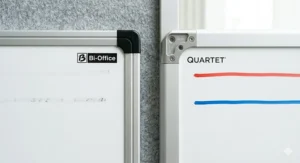
Here is a scenario that plays out in living rooms, home offices, and school corridors across Britain every single day: someone stares at a blank wall, credit card in hand, and types “best whiteboard UK” into Google. Within seconds, two names appear with almost suspicious regularity — Quartet and Bi-Office. One is an American heavyweight with a portfolio that reads like a materials science textbook. The other is a Portuguese-born European brand that has quietly become a fixture in UK classrooms, conference rooms, and tidy semi-detached studies from Bristol to Edinburgh.
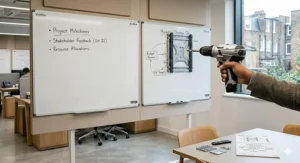
So which one deserves the space on your wall?
That is precisely what this Quartet whiteboard vs Bi-Office comparison sets out to answer. Not with vague platitudes about “smooth writing surfaces” and “durable frames” — you can get that from any product listing — but with the kind of honest, practical assessment that actually helps you decide. We are talking surface types, ghosting resistance in damp British conditions, value for money in pounds, and whether the premium you pay for porcelain over lacquered steel is genuinely worth it or simply a nice number to show off to colleagues on a video call.
Whether you are a student cramming in a box bedroom in Leeds, a freelancer running a home office in a Victorian terrace, or a small business outfitting a meeting room in Manchester, there is a board in this list for you. According to the Office for National Statistics, hybrid working is now a permanent fixture for millions of UK workers — and a good whiteboard is quietly one of the most underrated productivity tools you can own.
Right, let us get into it.
Quick Comparison: Quartet vs Bi-Office at a Glance
| Feature | Quartet (range) | Bi-Office (range) |
|---|---|---|
| Surface Options | Porcelain, Glass, Melamine | Enamel, Lacquered Steel, Melamine |
| Price Range (GBP) | Around £25–£250+ | Around £15–£120 |
| Warranty | 60 days – Lifetime | 1 year – 10 years (surface) |
| Magnetic? | Yes (most models) | Yes (most models) |
| UK Availability | Amazon.co.uk ✅ | Amazon.co.uk ✅ (wide range) |
| Best For | Heavy use, premium offices | Budget–mid-range, classrooms, WFH |
| Eco Credentials | GREENGUARD Gold (glass range) | Cradle to Cradle Certified (Earth range) |
As the table shows, Quartet and Bi-Office occupy genuinely different positions in the market — and that is rather the point. Bi-Office wins on affordability and variety for everyday UK buyers, while Quartet’s premium surfaces justify their price only when longevity truly matters. The right choice depends on how hard the board will work for you, and where it lives.
💬 Just one click — help others make better buying decisions too! 😊
✨ Don’t Miss These Exclusive Deals!
🔍 Take your productivity to the next level with these carefully selected whiteboards. Click on any highlighted product to check current pricing and availability on Amazon.co.uk. These picks will help you find exactly what you need!
Top 7 Whiteboards: Expert Analysis
1. Bi-Office Maya Magnetic Dry Wipe Aluminium Framed Whiteboard (60x90cm)
The Maya is Bi-Office’s workhorse — and for most UK buyers, it is probably all they will ever need. The lacquered steel magnetic surface comes in multiple sizes (60x45cm, 60x90cm, 90x60cm up to a barn-door 240x120cm), which makes it sensibly versatile for everything from a student’s bedroom to a small meeting room. The slim aluminium frame and plastic corner caps keep things looking tidy without screaming “office supply shop.” It mounts with four corner screws, which is exactly as straightforward as it sounds.
What the spec sheet does not tell you: lacquered steel surfaces perform best in the first couple of years. After sustained heavy use — daily writing, aggressive erasing, the occasional marker left uncapped overnight — ghosting can begin to appear. For a student using it a few times a week, this is unlikely to be a problem for the foreseeable future. For a small business running four people brainstorming at it daily, budget for a replacement in three or four years.
UK reviewers consistently praise the ease of installation and the clean, non-flimsy feel. A few note the pen tray clips on rather than fixing permanently, which is a minor niggle.
✅ Wide size range for UK living and office spaces
✅ Prime-eligible, fast UK delivery
✅ Budget-friendly entry point for the Bi-Office range
❌ Lacquered steel ghosts faster than enamel or porcelain
❌ Not ideal for daily heavy commercial use
Price range: Around £20–£65 depending on size. Solid value for the home study or small office.
2. Bi-Office Maya Enamel Aluminium Framed Whiteboard (90x60cm)
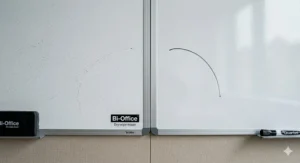
If the standard Maya is a reliable family hatchback, the Enamel Maya is the slightly upgraded estate — same trusted frame, noticeably better surface. Enamel (fired-on vitreous coating over steel) is considerably harder-wearing than lacquered steel, resists ghosting far more effectively, and feels noticeably smoother under the marker. It is also magnetic, which the standard melamine versions are not.
For UK buyers working from home in a dedicated study or spare room, this is the upgrade worth making. The enamel surface wipes cleanly even after a marker has sat for a day or two — a scenario that happens more than anyone will admit. The 90x60cm size is the sweet spot for a home office wall: large enough for meaningful planning, compact enough to fit above a desk in the kind of rooms that most British houses actually contain.
UK reviewers tend to land on words like “glossy,” “easy to clean,” and “no colour tint after erasing.” One reviewer noted the surface handles even cheaper own-brand markers without staining. That is genuinely useful to know.
✅ Enamel surface dramatically outperforms lacquered steel for longevity
✅ Full magnetic functionality — post notes, attach documents
✅ Sleek look that suits modern home office aesthetics
❌ Heavier than standard Maya, requires wall plugs and screws (not just command strips)
❌ Pricier than the entry-level Maya range
Price range: Around £35–£90 depending on size. The sweet spot between budget and premium.
3. Quartet Infinity Glass Dry Erase Board (G3624W — 90x76cm)
Now we are in different territory entirely. The Quartet Infinity Glass Board is not just a whiteboard — it is a statement piece. The frameless tempered glass surface floats on the wall like an art installation, completely clean-lined and frankly rather beautiful. It is GREENGUARD Gold certified, meaning the chemical emissions meet strict standards for indoor air quality — a consideration worth noting if the board lives in a bedroom study or a room with limited ventilation.
The tempered glass surface will not ghost, stain, scratch or dent. Ever. Quartet backs it with a 15-year warranty, and that is not marketing bravado — glass simply does not degrade the way coated steel does. The magnetic function works well, though you will need high-powered magnets specifically designed for glass boards (standard fridge magnets will slide off, disappointing).
Installation requires drilling into the wall, which puts some people off. But once it is up, it is up. This is the board you buy once and do not think about again for a decade.
✅ Zero ghosting — surface performs identically on day one and year ten
✅ GREENGUARD Gold certified: safer indoor air quality
✅ Exceptional build quality; looks genuinely impressive in any room
❌ Requires drilling and more involved installation
❌ Premium price bracket — may be overkill for casual users
❌ Requires glass-specific high-power magnets (sold separately)
Price range: Around £90–£160. An investment, but one that pays for itself over time in a professional home office or boardroom.
4. Bi-Office Earth Whiteboard (120x90cm)
Here is one for the sustainability-conscious buyer — and there are more of those in the UK than ever. The Bi-Office Earth Whiteboard is Cradle to Cradle Certified™ Silver, manufactured from recycled and recyclable materials, with a 10-year surface warranty that backs up the eco ambitions with genuine durability credentials. The aluminium pen tray and full wall-fixing kit are included, which is more than you get with some pricier options.
The magnetic dry-erase surface performs at mid-range enamel level — smooth, clean-wiping, and unlikely to give you grief for ghosting under normal use. The 120x90cm size makes it genuinely useful as a planning board for a home office or small team environment. The frame is restrained and professional rather than showy.
What makes this interesting is the value proposition: you are paying mid-range money for a product that lasts longer than budget alternatives, erases better, and does so without the environmental guilt. For a UK buyer with sustainability on their mind — which is an entirely reasonable thing to have on your mind — this is a quietly excellent choice.
✅ Cradle to Cradle Silver certified — genuine eco credentials, not greenwash
✅ 10-year surface warranty for confidence in longevity
✅ Good size for home offices and team planning walls
❌ Less widely stocked on Amazon.co.uk than the Maya range — check availability
❌ Frame design is functional rather than stylish
Price range: Around £55–£100. Good value when you factor in the longevity and sustainability credentials.
5. Quartet Prestige 2 DuraMax Porcelain Whiteboard (P557MP2 — 180x120cm)
For anyone who has ever watched a melamine board slowly turn into a ghost gallery of past meetings, the Quartet Prestige 2 DuraMax Porcelain is the answer to that quiet frustration. Porcelain is, as Wikipedia’s overview of dry-erase board surfaces notes, the gold standard for whiteboard durability — non-porous, incredibly smooth, and genuinely resistant to the kind of sustained abuse a busy meeting room inflicts. This specific model carries a lifetime warranty on the surface. That word lifetime is doing a lot of heavy lifting there, and Quartet means it.
The mahogany-effect frame adds a warmth that most corporate whiteboards lack, making it equally at home in a design studio as a boardroom. At 180x120cm it commands a wall, which is rather the point for a room where ideas need to breathe.
The caveat: this is a large, heavy board. It needs proper wall fixings into solid masonry or stud walls — not ideal for renters or those in older British properties with plaster that crumbles at the mere suggestion of a rawlplug. Check your walls before ordering.
✅ Porcelain surface — virtually zero ghosting, staining, or scratching
✅ Lifetime surface warranty: buy once, never replace
✅ Premium aesthetic with mahogany frame suits high-end office environments
❌ Heavy — requires solid wall fixings; unsuitable for renters
❌ Premium price reflects premium quality — not for casual use
Price range: Around £180–£260. Steep, but arguably the last whiteboard you will ever buy.
6. Bi-Office Maya Trio Whiteboard (Magnetic, 90x60cm)
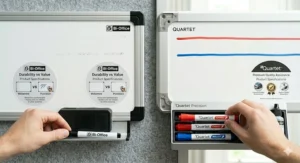
Lateral thinking at its finest. The Maya Trio opens up to reveal three separate magnetic whiteboard surfaces, giving you triple the writing real estate from a single wall-mount footprint. For a compact UK home office — the kind of room that doubles as a spare bedroom and has about 80cm of usable wall — this is a genuinely clever piece of engineering. Close it, and you have a discreet 90x60cm board. Open it, and you suddenly have a full brainstorming setup without having annexed the dining room.
The surfaces are lacquered steel magnetic, consistent with the standard Maya range. The tri-fold mechanism is sturdy enough for daily use, though obviously the hinge is the component most likely to show wear over years. The inner panels are also useful for keeping notes private — you can fold sensitive information inward and show only what you need to a client on a video call. A small thing, but a thoughtful one.
UK reviewers working from compact city flats have been particularly enthusiastic about this model. “Space-saving genius” is a phrase that appears more than once.
✅ Three magnetic surfaces in one compact wall-mount — ideal for small UK rooms
✅ Inner panels offer privacy for sensitive notes
✅ Clever solution for those who need space but cannot spare the wall
❌ Lacquered steel surfaces have the same long-term ghosting caveats as standard Maya
❌ Not suitable as a replacement for a large fixed board in a professional setting
Price range: Around £80–£130. Excellent value if wall space is your limiting factor.
7. Bi-Office Maya Gridded Magnetic Aluminium Framed Whiteboard (120x90cm)
A whiteboard with a pre-printed grid is one of those things you do not know you need until you have one. The Maya Gridded board prints a subtle grid pattern directly onto the magnetic enamel surface, making it vastly easier to draw accurate diagrams, lay out project timelines, or sketch organisational charts without everything looking like it was drawn on a particularly turbulent bus. Teachers, architects, project managers, and anyone who regularly draws on a whiteboard in a professional capacity will find this quietly transformative.
The 120x90cm size gives you a substantial working area, and the enamel surface means the grid lines remain crisp and clean long-term. Crucially, standard dry-erase markers wipe off cleanly without disturbing the printed grid — it stays put while your writing disappears. Neat.
UK reviewers in educational settings particularly praise this model, and it is easy to see why. For a secondary school classroom or a small-team training room, this is precisely the right tool.
✅ Pre-printed grid makes diagrams and planning significantly easier
✅ Enamel surface — better long-term performance than lacquered steel
✅ 120x90cm gives serious working space for education or team environments
❌ Overkill for general home use where a plain board suffices
❌ Larger size means more involved installation
Price range: Around £70–£120. Excellent value for educators and visual thinkers.
Setting Up Your Whiteboard for Maximum Effect: A Practical UK Guide
Getting the board on the wall is only half the job. Here is what most installation guides miss.
Placement matters more than people think. In British homes, natural light typically comes from the south and west — hang your whiteboard where direct sunlight will not create glare across the surface at certain times of day. A north-facing wall is often ideal. In office environments, avoid positioning the board behind the presenter; anyone joining via video call will be squinting into reflected light.
Wall type is a genuine consideration in UK housing. Victorian and Edwardian properties (which make up a substantial chunk of British housing stock, as anyone who has spent time on Rightmove will know) often have plaster over brick walls. Older plaster can be unpredictable. Use proper masonry fixings, not just the rawlplugs included with the board. For stud walls, locate the studs before drilling — no amount of whiteboard warranty covers a board that pulls down a section of plasterboard.
In rented properties, command strip alternatives can work for lighter boards like the smaller Maya models, but anything over 60x90cm is likely to need proper fixings. Check your tenancy agreement before drilling; many UK landlords now expect professional-standard redecoration on moving out, and unnecessary holes do not help negotiations.
Maintain the surface from day one. Use a proper dry-erase eraser — not a cloth, not a bit of kitchen roll — and wipe the board fully after every use. For all surface types, a monthly clean with a specialist whiteboard cleaner (widely available from UK office suppliers) will dramatically extend the board’s useful life. Bi-Office sells its own cleaning solution. Quartet recommends theirs. Both work.
Which Board Suits Your Life? Real UK Scenarios
The Leeds student, bedroom home study: You need something magnetic (for timetables and revision cards), compact (your room is not large), and budget-friendly. The Bi-Office Maya Magnetic 60x90cm is your board. Mount it horizontally above the desk. Done.
The Manchester freelance designer, dedicated home office: You use it daily, you care about it looking professional on video calls, and you want something that will last. The Quartet Infinity Glass Board or the Bi-Office Maya Enamel are both strong choices. The glass costs more but genuinely looks extraordinary. The enamel is more affordable and almost as durable.
The Edinburgh secondary school teacher, classroom: The Bi-Office Maya Gridded 120x90cm is, frankly, made for you. The pre-printed grid will save you a remarkable number of minutes per lesson.
The London small business, meeting room (and sustainability matters): The Bi-Office Earth Whiteboard 120x90cm ticks both the performance and environmental boxes. Your clients will notice the Cradle to Cradle certification. Some of them will care. That is not nothing.
The corporate boardroom, heavy daily use: The Quartet Prestige 2 DuraMax Porcelain is the only sensible answer. Lifetime warranty, zero ghosting, looks the part.
How to Choose the Right Whiteboard in the UK: 6 Criteria That Actually Matter
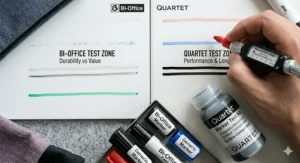
Choosing a whiteboard should not be complicated, but the sheer range of options makes it easy to overthink. Here are the six things worth actually considering, in order of importance.
- Surface type first, everything else second. Melamine is cheapest and wears fastest. Lacquered steel is a step up but still ghosts with heavy use. Enamel is the sensible mid-range choice for UK buyers. Porcelain and glass are premium, long-life options. Match the surface to how hard the board will work.
- Size relative to your actual wall space. Measure twice. British rooms are smaller than the aspirational staging in product photos suggests. A 90x60cm board fills a small study wall beautifully; the same board in a large meeting room looks a bit lost.
- Magnetic or not. If you want to pin documents, timetables, or notes to the surface, you need a magnetic board. Most mid-range and premium options are magnetic; some budget melamine boards are not. Check before buying.
- Warranty as a proxy for quality. A 10-year surface warranty (Bi-Office Earth) or 15-year warranty (Quartet Glass) tells you something real about how confident the manufacturer is in the product. A 60-day warranty (Quartet entry-level mini boards) tells you something equally real.
- Installation requirements vs your wall type. Glass and porcelain boards are heavy. Know what your walls are made of before committing to a large, heavy board. As Which? magazine regularly advises on home products, installation suitability is one of the most commonly overlooked factors in UK buyer decisions.
- Total cost of ownership. A £25 melamine board that needs replacing every two years costs more over a decade than a £90 enamel board that lasts eight. Run the maths before defaulting to the cheapest option.
Common Mistakes UK Buyers Make (And How to Avoid Them)
🚫 Buying US voltage or US plug models. Both Quartet and Bi-Office products sold on Amazon.co.uk are passive (no electrical components), so this is not an issue for whiteboards specifically — but it is worth checking any accessories or mounting systems that include electronic components.
🚫 Confusing melamine with magnetic surfaces. Many budget boards advertise themselves as whiteboards without mentioning they are not magnetic. If magnetic functionality matters to you — and for most UK buyers it does — check the listing carefully before purchasing.
🚫 Choosing size based on ambition rather than reality. A 240x120cm board sounds wonderful right up until the moment you realise it occupies your entire feature wall and leaves nowhere for the furniture.
🚫 Ignoring the ghosting issue until it is too late. Ghosting — the faint shadow of previous writing that lingers on the surface — is the number one complaint about budget whiteboards after 12-18 months of use. Investing slightly more in an enamel surface upfront eliminates this frustration entirely.
🚫 Not accounting for UK rental situations. If you rent, a heavy porcelain board requiring masonry fixings is a headache waiting to happen. Smaller, lighter magnetic boards with less invasive mounting options are a far more practical choice for the millions of UK renters.
Long-Term Value: Is Premium Worth It in GBP?
Let us run a simple cost comparison over five years, because this is the kind of maths that actually changes decisions.
A budget melamine board in the £20–£30 range might need replacing after two to three years of regular use before ghosting becomes intolerable. Over five years, that is two replacements: roughly £40–£60, plus the irritation of ghosted diagrams at your most important moments.
A Bi-Office Maya Enamel at around £50–£70 will comfortably last five years or more with reasonable maintenance. Total cost: one purchase.
A Quartet Porcelain or Glass board at £120–£200 will last a decade or longer. Amortised over ten years, the per-year cost is competitive with mid-range options — and you never have to think about it again.
The conclusion is fairly obvious: if you use the board daily or near-daily, spend more upfront. The maths works out. Research on educational environments from UK universities consistently shows that well-maintained physical learning tools support better outcomes — and a whiteboard that does not ghost is one that actually gets used.
FAQ
❓ Is Bi-Office a reliable brand for the UK market?
❓ Does the Quartet whiteboard range come with a UK plug or require any electrical setup?
❓ Which whiteboard surface is best for a UK home office that is also used for video calls?
❓ How do I clean a whiteboard properly to prevent ghosting in the long term?
❓ Are Bi-Office and Quartet whiteboards eligible for Amazon Prime delivery in the UK?
Conclusion: So, Which One Wins?
The honest answer — and slightly unsatisfying one — is that neither brand wins outright. They are simply solving different problems at different price points.
Bi-Office is the smart, practical choice for most UK buyers. The Maya range’s combination of availability, reasonable price, solid build quality, and sensible sizing options makes it the default recommendation for students, home office workers, and anyone equipping a small meeting room on a budget. The Enamel upgrade is worth the extra spend if you use the board regularly. The Earth Whiteboard is particularly compelling if sustainability is on your agenda.
Quartet earns its premium when you genuinely need premium. If you are outfitting a boardroom, running a busy professional office, or simply want a board that will still be performing flawlessly a decade from now without a moment’s maintenance, the DuraMax Porcelain or the Infinity Glass Board are outstanding products. They cost more. They are worth it.
The Quartet whiteboard vs Bi-Office comparison ultimately comes down to this: how hard will the board work, and for how long? Answer those two questions honestly, match your budget accordingly, and you will not go wrong with either brand.
✨ Don’t Miss These Exclusive Deals!
🔍 Check current pricing and availability on Amazon.co.uk for any of the boards featured above. Prices vary — use the links to see today’s best options and Prime delivery availability.
Recommended for You
- Best Moleskine Academic Diary UK 2026: 7 Top Picks Reviewed
- Best Mind Mapping Notebook for Students UK 2026 — Top 7 Picks
- Best Cube Timer for Focused Studying UK 2026: Top 7 Picks
Disclaimer: This article contains affiliate links. As an Amazon Associate, I earn from qualifying purchases. If you purchase products through these links, we may earn a small commission at no additional cost to you.
✨ Found this helpful? Share it with your mates! 💬🤗
