
In This Article
There is something almost stubbornly satisfying about opening a new diary. The crisp pages. The ribbon bookmark that hasn’t yet been bent at a ridiculous angle. The brief, optimistic moment before the whole thing becomes a chaotic mosaic of crossed-out deadlines and seminar reminders scrawled in three different ink colours. A good Moleskine academic diary doesn’t promise to make you organised — it simply gives you the best possible stage on which to attempt it.
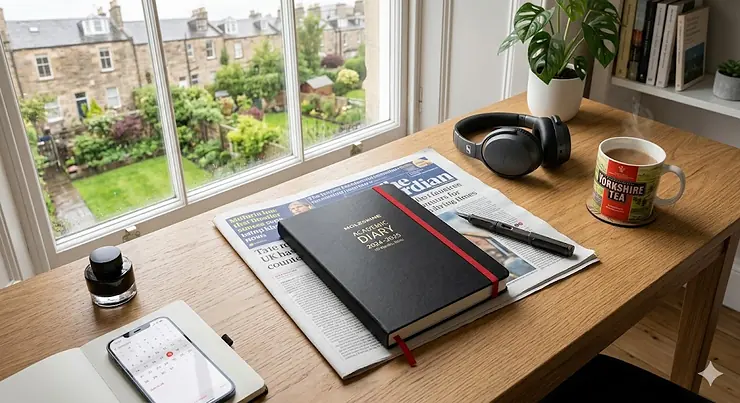
And here’s the thing: the paper planner is very much alive. Despite every app that swears it will change your life (before you forget the password), research from the University of Cambridge’s academic skills programme consistently recommends physical diaries as one of the most effective tools for student time management. There is something about handwriting your commitments — the physical act of pen meeting paper — that creates a cognitive anchor that a notification on your phone simply cannot replicate.
For British students in particular, the Moleskine academic diary sits at a peculiar sweet spot: affordable enough not to feel reckless, premium enough to feel motivating. Running from July 2025 through to December 2026, the 18-month format slots neatly around the UK academic calendar — autumn term, spring term, summer exams, and all the frantic WhatsApp messages in between. Whether you’re a first-year at a Russell Group university, a sixth-former navigating A-levels, or a postgraduate drowning in dissertation deadlines, there is a format here that will suit you.
What is a Moleskine academic diary? In short, it is an 18-month (or 12-month) paper planner produced by the Italian stationery brand Moleskine, running from July of one year to December of the next — specifically designed to align with academic years. Features typically include weekly or daily spreads, ivory acid-free paper, an elastic closure, ribbon bookmark, and an expandable inner pocket.
In this guide, we’ve tested and compared 7 of the best options available on Amazon.co.uk right now, so you can skip the indecision and get back to the deadlines.
Quick Comparison Table: Best Academic Diaries 2025–2026 (UK)
| Product | Format | Size | Cover | Price Range | Best For |
|---|---|---|---|---|---|
| Moleskine Classic 18M Weekly Hard Cover Large | Weekly | 13 × 21 cm | Hard | £25–£30 | Everyday students |
| Moleskine Classic 18M Weekly Soft Cover Large | Weekly | 13 × 21 cm | Soft | £22–£27 | Bag-friendly commuters |
| Moleskine Classic 18M Weekly Soft Cover XL | Weekly | 19 × 25 cm | Soft | £27–£33 | Visual planners, big writers |
| Moleskine Classic 18M Daily Hard Cover Large | Daily | 13 × 21 cm | Hard | £28–£35 | Detail-obsessed planners |
| Moleskine Student Life Diary 2025–2026 Large Spiral | Weekly/Monthly | 21 × 27 cm | Hard Spiral | £22–£28 | University students |
| Leuchtturm1917 Academic Week Planner A5 Hard Cover | Weekly (hourly) | 14.5 × 21 cm | Hard | £22–£28 | Structured timetablers |
| Pukka Pad Academic Diary 2025–2026 Soft Cover | Weekly/Monthly | ~A5 | Soft | £8–£14 | Budget-conscious students |
What the table tells us: The Moleskine range occupies the mid-to-premium tier (£22–£35), and within it the choice really comes down to two variables: hard vs soft cover, and how much daily detail you need. The Leuchtturm1917 is the closest rival in terms of build quality, while the Pukka Pad is the sensible choice if your budget is already stretched between rent and textbooks. We’ll unpack each one properly below.
💬 Just one click — help others make better buying decisions too! 😊
✨ Don’t Miss These Exclusive Deals!
🔍 These carefully selected academic diaries are all available on Amazon.co.uk. Click any highlighted product name to check current pricing and availability — Prime members enjoy free next-day delivery on most items.
Top 7 Academic Diaries for UK Students 2025–2026: Expert Analysis
1. Moleskine Classic 18-Month Weekly Planner 2025–2026, Hard Cover, Large (13 × 21 cm)
If someone mentions a “Moleskine diary,” this is almost certainly what they picture: the classic black hardback with rounded corners, that satisfying elastic closure, and ivory paper that makes your handwriting look rather more elegant than it probably is. The 18-month format runs from July 2025 to December 2026, which is precisely why it works so well for the UK academic calendar — your September freshers’ week and your June dissertation hand-in both fit comfortably within a single volume.
The hard cover is the key detail here. It lets you write on your lap during a lecture without the whole page buckling, which sounds trivial until you’ve spent a seminar trying to write on the soft surface of a bus seat at 8:45am. The 70 g/m² ivory paper is acid-free and fountain-pen friendly — no feathering, minimal show-through. The weekly spread gives you days on the left, lined notes page on the right: a layout that’s deceptively simple but remarkably effective for blocking out revision sessions and tracking overlapping module deadlines simultaneously.
UK buyers will appreciate that this is a Prime-eligible product on Amazon.co.uk, typically arriving next day. Multiple colour options include black, scarlet red, and aquamarine.
✅ Robust hard cover survives being shoved in a rucksack daily
✅ Fountain-pen friendly 70 g/m² ivory paper
✅ Lieflat binding opens 180° flat — genuinely useful in lectures
❌ No hourly time slots (weekly view only)
❌ Premium price compared to budget alternatives
UK customer feedback is strongly positive, with reviewers frequently praising the build quality and the sensible weekly layout. Priced in the £25–£30 range — a fair investment if this diary is going to survive twelve months of daily use.

2. Moleskine Classic 18-Month Weekly Planner 2025–2026, Soft Cover, Large (13 × 21 cm)
Everything the hard cover version offers, minus roughly £3 and a few grams of weight. That might sound like a trivial distinction, but for students who are already hauling laptops, water bottles, and an inexplicable number of phone chargers around campus, every gram matters. The soft cover folds back completely on itself, which means it actually takes up less space than the hardback when open — rather handy in cramped library carrels where desk space is rationed like it’s wartime.
The inner workings are identical to the flagship: the same 70 g/m² ivory acid-free paper, the same elastic closure, the same ribbon bookmark, the same expandable inner pocket that will end up full of receipts you meant to throw away. The soft cover is slightly more vulnerable to coffee rings and bag-corner damage, but if you’re the sort of person who keeps a diary in a protective sleeve (and yes, those people exist, and they tend to be very good at meeting deadlines), this is a sensible, slightly lighter alternative.
Available in black and several seasonal colours on Amazon.co.uk. Prime-eligible with fast UK delivery.
✅ Lighter and more flexible than the hardback
✅ Same high-quality paper as the premium version
✅ Lower price point for the same functional layout
❌ Cover wears more visibly over an 18-month lifespan
❌ Writing on lap requires a firm surface underneath
UK buyers consistently rate this as “the same Moleskine quality, sensibly priced.” Sitting in the £22–£27 range, it’s arguably the sweet spot of the Classic range.
3. Moleskine Classic 18-Month Weekly Planner 2025–2026, Soft Cover, XL (19 × 25 cm)
Here is the diary for people who think in large handwriting, draw revision mind-maps in the margins, or simply refuse to abbreviate “seminar preparation” to something illegible. The XL format at 19 × 25 cm is considerably larger than the standard large (13 × 21 cm) — we’re talking roughly A4 territory, which is a meaningful upgrade in usable page space.
Each weekly spread gives you a full left-hand page for daily appointments and a generously sized ruled page for notes on the right — and at this scale, you can actually use those note pages for something more than a single meeting agenda. Architecture students who need to sketch details, art students tracking project stages, or science students jotting data observations will find the extra real estate transformative.
The trade-off is obvious: this thing won’t disappear into a standard rucksack pocket. It goes in the main compartment, and it knows it. For students who work primarily from a fixed desk or study space, that’s a non-issue. For those who hot-desk across campus, it might feel like bringing a broadsheet newspaper to a coffee shop.
✅ Significantly more writing space per week
✅ Ideal for visual and detail-heavy planning
✅ Same Moleskine construction quality throughout
❌ Too large for jacket pockets or small bags
❌ Heavier to carry daily across campus
In the £27–£33 range on Amazon.co.uk — worth every penny if you genuinely need the space.
4. Moleskine Classic 18-Month Daily Planner 2025–2026, Hard Cover, Large (13 × 21 cm)
One page per day. Full stop. No weekly overviews competing for your attention, no shared note pages — just 24 hours of blank-lined space staring back at you each morning. For a certain type of student (typically the one who arrives to tutorials with colour-coded annotations and a printed reading list), this format is revelatory. For everyone else, it may feel like being handed a blank canvas when you only needed a to-do list.
The practical point: if you have hourly commitments — lab sessions, clinic placements, rehearsals, scheduled tutorials — the daily format lets you block time with far more granularity than any weekly spread. Medical students, law students managing mooting schedules, and education students on teaching placement will find this genuinely useful rather than aspirationally so.
The hard cover at this size and weight is essentially mandatory — a daily planner accumulates significantly more ink than a weekly one, making it heavier and more densely packed. The build quality means it will survive the year, which is important when you’re writing in it every single day. The University of Southampton’s time management guide specifically recommends backward-planning from deadlines — this format makes that kind of daily granularity effortless.
✅ Maximum daily planning granularity
✅ Ideal for students with tightly scheduled timetables
✅ Hard cover essential for frequent daily use
❌ No weekly overview without a separate tool
❌ Heavier and thicker than weekly options
Priced in the £28–£35 range — noticeably pricier than the weekly formats, reflecting the additional pages. Available on Amazon.co.uk with Prime delivery.
5. Moleskine Student Life Diary 2025–2026, Large, 12-Month, Spiral Hard Cover
Now things get interesting. The Student Life Diary isn’t just a Moleskine with “student” written on the cover — it’s a genuinely different product, designed with considerably more specificity for academic life. Running from July 2025 to June 2026 on 100 g/m² paper (notably heavier than the Classic range), it includes monthly and weekly spreads alongside features you won’t find anywhere else in the Moleskine range: a GPA and grade tracker, monthly habit trackers, weekly mood charts, and goal-setting pages for each term.
The spiral binding — unusual for Moleskine — means it opens completely flat with zero resistance, which makes it considerably easier to use on a desk alongside an open textbook or laptop. The three bookmark ribbons (three! a luxury) let you keep simultaneous tabs on your current week, upcoming deadlines, and monthly overview. Stickers are included for colour-coding, which either sounds delightful or excessive depending on your organisational personality.
What most buyers overlook: this is a 12-month diary (July 2025 to June 2026), not 18-month. If you’re buying for the full 2025–2026 academic year through to the following January, you’ll need to plan accordingly. For a standard UK academic year, though — September to June — it’s perfectly sized.
✅ Grade tracker and habit tracker built in
✅ 100 g/m² paper — the heaviest in the Moleskine range
✅ Spiral binding lies completely flat
❌ 12-month coverage only (July 2025–June 2026)
❌ Larger format doesn’t fit standard bag pockets
Priced in the £22–£28 range — outstanding value for the feature set. Available on Amazon.co.uk.

6. Leuchtturm1917 Academic Week Planner 2025–2026, Hard Cover, Medium (A5)
The German rival. Leuchtturm1917 has spent years building a reputation among serious stationery enthusiasts — the bullet journal community in particular swears by it — and its academic planner is a genuinely strong alternative to the Moleskine Classic range. Running from July 2025 to December 2026 in a weekly format with hourly time slots, it offers one feature the Moleskine Classic range conspicuously lacks: a structured timetable layout that lets you plan day-by-day within each week rather than simply blocking broad categories.
The 80 g/m² paper is notably heavier than Moleskine’s 70 g/m², making it more resistant to ink bleed — a meaningful advantage for anyone using fountain pens or felt tips. Two ribbon bookmarks (Moleskine offers one), a folding inner pocket, and removable note pages round out a very thoughtful package. The hardcover construction is solid if slightly less luxuriant in feel than Moleskine’s classic version — it’s more notebook than diary in its aesthetic, if that distinction means anything to you.
For UK buyers, Leuchtturm1917 is available on Amazon.co.uk and typically Prime-eligible. One caveat worth noting from UK customer reviews: some find the time-slot layout feels slightly clinical compared to Moleskine’s warmer, simpler layout. This is less a flaw than a personality question.
✅ 80 g/m² paper — fountain-pen and felt-tip friendly
✅ Hourly time slots for precise daily scheduling
✅ Two ribbon bookmarks and removable note pages
❌ Time-slot layout may feel overly structured for casual planners
❌ Less colour variety than Moleskine’s range
In the £22–£28 range on Amazon.co.uk — comparable to mid-range Moleskine options, with a genuinely different planning philosophy.
7. Pukka Pad Academic Diary 2025–2026, Soft Cover
Right. Let’s be honest. Not everyone can justify spending £28 on a diary when textbooks alone cost a small fortune and the rent has gone up again. The Pukka Pad Academic Diary is a British brand’s answer to the question “what if I need a decent diary but also need to eat this month?” And it’s a rather good answer.
Running from August 2025 to July 2026 — aligned precisely with the standard UK academic year — it features 80 g/m² paper (matching Leuchtturm’s heavier grade at a fraction of the price), monthly overview pages with generously sized date blocks, weekly spreads with lined writing space, and dedicated goal, to-do list, and important dates sections. The spiral wire binding lies flat, the ribbon bookmark keeps your page, and the soft cover travels lightly.
What it doesn’t have: the prestige, the ivory paper, the continental heritage, or the elastic closure that snaps shut with such satisfying authority. What it does have: a price under £15, solid UK availability on Amazon.co.uk, and functionality that, if we’re being rigorous, covers everything most students actually need from a diary. As University of York’s time management resources make clear, the best planning tool is the one you actually use — and a diary you can afford is infinitely more useful than one you can’t.
✅ Excellent value — under £15 on Amazon.co.uk
✅ 80 g/m² paper — better than some pricier options
✅ UK academic calendar aligned (August–July)
❌ No elastic closure or expandable pocket
❌ Less durable over a full academic year of daily use
Priced in the £8–£14 range — the pragmatic choice that won’t haunt your bank balance.
How to Actually Use a Moleskine Academic Diary (And Not Abandon It by October)
This is the section nobody puts in a product review, and it’s arguably the most useful. You have bought the diary. You have opened it to a fresh September week and written your name inside the cover with a pen that feels unnecessarily good. And then, approximately four weeks later, it has become an archaeological record of the first three weeks of term before you stopped filling it in.
Here is what actually works.
Set up your fixed commitments first. Before anything else, block out every lecture, seminar, and lab for the entire term. Not just week one — the full term. Use the monthly overview pages to mark assessment deadlines in a different colour. The University of Southampton specifically recommends backward-planning from deadlines — working out what needs to happen in the weeks before a submission date rather than treating the deadline itself as the planning horizon.
Use the notes page, not a separate notebook. The right-hand ruled page in the Moleskine weekly layout is not decoration. Each week, use it to capture the three things that actually need to happen that week — not the full list, just the three. If you’re using the Student Life Diary, the weekly habit tracker on that same page keeps a secondary record of routines alongside your commitments.
Don’t abandon ship after a missed week. This is the big one. A paper diary isn’t an app — it doesn’t send you passive-aggressive notifications when you fall behind. Missing a week doesn’t mean the diary has failed. Just open it to the current week and continue. The ghost of an empty October is not a reason to give up in November.
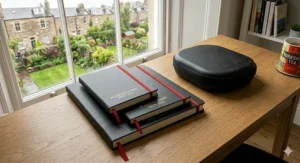
Keep it visible. This sounds obvious. It isn’t. If your diary lives in your bag, you’ll check it when you think of it, which is to say, rarely. If it sits on your desk next to your laptop — open, visible, slightly accusatory — you’ll engage with it every time you sit down to work.

Which Academic Diary Is Right for You? A UK Buyer’s Decision Guide
The honest answer is that the “best” diary is the one that matches how your brain works, not the one with the most impressive heritage or the most ambitious feature list. Here’s a quick framework.
If you’re a first-year undergraduate at a UK university starting in September and slightly overwhelmed by everything: the Moleskine Classic 18-Month Weekly Hard Cover Large is your anchor. Simple layout, robust cover, arrives by next-day Prime. Don’t overthink it.
If you commute by public transport — a 7:15 train to Waterloo, say, or the Tube through Zone 2 with a packed bag — the Moleskine Classic 18-Month Weekly Soft Cover Large weighs less and bends rather than breaks. The cover survives a squashed rucksack better than you’d expect.
If you’re a postgraduate or professional postgraduate student (medicine, law, education) with a timetabled week full of contact hours: the Leuchtturm1917 Academic Week Planner with hourly time slots gives you the precision a weekly-view-only diary simply can’t offer.
If budget is genuinely tight — and there’s no shame in that, given the current cost of renting a room in any major UK city — the Pukka Pad Academic Diary covers every functional base at a price that doesn’t require a difficult conversation with your bank.
If you want to use your diary as a wellbeing tool as much as a scheduling one: the Moleskine Student Life Diary with its habit trackers and mood charts is thoughtfully designed for exactly this, and nothing else in this comparison comes close.
Moleskine Academic Diary vs Digital Planning Apps: An Honest Assessment
The question everyone asks at some point: why bother with paper at all? It’s a fair challenge. Google Calendar is free, syncs across every device, and never gets left on the bus.
But research on handwriting and memory — including a much-cited study published in Psychological Science by Mueller and Oppenheimer — suggests that writing by hand promotes deeper processing of information than typing. Physical planners engage different cognitive regions than digital ones, making it more likely that a commitment you’ve written down by hand will actually register as a priority rather than just another notification to swipe away.
There’s also the focus question. A paper diary doesn’t have notifications, doesn’t surface social media, and doesn’t try to sell you anything between March and April. Opening it is a single-purpose act. In an environment where attention is the scarcest academic resource most students possess, that simplicity is not a limitation — it’s the point.
That said, the honest answer isn’t paper vs digital. It’s both, used for different things. Use Google Calendar for shared events and alerts. Use your Moleskine academic diary for weekly planning, goal-setting, and anything you actually need to remember.
Common Mistakes When Buying an Academic Diary in the UK
A few traps worth knowing before you click “add to basket.”
Buying a calendar-year diary by accident. Moleskine produces both 12-month (January–December) and 18-month (July–December of the following year) diaries. If you’re a UK student and you pick up the 12-month version in September, you’ll have already missed three months of the book. Check the cover: if it says “18 months” and starts in July, you’re in the right place.
Choosing the size based on aesthetics rather than use case. The pocket format (9 × 14 cm) is extremely good-looking and entirely impractical for anyone with more than two commitments per day. The XL format is excellent if you have a desk to use it on; less so if it lives in your bag.
Ignoring paper weight. If you use felt-tip pens or highlighters, 70 g/m² paper (Moleskine Classic) will show bleed-through more than the 80 g/m² paper used by Leuchtturm1917 and Pukka Pad. If you’re a fountain pen user or a heavy highlighter, factor this in.
Buying in a rush before delivery windows close. Amazon.co.uk Prime members enjoy free next-day delivery on most Moleskine products; non-Prime orders over £25 typically qualify for free standard delivery. Worth confirming at the basket stage rather than paying a premium for speed.
Moleskine Academic Diary vs Leuchtturm1917 Student Planner: Which Wins?
| Feature | Moleskine Classic 18M | Leuchtturm1917 Academic |
|---|---|---|
| Paper weight | 70 g/m² | 80 g/m² |
| Cover option | Hard or Soft | Hard |
| Layout style | Days + lined notes | Hourly time columns |
| Ribbon bookmarks | 1 | 2 |
| Price range (Amazon.co.uk) | £22–£30 | £22–£28 |
| Best for | General student planning | Structured timetabling |
| Available on Amazon.co.uk | ✅ Yes | ✅ Yes |
What the table doesn’t say: Moleskine wins on brand heritage, colour variety, and the sheer availability of accessories — covers, stickers, companion notebooks. Leuchtturm wins on paper quality and layout precision. If you’re choosing between these two specifically, it comes down to this: do you want a diary that feels like planning, or one that forces structure? The Moleskine is warm and flexible; the Leuchtturm is efficient and disciplined. Both are excellent. Neither is wrong.
Long-Term Value: Is a Premium Academic Diary Worth the Money?
Let’s do the maths. A Moleskine Classic 18-Month Weekly Hard Cover costs in the £25–£30 range. That’s 18 months of coverage — roughly £1.50 per month, or about 50p per week. Put differently: the price of a cup of coffee every three weeks buys you a planning system that, if used consistently, can meaningfully reduce the stress of an academic year that, for UK university students, typically involves six to eight concurrent modules across two or three assessment windows.
Research from UK universities consistently finds that time management challenges are among the leading contributors to academic underperformance. A quality planning tool that you actually use — one you like opening, that sits visibly on your desk, that survives the entire year — is not a stationery luxury. It’s arguably a study investment with a higher ROI than several academic textbooks that sit on the shelf untouched.
The Pukka Pad at under £15 makes the same basic case even more economically. And the Student Life Diary with its grade tracker is, at £22–£28, essentially a dedicated academic productivity system for the price of a mediocre meal in a university town restaurant.
✨ Don’t Miss These Exclusive Deals!
🔍 All seven diaries above are available to check on Amazon.co.uk — pricing updates daily, and Prime members typically get next-day delivery free. Click any highlighted product name to check current availability.

FAQ: Moleskine Academic Diary UK — Your Questions Answered
❓ What is the difference between the Moleskine 12-month and 18-month academic diary?
❓ Is the Moleskine academic diary available on Amazon.co.uk with Prime delivery?
❓ Does the Moleskine Classic diary paper handle fountain pens well?
❓ When should I buy a Moleskine academic diary in the UK?
❓ How does the Moleskine Student Life Diary differ from the Classic range?
Conclusion
A Moleskine academic diary is not a magic system. It will not write your essays, negotiate extensions, or remind you that the dissertation hand-in is a Tuesday rather than a Wednesday (though the elastic closure will at least prevent it from falling open to an incriminating blank page in your supervision). What it will do, if you use it properly, is give you a single, reliable, tactile home for the information your academic year depends on.
For most UK students, the Moleskine Classic 18-Month Weekly Hard Cover Large in black is the right starting point — robust, simple, and precisely formatted for the academic year. If budget is tight, the Pukka Pad Academic Diary covers the functional bases without the premium price tag. If you want the full integrated experience — grade tracking, habit monitoring, mood awareness — the Moleskine Student Life Diary is something genuinely different.
Buy it, open it to the current week, and put every deadline from your course handbook into it this afternoon. That single act is worth more than any feature comparison table.
✨ Don’t Miss These Exclusive Deals!
🔍 Check current pricing and availability for all seven diaries on Amazon.co.uk — and if you’re a Prime member, most will be on your desk by tomorrow.
Recommended for You
- Best Mind Mapping Notebook for Students UK 2026 — Top 7 Picks
- Best Cube Timer for Focused Studying UK 2026: Top 7 Picks
- Best Study Timer for Pomodoro Technique: Top 7 UK Picks (2026)
Disclaimer: This article contains affiliate links. As an Amazon Associate, I earn from qualifying purchases. If you purchase products through these links, we may earn a small commission at no additional cost to you.
✨ Found this helpful? Share it with your mates! 💬🤗
