

In This Article
Choosing the right GCSE maths revision guide can feel rather like navigating a maze whilst blindfolded—there’s an overwhelming selection on Amazon.co.uk, each promising to unlock your mathematical potential. After reviewing dozens of revision guides and analysing feedback from UK students preparing for their 2026 and 2027 exams, I’ve identified seven exceptional options that actually deliver on their promises.
The landscape of GCSE maths revision has evolved considerably since the 9-1 grading system was introduced by the Department for Education. What you need isn’t just any revision guide—you need one that matches your exam board (AQA, Edexcel, or OCR), your tier (foundation or higher), and your learning style. Some students thrive with CGP’s irreverent humour and colour-coded pages, whilst others prefer Pearson’s structured approach with digital quizzes. The best GCSE maths revision guide for you depends on whether you’re aiming for a solid grade 5 pass or pushing towards those elusive grades 8-9.
In this comprehensive guide, I’ll walk you through seven standout revision resources available on Amazon.co.uk, each selected for different student needs. From budget-conscious families seeking all-in-one solutions to ambitious students targeting top grades, you’ll discover which guide deserves a spot on your revision desk. Let’s dive into what actually works for British students preparing for their maths GCSEs in 2026.
Quick Comparison: Top GCSE Maths Revision Guides at a Glance
| Revision Guide | Exam Board | Tier | Price Range | Best For | Key Feature |
|---|---|---|---|---|---|
| CGP AQA Higher | AQA | Higher | £10-£15 | Grades 7-9 students | Video solutions & online quizzes |
| CGP Complete Foundation | All boards | Foundation | £12-£18 | Comprehensive practice | Full practice papers included |
| White Rose Edexcel Grade 5/6 | Edexcel | Both | £8-£12 | Grades 4-6 students | White Rose methodology |
| Pearson AQA Foundation | AQA | Foundation | £10-£14 | Visual learners | Colour-coded topics |
| CGP Edexcel Higher | Edexcel | Higher | £10-£15 | Independent study | Online edition access |
| CGP AQA Complete Higher | AQA | Higher | £14-£20 | All-in-one solution | Revision + practice + papers |
| CGP Edexcel Complete Higher | Edexcel | Higher | £14-£20 | Exam-ready prep | QR code video support |
From this comparison, the CGP Complete Revision & Practice books offer the best value for most students—combining revision notes, practice questions, and full mock papers in one package. However, if you’re specifically targeting grades 5-6, the White Rose Edexcel guide provides focused support at that crucial middle tier. Budget-conscious families should note that whilst single revision guides sit around the £10-£12 mark, the complete packages at £14-£20 eliminate the need for separate workbooks, actually saving you money in the long run.
💬 Just one click — help others make better buying decisions too! 😊
✨ Don’t Miss These Exclusive Deals!
🔍 Take your GCSE maths revision to the next level with these carefully selected products. Click on any highlighted item to check current pricing and availability on Amazon.co.uk. These picks will help you find exactly what you need!
Top 7 GCSE Maths Revision Guides: Expert Analysis
1. CGP GCSE Maths AQA Revision Guide: Higher
If you’re sitting AQA higher tier and aiming for grades 6-9, this is the gold standard. The CGP GCSE Maths AQA Revision Guide: Higher combines clear explanations with worked examples that actually make sense—no small feat when you’re wrestling with quadratic equations at 10pm on a Wednesday.
What sets this guide apart is its pragmatic approach to the higher tier’s challenging content. Rather than drowning you in unnecessary complexity, it focuses on the grade stamps that show which topics are grade 6, 7, 8, or 9 material. This means you can prioritise your revision time sensibly—essential when British students are typically juggling 8-10 GCSEs simultaneously. The QR codes scattered throughout link to video solutions from CGP’s in-house experts, which proves invaluable when you’re stuck on a tricky trigonometry problem at midnight and can’t pester your maths teacher.
The online edition (included via a code in the front) works brilliantly on tablets, which UK students appreciate during those long train commutes or revision sessions in the local library. One Year 11 student from Manchester noted that the step-by-step worked solutions helped her jump from predicted grade 6 to achieving grade 8 in her mocks. Particularly useful for British learners: the guide covers all AQA-specific approaches and doesn’t waste time on content from other boards.
Pros:
- Grade stamps clearly indicate difficulty level for strategic revision
- Video solutions accessible via QR codes—perfect for visual learners
- Online edition included for revision on-the-go
- Covers new 9-1 content comprehensively
Cons:
- Needs separate workbook for extensive practice (sold separately)
- Higher tier focus means it’s not suitable for foundation students
Price range: Around £10-£15 on Amazon.co.uk. For serious higher tier students, this represents excellent value considering the online resources included. Best paired with the matching CGP exam practice workbook if your budget stretches to around £25 total.
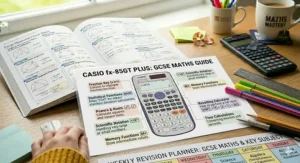
2. CGP GCSE Maths Complete Revision & Practice: Foundation
The CGP GCSE Maths Complete Revision & Practice: Foundation is essentially three books in one—revision guide, practice workbook, and exam paper collection. For families watching their budget, this all-in-one approach eliminates the need to purchase separate resources, typically saving you £10-£15 compared to buying individual books.
This foundation tier guide targets students aiming for grades 1-5, with content carefully pitched at the right level. What most foundation students struggle with isn’t the maths itself—it’s the exam technique and question interpretation. This guide addresses that brilliantly through its mixed revision questions at the end of each section, which mirror real exam conditions. The worked video solutions via QR codes are particularly helpful for British students revising independently, perhaps in their bedroom or during study leave when teachers aren’t available.
Importantly for UK students, this covers the foundation tier specification comprehensively, including all the topics that overlap with higher tier (grades 3-5). The practice papers at the back are realistic mock exams that help reduce that exam-day anxiety British students often experience. One parent from Birmingham mentioned her daughter used this guide exclusively and achieved a grade 5—the “strong pass” that sixth forms look for.
Pros:
- All-in-one package saves money versus separate books
- Mixed practice questions after each section cement learning
- Full practice papers included with video solutions
- Foundation-appropriate difficulty throughout
Cons:
- Bulky size (400+ pages) less portable than single revision guide
- Can’t achieve grade 6+ with foundation tier
Price range: Typically £12-£18 on Amazon.co.uk with Prime delivery. Best value for foundation students who want comprehensive coverage without multiple purchases. Check for bundle deals during back-to-school season in September.
3. White Rose Maths Edexcel GCSE 9-1 Revision Guide: Aiming for Grade 5/6
The White Rose Maths Edexcel GCSE 9-1 Revision Guide: Aiming for Grade 5/6 takes a refreshingly different approach. Published in partnership with White Rose Maths (widely used across UK schools), this guide focuses specifically on that crucial grade 5-6 boundary—where most British students find themselves.
What makes White Rose methodology distinctive is its emphasis on visual representations and conceptual understanding rather than rote memorisation. For students who’ve struggled with maths throughout secondary school but need that grade 5 for sixth form entry, this approach can be transformative. The worked examples include detailed commentary explaining why each step works, not just what to do. This proves particularly valuable for British students who’ve been taught in White Rose-aligned schools, as the language and approach feel familiar.
The guide suits both foundation tier students pushing for grade 5 and higher tier students securing grades 5-6. One London-based tutor mentioned this guide helped several of her students finally grasp topics like ratio and proportion—concepts that appear in nearly every GCSE paper. Worth noting: this is Edexcel-specific, so check your exam board before purchasing.
Pros:
- Targets the grade 5-6 sweet spot most students need
- White Rose approach familiar to UK school students
- Visual models aid conceptual understanding
- Works for both foundation and lower higher tier
Cons:
- Edexcel only—not suitable for AQA or OCR students
- Limited content for grades 7-9 students
Price range: Around £8-£12 on Amazon.co.uk. Excellent value for students specifically targeting grades 5-6. Often in stock with quick Prime delivery for last-minute revision needs.
4. Pearson REVISE AQA GCSE Maths Foundation Revision Guide
The Pearson REVISE AQA GCSE Maths Foundation Revision Guide brings publisher Pearson’s substantial resources to bear on GCSE revision. Written in collaboration with subject experts and examiners, this guide offers a more traditional textbook-style approach compared to CGP’s irreverent style—which some British students and parents prefer.
The one-topic-per-page layout works brilliantly for bite-sized revision sessions—essential when you’re fitting maths revision around part-time work, family responsibilities, or those endless November evenings of British rain. Each page focuses on a single concept without overwhelming you with information. The online components include flashcards and progress trackers, which particularly suit students who respond well to gamification and visual progress indicators.
British reviewers consistently praise the clear explanations and colour-coded difficulty levels. One Bristol teacher noted her foundation tier class found the worked example videos especially helpful for topics like algebraic fractions and probability trees. The online quizzes adapt to your performance, providing targeted practice where you need it most—rather useful when you’re trying to squeeze maximum value from limited revision time.
Pros:
- One-topic-per-page layout perfect for short revision bursts
- Online flashcards and progress tracker included
- Written by current examiners familiar with mark schemes
- Colour-coded topics aid visual learning
Cons:
- More formal tone than CGP—less engaging for some students
- Online access requires internet connection (problematic for some UK households)
Price range: Around £10-£14 on Amazon.co.uk. Solid choice for foundation tier AQA students who prefer traditional textbook format. Check the publication date carefully—earlier editions had errors that were later corrected.
5. CGP GCSE Maths Edexcel Revision Guide: Higher
For Edexcel students, the CGP GCSE Maths Edexcel Revision Guide: Higher delivers the same high-quality approach as CGP’s AQA offering but tailored specifically to Edexcel’s specification and exam style. This matters more than many students realise—exam boards have distinct questioning styles and topic emphases.
What Edexcel students will appreciate is how this guide mirrors the actual exam paper format and language. CGP has clearly studied Edexcel’s approach to problem-solving questions and incorporated that throughout. The grade stamps help you prioritise—if you’re confident of a grade 6 and pushing for grade 7, you know which sections demand extra attention. The informal, occasionally humorous tone (“CGP’s clear informal and, dare we say, humorous style” as they put it) helps lighten what can feel like an overwhelming revision burden for British teenagers.
Parents of students in rural areas particularly value the online edition access—when your nearest maths tutor is 30 minutes away and booked solid, having video solutions at your fingertips becomes essential. One Scottish student mentioned the online quizzes helped him identify weak areas in his understanding of vectors and transformations, topics that frequently appear in Edexcel papers.
Pros:
- Edexcel-specific content and exam style
- Online edition for flexible revision location
- Grade stamps guide strategic topic selection
- Video solutions for complex problems
Cons:
- Requires separate workbook for extensive question practice
- Not suitable for students taking AQA or OCR
Price range: Around £10-£15 on Amazon.co.uk with reliable Prime delivery. Best value when paired with the matching Edexcel workbook, bringing total cost to around £22-£28 for comprehensive coverage.
6. CGP GCSE Maths AQA Complete Revision & Practice: Higher
The CGP GCSE Maths AQA Complete Revision & Practice: Higher is the heavyweight champion of revision guides—combining study notes, hundreds of practice questions, and full mock papers in one 400+ page tome. For higher tier AQA students serious about achieving grades 7-9, this represents the most comprehensive single resource available.
What distinguishes this from the standalone revision guide is the extensive practice question integration. Rather than studying a topic then needing to find practice elsewhere, each section flows seamlessly from explanation to worked examples to practice questions to mixed topic questions. This scaffolded approach mirrors how British maths teachers structure their lessons, making it feel like having a good teacher available 24/7. The full practice papers at the end replicate actual exam conditions—essential for reducing that exam-day panic British students often experience.
The QR code video solutions are particularly valuable for grades 8-9 content, which ventures into genuinely challenging territory. One Hampshire student mentioned this guide helped her secure grade 9—noting the mixed revision questions forced her to apply concepts across topics, exactly what the real GCSE papers demand. The online quizzes provide that extra edge for high-achieving students who’ve exhausted the printed questions.
Pros:
- Comprehensive all-in-one solution eliminates multiple purchases
- Full practice papers replicate exam conditions
- Mixed questions build cross-topic application skills
- Video solutions for all difficult questions
Cons:
- Hefty size makes portability challenging
- Can feel overwhelming for students targeting grades 4-6
Price range: Typically £14-£20 on Amazon.co.uk. Premium pricing but saves money versus buying separate revision guide, workbook, and practice papers. Best investment for ambitious higher tier students.
7. CGP GCSE Maths Edexcel Complete Revision & Practice: Higher
Rounding out our selection, the CGP GCSE Maths Edexcel Complete Revision & Practice: Higher delivers the same all-in-one value proposition as the AQA version but for Edexcel students. If you’re taking Edexcel higher tier and want comprehensive coverage without multiple purchases, this guide deserves serious consideration.
The structure mirrors the AQA complete guide—study notes, worked examples, practice questions, mixed revision questions, and full practice papers—but with content and questioning style tailored to Edexcel’s specification. This matters particularly for topics like statistics and probability, where Edexcel often takes a different approach compared to AQA. The QR code video solutions cover every worked example, which British students find invaluable when revising independently.
One Welsh student mentioned this guide helped him jump from predicted grade 6 to achieving grade 8 in his actual exams. The mixed practice questions particularly helped—forcing him to identify which mathematical tools to apply without the section heading giving it away. That’s exactly what separates grade 6 students from grade 8 students in the actual exam. The full practice papers helped him develop exam stamina—sitting through three 90-minute papers requires genuine endurance, something British students sometimes underestimate.
Pros:
- Complete all-in-one Edexcel solution
- Practice papers build exam stamina
- Video solutions for every worked example
- Mixed questions develop problem-solving skills
Cons:
- Large format less convenient for transport
- Premium price point versus basic revision guides
Price range: Around £14-£20 on Amazon.co.uk. Premium investment but comprehensive coverage saves purchasing multiple resources. Check for deals during exam season (April-May).
Foundation vs Higher Tier: Making the Right Choice for Your GCSE Maths Journey
One of the most consequential decisions in your GCSE maths journey happens months before you sit the actual exam—choosing between foundation and higher tier. This decision directly determines your maximum achievable grade, making it worth understanding thoroughly rather than leaving it entirely to your teacher’s recommendation.
The Foundation tier targets grades 1-5, whilst the Higher tier covers grades 4-9 with a safety-net grade 3 for students scoring just below grade 4. This means foundation students face a ceiling—no matter how brilliantly you perform, grade 5 is your maximum. For British students planning A-levels, this matters enormously. According to Ofqual, the qualifications regulator, many sixth form colleges in England require grade 6 minimum in maths for A-level study, and science A-levels often have similar requirements.
The content differs substantially between tiers. Foundation tier emphasises number skills, basic algebra, proportion, ratio, probability and statistics, covering core topics necessary for functional everyday maths whilst avoiding advanced abstract concepts. In contrast, Higher tier includes all Foundation material plus complex algebraic proof, simultaneous and quadratic equations, trigonometry, functions, vectors and circle theorems. This means higher tier students must master considerably more content—roughly 40% additional topics compared to foundation.
For students hovering around the grade 4-5 boundary, the tier decision becomes genuinely difficult. Foundation tier offers a more comfortable path to grade 5, with questions structured to guide you step-by-step. Higher tier demands multi-stage problem-solving without scaffolding—the questions deliberately don’t tell you which mathematical technique to apply. That cognitive leap separates grade 5 students from grade 6+ students.
According to Ofqual guidance, exam boards allow tier changes fairly late—usually until late April for summer exams. This flexibility means you’re not locked into your initial choice, though switching tiers close to exams creates obvious stress. Teachers typically make tier recommendations based on mock exam performance, predicted grades, and your mathematical confidence with unfamiliar problems. However, the final decision should consider your post-16 plans—if you need grade 6+ for sixth form or college, foundation tier simply won’t get you there.
The British education system’s tiering approach has attracted debate, with some arguing it creates artificial ceilings whilst others maintain it prevents foundation students from facing inappropriately difficult content. Regardless of the broader debate, for your GCSEs in 2026, the tier choice shapes your available grades. Use practice papers for both tiers to assess where you feel more confident, discuss your post-16 plans with your careers advisor, and communicate early with your maths teacher if you believe you’re on the wrong tier.
How to Choose Your GCSE Maths Revision Guide in 2026: A Strategic Framework
Selecting the right GCSE maths revision guide involves more than randomly picking the top-selling option on Amazon.co.uk. You need a strategic approach that considers your exam board, tier, learning style, and budget constraints—factors that vary enormously across British students.
First criterion: Exam board alignment. British schools use three main exam boards—AQA (most common in England), Edexcel, and OCR. Each exam board follows the same national curriculum but has distinct specification details, questioning styles, and topic emphases. A revision guide written for AQA won’t perfectly align with Edexcel’s approach to topics like statistics or trigonometry. Check your exam board before purchasing—it’s printed on your school’s exam entry information and timetable.
Second criterion: Tier appropriateness. Foundation and higher tier guides cover substantially different content. If you’re sitting foundation tier, purchasing a higher tier revision guide wastes money and creates unnecessary confusion. The grade stamps on CGP guides help identify which content applies to which tier, but starting with the correct tier guide from the outset makes far more sense for British students managing limited revision time.
Third criterion: Learning style compatibility. Some students thrive with CGP’s colourful, informal approach—the humorous asides and cartoon illustrations make dense mathematical content more digestible. Others find this style distracting and prefer Pearson’s more formal textbook approach. If you’re a visual learner, prioritise guides with strong diagram integration and video solutions. If you learn best through repetition, focus on guides with extensive practice questions integrated throughout. Neither approach is objectively better—it depends entirely on what helps you personally retain information.
Fourth criterion: Digital resource integration. In 2026, most quality revision guides include online components—video solutions, digital quizzes, flashcards, or full online editions. These prove particularly valuable for British students who commute to school via train or bus, or who prefer revising on tablets rather than lugging heavy books. However, check the access duration—some online resources expire after 12 months, which could create problems if you need to resit in Year 12.
Fifth criterion: Budget and value assessment. A single revision guide costs around £10-£15, whilst complete revision and practice books run £14-£20. Workbooks and exam practice books add another £8-£12 each. For families managing tight budgets, the complete all-in-one guides represent better value—one £18 purchase versus three separate £12 purchases totaling £36. Consider whether your school provides any revision materials (many UK schools purchase class sets of practice papers) before duplicating resources.
Sixth criterion: Customer review analysis. British Amazon.co.uk reviews provide genuine insight into guide effectiveness. Look for reviews from UK students (not American ones—the systems differ substantially) who took the same exam board and tier as you. Pay attention to reviews mentioning specific grade improvements rather than vague praise. For independent product testing and consumer advice, Which? provides trusted reviews of educational resources. A Cardiff student’s detailed review about jumping from grade 5 to grade 7 carries more weight than a generic “great book” comment.
For most British students in 2026, I’d recommend the following decision tree: Identify your exam board and tier first. If you want comprehensive coverage with one purchase, choose the relevant “Complete Revision & Practice” book. If you prefer separate, lighter resources, buy the standard revision guide plus matching workbook. If you’re targeting grades 5-6 specifically, consider the White Rose Edexcel guide even if you’re on a different board (the methodology transfers well). If your budget is very tight, prioritise the standard revision guide over the complete version—it covers all the content, just with fewer practice questions.
What British Students Actually Need from GCSE Maths Revision Guides
Having reviewed dozens of GCSE maths guides and spoken with British students preparing for 2026 exams, certain patterns emerge about what actually helps versus what merely looks impressive on Amazon listings. The UK education context creates specific needs that American or Australian revision guides don’t address.
Reality check one: Foundation tier’s grade 5 ceiling. Many British students (and their parents) don’t fully grasp that foundation tier maxes out at grade 5. If your sixth form requires grade 6+ for maths—and most do if you’re planning science or economics A-levels—then foundation tier physically cannot get you there. The revision guide needs to make this crystal clear from page one, not buried in small print. CGP guides handle this well with explicit tier labelling and grade stamps throughout.
Reality check two: Exam board differences matter. AQA structures its statistics questions differently from Edexcel’s approach. OCR favours certain problem-solving contexts that rarely appear in AQA papers. A “general GCSE maths” guide might cover the content, but exam-board-specific guides better prepare you for the actual question style you’ll face. This isn’t pedantry—it’s about reducing exam-day surprises when you’re already dealing with British teenage anxiety about GCSEs determining your entire future (or so it feels at 16).
Reality check three: Video solutions > written solutions. British students in 2026 grew up with YouTube tutorials and TikTok explanations. Static written solutions, whilst thorough, don’t match how most teenagers actually learn mathematical concepts. The QR code video solutions in modern CGP guides acknowledge this reality. When you’re stuck on simultaneous equations at 11pm and your parents don’t remember how to solve them, scanning a QR code beats deciphering written step-by-step solutions.
Reality check four: Mock papers build exam resilience. British GCSE students face three 90-minute maths papers—sitting still, concentrating intensely, and problem-solving under time pressure for 4.5 hours total. Many students find this mental endurance challenge more difficult than the actual maths. Revision guides with full practice papers help build this stamina. The “Complete Revision & Practice” guides excel here—you can simulate exam conditions at home, identifying whether you struggle more with timing, question interpretation, or actual mathematical knowledge.
Reality check five: Mixed topic questions develop grade 7+ skills. The difference between grade 6 and grade 8 students isn’t that grade 8 students know more content—it’s that they recognise which mathematical tools to apply when the question doesn’t explicitly tell them. Foundation tier papers helpfully group questions by topic (geometry questions in the geometry section). Higher tier papers deliberately mix topics—you might need circle theorems, then Pythagoras, then probability, then algebra, all within three consecutive questions. Revision guides with extensive mixed topic sections better prepare you for this cognitive challenge.
Reality check six: The April revision panic is real. Most British students don’t begin serious GCSE revision until the Easter holidays—roughly eight weeks before exams. This creates a genuine time crunch. You need revision guides structured for efficient coverage, not encyclopedic depth. One-topic-per-page formats, clear priority indicators (grade stamps), and integrated practice questions serve this reality better than traditional textbooks requiring you to cross-reference between chapters.
For students reading this in Year 10 planning ahead (well done, you’re rare), you have the luxury of working through comprehensive guides steadily. For the majority reading this in March or April of Year 11, you need strategic, efficient resources that maximise grade improvement per revision hour invested. The guides reviewed above acknowledge this reality with their structure and resource integration.
Common Mistakes When Buying GCSE Maths Revision Guides
British students and parents make predictable errors when selecting maths revision materials. These mistakes waste money, create confusion, and sometimes actively harm exam performance. Having seen these patterns repeatedly, here’s what to avoid in 2026.
Mistake one: Buying the wrong tier. Sounds obvious, yet it happens frequently—particularly when older siblings pass down revision materials or parents purchase guides without checking the tier designation. Foundation and higher tier guides contain substantially different content. Using a foundation guide for higher tier means missing vectors, circle theorems, algebraic proof, and other grade 7-9 content. Using a higher guide for foundation tier overwhelms you with content you don’t need, wasting precious revision time. Always check the tier label on the cover before purchasing.
Mistake two: Ignoring exam board compatibility. “It’s all GCSE maths, isn’t it?” Yes and no. The content coverage is similar across boards, but the questioning style, topic emphasis, and even mark scheme approaches differ. AQA loves context-heavy real-world problems. Edexcel frequently tests functional maths skills. OCR emphasises problem-solving across topics. Revision guides written specifically for your exam board prepare you better for those board-specific quirks. Generic “GCSE maths” guides exist but provide less targeted preparation for British students facing board-specific papers.
Mistake three: Over-buying resources. The anxiety-driven student (or parent) who purchases a revision guide, a complete guide, a workbook, a practice paper book, and a 10-minute tests book—spending £60+ on overlapping resources. Most of these books cover the same content with slight presentation variations. You’re better off with one comprehensive guide (like the “Complete Revision & Practice” books) that you actually work through thoroughly, rather than five guides you skim. Quality over quantity applies to revision resources.
Mistake four: Buying last year’s edition to save £3. Exam boards occasionally update specifications, mark schemes, or assessment approaches. A 2020 edition guide might miss content added for 2026 exams or include content no longer assessed. The few pounds saved aren’t worth the risk of revising incorrect material. Always verify you’re purchasing guides updated for 2026-2027 exams. Amazon.co.uk usually lists this in the subtitle—look for phrases like “for the 2026 and 2027 exams.”
Mistake five: Neglecting online resources. Modern revision guides include substantial digital components—video solutions, online quizzes, digital flashcards, full online editions. If you ignore these, you’re using about 60% of what you paid for. The QR codes aren’t decorative—they link to valuable video explanations that clarify concepts better than written text alone. The online quizzes adapt to your performance, providing targeted practice. Make sure you actually register the online access code and explore the digital resources.
Mistake six: Choosing based solely on Amazon bestseller rankings. The top-selling revision guide isn’t necessarily the best for your specific needs. CGP dominates UK sales partly through brand recognition and clever marketing, and whilst their guides are genuinely good, alternative publishers like Pearson offer different approaches that might suit you better. Read actual UK customer reviews focusing on students with similar starting grades and target grades as you.
Mistake seven: Assuming expensive equals better. A £20 complete guide isn’t automatically superior to a £12 standard revision guide if the latter better matches your learning style and needs. Price often reflects page count and included resources (practice papers, online access), not necessarily quality of explanations or effectiveness of approach. If you’re a confident student needing only topic reminders and some practice questions, a standard guide suffices. If you want comprehensive all-in-one coverage, the premium price of complete guides offers value.
For families on tight budgets, don’t feel pressured into purchasing the most expensive option. A well-used £12 revision guide beats an untouched £20 complete guide sitting on your shelf. Many British schools also provide free access to practice papers and past papers—check with your maths teacher before purchasing duplicate resources. Your school might also have revision guides available in the library that you can borrow rather than buy.
GCSE Maths Grade Boundaries 2026: What You Need to Understand
Understanding how GCSE maths grade boundaries work helps you set realistic revision targets and choose appropriate revision materials. The British grading system’s peculiarities create confusion for students and parents, so let’s clarify the essential points for 2026.
The current 9-1 grading scale replaced the old A*-G system in 2017. Grade 4 represents a ‘standard pass’ (roughly equivalent to old grade C), whilst grade 5 is a ‘strong pass’ equivalent to a high C or low B. The UK government’s official guidance explains that most British sixth forms require grade 5 minimum for A-level study, with science and economics A-levels typically demanding grade 6+. This makes the grade 5 threshold crucial for students’ post-16 options.
Grade boundaries—the minimum marks needed for each grade—vary annually based on exam difficulty. If papers are harder than expected, boundaries may drop to ensure similar proportions of students achieve each grade. This means you can’t predict exact 2026 boundaries in advance. However, recent years provide useful benchmarks. For context, in 2025, AQA Foundation required 39 marks out of 240 for grade 4, whilst Edexcel Foundation required only 29 marks—showing how boundaries vary by board even for the same grade.
The two-tier system creates separate grade boundaries. Foundation tier assesses grades 1-5, whilst higher tier assesses grades 4-9 with a safety-net grade 3. This means achieving grade 5 on foundation tier requires a much higher percentage of marks than grade 5 on higher tier. Foundation papers target half their marks at grades 5, 4 and top of grade 3, with the other half at bottom of grade 3 and grades 2 and 1. Higher tier papers distribute differently, with half targeting grades 9, 8 and 7, and half targeting grades 6, 5 and 4.
This structure means British students face a genuine strategic choice. A strong foundation tier student securing 180/240 marks earns grade 5. A struggling higher tier student scoring 180/240 might achieve grade 7 or 8, but a higher tier student scoring poorly could drop to grade 3—below the “pass” threshold despite sitting the higher paper. Teachers typically recommend foundation tier if your mock exams suggest you’ll score below grade 4 on higher tier, but higher tier if you’re reliably achieving grade 5+ in practice.
The 2025-2027 provision of formula sheets for maths GCSEs creates additional context. In response to pandemic learning disruptions, students don’t need to memorise formulae for GCSE maths exams through 2027—formula sheets are provided in exams. This might make papers slightly easier, but grade boundaries adjust accordingly. You still need to know when and how to apply formulae—the sheet doesn’t help if you don’t recognise which formula to use.
For British students preparing for 2026 exams, focus on maximising your marks rather than obsessing over predicted boundaries. Use past papers from your exam board to gauge your current performance level. If you’re consistently scoring around 150-170 marks out of 240 on foundation tier practice papers, you’re in solid grade 5 territory. If you’re hitting 200+ marks on higher tier, you’re approaching grades 8-9. The revision guides reviewed above help you identify and strengthen weak areas, pushing your raw marks higher regardless of where boundaries eventually land.
Real-World Application: How UK Students Actually Use GCSE Maths Revision Guides
Academic theory about revision strategies matters less than what actually works for British teenagers managing multiple GCSEs simultaneously. Here’s how successful students integrate maths revision guides into their preparation, based on patterns from students who achieved grades 7-9 in recent years.
The March-April revision framework: Most British students don’t begin intensive GCSE revision until the Easter holidays—typically early April. This creates an eight-week window before May/June exams. Successful students use this structure: Weeks 1-2 (Easter holidays): Complete topic-by-topic review using the revision guide, making notes on weak areas. Weeks 3-4 (back at school): Focused practice on identified weak topics using the workbook or exam practice book. Weeks 5-6: Full practice papers under exam conditions, analyzing mistakes. Weeks 7-8: Final review of persistent weak areas and memorisation of key processes. This framework acknowledges the reality that British teenagers won’t revise consistently from January—work with human nature, not against it.
The Monday-Friday evening routine: During term time, most British students manage 30-60 minutes of maths revision on weekday evenings. Successful students use revision guides efficiently: Monday: One topic from the guide (30 minutes). Tuesday: Practice questions on Monday’s topic (30 minutes). Wednesday: New topic (30 minutes). Thursday: Practice questions and one full past paper question (45 minutes). Friday: Rest (mental health matters). This creates a sustainable rhythm that doesn’t lead to burnout—essential for British students managing homework, part-time jobs, and social lives simultaneously.
The weekend deep-dive: Saturday or Sunday mornings work well for longer revision sessions. Successful students dedicate 2-3 hours to tackling challenging topics or completing full practice papers. The “Complete Revision & Practice” guides shine here—you can work through an entire section (topic review, worked examples, practice questions, mixed questions) in one sitting without switching between multiple books. The weekend timing also means parents can help if needed, or you can attend revision sessions at local libraries or study centres.
The mobile-friendly approach: British students in 2026 grew up with smartphones. The guides with QR code video solutions integrate perfectly with this—scan the code, watch the explanation on your phone, practice the technique. This mobility means revision happens during train commutes, lunch breaks, or study periods at school. One Manchester student mentioned watching CGP video solutions during her 40-minute bus commute each morning—accumulating nearly 4 hours of maths revision weekly during dead time.
The study group method: Many British students form small revision groups (2-4 people) for challenging subjects like maths. Revision guides facilitate this well—one person works through a topic from the guide and explains it to others, rotating who leads each session. This forced teaching cements understanding better than passive reading. However, this only works if the group stays focused—British teenagers are rather good at turning study groups into social events, so set clear boundaries.
The target grade strategy: Successful students use grade stamps (CGP guides) or difficulty indicators to prioritise intelligently. If you’re targeting grade 6, you don’t need to master grade 9 content—focus intensively on grade 4-6 material until it’s absolutely solid before attempting higher-grade content. This strategic approach maximises grade improvement per revision hour, crucial when British students face time constraints from juggling multiple GCSEs.
For students struggling with motivation (most British teenagers at some point), try the “Pomodoro” approach: 25 minutes of focused revision from the guide, 5-minute break, repeat. Four Pomodoros equals two hours of quality revision without the mental exhaustion of marathon sessions. The one-topic-per-page format of modern guides works perfectly with this—one Pomodoro often covers exactly one topic.
Frequently Asked Questions About GCSE Maths Revision Guides
❓ What's the difference between foundation and higher tier GCSE maths revision guides?
❓ Which exam board GCSE maths revision guide should I buy in the UK?
❓ Are CGP GCSE maths revision guides better than Pearson or other publishers?
❓ When should I start using my GCSE maths revision guide for 2026 exams?
❓ Do I need both a revision guide and a workbook for GCSE maths?
Conclusion: Your Path to GCSE Maths Success
Selecting the right GCSE maths revision guide represents just one component of exam preparation, but it’s a rather important one. The seven guides reviewed above each excel in different contexts—CGP Complete Revision & Practice books for comprehensive all-in-one coverage, White Rose Edexcel guides for targeted grade 5-6 support, and Pearson guides for visual learners preferring structured approaches.
For most British students preparing for 2026 exams, I’d recommend this purchasing strategy: Identify your exam board and tier definitively first. If your budget allows £14-£20, choose the relevant “Complete Revision & Practice” book—it eliminates the need for separate workbooks and practice papers. If you’re budget-conscious, the standard revision guide (around £10-£12) covers all essential content, supplemented by free practice papers from your school or exam board websites. If you’re specifically targeting grades 5-6, the White Rose approach offers focused support at that crucial threshold.
Remember that the revision guide is a tool, not a magic solution. British students who systematically work through guides—reading explanations, attempting practice questions, reviewing mistakes, and completing past papers—see genuine grade improvements. Those who purchase guides then leave them untouched won’t. The CGP guides’ humorous asides about this reality (“You need a CGP book—they’re simply the best! …if you actually use it”) capture this truth rather well.
Your GCSE maths grade shapes your post-16 options more than many British teenagers realise. That grade 5 threshold determines whether sixth form maths A-level remains accessible. Grade 6+ opens doors to science and economics A-levels. Grades 8-9 position you for university courses with high maths requirements. Investing £12-£20 in a quality revision guide—and actually using it consistently through April and May—represents one of the most cost-effective investments you can make in your educational future.
Start your revision journey today by selecting the appropriate guide from the options above, registering your online access code if included, and committing to working through it systematically. Your future self—receiving those GCSE results in August 2026—will thank you for the effort you invest now.
Recommended for You
- 7 Best Combination Cork and Whiteboard 2026 | Top UK Picks
- 7 Best Large Corkboard for Bedroom Wall UK 2026
- Glass Whiteboard for Home Office Student: 7 Best UK Picks 2026
Disclaimer: This article contains affiliate links. As an Amazon Associate, I earn from qualifying purchases. If you purchase products through these links, we may earn a small commission at no additional cost to you.
✨ Found this helpful? Share it with your mates! 💬🤗
