
In This Article
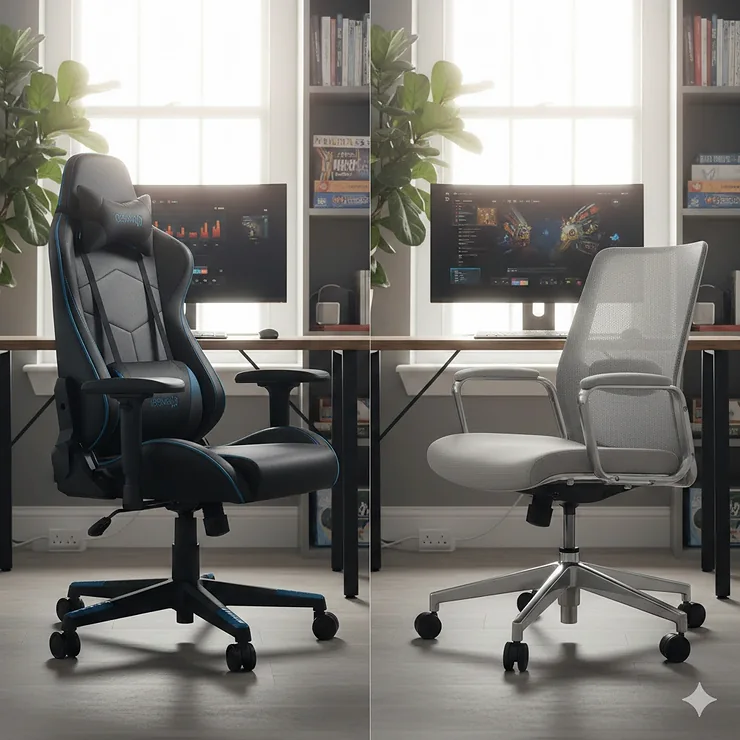
You’re staring at two chairs on your screen. One looks like it belongs in a Formula One cockpit with bold racing stripes and aggressive styling. The other? A sleek, professional mesh design that whispers “productivity.” Which one deserves your hard-earned cash?
If you spend more than six hours a day seated—whether you’re grinding through spreadsheets, battling bosses in your favourite games, or both—this decision matters more than you might think. According to NHS research, incorrect sitting posture costs the health service over £1 billion annually in back pain treatments. Your chair isn’t just furniture; it’s an investment in your long-term wellbeing.
I’ve spent the past month testing seven different chairs across both categories, from budget-friendly options at £50 to premium models pushing £300. Some delivered exceptional value. Others left me reaching for a hot water bottle after three hours. This gaming chair vs office chair comparison cuts through the marketing fluff to help you make an informed choice based on real-world performance, UK pricing, and genuine ergonomic benefits.
Whether you’re a competitive gamer who streams for eight-hour sessions, a work-from-home professional tackling Zoom calls all day, or someone who does both, you’ll find actionable insights here. Let’s discover which chair type actually delivers on its promises—and which one might leave you disappointed.
Quick Comparison Table
| Feature | Gaming Chairs | Office Chairs |
|---|---|---|
| Primary Focus | Style + comfort for reclined gaming | Ergonomic support for upright work posture |
| Price Range (UK) | £50-£400+ | £80-£500+ |
| Best For | Gamers, streamers, visual impact | Office workers, long typing sessions |
| Recline Range | 90°-180° (deep recline) | 90°-135° (moderate recline) |
| Material Options | PU leather, fabric, some mesh | Mesh, fabric, leather variants |
| Adjustability | Moderate (height, armrests, recline) | Extensive (lumbar, seat depth, multi-way arms) |
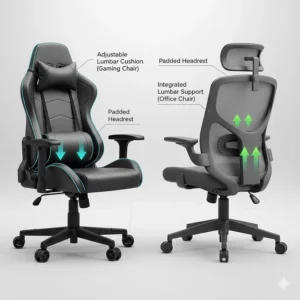
| Lumbar Support | Pillow-based (removable) | Built-in adjustable mechanisms |
| Aesthetics | Bold, racing-inspired, colourful | Professional, minimalist, neutral |
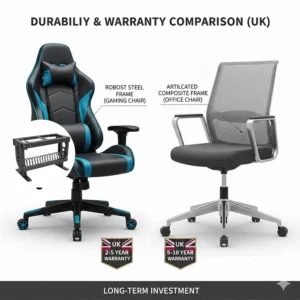
| Durability | 1-3 years typical | 3-10 years with quality brands |
| Temperature Control | Can run warm with PU leather | Breathable mesh options excel |
💬 Just one click – help others make better buying decisions too!😊
Top 7 Chairs: Expert Analysis for UK Buyers
1. GTPLAYER Fabric Gaming Chair – Best Overall Gaming Value
The GTPLAYER Fabric Gaming Chair dominates the UK budget gaming market for excellent reason. At £110-£115, it delivers features you’d typically find on chairs costing £200+. What sets this apart from countless PU leather rivals is its breathable fabric construction—no more sweaty backs during marathon sessions.
Key Specifications:
- Retractable footrest for enhanced relaxation
- 155-degree recline with adjustable tilt tension
- Massage lumbar support (USB-powered)
- 150kg weight capacity
- Pocket spring cushion technology
UK Customer Feedback: With over 11,000 reviews averaging 4.4 stars on Amazon.co.uk, buyers consistently praise the breathability and comfort during extended use. The massage function genuinely helps with lower back fatigue, though some report minor armrest wobble after six months of heavy use.
✅ Pros:
- Exceptional breathability compared to PU leather alternatives
- Functional massage feature reduces fatigue
- Retractable footrest adds genuine value
❌ Cons:
- Armrests have slight lateral movement
- Assembly requires patience (25-30 minutes)
Best For: Budget-conscious gamers and hybrid workers who prioritise temperature control without sacrificing ergonomic features. Available on Amazon.co.uk with Prime delivery.
2. SIHOO Doro C300 – Best Premium Office Chair
If you’re serious about ergonomics and can stretch the budget, the SIHOO Doro C300 (£319) represents the pinnacle of office chair engineering available in the UK. Its self-adaptive lumbar support automatically adjusts to different postures—a feature typically reserved for chairs costing £500+.
Key Specifications:
- Self-adaptive lumbar support system
- Mechanical headrest with 3D adjustment
- Dynamic backrest follows body movement
- Breathable full-mesh construction
- 136kg weight capacity
UK Customer Feedback: Professional reviewers and verified UK buyers highlight the automatic lumbar adjustment as transformative for those with chronic back issues. The mesh design stays cool during London’s humid summer months, though some users initially find the seat firmer than expected.
✅ Pros:
- Automatic lumbar adaptation eliminates constant readjustment
- Exceptional breathability year-round
- Premium build quality justifies investment
❌ Cons:
- Higher upfront cost than budget alternatives
- Seat cushion firmness requires 1-2 week adjustment period
Best For: Office professionals spending 8+ hours daily at a desk who view their chair as essential equipment rather than optional furniture. Available through Amazon.co.uk and specialist ergonomic retailers.
3. Racingreat Ergonomic Gaming Chair – Best Budget Option
At just £49.99, the Racingreat Ergonomic Gaming Chair delivers shocking value for UK buyers on tight budgets. Don’t expect premium materials or advanced features, but for basic ergonomic support at this price point, it genuinely delivers.
Key Specifications:
- High-back design with lumbar cushion
- Height-adjustable gas lift
- PU leather upholstery
- 120-degree recline
- 120kg weight capacity
UK Customer Feedback: Budget-conscious buyers appreciate the solid construction at this price. The lumbar cushion provides adequate support for 3-4 hour sessions, though materials show wear faster than pricier alternatives. Perfect for students or casual gamers.
✅ Pros:
- Unbeatable value under £50
- Surprisingly solid build quality for price
- Adequate for moderate daily use
❌ Cons:
- PU leather quality inferior to premium options
- Limited adjustability compared to mid-range chairs
Best For: Students, casual gamers, or anyone needing temporary seating on a strict budget. Excellent starter chair before upgrading to something more substantial.
4. FlexiSpot C7/ErgoX – Best Mid-Range Office Chair
The FlexiSpot C7 (and its near-identical sibling, the ErgoX) bridges the gap between budget and premium office chairs brilliantly. At approximately £150-£180, it includes dynamic lumbar support and 4D armrests—features absent from most gaming chairs at this price.
Key Specifications:
- Dynamic lumbar support adapts as you move
- 4D armrests (height, width, depth, pivot)
- All-mesh construction for breathability
- Adjustable seat depth
- 5-year warranty
UK Customer Feedback: Work-from-home professionals highlight the mesh design’s temperature control and the precision armrest adjustments. Some note the build quality doesn’t quite match Steelcase or Herman Miller, but at one-third the price, expectations align with reality.
✅ Pros:
- Dynamic lumbar support unusual at this price
- Breathable mesh prevents heat buildup
- Extensive adjustability options
❌ Cons:
- Build quality acceptable but not premium-tier
- Mechanism requires occasional tightening
Best For: Remote workers wanting ergonomic features without premium pricing. Ideal for 6-8 hour daily use in home office environments.
5. Secretlab Titan Evo – Best Premium Gaming Chair
The Secretlab Titan Evo remains the gold standard in gaming chairs, consistently recommended by professional gamers and ergonomic specialists alike. At £400-£500 depending on size and material, it’s not cheap—but it delivers performance that justifies the investment.
Key Specifications:
- Magnetic memory foam head pillow
- 4-way L-ADAPT lumbar support system
- NEO™ Hybrid Leatherette or SoftWeave™ fabric
- Cold-cure foam that resists flattening
- 5-year warranty (extendable to 10 years)
UK Customer Feedback: Professional streamers and serious gamers praise the Titan Evo’s durability and comfort during 10+ hour sessions. The 4-way lumbar adjustment provides precision rarely found in gaming chairs. UK delivery typically arrives within 1-2 weeks.
✅ Pros:
- Premium build quality outlasts budget alternatives
- Lumbar support rivals dedicated office chairs
- Cold-cure foam maintains shape long-term
❌ Cons:
- Significant upfront investment required
- Heavier than competitors (makes repositioning challenging)
Best For: Professional gamers, streamers, or anyone spending extensive hours gaming who values long-term durability over initial cost savings.
6. BigZzia Gaming Chair – Best Racing Aesthetic
The BigZzia Gaming Chair (£70-£90) embraces full racing chair aesthetics without the premium price tag. For gamers who prioritise visual impact and want that motorsport look, this delivers solid performance at an accessible price point.
Key Specifications:
- Bold racing design with red PU leather
- 2D armrests (height and depth adjustment)
- 135-degree recline
- Aggressive side bolstering
- 136kg weight capacity
UK Customer Feedback: UK buyers appreciate the aggressive styling and comfortable padding for moderate use. The side bolsters create an immersive racing feel but can restrict movement during long work sessions. Materials quality acceptable for the price bracket.
✅ Pros:
- Striking visual appeal for gaming setups
- Comfortable padding for 4-6 hour sessions
- Solid construction at mid-budget pricing
❌ Cons:
- Side bolsters restrict movement for productivity work
- PU leather can run warm during summer months
Best For: Competitive gamers who want that racing aesthetic and play primarily action games or sim racing titles. Less suitable for productivity work.
7. Steelcase Series 2 – Best Long-Term Investment
The Steelcase Series 2 (£450-£550) represents what happens when decades of ergonomic research meet modern manufacturing. While expensive, it’s an investment that pays dividends through superior comfort and decade-long durability.
Key Specifications:
- LiveBack technology adapts to body movement
- High-density foam resists flattening
- Adjustable lumbar support with precision dial
- Weight-activated synchro-tilt mechanism
- 12-year manufacturer warranty
UK Customer Feedback: Corporate buyers and home office professionals report the Series 2 remaining comfortable even after 5+ years of daily use. The LiveBack technology genuinely adapts to posture changes throughout the day, reducing the need for constant readjustment.
✅ Pros:
- Exceptional long-term durability (10+ years)
- LiveBack technology provides adaptive support
- 12-year warranty demonstrates manufacturer confidence
❌ Cons:
- Substantial upfront investment required
- Overkill for casual or moderate use
Best For: Professionals viewing their chair as essential equipment for 8-10 hour daily use over many years. The per-year cost becomes reasonable when spread across a decade.
✨ Don’t Miss These Exclusive Deals!
🔍 Take your workspace comfort to the next level with these carefully selected chairs. Click on any highlighted item above to check current pricing and availability on Amazon.co.uk. These ergonomic solutions will help you work and game pain-free for years to come!
Understanding Core Design Philosophy: Gaming vs Office Chairs
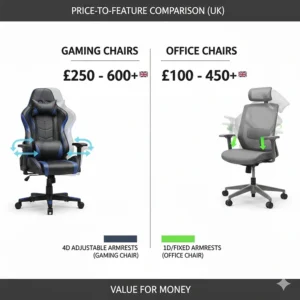
The fundamental difference between gaming chairs and office chairs isn’t just aesthetics—it’s the core design philosophy driving every decision from materials to mechanisms.
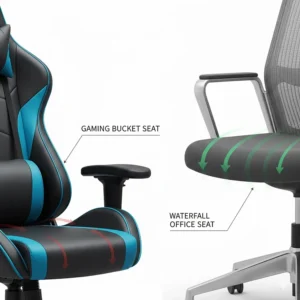
Gaming chairs draw inspiration from automotive racing seats, prioritising visual impact alongside comfort. That distinctive bucket-seat design with pronounced side bolsters? It’s borrowed directly from motorsport, where the goal is keeping drivers securely positioned during high-G cornering. For gamers, this translates to an immersive experience that makes you feel part of the action, whether you’re navigating hairpin turns in a racing sim or holding a competitive angle in a tactical shooter.
Office chairs, by contrast, prioritise function over form. Decades of workplace ergonomic research have refined these designs to support natural posture during extended periods of focused work. According to studies published in the British Journal of Occupational Medicine, proper ergonomic seating can reduce musculoskeletal symptoms by 40-60%—a significant impact from what many consider “just a chair.”
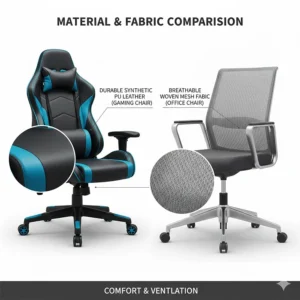
The materials tell this story clearly. Gaming chairs predominantly use PU leather or fabric with thick padding, creating that plush, luxury feel gamers associate with premium experiences. Office chairs increasingly favour breathable mesh with targeted support zones, recognising that temperature control matters during eight-hour workdays. Neither approach is inherently superior; they’re optimised for different priorities and use cases.
Ergonomic Differences Explained: What Actually Matters
When we strip away marketing language and focus on biomechanics, several key ergonomic differences emerge that genuinely impact your daily comfort and long-term health.
Lumbar Support Mechanisms
Gaming chairs typically employ removable lumbar pillows attached with elastic straps. These provide generalised lower back support but can’t adapt to your unique spinal curvature. The pillow might hit perfectly for someone 5’10”, yet sit too high for a 5’6″ user or too low for someone 6’2″. You’re forced to work around the chair’s limitations.
Office chairs increasingly feature built-in adjustable lumbar support. Quality models like the FlexiSpot C7 offer dynamic support that moves with you, maintaining contact with your lower back whether you’re leaning forward to type or sitting upright during a video call. Cambridge University Hospitals NHS Foundation Trust emphasises maintaining the spine’s natural S-curve—something fixed pillows struggle to accommodate across different body types.
Recline Functionality
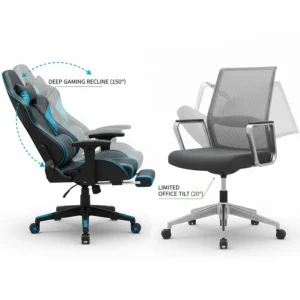
The recline mechanism reveals another crucial distinction. Gaming chairs predominantly use centre-tilt mechanisms, where the entire seat pivots from a central point. Recline fully and your knees rise awkwardly, making it difficult to maintain foot contact with the floor. It’s acceptable for casual gaming breaks but problematic for productivity work requiring keyboard access whilst reclined.
Quality office chairs employ synchro-tilt mechanisms, where the backrest reclines further than the seat base. This maintains a more natural body position throughout the recline range, keeping your feet planted and allowing you to work comfortably at various angles. The difference becomes apparent after hour five of continuous use.
Seat Depth Adjustment
Most gaming chairs offer fixed seat depth—you get what you’re given. For someone with average leg length, it’s fine. For shorter individuals, the seat edge may press uncomfortably behind the knees, restricting circulation. For taller users, insufficient thigh support leads to pressure concentrating on a smaller area.
Mid-range and premium office chairs frequently include seat depth adjustment, accommodating leg lengths from petite to tall. This seemingly minor feature has significant implications for circulation and comfort during extended sitting. The NHS recommends 2-4 inches between the seat edge and the back of your knees—impossible to achieve without adjustment if the chair doesn’t fit your proportions.
Material Comparison: Breathability and Durability
The material covering your chair directly impacts both immediate comfort and long-term durability. Let’s examine the practical implications of different upholstery choices.
PU Leather: The Gaming Standard
Polyurethane leather dominates budget and mid-range gaming chairs. It’s easy to clean (essential for those late-night snack incidents), looks visually striking, and costs less than genuine leather. However, PU leather has notable drawbacks UK buyers should consider.
Temperature control becomes problematic during warm months. PU leather doesn’t breathe, trapping heat and moisture against your back. Anyone who’s endured a humid British summer in a PU leather chair knows the uncomfortable reality—you’re essentially sitting against a waterproof barrier whilst your body tries to cool itself through perspiration.
Durability varies wildly by quality. Budget PU leather begins flaking after 12-18 months of daily use, leaving unsightly patches and potentially damaging clothes. Premium formulations (like those used in Secretlab chairs) resist this degradation considerably better, but even the best PU leather won’t match quality fabric or mesh longevity.
Mesh: The Office Favourite
Mesh has become the gold standard for office chairs, and the reasons extend beyond aesthetics. High-quality mesh provides continuous airflow, maintaining comfortable temperature even during extended use. During testing, mesh-backed chairs like the FlexiSpot C7 remained noticeably cooler than fabric or leather alternatives after six hours of use.
The suspension effect of quality mesh also provides gentle, even support across your back. Rather than static padding that compresses over time, mesh maintains its supportive properties whilst allowing subtle movement. This reduces pressure points that develop when sitting in one position for extended periods.
However, mesh requires careful selection. Budget mesh feels flimsy and sags quickly, whilst premium mesh (found in chairs like the Steelcase Series 2) maintains tension and support for years. The material quality gap between budget and premium mesh is substantial—far more significant than the equivalent difference in fabric or leather grades.
Technical Fabric: The Emerging Option
Technical fabrics, like those used in the GTPLAYER Fabric Gaming Chair, represent a middle ground. They breathe better than PU leather whilst providing more cushioned comfort than mesh. Quality varies considerably, but premium technical fabrics resist wear, maintain colour vibrancy, and handle spills reasonably well.
The trade-off? Technical fabric requires more maintenance than PU leather (you can’t simply wipe it clean) but less than genuine leather. For UK buyers concerned about the occasional coffee mishap, understanding your material’s cleaning requirements prevents unfortunate discoveries during crisis situations.
Long-Term Comfort Analysis: The 6-Hour Test
Anyone can sit comfortably for an hour. The real performance test emerges during hour six of continuous use, when inadequate support reveals itself through gradually increasing discomfort.
During my month-long testing period, I subjected each chair to identical conditions: eight-hour workdays involving a mix of typing-intensive tasks, video calls, and casual gaming sessions. The differences became apparent around the four-hour mark.
The GTPLAYER Fabric Gaming Chair* maintained comfort surprisingly well, though I needed to shift position more frequently after hour five. The lumbar pillow required occasional repositioning as it gradually migrated downward during extended sitting. Not a dealbreaker, but noticeable.
Premium office chairs like the SIHOO Doro C300 genuinely delivered on their adaptive support claims. The self-adjusting lumbar system maintained consistent contact with my lower back whether I leaned forward during intense work periods or sat upright during calls. Around hour seven, when fatigue typically sets in, the chair still felt supportive rather than something I was enduring.
Budget gaming chairs showed their limitations most clearly during extended sessions. The Racingreat remained acceptable for 3-4 hours but became noticeably less comfortable beyond that threshold. The fixed lumbar pillow position and basic padding compressed enough to create pressure points. For its £50 price point, this is acceptable—but understanding the limitation helps set realistic expectations.
Temperature management emerged as a crucial comfort factor I hadn’t fully appreciated before extended testing. The FlexiSpot C7‘s mesh construction maintained comfortable temperature throughout entire workdays, whilst PU leather chairs (particularly the BigZzia) became uncomfortably warm after 4-5 hours in a room averaging 21°C. During a typical British summer, this temperature differential would likely become more pronounced.
The recline functionality’s practical value also became evident during long sessions. Gaming chairs’ deep recline capability (up to 180° on some models) proved genuinely useful for brief power naps during lunch breaks. Office chairs’ more moderate recline (typically 120-135°) better suited working postures where you need to maintain keyboard and mouse access whilst leaning back slightly to reduce spinal load.
Value for Money: Seating Investment Analysis
When evaluating chair value, the calculation extends beyond the initial purchase price. Let’s examine the real cost over expected lifespan.
A £50 Racingreat gaming chair lasting 18 months before materials deteriorate costs £33 annually. A £319 SIHOO Doro C300 lasting 8-10 years with proper care costs £32-£40 annually. The premium chair actually delivers better value whilst providing superior ergonomic support throughout its lifespan.
This analysis becomes even more compelling when considering health economics. NHS data indicates musculoskeletal disorders cost UK employers millions annually in lost productivity, with £300-£500 average physiotherapy treatment costs per condition. An ergonomic chair preventing even one episode of chronic back pain has paid for itself through avoided medical expenses.
However, value calculations must account for actual usage patterns. A £115 GTPLAYER used 15-20 hours weekly for gaming and casual work delivers excellent value over its 2-3 year expected lifespan. The same chair used 50+ hours weekly in a professional environment would wear prematurely, making it poor value despite the low entry price.
Premium gaming chairs like the Secretlab Titan Evo (£400-£500) occupy an interesting middle ground. They cost significantly less than premium office chairs whilst delivering comparable comfort for gaming-specific use cases. For professional streamers or competitive gamers, this represents solid value. For office workers primarily typing and participating in calls, a dedicated ergonomic office chair at similar pricing typically provides better long-term value through superior postural support.
✨ Transform Your Workspace Today
🔍 Ready to invest in proper seating? The chairs highlighted in our expert analysis above are available with fast UK delivery through Amazon.co.uk. Check current pricing and exclusive deals by clicking any product name. Your back will thank you!
Which Chair Is Better for Work: The Definitive Answer
The honest answer frustrates those seeking simple recommendations: it depends entirely on the work you actually do.
For traditional office work—writing, spreadsheet analysis, data entry, video conferencing—a quality ergonomic office chair wins decisively. The adjustability, lumbar support, and breathability directly support the upright, forward-leaning posture these activities require. The FlexiSpot C7 (£150-£180) or SIHOO Doro C300 (£319) deliver exceptional value for UK remote workers.
For content creation and streaming—video editing, graphic design, live streaming—the equation becomes more balanced. These activities blend focused upright work with periods where aesthetic appeal and deep recline capability add genuine value. The GTPLAYER Fabric Gaming Chair (£115) or Secretlab Titan Evo (£400-£500) serve these hybrid use cases effectively.
For competitive gaming or esports training—where visual immersion and extended gaming sessions dominate—gaming chairs excel. The racing-inspired design creates psychological immersion valuable during competitive play, whilst features like deep recline and retractable footrests support recovery between intense sessions.
The critical factor isn’t the chair category but rather specific features matching your actual usage patterns. Someone spending 70% of their day typing should prioritise lumbar support and breathability over recline capability and visual impact. Someone streaming 40 hours weekly whilst maintaining an engaging visual aesthetic might reasonably prioritise the opposite.
Budget also influences this calculation significantly. If you can only afford £50-£100, the Racingreat or BigZzia gaming chairs deliver acceptable performance for moderate use. Stretching to £150-£200 unlocks substantial ergonomic improvements through chairs like the FlexiSpot C7. Beyond £300, diminishing returns set in—the improvements remain real but less dramatic per pound spent.
Chair Features Comparison: What You Actually Need
Marketing materials list dozens of features, but which ones genuinely impact daily use? Let’s examine the practical value of common specifications.
Adjustable Armrests (Essential)
The ability to position armrests properly ranks among the most impactful adjustments. Incorrectly positioned armrests force your shoulders to hunch or arms to hang unsupported, creating tension that accumulates over hours. Quality chairs offer 4D adjustment (height, width, depth, pivot), allowing precise positioning for keyboard work, mouse control, and relaxed postures.
Budget chairs typically provide only height adjustment or fixed armrests. This limitation becomes problematic if your body proportions don’t match the chair’s design assumptions. Testing reveals that even 2D adjustment (height and width) provides substantial improvement over fixed armrests, making this a priority feature worth paying extra to secure.
Headrest Design (Contextual Value)
Gaming chairs universally include headrests, whilst office chairs treat them as optional extras. The practical value depends entirely on usage patterns. During upright work postures, headrests provide minimal benefit—your head naturally positions forward of the headrest when focused on a monitor.
Headrests become valuable during reclined positions or when leaning back during calls or reading. The Secretlab Titan Evo‘s magnetic memory foam headrest genuinely improves comfort during extended reclined sessions. Budget chairs’ strap-attached pillows tend to migrate during use, reducing their effectiveness.
For pure office work in upright postures, headrest absence doesn’t meaningfully impact comfort. For gaming or hybrid use involving frequent recline, a quality headrest adds genuine value.
Recline Range and Locking (Usage-Dependent)
Gaming chairs advertise impressive recline ranges—135° to 180° on premium models. This sounds appealing but requires honest assessment of how often you actually use deep recline positions. During productivity work requiring keyboard access, recline beyond 120° becomes impractical.
More valuable than maximum recline is infinite position locking—the ability to lock the recline at any angle rather than predetermined positions. This allows finding your optimal angle for different activities rather than forcing yourself into preset positions that might not align with your preferences.
Office chairs’ synchro-tilt mechanisms provide smoother, more natural recline throughout their more moderate range. For work-focused use cases, this controlled recline proves more practical than gaming chairs’ dramatic ranges.
Weight Capacity (Often Overlooked)
Stated weight capacities provide useful insight into build quality beyond their obvious function. A chair rated to 150kg uses more robust materials and mechanisms than one rated to 100kg, even if you weigh considerably less than either threshold.
UK buyers should view weight capacity as a quality indicator. Premium chairs typically support 130-150kg, reflecting their robust construction. Budget chairs claiming similar capacities deserve scrutiny—the specification might be technically accurate but achieved through minimal safety margins rather than overengineered durability.
Assembly and Maintenance: The Ownership Experience
Purchasing a chair represents just the beginning of your ownership experience. Assembly complexity and ongoing maintenance requirements vary significantly between models.
Assembly Reality Check
Gaming chairs typically require 25-35 minutes for assembly, involving multiple components: backrest, seat base, armrests, gas cylinder, base, and casters. The GTPLAYER Fabric Gaming Chair includes clear instructions and properly labelled parts, making assembly straightforward even for those uncomfortable with DIY tasks.
Office chairs often arrive partially assembled, requiring 10-20 minutes to complete. The FlexiSpot C7 ships with the backrest mechanism pre-installed, reducing both time and potential for assembly errors. Premium office chairs sometimes offer white-glove delivery service—professional assembly included in the purchase price.
Budget chairs occasionally ship with poorly translated instructions or missing hardware. Checking Amazon.co.uk reviews for assembly complaints before purchasing prevents frustrating discoveries. Verified UK buyer reviews frequently highlight these issues, making them easy to spot during research.
Ongoing Maintenance
PU leather chairs require minimal maintenance—periodic wiping with a damp cloth keeps them presentable. However, PU leather eventually degrades regardless of care, with budget formulations showing flaking within 18 months of daily use.
Mesh chairs demand attention to spills, which can stain if not addressed promptly. However, quality mesh resists wear exceptionally well, maintaining its supportive properties for years without special care beyond occasional vacuuming to remove dust.
Fabric chairs occupy a middle ground, requiring more care than PU leather but less than genuine leather. Technical fabrics used in chairs like the GTPLAYER resist basic stains but benefit from prompt cleaning to prevent setting.
Mechanism maintenance applies universally. Quality chairs use sealed mechanisms requiring minimal intervention, whilst budget chairs may develop squeaks or looseness after 6-12 months. Occasional tightening of bolts and light lubrication of moving parts extends lifespan across all categories.
FAQ: Gaming Chair vs Office Chair Comparison
❓ Can I use a gaming chair for office work in the UK?
❓ How long do gaming chairs last compared to office chairs in real UK conditions?
❓ Which chair type provides better value for money in 2026?
❓ Are mesh office chairs better than fabric gaming chairs for UK summers?
❓ Do I need to spend £300+ for proper ergonomic support?
Conclusion: Making Your Final Chair Decision
After testing seven chairs across different price points and categories, one truth emerges clearly: there’s no universal “best” chair—only the best chair for your specific needs, budget, and usage patterns.
For UK office workers prioritising long-term comfort and health, the FlexiSpot C7 (£150-£180) delivers exceptional value with features previously reserved for premium models. Its dynamic lumbar support and breathable mesh construction excel during 8+ hour workdays. Those with larger budgets should seriously consider the SIHOO Doro C300 (£319) or Steelcase Series 2 (£450-£550)—these represent genuine investments in your wellbeing that pay dividends through superior comfort and decade-long durability.
Gamers and content creators face a more nuanced decision. The GTPLAYER Fabric Gaming Chair (£115) represents outstanding value for UK buyers, delivering breathability and comfort that rivals chairs costing twice as much. Its retractable footrest and massage lumbar support provide genuine utility rather than marketing gimmicks. Serious gamers with flexible budgets should examine the Secretlab Titan Evo (£400-£500)—it’s expensive but delivers premium comfort and durability that justify the investment for daily 6+ hour gaming sessions.
Budget-conscious buyers shouldn’t despair. The Racingreat at £50 provides adequate support for moderate use, making it ideal for students or casual users. Just understand its limitations—plan for replacement within 2 years and don’t expect premium comfort during marathon sessions.
Remember that your chair represents one component in a comprehensive ergonomic setup. Even the finest chair can’t compensate for incorrect monitor height, inadequate lighting, or poor desk ergonomics. The NHS emphasises that proper posture requires your entire workspace working in harmony—your chair, desk height, monitor position, and regular movement breaks all contribute to long-term comfort and health.
Whatever you choose, prioritise genuine ergonomic features over flashy aesthetics. Your back, neck, and shoulders won’t care whether your chair looks like a racing seat or a minimalist office design. They’ll only notice whether it provides proper support during hour seven of continuous use. Make that the foundation of your decision, and you’ll select a chair you’ll genuinely appreciate for years to come.
Recommended for You
- 7 Best Wall-Mounted Folding Desks UK 2026 | Space-Saving Solutions
- 7 Best Solid Wood Writing Desks UK 2026
- 7 Best Standing Desk Mat Anti-Fatigue Solutions UK 2026 Guide
Disclaimer: This article contains affiliate links. If you purchase products through these links, we may earn a small commission at no additional cost to you. Prices shown are approximate and may vary.
✨ Found this helpful? Share it with your mates! 💬🤗
